Why Chesterfield food and beverage plants face a stricter pretreatment bar
Chesterfield County Utilities operates a federally delegated Industrial Pretreatment Program under 40 CFR 403, with local limits derived under 40 CFR 40.5 to protect the Proctors Creek and Falling Creek WWTPs, receiving streams, biosolids, and worker safety (per chesterfield.gov). The program was awarded the EPA Clean Water Act Recognition Award in 1997 and 2002, signaling an active enforcement posture. Federal EPA effluent limitation guidelines set the floor, but for any food or beverage plant discharging to the sewer in Chesterfield County, Chapter 18, Article IV (Industrial Waste Discharge) of the County Ordinance is the binding document at the discharge manhole (per chesterfield.gov). Local limits are written to keep both plants inside their own NPDES permits, which means a food plant can comply with EPA effluent guidelines and still fail Chesterfield's local limits. The parameters most actively regulated are FOG, BOD, TSS, and pH, with FOG acceptable to the sewer only when concentration stays below the program cap (per chesterfield.gov). For a dairy, meat, beverage, or ingredients facility, the operational consequence is straightforward: a discharge permit with monitoring, sampling, and reporting obligations is required, and pretreatment is mandatory when pollutants exceed or threaten to exceed allowable concentrations.
What food and beverage wastewater actually looks like at the plant
Food and beverage wastewater routinely runs 10–20× stronger than domestic sewage, and organic loading can represent 65–80% of total wastewater treatment cost for a food processor (per Crystal Clean and xpelwater). That strength gap is the single most important factor for sizing a pretreatment train: a 50,000 lb BOD/day dairy or beverage plant sends more organic load to the sewer than a town of 25,000 people, and a municipal plant designed for domestic sewage cannot absorb that without pretreatment. The stream is not uniform. Raw material washing, cooking/cooling/rinsing, product changeovers, off-spec material, and CIP/sanitation cycles each produce different BOD, COD, TSS, FOG, nutrient, and pH profiles, and they are generated on different schedules throughout the day (per xpelwater). A facility can discharge relatively little during production hours and then surge during sanitation, so any treatment program built around average conditions fails at the moments regulators sample (per Crystal Clean). Subsector matters: dairy streams carry fats and proteins; meat and poultry generate elevated solids and grease; beverage plants push large hydraulic volumes with variable sugar and carbohydrate loading (per the MDPI study cited by xpelwater). Variability makes food-plant pretreatment engineering a load-shaping problem before it is a contaminant-removal problem.
The pretreatment train a Chesterfield food plant typically runs
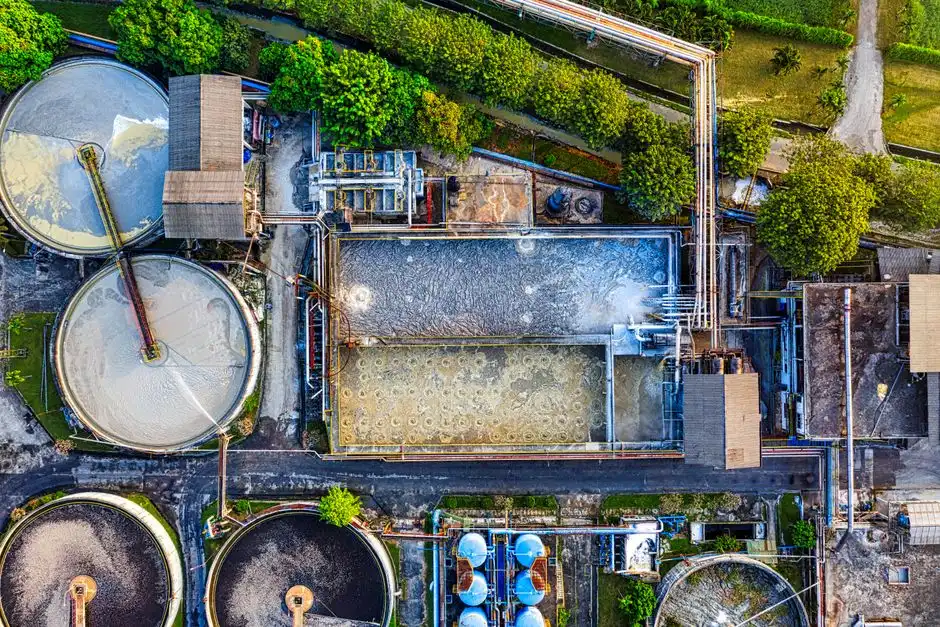
A typical food-plant pretreatment train upstream of the Proctors Creek or Falling Creek POTW runs in six ordered steps, each tied to a specific parameter and piece of equipment.
- Solids protection — headworks screening. A GX rotary mechanical bar screen at the headworks removes rags, plastics, fruit and vegetable solids, and bone or packaging fragments before they damage pumps, valves, and downstream flotation equipment.
- Flow and load equalization. An equalization basin sized for 12–24 hours of peak flow blends CIP spikes with production flow and damps pH swings before the stream hits any biological or chemical step.
- DAF for FOG and TSS. A dissolved air flotation system (4–300 m³/h class) strips free and emulsified fats, oils, and grease plus suspended solids, which is typically the single largest load reduction step in a food-plant train.
- Biological polishing. Either conventional activated sludge or an MBR membrane bioreactor for sites where space is tight or near-reuse effluent is needed; MBRs deliver sub-micron filtered effluent in a smaller footprint (see also the MBR system engineering selection guide).
- pH trim and disinfection. An automatic chemical dosing system holds the discharge inside the 5–9 or 6–10 pH envelope typically required by local limits, followed by UV or chlorine dioxide for downstream POTW protection.
- Sludge handling. A plate-and-frame filter press or lamella clarifier dewaters DAF float and biological sludge before off-site disposal, avoiding the surcharges and hauling exposure of un-dewatered slurry.
| Step | Unit operation | Primary target | Typical F&B performance |
|---|---|---|---|
| 1 | Rotary mechanical bar screen | Rags, large solids, packaging | 2–6 mm openings; protects downstream equipment |
| 2 | Equalization basin | Flow, BOD/COD, pH variability | 12–24 h HRT; smooths 3–5× peaking factor |
| 3 | Dissolved air flotation (DAF) | FOG, TSS, partial BOD | 50–90% TSS, 60–95% FOG removal |
| 4 | MBR or CAS | Soluble BOD/COD, ammonia | 95–99% BOD; MBR effluent <1 μm filtered |
| 5 | pH trim + UV/ClO₂ | pH, residual pathogens | Hold pH 5–9; UV dose 30–40 mJ/cm² typical |
| 6 | Filter press / lamella | Sludge volume reduction | Cake 18–25% DS vs 2–5% in slurry |
Unit operation comparison: which step earns its place upstream of the POTW
Capital is rarely unlimited, so selecting the right equipment for a specific facility's profile is critical. The standard ranking for a Chesterfield F&B facility is screening → equalization → DAF → biological → pH/disinfection → sludge dewatering, and the comparison below shows why.
| Unit operation | Best at | Footprint | Capex/energy | Limits |
|---|---|---|---|---|
| DAF | FOG + TSS removal | Small | Low–moderate energy, moderate capex | Needs chemical coagulant/polymer dosing |
| Primary clarifier | Bulk settleable solids | Large | Low capex, low energy | Weak on emulsified FOG; large footprint |
| MBR | Soluble BOD, near-reuse quality | Small (vs CAS) | Higher energy for aeration + membrane | Membrane fouling risk on FOG upsets |
| CAS (conventional activated sludge) | Soluble BOD at lower cost | Large | Lowest capex; moderate energy | Sensitive to peak loads and FOG slug |
| Lamella clarifier | High-flow, moderate FOG | Compact vs conventional | Low energy, no aeration | 20–40 m/h surface loading; limited on FOG |
For most food plants discharging to a POTW, DAF replaces a primary clarifier because the FOG fraction is the parameter that triggers local-limit violations and sewer surcharges. MBR earns its place when site footprint is constrained, when a downstream reuse loop is being designed, or when the discharge permit tightens to near-reuse quality; otherwise, conventional activated sludge is the lower-risk, lower-energy choice (per HydropureWater field data, 2026). Lamella plates are a useful retrofit where flow is high and FOG is moderate, with documented surface loading rates in the 20–40 m/h range.
Staying inside Chesterfield's local limits day to day

Compliance is won or lost in the gap between the grab sample and the daily operating envelope. The FOG program elements Chesterfield's ordinance cares about are concentration limits, interceptor maintenance, manifest records, and hauler documentation; missing any of these is a permit-level finding rather than a maintenance issue (per chesterfield.gov). A well-sized equalization basin paired with an automatic chemical dosing system turns grab-sample compliance into a controllable setpoint — the basin absorbs a CIP surge and the dosing system holds pH inside the required 5–9 or 6–10 envelope while the DAF and biological steps hold FOG, BOD, and TSS inside their caps. Digital monitoring for environmental compliance with continuous data logging is the way to prove compliance to Chesterfield Utilities during routine sampling and facility inspections, and to demonstrate continuous improvement during a permit interaction. The escalation chain documented by the program involves increased monitoring, mandatory pretreatment installation, permit revocation, and production shutdown risk (per Crystal Clean field experience, 2026). For a comparable regulated-discharge scenario in a different Virginia jurisdiction, the Hopewell, VA chemical plant pretreatment guide walks through the same permit-revocation logic in a different industrial context.
Frequently Asked Questions
What local limits does Chesterfield County enforce on food and beverage discharges to the Proctors Creek or Falling Creek POTWs?
Chesterfield's Industrial Pretreatment Program sets local limits under 40 CFR 403 and 40 CFR 40.5 to protect the two POTWs, their receiving streams, biosolids quality, and worker safety. The parameters most actively regulated are FOG (with a stated sewer-acceptance cap), BOD, TSS, and pH, and industries must meet federal prohibited-discharge and categorical standards plus the local limits (per chesterfield.gov).
What happens if a food plant exceeds its discharge limits in Chesterfield?
Non-compliance escalates from surcharges through increased monitoring, mandatory pretreatment installation, and ultimately permit revocation, with production shutdown risk if the discharge problem threatens the POTW's own NPDES permit (per chesterfield.gov and Crystal Clean field experience, 2026). Sewer surcharges on BOD, TSS, and FOG are typically assessed on a per-pound basis above the cap, and a single quarter of repeated violations is usually enough to trigger a permit review.
Can a small craft food or beverage operation in Chesterfield rely on haul-off instead of building on-site pretreatment?
Haul-off is viable for low-volume, high-strength batches that cannot be safely neutralized on-site, and it shifts the treatment burden to a permitted off-site facility, but it is not a long-term substitute for pretreatment at any operation that discharges more than a few thousand gallons per day of production or CIP wastewater (per Crystal Clean field experience, 2026). Chesterfield's ordinance requires pretreatment when pollutants exceed or threaten to exceed allowable discharge concentrations, and haul-off frequency, manifest records, and hauler documentation become part of the FOG program the utility inspects.
Which unit operation delivers the biggest load reduction for a food plant upstream of the POTW?
A DAF unit ahead of any biological step typically removes 50–90% of TSS and 60–95% of FOG, which is the single largest load reduction step in a food-plant train, followed by an MBR or CAS step for soluble BOD at 95–99% removal (per HydropureWater field data, 2026). Equalization comes first because it protects every downstream step from CIP surges and pH swings.