
Why Fab Wastewater Is a Distinct Treatment Challenge
A single semiconductor fab can draw millions to tens of millions of gallons of water per day, the majority of it consumed as ultra-pure water (UPW) for repeated rinsing between process steps. Because UPW production itself rejects a large fraction of the incoming feed, the UPW reject stream is often the single largest wastewater source on site, even before the process drains are added (Samco, 2025). On top of that, fab process drains carry a contaminant mix that no other light-industrial sector reproduces at scale: strong acids and caustics, dissolved metals from plating and chemical-mechanical planarization (CMP) slurries, fluoride from etchants, ammonium from CVD and photoresist residues, specialty organics from lithography solvents, and fine suspended solids from slurry handling.
End-of-pipe mixing of all those streams produces a wastewater that is simultaneously high in TDS, high in organics, high in fluoride, and high in metals, and therefore very expensive to treat as a single combined stream. The established approach, articulated both in the Samco industry overview (2025) and in Intel's site disclosures, is to segregate waste streams at source and treat each one with a targeted unit process, then polish the bulk rinse water for reuse. Intel's 2019 Circularity in Semiconductor Manufacturing white paper lists the practical starting taxonomy: lithography-related solvents, metal plating waste, specialty base cleaners, spent sulfuric acid, ammonium sulfate, and calcium fluoride, and that stream list effectively maps onto the unit processes described in the rest of this article.
Intel's Three-Pillar Water Strategy
Intel has committed to net positive water by 2030, defined as restoring more than 100% of its freshwater consumption through a combination of in-plant conservation, on-site reclamation, and third-party-funded watershed restoration (Intel 2023 Water Restoration Progress Report, published March 2024). The commitment is operationalised through three objectives stated in the same report: reduce water used in operations through conservation projects, reclaim water within operations through large investments in state-of-the-art water treatment facilities, and restore water to watersheds in collaboration with local communities.
By year-end 2023, Intel reported 3,141 MGY (million gallons per year) of water restored across 44 projects globally, with net positive water already achieved in the United States, India, Costa Rica, and Mexico. New 2023 additions included the Agua Tica Forest Protection Phase II in Costa Rica (71.3 MGY, implemented by Fundecor) and a rainwater-harvesting programme across 86 schools in Hồ Chí Minh City, Vietnam (17.2 MGY, implemented by CLEAN International, benefits starting in 2024). Watershed restoration benefits are quantified by external consultant LimnoTech using the Rozza et al. (2013) and WRI Reig et al. (2019) methodologies developed with The Nature Conservancy.
For an engineer building a process train, the boundary to draw is this: Intel's "three pillars" cover conservation, in-plant treatment, and off-site restoration, but the unit processes that physically treat the wastewater live entirely in pillar two. The remainder of this article is scoped to pillar two, with by-product recovery (which sits between pillars two and three) covered separately.
The Fab Wastewater Treatment Train, Stream by Stream
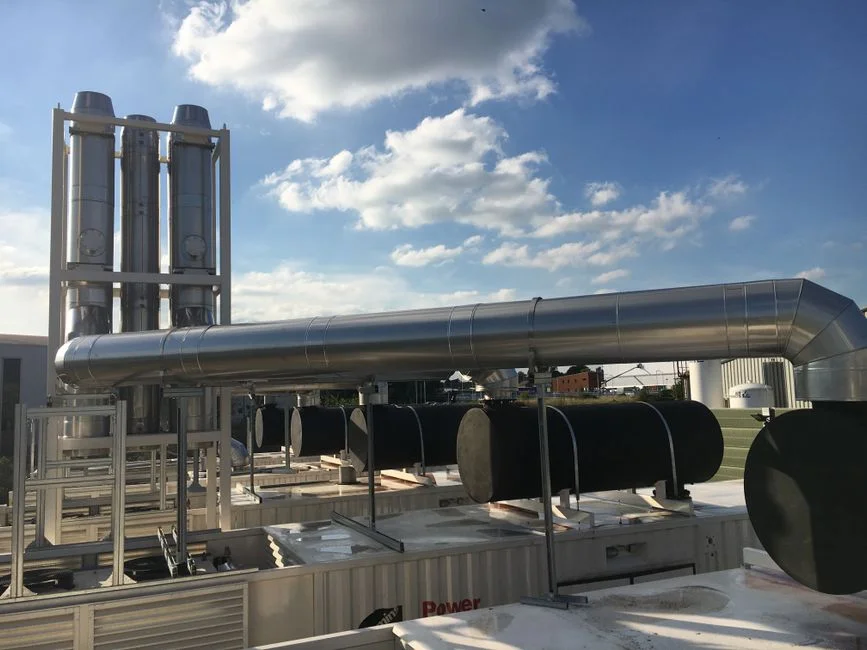
Intel's process train is best read as five segregated legs that converge on a central reclamation header, with the site-specific unit operations varying by what each fab produces. The taxonomy below combines the FAB28 (Qiryat Gat, Israel) pretreatment disclosures (exploreintel.com, 2012 site page), the Ocotillo (Arizona) EPA case study, the Oregon and Arizona recovery programmes from the Intel Circularity white paper (November 2019), and the Ireland circularity disclosures in the same white paper.
Copper and CMP waste. At FAB28 in Israel, copper-bearing waste is segregated and treated in a dedicated copper-waste pretreatment system with industrial-effluent pH balancing, before the stream enters a dedicated Wastewater and Treatment Recovery facility that handles the organic load. In Oregon, Intel added on-site electroplating so that scrap copper is sold rather than hauled, and in 2019 the Oregon site expected to send more than 600 tons of metal plating-bath waste to supplier facilities for recovery back to the commodity market (Intel Circularity white paper, November 2019).
Ammonium-bearing wastewater. Ammonium treatment reduces the nitrogen load sent to local POTWs, and the ammonium sulfate by-product is diverted to fertilizer manufacturing. Oregon and Arizona have been sending ammonium sulfate to fertilizer since 2013, accumulating more than 35,000 tons; Ireland has since begun sending its own ammonium sulfate to fertilizer as well.
Fluoride and calcium streams. Calcium fluoride is precipitated out of the fluoride-bearing waste and is diverted from landfill to cement-product manufacturing in Ireland, and is used as alternative daily cover at a local landfill at FAB28 in Qiryat Gat. Ammonium-fluoride treatment is explicitly listed as a pretreatment step at FAB28. Engineers specifying this leg will find more detail in this fluoride wastewater treatment guide.
Organics and lithography solvents. Distillation and recovery of lithography solvents for resale is practiced in Ireland; specialty base cleaners are routed to fuel blending. The Intel Circularity white paper also lists cyclohexanone recovery and paint-thinner blending as current or near-future opportunities.
Bulk rinse water and UPW reject. This leg is typically a UF → RO → IX/DI train producing water suitable for in-house reuse, and at Ocotillo, drinking-quality water for aquifer recharge. Final polish at Intel sites uses pH correction and final filtration before reuse or discharge headers, with best-available techniques applied to air-emissions control and pH balancing on industrial effluent.
| Stream | Unit process | Key operating concern | Reuse destination |
|---|---|---|---|
| Copper / CMP waste | Source segregation, pH balancing, ion exchange or precipitation, media filtration | Plating bath stability, metal recovery yield | Scrap metal sale; commodity-market recovery (Oregon) |
| Ammonium-bearing wastewater | Ammonia stripping or biological nitrification, sulfate crystallisation | Residual nitrogen to POTW | Ammonium sulfate to fertilizer (35,000+ t since 2013, Oregon + Arizona; also Ireland) |
| Fluoride / calcium streams | Calcium precipitation, solids dewatering | Fluoride solubility, sludge handling | Calcium fluoride to cement (Ireland); alternative daily cover (Israel FAB28) |
| Lithography solvents / base cleaners | Distillation, solvent recovery, fuel blending | Solvent purity, flammability management | Resale as recovered solvent; fuel-blend product (Ireland) |
| Bulk rinse / UPW reject | UF → RO → IX/DI polish, pH correction | Silica, TDS, low-MW organics; membrane fouling | In-house reuse (scrubbers, cooling towers); aquifer recharge (Ocotillo) |
Inside Ocotillo: The Reference Design for Fab Water Reuse
Intel's Ocotillo campus in Chandler, Arizona is the most documented benchmark in the public record, and the design it represents is the one a new fab in a water-stressed watershed should be measured against. The headline numbers from the EPA case study are: approximately 5.2 MGD (million gallons per day) conserved, up to 75% of water reused, and more than 3.5 billion gallons of drinking-quality water returned to the underground aquifer since the Chandler RO Recharge Facility began operation. The case study quantifies the impact as: "up to 75% of its water" is reused, with the 3.5 B gallon aquifer-recharge figure measured from project inception through the case-study period (US EPA Region 9 case study, 2017 snapshot).
The design rests on three initiatives. The Chandler RO Recharge Facility, funded and operated by Intel in partnership with the City of Chandler, treats process wastewater from the Ocotillo fabs to drinking-water standards and recharges the aquifer. The POTW Effluent Reuse Programme takes back a portion of the city's treated effluent for use in scrubbers, cooling towers, landscaping, and forage-crop irrigation, totalling more than 876 million gallons reused in 2007 alone. Internal Industrial Water Management (IWM) at Fab 22, including the reclamation of process and facilities wastewater for equipment that would otherwise consume fresh city water, saved an additional 385 million gallons in 2007.
Why Ocotillo is the reference site: it sits in a hot, arid, water-stressed basin where reuse is a permit and supply necessity rather than a CSR choice, and where the EPA has independently verified both the reuse rate and the recharge volume. Any new fab in a constrained watershed, whether Phoenix, Kiryat Gat, or Hsinchu, is effectively being benchmarked against this design envelope of about 75% reuse with RO polish to drinking-water quality.
By-Product Recovery: Fab Waste as a Circular Feedstock
By-product recovery is where fab water management stops being a compliance cost and starts being a circular-economy line item. Intel's spent-sulfuric-acid programme at Arizona is the clearest economic case study. Intel began collecting sulfuric acid waste from the wet cleans process in 2017, initially routed only to stabilisation and landfill. By August 2018, spent acid was being sent offsite for purification to technical grade, with a portion returning to Intel's Arizona and New Mexico wastewater treatment systems for on-site reuse. Since August 2018, nearly 3,000 tons of hazardous waste have been diverted from landfill, with the site on track for more than 4,300 tons in 2019 and an estimated $700,000 in disposal-cost savings over three years (Intel Circularity white paper, November 2019).
Metal plating waste is the second line. With on-site electroplating in Oregon, more than 600 tons of plating-bath waste per year is sent to supplier facilities where copper is recovered and returned to the commodity market. Lithography solvents and specialty base cleaners are recovered through distillation for resale in Ireland, with specialty base cleaners going to fuel blending. Ammonium sulfate and calcium fluoride complete the tonnage scoreboard: more than 35,000 tons of ammonium sulfate to fertilizer (Oregon and Arizona since 2013), calcium fluoride to cement product manufacturing in Ireland, and calcium fluoride to alternative daily cover at a Qiryat Gat landfill in Israel. Samco (2025) adds the broader industry context: fab water treatment can also recover silicon, fluoride, copper, and isopropyl alcohol for internal reuse, depending on the process mix.
Process Parameters and Equipment Implications for Engineers
The equipment implications of Intel's process train fall into three families. For the bulk rinse and UPW reject leg, the typical duty is silica-bounded, low-TDS polishing with trace low-molecular-weight organics, which is the operating envelope for industrial reverse osmosis systems preceded by hollow-fiber ultrafiltration as a guard filter. RO recovery on fab rinse water is normally tuned in the 75-90% range to balance membrane scaling against reuse yield, with IX/DI polish downstream where UPW-grade reuse is required.
For the copper and CMP leg, the typical polish is ion exchange or precipitation followed by multimedia filtration; pH control at the head of the leg is the most important operating parameter, and a PLC-controlled chemical dosing system is the equipment category typically specified to hold the tight pH window that downstream metal-removal steps require. For the organics and color/TDS-reduction path, activated carbon adsorption and oxidation (often peroxide- or ozone-based) are the standard guard steps ahead of any RO or IX leg, with no single dosage applying across all fab chemistries.
| Fab stream | Primary unit process | Typical equipment family | Design consideration for engineers |
|---|---|---|---|
| UPW reject / bulk rinse | UF → RO → IX/DI | Hollow-fiber UF; brackish-water RO; mixed-bed IX | Silica scaling, recovery vs. concentrate disposal, membrane material selection |
| Copper / CMP waste | pH adjust → IX or precipitation → media filter | Automatic chemical dosing, ion exchange vessels, multimedia filters | pH window stability, metal recovery vs. sludge yield, bath chemistry |
| Ammonium / fluoride | Stripping or bio-N → sulfate recovery; Ca precipitation | Air stripper or MBBR; crystalliser; clarifier | Residual N to POTW, CaF2 dewatering, byproduct purity |
| Organics / solvents | Distillation, carbon adsorption, advanced oxidation | Solvent stills, GAC contactors, ozone or AOP reactors | Flammability, solvent purity for resale, fouling control on downstream RO |
| Final polish | pH correction → final filtration | Dosing skids, cartridge or bag filters | Discharge vs. reuse header routing, monitoring and telemetry |
For a deeper dive on how these unit operations map to a 99%+ recovery / ZLD microelectronics reclaim design, see this microelectronics wastewater reclaim engineering specs guide.
How Intel's Approach Compares With the Industry in 2026
Samco (2025) estimates that chip fab facilities can reach a recovery rate of about 60% by re-routing spent process streams to less exacting downstream uses such as cooling. Intel Ocotillo's documented ~75% reuse rate sits meaningfully above that typical operating envelope and is achieved with the additional step of RO-polishing to drinking-water standards for aquifer recharge. The 2026 industry context confirms the direction of travel: Samsung announced a plan on 11 September 2026 at KIWW Daegu to reuse 330,000 t/day of treated wastewater at Korean fabs, and SK Hynix has publicly reported record water-recycling performance at its Korean sites (see Samsung's 330,000 t/day fab reuse plan).
With Intel's 2030 net positive water commitment, plus tightening watershed constraints in Arizona, Israel, and Oregon, the next two design steps for any fab in a stressed watershed are ZLD (zero liquid discharge) and on-site RO polishing to reuse headers, with by-product recovery (sulfuric acid, copper, ammonium sulfate, calcium fluoride) treated as a core revenue line rather than a compliance afterthought.
Frequently Asked Questions
What percentage of fab water does Intel reuse?
Up to 75% at the Ocotillo campus in Chandler, Arizona, anchored to the EPA Region 9 water-efficiency case study, which quantifies ~5.2 MGD conserved and more than 3.5 billion gallons of RO-polished water returned to the underground aquifer since project inception.
How does fab wastewater become drinking water at Intel?
Through the Chandler RO Recharge Facility, which treats fab process wastewater to drinking-water standards and recharges the underground aquifer in partnership with the City of Chandler.
What happens to the by-products from fab wastewater treatment?
Ammonium sulfate is sent to fertilizer manufacturing (more than 35,000 tons since 2013 from Oregon and Arizona, with Ireland also sending material to fertilizer). Calcium fluoride is sent to cement product manufacturing in Ireland and used as alternative daily cover at a Qiryat Gat landfill. Spent sulfuric acid from Arizona is purified offsite and partly returned for on-site wastewater treatment, with nearly 3,000 tons diverted from landfill since August 2018. Copper is recovered from plating-bath waste in Oregon and returned to the commodity market.
Which Intel site is the benchmark for fab water reuse?
Ocotillo (Chandler, Arizona), because its EPA-documented ~75% reuse rate and aquifer-recharge volume make it the most fully quantified reference design, and because it sits in a hot, arid, water-stressed watershed where reuse is a permit and supply necessity.
What unit processes do fab wastewater treatment trains typically use?
UF, RO, ion exchange or DI for the rinse and UPW-reject leg; pH balancing, ion exchange or precipitation, and media filtration for the copper/CMP leg; ammonia stripping or biological nitrification with sulfate recovery for the ammonium leg; calcium precipitation for the fluoride leg; and distillation, activated carbon, and oxidation for the organics leg, with sludge handling and chemical-dosing systems tying the train together.