What Plastics and Rubber Wastewater Looks Like in Sugar Hill
NAICS 326 (plastics and rubber products) and SIC 2821 facilities in the Sugar Hill area typically discharge wastewater with COD in the 1,500–8,000 mg/L range, BOD₅ between 800 and 4,500 mg/L, frequent BOD/N ratios below 4 (often 2–3 because TKN runs 60–120 mg/L while nitrogen-poor latex washwater drives the imbalance), pH swings from 4 to 11 across batch operations, and visible plastic pellet and short-fiber carryover from compounding and extrusion washdowns. These streams concentrate polymer emulsions, surfactant residues, and oligomeric additives that resist biodegradation in a standard aerobic basin. Any plant discharging to the Upper Chattahoochee basin or to the City of Sugar Hill sewer must meet 40 CFR 430 rubber-processing categorical pretreatment limits and 40 CFR 433 metal-finishing limits where finishing lines coexist, with local POTW limits typically enforced at total COD 250–500 mg/L, TSS 100–250 mg/L, and oil & grease 50–100 mg/L. The MBR-vs-CAS decision only matters after screening, grit removal, flow equalization, and pH correction — both process trains require the same headworks, and a properly sized GX series rotary mechanical bar screen at 2–3 mm aperture is the first defense against pellet carryover that would otherwise blind a membrane cassette or float over a clarifier weir.
How Conventional Activated Sludge Treats Polymer Wastewater
Conventional Activated Sludge (CAS) achieves pollutant removal through three coupled steps: aerobic biological oxidation in an aeration basin, gravity clarification of biological floc in a secondary settling tank, and return activated sludge (RAS) recycle back to the basin head (Mannina et al., 2020). The process has been deployed for more than a century, remains the most widely installed secondary treatment worldwide, and is the lower-CAPEX baseline against which every alternative is measured (Mannina et al., 2020). For a Sugar Hill plastics plant, CAS is attractive because the hardware list is short, the control philosophy is familiar to any operator with a municipal wastewater background, and the unit CAPEX in a 200–500 m³/day range typically runs USD 800–1,400 per m³/day of installed capacity (Karim and Mark, 2017, as reviewed in S4).
CAS struggles with two features of polymer wastewater: the slowly biodegradable fraction tied to polymer additives and plasticizers, which wash through the aeration basin at SRTs of 5–10 days, and the microplastic fibers and pellet fragments that escape the clarifier in the effluent weir overflow. Bertanza et al. (2017), referenced in S4, found CAS effluent microplastic concentrations around 1 MP/L — enough to put a downstream reuse loop at risk and to draw scrutiny if the plant discharges to a POTW with an emerging contaminant ordinance. Bulking sludge, common when surfactant-rich latex streams dominate the feed, further erodes settling performance and pushes the operator toward higher RAS rates and polymer dosing.
How a Membrane Bioreactor Treats the Same Stream
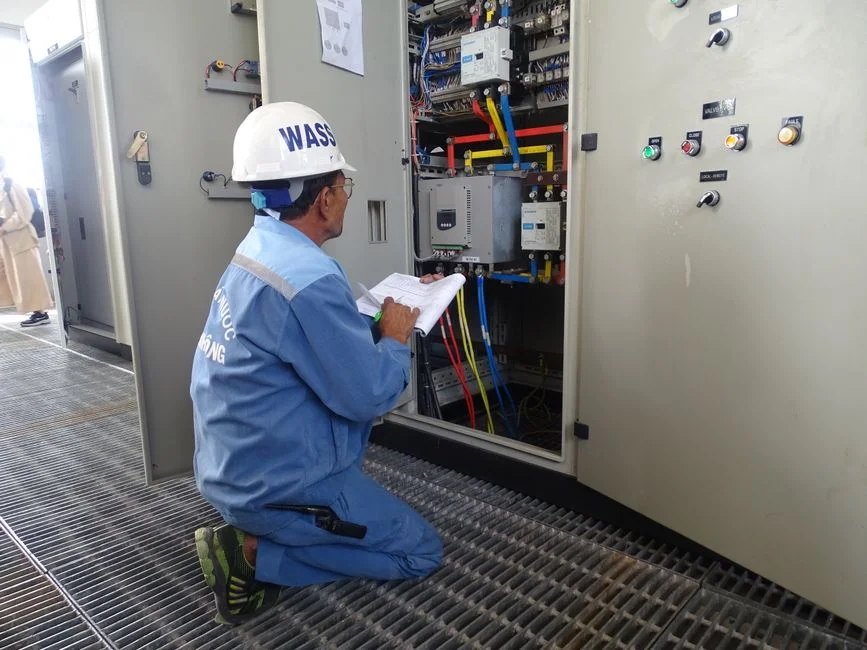
A Membrane Bioreactor (MBR) couples the same activated-sludge biology as CAS with submerged PVDF ultrafiltration cassettes (sub-1 μm pore) that replace the secondary clarifier entirely. The HydropureWater integrated MBR membrane bioreactor system retains nearly all biomass and suspended solids in the reactor, sustaining MLSS at 8,000–12,000 mg/L versus 2,500–4,000 mg/L in a typical CAS basin. Mannina et al. (2020) summarized the four MBR advantages that matter to a plastics plant: (i) higher SRT — commonly 20–40 days — which lets slow-growing organisms degrade recalcitrant polymer additives; (ii) lower observed cell yield, so waste activated sludge mass is reduced roughly 20–30% versus CAS at equal load; (iii) a physical solid/liquid barrier that produces near-reuse-quality effluent independent of sludge settleability; and (iv) a significant footprint reduction because the membrane cassette replaces both the clarifier and most of the aeration-tank volume that a clarifier-fed basin would need.
Membrane fouling raises transmembrane pressure (TMP) and forces recovery cleaning, creating an energy and chemical demand for mitigation (Mannina et al., 2020). Jijingi et al. (2024) recommend a combined program of membrane backwashing, scheduled chemical cleaning (typically NaOCl plus citric acid on a 1–4 week cycle), and aeration optimization to extend membrane life in industrial service. Successful MBR operation in industrial plants depends on skilled operators, consistent pretreatment, and a documented cleaning SOP. In the Sugar Hill context, an MBR also opens the door to closed-loop process-water reuse because TSS consistently lands below 5 mg/L and turbidity below 1 NTU without tertiary polishing.
Engineering Comparison: MBR vs CAS for Plastics and Rubber Plants
The table below consolidates the parameters that drive the choice for a Sugar Hill plastics or rubber facility. Direct GHG emissions, microplastic removal, and footprint numbers are anchored to the Mannina et al. (2020) plant-wide model and Lares et al. (2018) as reviewed in S4; MLSS, SRT, and CAPEX/OPEX direction are drawn from the same source plus Karim and Mark (2017). Where the research is silent on a plastics-specific number, the table states the engineering principle rather than fabricating a value.
| Parameter | Conventional Activated Sludge (CAS) | Membrane Bioreactor (MBR) |
|---|---|---|
| MLSS operating range | 2,500–4,000 mg/L | 8,000–12,000 mg/L |
| Typical SRT | 5–10 days | 20–40 days |
| Footprint (equal load) | Baseline (1.0×) | ~60% of CAS footprint (S6 product catalog; consistent with S4) |
| Effluent TSS | 10–30 mg/L | <5 mg/L |
| Effluent microplastic count | ~1 MP/L (Lares et al., 2018 via S4) | ~0.4 MP/L (Lares et al., 2018 via S4) |
| Direct GHG emissions | 0.85 kgCO₂eq/m³ (Mannina et al., 2020) | 0.91 kgCO₂eq/m³ (Mannina et al., 2020) |
| Energy demand | Lower (no membrane aeration) | Higher (membrane scour + permeate pumps) |
| Sludge yield (observed) | Higher | Lower (~20–30% reduction at equal load) |
| Reuse suitability | Requires tertiary polishing | Near-reuse quality without polishing |
| CAPEX direction | Lower (baseline) | Higher (membrane cassettes, blowers, CIP) |
| OPEX direction (long run, >67 yr horizon) | Higher per m³ treated long-term | Lower per m³ treated long-term (Karim and Mark, 2017 via S4) |
| rbCOD/TKN sensitivity | Denitrification-dominant driver | Also influences nitrification and N₂O inside the aerobic reactor (Mannina et al., 2020) |
The small GHG gap (0.06 kgCO₂eq/m³) is roughly offset by the sludge-hauling reduction on the MBR side, so direct emissions rarely decide the project. Because the rbCOD/TKN ratio is often low in latex washwater, the design must include a nitrogen-balance check before specifying blower capacity to account for N₂O formation inside the MBR (Mannina et al., 2020).
When Each System Wins at a Sugar Hill Plant

The decision rule below maps site-specific triggers to a clear technology recommendation based on local constraints: a tight lot in an industrial park, an Upper Chattahoochee discharge that is increasingly scrutinized, and a local POTW that levies surcharges on TSS, oil & grease, and emerging contaminants.
| Site condition | Recommended technology | Why |
|---|---|---|
| Plot space < 0.4 m² per m³/day of design flow | MBR | ~60% smaller footprint fits a constrained lot (S6; S4) |
| Process-water reuse goal ≥ 30% of effluent | MBR | Sub-5 mg/L TSS and <1 NTU turbidity enable reuse without tertiary polish (S6; S4) |
| Visible microplastic carryover in equalized feed | MBR | 0.4 MP/L effluent vs 1 MP/L for CAS (Lares et al., 2018 via S4) |
| Tightening discharge limits (TSS < 10 mg/L) | MBR | Physical barrier decouples effluent from sludge settleability |
| CAPEX is the binding constraint and a large footprint is available | CAS | Lower installed cost, familiar to operators (Karim and Mark, 2017 via S4) |
| Influent is relatively uniform, no reuse target, discharge to POTW | CAS | Lower OPEX complexity, no membrane cleaning chemistry |
| Plant is replacing an existing clarifier with reuse upside | MBR retrofit | Avoided clarifier rebuild + reuse revenue justify the membrane premium |
The MBR retrofit is rarely justified by biological performance alone; it is justified by reuse revenue, avoided clarifier rebuild costs, or discharge limits that CAS cannot meet without tertiary polishing. When none of these triggers apply, CAS remains the more economical baseline.
Pretreatment and Operating Risks Unique to MBR on Polymer Streams
An MBR on a plastics or rubber feed is only as reliable as the headworks in front of it. Jijingi et al. (2024) flag inadequate pretreatment as the leading cause of MBR clogging and premature membrane replacement in industrial service. For a Sugar Hill plant, three pieces of pretreatment are non-negotiable: a 2–3 mm aperture GX series rotary mechanical bar screen to capture plastic pellets, fibers, and stringy latex agglomerates; a dissolved air flotation system to remove emulsified oils, free latex, and floating polymer fragments; and a high-efficiency sedimentation tank to drop out heavy grit and inorganic filler residues.
Two recurring OPEX items must be priced into the lifecycle model. Membrane cleaning chemicals — typically NaOCl at 500–1,000 mg/L for organic fouling and citric acid at 1,000–2,000 mg/L for inorganic scaling, on a 1–4 week rotation — represent a steady consumables line that CAS does not carry (Jijingi et al., 2024; Mannina et al., 2020). Operator training is also essential: TMP trending, in-situ relaxation cycles, and clean-in-place (CIP) sequencing are skills required for long-term MBR viability. For a sister comparison covering a different plastics hub, see the sister comparison for Casa Grande, AZ. For pulp and paper streams, the trade-offs shift and the MBR vs CAS for pulp and paper wastewater analysis applies. Operators evaluating flat-sheet versus hollow-fiber module geometry should also review the hollow fiber MBR vs flat sheet and tubular alternatives comparison before specifying a cassette supplier.
Frequently Asked Questions
Is MBR or CAS cheaper for a plastics and rubber plant in Sugar Hill?
CAS has a lower installed CAPEX and is cheaper to operate when plot space, reuse demand, and tightening discharge limits are not constraints; MBR has a higher CAPEX but a lower long-
Frequently Asked Questions
Is MBR better than conventional activated sludge for a plastics and rubber plant in Sugar Hill?
MBR (Membrane Bioreactor) is generally superior for Sugar Hill facilities due to its ability to maintain high Mixed Liquor Suspended Solids (MLSS) concentrations, typically ranging from 8,000 to 15,000 mg/L, compared to 2,000 to 4,000 mg/L in Conventional Activated Sludge (CAS). This higher biomass concentration allows for the effective degradation of complex synthetic organic compounds and recalcitrant monomers often found in rubber and plastics manufacturing that would otherwise cause sludge bulking or poor settling in a conventional clarifier.
What footprint savings can a Sugar Hill plastics facility expect from an MBR vs CAS?
An MBR system typically requires 50% to 70% less physical footprint than a CAS system with secondary clarification. By eliminating the need for large, gravity-based secondary clarifiers and reducing the hydraulic retention time required for effective biodegradation, Sugar Hill plants can maximize limited industrial land use while meeting stringent discharge standards.
How does an MBR handle microplastic and polymer additives in rubber wastewater?
MBR systems utilize physical membrane barriers with pore sizes typically between 0.04 and 0.4 microns, which provide an absolute physical retention of suspended microplastics. Unlike CAS, which relies on flocculation and sedimentation that may allow microplastics to bypass the clarifier, MBR ensures that both micro-particulates and high-molecular-weight polymer additives are retained within the reactor for extended biodegradation or removed entirely from the effluent stream.
What pretreatment does an MBR need before a plastics washwater stream?
Pretreatment is critical to prevent membrane fouling and irreversible damage. A typical configuration for plastics washwater requires fine screening (ideally <1mm) to remove plastic shards and debris, followed by Dissolved Air Flotation (DAF) or oil-water separation to reduce grease, oil, and surfactant concentrations to below 50 mg/L. Failure to adequately remove these hydrophobic compounds will lead to rapid membrane flux decline and increased chemical cleaning frequency.
Can an MBR effluent be reused in a plastics or rubber plant, and does CAS allow that?
MBR effluent is highly suitable for non-potable reuse, such as cooling tower makeup, equipment washing, or facility cleaning, as it consistently achieves turbidity levels below 0.2 NTU and effectively removes pathogens and suspended solids. While CAS effluent can be reused, it typically requires significant tertiary treatment—such as multi-media filtration and ultrafiltration—to match the baseline water quality provided directly by an MBR system.