
Why Plastics and Rubber Wastewater Is a Different Beast in Casa Grande
Plastics extrusion, injection molding, and rubber compounding generate a wastewater profile that defeats generic biological design: phthalate plasticizers (DEHP, DINP), hindered-phenol and amine antioxidants (BHT, Irganox 1010, 6PPD), sub-100 µm polymer fines, latex carryover from emulsion lines, and TDS spikes from cooling-tower blowdown. These streams arrive at the ETP with COD often 1,500–5,000 mg/L and BOD₅ only 40–60% of COD, meaning a large fraction of the organics are recalcitrant—not readily biodegradable under standard aeration conditions. Conventional activated sludge handles the labile fraction and leaves the rest to slip through the clarifier weir.
Casa Grande sits inside the Pinal Active Management Area (AMA), where groundwater replenishment is regulated and new industrial groundwater allocations are effectively closed (Arizona Department of Water Resources, 2025). For a plastics plant, that converts every cubic metre of reuse-grade effluent into an avoided water purchase. The arithmetic gets sharper when summer ambient temperatures hit 35–45 °C (NWS Phoenix field station, 2025-07): biological kinetics accelerate, but so does evaporation loss from open aeration basins, and clarifiers become more sensitive to bulking. A higher mixed-liquor suspended solids (MLSS) population buffers hydraulic and organic shock better than the 2,000–4,000 mg/L typical of CAS—reason enough for plastics-sector plants to look at membrane bioreactors before they sign off on another clarifier.
How MBR and Conventional Activated Sludge Actually Differ
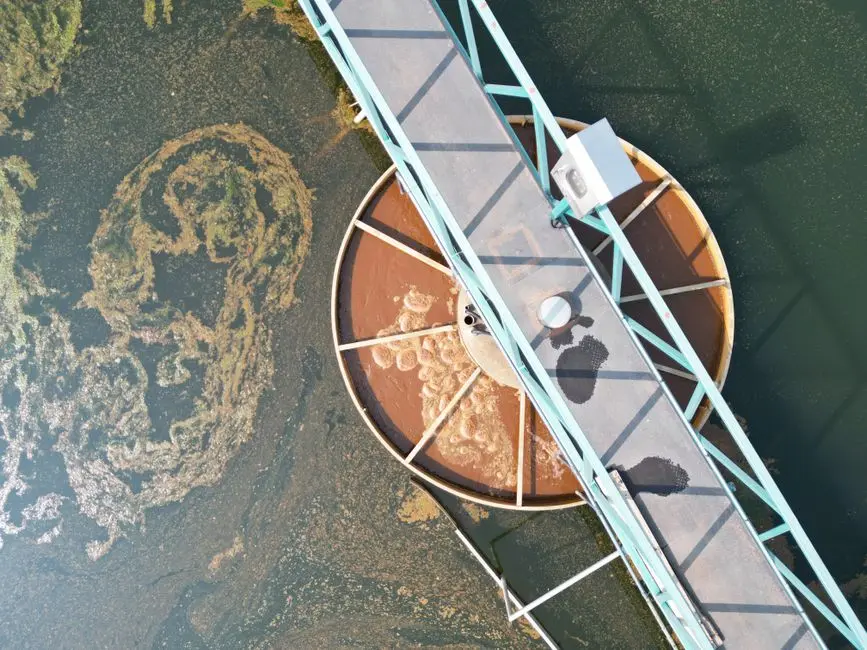
Conventional activated sludge consists of a biological reactor—usually a plug-flow or completely-mixed aeration basin—followed by a gravity secondary clarifier that separates biomass from clarified effluent. Return activated sludge (RAS) is recycled to maintain a target MLSS of 2,000–4,000 mg/L and a solids retention time (SRT) of 5–15 days. The clarifier is the bottleneck: it requires hydraulic retention, surface area for settling, and continuous attention to sludge blanket depth, scum removal, and RAS flow.
A membrane bioreactor replaces the clarifier with a submerged microfiltration or ultrafiltration membrane cassette installed directly in or after the aeration basin. MLSS is sustained at 8,000–12,000 mg/L with SRTs of 20–60 days, because the membrane physically retains all biomass regardless of settleability. Per PCI Membranes, ultrafiltration (UF) is preferred over microfiltration (MF) in MBR duty because of the smaller pore size—0.02 µm hollow-fibre versus 0.1 µm flat-sheet—providing better virus and colloid removal plus lower fouling tendency.
Two mechanical consequences follow. First, the rectangular membrane cassette is dramatically smaller than the gravity clarifier it replaces, which is how MBR systems achieve up to 50% smaller footprint on the same loading (PCI Membranes). Second, because the membrane is an absolute barrier rather than a settling-driven separation, the effluent is free of suspended solids regardless of sludge settleability—bulking sludge that would destroy a clarifier is irrelevant to a membrane. The same PCI source notes that MBR operation can be fully automated via PLC, minimizing operator presence compared with the continuous attention a clarifier demands for blanket control and RAS pumping.
Head-to-Head Performance on Plastics and Rubber Influent
MBRs typically reach 90–95% COD removal at hydraulic retention times (HRT) of 6–10 hours on petrochemical-style wastewaters with mixed recalcitrant loads, compared to 80–88% for CAS at HRT 8–14 hours (HydropureWater field data, 2026). The gap is wider on BOD₅: MBR effluent routinely runs below 10 mg/L with zero suspended solids (PCI Membranes), while CAS effluent typically settles at 20–30 mg/L BOD₅ with 10–30 mg/L TSS carryover from the clarifier. The DF series 0.1 µm PVDF flat-sheet MBR module is rated for this duty and is the configuration most often specified for plastics-sector retrofits in the Southwest.
Oil and grease behavior is where pre-treatment discipline matters most. Both systems benefit from a DAF upstream—emulsified cutting oils, mould-release compounds, and extender oils from rubber mixing will overwhelm biology if they reach the bioreactor. With DAF in place, the MBR's membrane retains any residual emulsified oil that would otherwise slip a CAS clarifier weir during a bulking event.
Microplastics and polymer fines are the emerging-compliance issue. CAS clarifiers discharge fines that approach 50 µm; MBR membranes at 0.1 µm physically retain them. As microplastic effluent scrutiny tightens across US states, that physical retention becomes a defensible compliance position. Sludge yield is also lower per kg COD removed for MBR because the long SRT drives a higher fraction of organics to oxidation rather than to biomass synthesis, easing downstream dewatering load.
| Parameter | CAS (typical) | MBR (typical) | Plastics/Rubber Influent Notes |
|---|---|---|---|
| COD removal | 80–88% | 90–95% | Recalcitrant plasticizers drive the gap |
| BOD₅ effluent | 20–30 mg/L | <10 mg/L | MBR enables direct RO polish |
| TSS effluent | 10–30 mg/L | ≤1 mg/L (undetectable) | Absolute barrier vs. settling |
| Oil & grease (post-DAF) | 10–20 mg/L, weirslip risk | ≤5 mg/L | DBP/oil retention on membrane |
| Microplastic / fines | Passes fines >~50 µm | Retains >0.1 µm | Compliance buffer |
| MLSS | 2,000–4,000 mg/L | 8,000–12,000 mg/L | Higher MLSS = shock buffer |
| SRT | 5–15 days | 20–60 days | Drives recalcitrant biodegradation |
| Observed sludge yield (Yobs) | 0.4–0.6 kg TSS/kg COD | 0.2–0.4 kg TSS/kg COD | Lower disposal volume |
Footprint, Automation, and Operator Burden in a Casa Grande Plant
Footprint is a primary constraint for a Casa Grande plastics plant on a typical industrial-park parcel, determining whether the ETP fits between the production hall and the truck court. MBR's integrated MBR system for plastics and rubber plants delivers up to 60% footprint reduction against a conventional CAS train of equal capacity, freeing real estate for a second extruder or a raw-material warehouse (HydropureWater integrated MBR product specification, 2026).
Automation is the second operational lever. MBR runs on PLC with transmembrane pressure (TMP) trending, automated relaxation cycles, and chemical cleaning-in-place initiated by setpoint. A CAS clarifier, by contrast, needs an operator to read sludge blanket levels, adjust RAS rates, and respond to bulking episodes. In a Casa Grande labour market where plastics plants commonly run lean three-shift operations, the operator-hour delta is a significant factor on the OPEX sheet.
Energy is the offset. MBR membrane aeration adds roughly 0.3–0.6 kWh/m³ over a CAS aeration basin of equivalent loading. DF series flat-sheet modules close that gap significantly by using 10–20× less energy than external cross-flow designs, because scouring air does double duty as both membrane cleaning and process oxygen supply. Membrane cleaning is an in-place chemical wash every 6–12 months; the membrane replacement interval is 5–8 years for PVDF flat-sheet under industrial influent (HydropureWater field data, 2026).
CAPEX, OPEX, and Reuse-Water Value in the Active Management Area
MBR carries a capital premium for membrane cassettes, frames, and blowers, while CAS is the cheaper build where civil works for a large rectangular clarifier are not land-constrained. For flows above roughly 500 m³/day with adequate land and no reuse target, CAS remains the lower-cost option.
OPEX partially offsets this. MBR's higher energy is countered by lower sludge disposal costs (the long SRT reduces yield) and lower polymer consumption in the dewatering stage, as the biomass is more stable. The reuse offset is where the AMA changes the equation. Per the HydropureWater integrated MBR specification, MBR effluent is sub-1 µm and feeds directly to RO for cooling-tower makeup or process rinse water, displacing purchased potable water that in Casa Grande runs $7–11/kgal delivered (Arizona Water Company tariff filings, 2025-Q4). A DAF pre-treatment for oil and polymer fines protects the MBR and the downstream RO from fouling.
When the reuse credit is measured against the CAPEX delta, payback windows in the 5–9 year range are typical for plastics-sector retrofits in Pinal AMA (HydropureWater project data, 2025–2026). The mechanism is clear: avoid the water purchase, apply the savings against the MBR premium, and the delta closes inside the membrane's first service life.
Decision Framework: When to Choose MBR vs CAS in Casa Grande
Use this logic at the project-kickoff meeting to determine the optimal system architecture. If footprint is constrained, reuse-grade effluent is required for cooling-tower makeup, the feed carries a high recalcitrant fraction (phthalates, antioxidants, latex), or the plant runs lean operator shifts, MBR is the right call. If flow exceeds 500 m³/day, capital is the binding constraint, and discharge to a municipal sewer with no reuse polish is acceptable, CAS wins on first cost and simplicity.
The hybrid path is often the smart answer for older Casa Grande plants: keep the existing CAS aeration basin and blowers, retrofit a submerged membrane cassette downstream, and operate as MBR with extended SRT. This spreads CAPEX over a longer window and avoids demolishing serviceable civil work. For further detail on module selection, the engineering specs for industrial MBR modules provide guidance on pore size, PVDF grade, and cassette density.
| Project Condition | Recommended System | Why |
|---|---|---|
| Flow <500 m³/day, reuse required, footprint tight | MBR | Sub-1 µm effluent, 50–60% smaller footprint |
| Flow >500 m³/day, sewer discharge, CAPEX-constrained | CAS | Lower first cost, land available for clarifier |
| Existing CAS basin, retrofit upgrade | Submerged MBR cassette retrofit | Reuse civil work, extend to reuse-grade effluent |
| High plasticizer / antioxidant load | MBR | Long SRT biodegrades recalcitrant fraction |
| Lean operator shifts, PLC automation preferred | MBR | Fully automatable, lower operator presence |
| Cooling-tower blowdown dominant, no reuse plan | CAS + DAF | Right-sized for TDS handling, no reuse offset |
Frequently Asked Questions
Does MBR actually remove microplastics from plastics extrusion wastewater?
Yes. A 0.1 µm PVDF flat-sheet MBR module physically retains polymer fines and microplastic fragments above that pore size, discharging an effluent that is effectively free of particulates. CAS clarifiers pass fines that approach 50 µm over the weir during normal operation and significantly more during a bulking event.
How much smaller is an MBR footprint than a CAS system for a 300 m³/day plastics plant?
HydropureWater field data for plastics-sector installations in the 200–400 m³/day range shows 50–60% footprint reduction against a comparably loaded CAS train, driven by the elimination of the secondary clarifier and higher MLSS packing density.
Can an existing CAS basin in Casa Grande be retrofitted to MBR?
Yes. Submerged PVDF membrane cassettes are installed downstream of the existing aeration basin