What Decatur Food & Beverage Plants Are Actually Treating in 2026
Decatur-area food and beverage plants in 2026 typically generate a wastewater envelope in the range documented for EPA Plant A — average flow 318 m³/day with design peaks to 455 m³/day, BOD swinging between 400 and 900 mg/L (avg 600 mg/L), and suspended solids 250–500 mg/L (avg 400 mg/L) (source: EPA-600/2-78-188, Ninth National Symposium on Food Processing Wastes, March 1978). On top of those averages, Decatur streams carry a pollutant mix that drives the unit-process choice: free and emulsified fats, oils, and grease (FOG) from rendering, dairy separation, and beverage bottling; suspended protein and starch from corn wet-milling; high BOD/COD from fermentation and CIP rinses; and Clean-in-Place surges that swing pH from 2 to 12 over a 30-minute window. Seasonal flow swings add a second dimension — corn wet-milling campaigns and dairy holiday runs can push peak-to-average ratios to 2–3×.
Cold-winter climate is a third, often ignored variable. At Plant A in Canada, "freezing problems were also encountered with the integral clarifier," and the plant "alleviated [them] by enclosing the clarifier in a metal structure, and blowing warm air over the liquid surface" (source: EPA-600/2-78-188). Any outdoor DAF or lamella unit in central Illinois faces the same December–February risk and should be specified with enclosure or buried-tank provisions. Compliance context: the Decatur Sanitary District operates under an Illinois EPA NPDES permit with local pretreatment limits on BOD, TSS, and FOG; the District enforces limits that map back to 40 CFR 432 (Meat & Poultry Products), 40 CFR 405 (Dairy Products), and 40 CFR 406 (Grain Processing) for the corn wet-milling cluster anchored around Archer Daniels Midland and surrounding soybean processors.
DAF vs Clarifier: How Each Unit Process Actually Works on Food Wastewater
Dissolved air flotation (DAF) removes suspended solids and FOG by saturating a recycle water sidestream with air at 4–6 bar (60–90 psig) in a pressure vessel, then depressurizing the stream into the flotation tank. The pressure drop releases 30–50 μm microbubbles that attach to chemically conditioned floc and lift it to the surface, where a paddle skimmer removes the float (per Clearwater/SigmaDAF technical literature; Komline-Sanderson DAF product description). DAF is "best applied to remove materials that normally settle slowly, persist by remaining in suspension, or have a tendency to float" (source: Komline, Dissolved Air Flotation product page, 2026). That description is the operative definition: emulsified oil, free FOG, light protein, and starch colloids are DAF's target fraction.
A lamella or inclined-plate clarifier operates on gravity settling. Influent flows upward between 55–60° inclined plates spaced 50–80 mm apart; the effective settling depth drops from a conventional clarifier's 2–4 m to 50–80 mm, multiplying the equivalent clarification area 4–6× within the same footprint (per HydropureWater high-efficiency sedimentation tank specifications). Surface loading rates of 20–40 m/h are achievable on settleable, inorganic-heavy solids. DAF always requires upstream coagulation/flocculation (typically aluminum or iron coagulant plus anionic or cationic polymer at 5–30 mg/L) to grow floc large enough for bubble attachment; lamella clarifiers need flocculation as well, but tolerate less aggressive chemistry because they rely on settling, not adhesion.
The HydropureWater DAF system is engineered for the 4–300 m³/h flow range typical of mid-size Decatur processors, and the HydropureWater lamella clarifier covers 10–200 m³/h — a direct sizing overlap that is why the choice between them is a real engineering decision, not a market-segment artifact.
Head-to-Head Performance: Removal Efficiency, Loading, and Footprint
The table below puts both technologies side by side on the parameters a Decatur engineer will use to size a unit. Numbers are compiled from EPA Plant A performance data, the Clearwater/SigmaDAF and Komline product literature, and HydropureWater engineering specifications, 2026.
| Parameter | DAF | Lamella / ICS Clarifier | Conventional Gravity Clarifier |
|---|---|---|---|
| Typical TSS removal (primary) | 80–95% | 50–70% | 40–60% |
| FOG removal | 90–98% | 10–30% (most floatables escape) | 5–20% |
| BOD removal as primary | 30–50% | 20–35% | 15–30% |
| Hydraulic loading (m/h) | 5–25 | 20–40 | 0.8–1.5 |
| Typical footprint, 300 m³/d | 10–15 m² (with recycle) | 20–30 m² | 60–100 m² |
| Polymer/coagulant demand | 5–30 mg/L (mandatory) | 0–10 mg/L (often none) | 0–5 mg/L |
| Solids removal mechanism | Paddle skimmer (float) + bottom auger | Sludge scraper / hopper | Sludge scraper |
| Sludge consistency | 3–5% DS (float) | 0.5–2% DS | 0.5–2% DS |
| Cold-climate tolerance | Good if enclosed | Good if enclosed; surface freezing risk | Poor outdoors; enclosure required (per EPA Plant A) |
The hydraulic loading column is the single biggest number to anchor sizing. EPA Plant A's secondary clarifier overflow rate was 19.5 m³/day/m², equal to 0.81 m/h — the practical floor for conventional clarifier hydraulics (source: EPA-600/2-78-188, Table 1). A lamella clarifier runs 25–50× that loading on the same footprint by using inclined plates. DAF sits in between on hydraulic rate but wins decisively on FOG fraction, which a clarifier cannot recover — floatable oil exits a clarifier in the effluent launder unless a separate grease trap precedes it.
For model selection within DAF itself, Clearwater/SigmaDAF defines four product lines relevant to Decatur food streams: the FPAC for small-to-medium flow with very high solids/FOG loads; the FPBC with integrated lamella pack for low-to-medium solids; the FPHF for high flow low-to-large solids; and the COMPACT plug-and-play skid for ≤66 GPM (≈15 m³/h) — a useful pre-engineered option for smaller dairy and bottling operations. (source: Clearwater Industries, DAF Systems product page, accessed 2026-04)
When a Decatur Plant Should Choose DAF (and When to Walk Away)
Choose DAF when any of the following describe your stream: FOG above 50 mg/L on routine composites, free oil visible in the collection trough, batch CIP surges in the 200–500 m³/h peak range, or surface loadings above 15 m/h on the existing primary. DAF is the standard primary in food plants that run biological polishing — it protects aeration basins and downstream clarifiers from oil shock, a fact demonstrated at EPA Plant B, where "grease is recovered from the process wastewater for rendering by means of air flotation prior to discharge to a wet-well," with the wastewater then going to vibrating screens and extended aeration (source: EPA-600/2-78-188, Plant B description).
Skip DAF when the solids are dense and settleable — think grain dust, large grit from a corn milling receiving area, or a beverage bottle wash with mostly inorganic silt. DAF recycle-pump economics also suffer at very low and intermittent flow, because the saturator and recycle pump still run at baseline; a 20 m³/d batch operation pays for chemistry it barely uses. Operator skill matters: DAF requires consistent polymer and coagulant dosing plus stable dissolved-air pressure, while a lamella clarifier is more forgiving for a single-operator plant.
When a Lamella or Conventional Clarifier Is the Right Answer
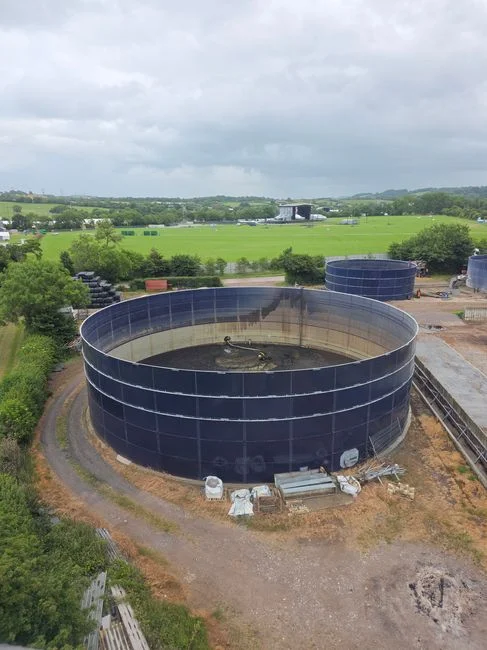
The clarifier argument is not a loser by default. Pick a lamella or ICS clarifier when the stream is mostly settleable, low-FOG, steady-flow, and downstream of a biological stage that just needs solids capture. At Plant A, the secondary clarifier after extended aeration achieved effluent BOD below 30 mg/L and suspended solids below 40 mg/L at 70,000 Igpd (≈318 m³/day) using simple gravity separation with no chemical addition (source: EPA-600/2-78-188, Plant A performance summary). The upgrade path for older circular clarifiers in space-constrained Decatur facilities is a lamella pack retrofit — same tank footprint, 4–6× the effective clarification area.
A conventional gravity clarifier still wins on simplicity and lowest CAPEX for low-rate, low-FOG streams such as bottle rinse water, beverage ingredient wash water, or cooling-tower blowdown routed through a sediment step. The right answer for the plant with an existing activated-sludge or MBR stage that just needs polishing is almost always a lamella upgrade, not a DAF — adding a DAF upstream of an MBR would defeat the MBR's job. For greenfield food plants, the HydropureWater lamella clarifier is the space-efficient answer when FOG is below the 50 mg/L threshold.
2026 Sizing, Cost, and Compliance Numbers for a Decatur Plant
For a 100–500 m³/day Decatur food plant in 2026, turnkey CAPEX ranges $250,000–$600,000 for a DAF system and $150,000–$400,000 for a lamella clarifier at similar flow, based on the HydropureWater DAF (4–300 m³/h) and lamella (10–200 m³/h) product envelopes cross-referenced against 2026 stainless-steel and instrumentation pricing. OPEX bands: DAF $0.20–$0.50 per m³ treated, driven by polymer and coagulant consumption; lamella $0.05–$0.15 per m³, consistent with HydropureWater's claim of up to 30% lower chemical use versus conventional clarifiers.
Anchor the OPEX check against historical Plant A numbers: capital cost $400,000 in November 1977 dollars and annual OPEX of $18,600, equal to $0.75 per m³ treated and $1.32 per kg BOD removed (source: EPA-600/2-78-188, Table 2). Inflation-adjusted for 2026 polymer, electrical, and labor costs — the ENR Construction Cost Index has multiplied roughly 8–10× since 1977, and energy and polymer have inflated faster than headline CPI — current OPEX for a comparable food-plant biological system is best estimated by multiplying the 1977 OPEX by 4–6×, which lands near $0.30–$0.50 per m³ treated. The table below summarizes the 2026 decision economics:
| Cost / Compliance Item | DAF (2026 USD) | Lamella Clarifier (2026 USD) |
|---|---|---|
| Turnkey CAPEX, 100–500 m³/d | $250K–$600K | $150K–$400K |
| OPEX per m³ treated | $0.20–$0.50 | $0.05–$0.15 |
| Polymer/coagulant | 5–30 mg/L (required) | 0–10 mg/L (optional) |
| Regulatory anchor | 40 CFR 432 / 405 / 406 compliance | Best as secondary polish; not a FOG compliance unit |
| POTW surcharge exposure (BOD/TSS/FOG over limit) | $0.10–$0.50 per lb excess avoided | Limited FOG reduction; surcharge risk remains |
| Effluent FOG after primary | ~10–30 mg/L | ~100–300 mg/L (unchanged) |
The Decatur Sanitary District surcharge schedule applies excess-mass charges on BOD, TSS, and FOG over local limits. Avoiding even 100 lb/day of excess FOG at $0.20–$0.50 per lb is $7,300–$18,250 per year in saved surcharges, often more than the marginal cost of the polymer. The DAF vs clarifier decision is therefore not a CAPEX question alone — it is a question of which technology protects the plant from surcharges it is already paying.
Implementation Checklist: Pilot Testing, Controls, and Integration
- Run a jar-test program first. Screen aluminum or iron coagulants (50–300 mg/L as Al or Fe) and anionic or cationic polymers (0.5–10 mg/L) on actual plant wastewater; pick the combination that produces the largest, fastest-settling (or fastest-floating, for DAF) floc.
- Pilot the chosen unit on real flow for 4–8 weeks. Komline states explicitly that "a simple lab test will generally determine if the use of a DAF is feasible," and that further testing can simulate operation under site-specific conditions (source: Komline DAF product page, 2026).
- Size to peak hourly flow, not daily average. Decatur food plants regularly see 2–3× peak-to-average swings from CIP — a DAF or lamella sized to 200 m³/d average flow but undersized for 500 m³/d peaks will bypass solids and trip the POTW's instantaneous-maximum limit.
- Integrate sludge handling. DAF float at 3–5% dry solids can feed a HydropureWater plate and frame filter press directly; lamella clarifier sludge at 0.5–2% DS needs a thickener (gravity belt or rotary drum) before dewatering.
- Specify PLC controls with feedback. Use the HydropureWater automatic chemical dosing system tied to effluent turbidity and inlet flow on the DAF for coagulant/polymer trim; lamella units typically need only level control and sludge pump timer logic.
- Enclose outdoor units in Decatur. Direct quote from EPA Plant A: "freezing problems were also encountered with the integral clarifier" and were "alleviated by enclosing the clarifier in a metal structure, and blowing warm air over the liquid surface" (source: EPA-600/2-78-188). The same applies to DAF — saturator vessels, recycle pumps, and skimmer drives all need protection below freezing.
- Plan for FOG by-product revenue or disposal. DAF float from a meat or poultry line at 3–5% DS can be sold to a renderer for $20–$80 per ton in 2026 markets; dairy float typically goes to anaerobic digestion or landfill.
- Validate biological polishing readiness. A DAF primary should reduce influent FOG below ~50 mg/L before activated sludge; a lamella should achieve TSS below ~100 mg/L. Confirm with composite sampling before and after start-up. For a broader context on biological stage selection, the MBR vs activated sludge for food and beverage wastewater comparison covers the downstream side of this decision, and the secondary vs tertiary wastewater treatment comparison frames where the clarifier fits in the overall train.
For processors comparing DAF and clarifier in a parallel food-and-beverage context outside Decatur — for example, a chemicals plant in the Southeast — the same parameter matrix applies; the DAF vs clarifier selection framework for industrial buyers walks through a parallel case with different influent chemistry.
Frequently Asked Questions
How do you size a DAF for FOG-only removal at a Decatur meat or poultry plant?
For a FOG-dominated stream with 500–2,000 mg/L oil and grease, size the DAF hydraulically on peak flow with 15–25% recycle ratio (i.e., recycle flow = 15–25% of forward flow) and 4–6 bar saturator pressure. Hydraulic loading of 5–15 m/h on the flotation surface is appropriate when FOG is the primary target. Jar-testing should confirm polymer dose — typically 5–20 mg/L cationic polymer plus 100–200 mg/L aluminum or iron coagulant — before pilot confirmation.
Is DAF or a lamella clarifier better for a small Decatur dairy plant (50–150 m³/day)?
For dairy streams at 50–150 m³/day with 200–600 mg/L BOD, 150–400 mg/L TSS, and 100–400 mg/L FOG, DAF is the right primary because the FOG fraction is the surcharge driver. A DAF at this flow can be specified as a pre-assembled COMPACT-style skid with integrated coagulation/flocculation; a lamella clarifier would be a downstream polishing step after biological treatment, not a replacement for the FOG removal step.
What drives polymer cost on a food-plant DAF in 2026?
Polymer cost is driven by dose (5–30 mg/L) and active-content price ($3–$8 per kg in 2026 for anionic or cationic polyacrylamide). At a 300 m³/day plant running 15 mg/L polymer, polymer consumption is ~4.5 kg/day, or $15–$35 per day — roughly $0.05–$0.12 per m³ treated, the largest controllable OPEX line item on a food-plant DAF. Optimizing dose via jar-testing and streaming-current control is the single most effective OPEX reduction.
Can a DAF discharge directly to a Decatur POTW, or is biological treatment always required?
DAF effluent alone will not meet the Decatur Sanitary District's BOD limit for direct discharge for most food streams — DAF typically removes 30–50% of BOD as primary, leaving the rest for a biological stage. Direct discharge is only feasible when influent BOD is already below the local limit (typically 250–350 mg/L for food streams under 40 CFR 432/405/406) and FOG is the only concern. For most Decatur processors, DAF is the primary step upstream of activated sludge, an MBR, or a sequencing batch reactor.