Why Great Bend Fabricated Metals Plants Are Rethinking Activated Sludge in 2026
Great Bend sits in the middle of central Kansas's oilfield supply chain and agricultural equipment cluster, and the fabricated metals job shops that feed that cluster — stamping cells, CNC machining, weldment cleaning, and small-batch zinc or trivalent chromium platers — are exactly the kind of small industrial dischargers Kansas DEQ has been watching more closely under EPA Multi-Sector General Permit (MSGP) coverage in 2026. Their effluent is not a clean municipal stream: it carries tramp oil from stamping press sumps, emulsified cutting fluids, batch dumps of zinc phosphate rinsewater, occasional hexavalent chrome from touch-up plating, and dissolved metals (Cu, Ni, Zn, Pb, Cd) regulated under 40 CFR Part 433 Metal Finishing categorical pretreatment standards. Conventional activated sludge (CAS) handles the biodegradable fraction of those streams well enough, but it stumbles on the oil emulsions, the metal hydroxide floc that does not settle cleanly, and the pH swings that arrive every time a rinse tank dumps. Engineers in this region are also working under a real estate constraint: most job shops sit on two- to five-acre parcels where any expansion of the existing aeration basin or clarifier means paving over a loading dock. That is the operational context behind the current interest in packaged membrane bioreactor (MBR) systems, and it is why the MBR vs CAS decision for a Great Bend fab shop is not a generic municipal WWTP question. Pretreatment expectations are anchored in the federal metal finishing categorical standards and the state NPDES permit, and the real engineering prerequisite that most MBR marketing copy omits is mandatory dissolved air flotation (DAF) and chemical precipitation upstream — skip those and the membrane fouls in weeks on real coolant- and oil-laden fab effluent. For operators weighing advanced treatment like RO for nickel removal in 2026, the upstream biology choice is the gate.
How Conventional Activated Sludge Treats Fabricated Metals Wastewater
CAS has been the default biological stage in industrial wastewater treatment for over a century (Mannina et al., 2020, citing Jenkins and Wanner, 2014), and the train a Great Bend fab retrofit typically runs is straightforward: equalization, pH adjustment to 8.5–9.5 with lime or NaOH, hydroxide precipitation of dissolved metals, coagulation/flocculation (often with a polymer), an aeration basin operated at MLSS 2,000–4,000 mg/L with dissolved oxygen 1.5–2.5 mg/L, and a circular or rectangular clarifier for solids-liquid separation. Sludge retention time (SRT) typically lands between 5 and 15 days, hydraulic retention time (HRT) 6–12 hours, and a well-tuned clarifier will produce effluent TSS in the 10–30 mg/L range with biological oxygen demand reductions of 85–95% on the biodegradable fraction of cutting fluids. The strengths that keep CAS in the conversation are real: it is robust to flow variation if a properly sized EQ tank is upstream, it handles biodegradable emulsions at moderate loads, and the retrofit CAPEX is the lowest of the realistic options. The weaknesses are equally real and they show up on fab effluent specifically. Metal hydroxide sludge is voluminous and hard to dewater, free oil and grease trigger filamentous bulking (typically Microthrix parvicella or Nocardia-like foaming), and a pH excursion from a batch plating rinse dump can take the clarifier offline for 24–48 hours while the biomass re-flocs. Upstream oil removal with a dissolved air flotation unit and clarification with a high-efficiency sedimentation tank reduce but do not eliminate these failure modes, which is why operators keep asking whether biology-plus-membrane is a more stable answer for the same influent.
How an MBR Treats the Same Effluent — and What Changes
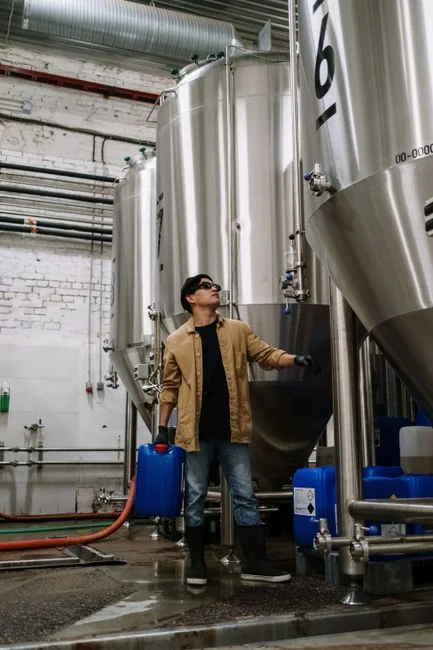
An MBR is, mechanically, a CAS basin with a submerged PVDF flat-sheet or hollow-fiber membrane module sitting inside or in a separate chamber, replacing the secondary clarifier. Pore sizes of 0.1–0.4 μm (most PVDF flat-sheet modules are 0.1 μm) physically retain virtually all biomass and most colloidal suspended solids, so the mixed liquor can be pushed to MLSS 8,000–12,000 mg/L — roughly three times a CAS clarifier can handle — and SRT extends to 20–60+ days without the washout risk a clarifier-based system would face. The effluent that comes off the membrane typically tests <5 mg/L TSS and <1 NTU turbidity, which is the threshold downstream RO or UF expects for sustainable operation, and the membrane also retains most bacteria and many viruses, reducing downstream disinfection burden. Three things change for the operator: sludge production drops because of the higher SRT and lower observed yield, the basin footprint shrinks (the catalog figure for an integrated system like the HydropureWater integrated MBR system is roughly 40% of an equivalent CAS plot, with the MBR footprint in operation commonly cited as 60% smaller than CAS), and the operator's failure-mode list grows by one critical item: membrane fouling. Free oil, tramp oil, and metal hydroxide precipitates blind the membrane irreversibly if they reach the module, which is why every serious MBR datasheet — including the DF series PVDF flat sheet MBR module spec — specifies an upstream oil & grease target below 50 mg/L and a TSS ceiling on the feed. There is also a small lifecycle GHG penalty: Mannina et al. (2020) reported 0.91 kgCO₂eq/m³ direct emissions for MBR versus 0.85 kgCO₂eq/m³ for CAS in their plant-wide benchmark, driven by scouring aeration across the membrane. That 7% gap is real but small compared with the energy and chemical footprint of chemical precipitation upstream.
MBR vs CAS: 2026 Parameter Comparison for Fabricated Metals Duty
For a Great Bend fab choosing between retrofitting CAS and installing a packaged MBR, the following matrix is the working comparison. Footprint, effluent quality, and oil-tolerance are where MBR pulls ahead; CAPEX and energy are where CAS still has the edge.
| Parameter | CAS (well-tuned retrofit) | Packaged MBR | MBR + RO polishing |
|---|---|---|---|
| Footprint relative to CAS baseline | 1.0× (baseline) | ~0.4× (catalog data) / ~0.6× typical operating | ~0.5× |
| Effluent TSS (mg/L) | 10–30 | <5 (typically <2) | <1 |
| Effluent turbidity (NTU) | 5–20 | <1 | <0.1 |
| MLSS tolerance (mg/L) | 2,000–4,000 | 8,000–12,000 | 8,000–12,000 |
| SRT (days) | 5–15 | 20–60+ | 20–60+ |
| Oil & grease feed tolerance | Up to ~100 mg/L with DAF | <50 mg/L required | <50 mg/L required |
| Sludge production | Baseline | 20–30% lower | 20–30% lower |
| Energy (kWh/m³) | 0.4–0.8 | +0.2–0.5 vs CAS (scouring aeration) | +0.6–1.2 vs CAS incl. RO |
| Direct GHG (kgCO₂eq/m³, Mannina 2020) | 0.85 | 0.91 | Higher (RO energy) |
| CAPEX ranking (1× CAS baseline) | 1.0× | 1.5–2.0× | 2.5–3.0× |
| OPEX vs CAS | Baseline | +15–25% (membrane CIP, scour air) | +30–50% (CIP, RO membrane replacement) |
| Cooling-tower make-up reuse | Marginal (SDI too high) | Marginal (SDI ~3–5) | Suitable (SDI <2) |
| Rinsewater reuse | No | No without polishing | Yes |
The MBR+RO column matters for any Great Bend fab with a 50–200 gpm cooling tower or a rinsewater loop, because only that configuration reliably hits the Silt Density Index (SDI <2) and TSS (<1 mg/L) that cooling-tower chemistry and plating rinse quality demand. Without RO polishing, MBR permeate is excellent for discharge but still marginal for reuse loops that carry dissolved metals, because the membrane rejects TSS, not ions. MBR permeate pairs with RO or NF for the next polishing step; RO/UF membrane elements downstream are the typical train. If the operational question is reuse for a different duty, the same MBR-side logic in the MBR vs MBBR reuse comparison carries over — the bottleneck is downstream, not the biology.
Meeting 40 CFR Part 433 and Kansas Pretreatment on Either System
The compliance question is shorter than the engineering question, and the answer is the same for both systems: biology does not remove dissolved metals, chemistry does. The 40 CFR Part 433 Metal Finishing categorical pretreatment daily maximum limits (DML) that apply to most Central Plains job shops are Cu 2.68 mg/L, Pb 0.69 mg/L, Ni 3.98 mg/L, Zn 4.33 mg/L, total chromium 2.77 mg/L, and Cd 0.69 mg/L, with total toxic organics and oil & grease also regulated (40 CFR Part 433). Both CAS and MBR can meet these limits — but only if upstream hydroxide precipitation (pH 8.5–9.5) and, where hex chrome is present, ORP-controlled reduction to trivalent chrome are working first. The MBR does add a compliance margin: the tighter effluent TSS (<5 mg/L) and lower residual biomass make downstream polishing steps — activated carbon for complexed nickel, ion exchange for hexavalent chrome breakthrough, and RO for nickel polishing in 2026 — operate more reliably because the polishing media is not fouled by TSS carryover. The membrane does not replace chemical precipitation; it just makes everything downstream the precipitation step work better.
Pretreatment You Cannot Skip: DAF, Oil-Water Separation, and pH Control
This is the section most MBR marketing copy skips, and it is where real metalworking MBR installations live or die. Free and emulsified oil is the single fastest membrane foulant on a fab shop's waste stream, and tramp oil from a stamping press sump will blind a PVDF module in days if it reaches the tank untreated. The non-negotiable upstream train is: (1) a plate coalescer or oil-water separator on the stamping and CNC coolant side streams; (2) a dissolved air flotation unit on the combined flow, sized to drop oil & grease below 50 mg/L and TSS below 100 mg/L before the biological stage (the DAF range covers 4–300 m³/h, which is most Great Bend fabs); (3) pH adjustment to 8.5–9.5 with a HydropureWater automatic chemical dosing system for hydroxide precipitation of Cu, Ni, Zn, and Cd; and (4) if hexavalent chrome is present, an ORP-controlled reduction step (typically NaHS or FeSO₄ at pH 2–3, then re-neutralization) upstream of any membrane. Skip the DAF, and the MBR fouls in weeks; skip the reduction step on a hex-bearing stream, and the membrane sees Cr(VI) it cannot reject. CAS is more forgiving of oil excursions because the clarifier can be re-seeded; MBR is not.
When CAS Still Wins in 2026 — and When MBR Pays Back
The decision rule for a Great Bend fab in 2026 is a flow-and-reuse rule, not a technology preference. CAS retrofit is the right call when: average flow is below ~200 m³/day, there is no water-reuse loop to feed, the site has a working equalization tank and a willing operator, and CAPEX is the binding constraint. MBR is the right call when: the site is footprint-constrained (loading dock, setback, or expansion room is gone), the fab wants rinsewater or cooling-tower make-up reuse, future production expansion is planned, discharge limits are tightening at the next permit renewal, or batch operations chronically upset the existing clarifier. The payback math depends on whether reuse credit and avoided surcharges are counted, and a 300 m³/day MBR vs CAS retrofit typically lands in the 4–8 year payback band when those credits are real; without them, MBR can struggle to amortize. The long-horizon literature supports the MBR case: Karim and Mark (2017), summarized in Mannina et al. (2020), found that over a 67-year operating horizon MBR wins on lifecycle cost, while CAS often wins over horizons under ~10 years.
| Flow band (m³/day) | Recommended primary biology | Typical payback (vs CAS retrofit) | Decision driver |
|---|---|---|---|
| <100 | CAS retrofit (or package chem-only) | n/a — MBR CAPEX rarely amortizes | CAPEX-constrained, no reuse |
| 100–200 | CAS retrofit unless reuse or footprint forces MBR | 6–10 years (with reuse credit) | Equalization & operator skill |
| 200–500 | Packaged MBR; MBR+RO if reuse needed | 4–8 years (with reuse credit) | Footprint, reuse, tightening limits |
| >500 | MBR or MBR+RO, site-specific | 3–6 years (with reuse credit) | Reuse and compliance margin |
OPEX on the AAO and similar biological trains is a useful cross-check — the AAO process OPEX in 2026 benchmark is a fair proxy for the aeration energy and sludge handling cost line that any biological plant carries, and MBR runs ~15–25% above that on a like-for-like basis. For a different reuse-quality comparison on a different industry, the RO vs ion exchange OPEX comparison puts the downstream polishing cost in context.
Frequently Asked Questions
Is MBR more energy-intensive than CAS for a fabricated metals plant?
Yes — MBR typically adds 0.2–0.5 kWh/m³ of aeration energy for membrane scouring above an equivalent CAS system, and plant-wide modeling by Mannina et al. (2020) measured direct GHG emissions at 0.91 kgCO₂eq/m³ for MBR versus 0.85 kgCO₂eq/m³ for CAS. The OPEX penalty is real but is usually smaller than the savings from lower sludge production, avoided clarifier recycle pumping, and reuse credit. A CAPEX-adjusted lifecycle view in 2026 typically shows MBR reaching OPEX parity with CAS in the 200–500 m³/day band when reuse is monetized.
What oil & grease level is required upstream of an MBR on a fab shop?
Target oil & grease below 50 mg/L and TSS below 100 mg/L in the MBR feed, with no measurable free or tramp oil. That almost always requires a DAF upstream of the membrane tank, sized to handle the peak flow from the stamping, machining, and plating rinse streams combined. Without DAF polishing, oil fouls PVDF modules in days; with it, modules run 6–12 months between clean-in-place cycles.
At what flow rate does MBR start to make sense over CAS retrofit?
For a Great Bend fabricated metals job shop in 2026, the working tipping point is roughly 200 m³/day — below that, CAS retrofit is hard to beat on payback; above it, MBR pulls ahead on footprint, compliance margin, and reuse potential. The 4–8 year payback band is realistic when rinsewater or cooling-tower make-up reuse is in the project scope, and 5 years is a defensible planning number to take to a board meeting.
Do MBR membranes replace chemical precipitation for metals compliance?
No. 40 CFR Part 433 categorical pretreatment limits for Cu, Pb, Ni, Zn, total Cr, and Cd are dissolved-metal limits, and a 0.1 μm membrane does not reject dissolved ions. Hydroxide precipitation at pH 8.5–9.5 (and ORP-controlled reduction for hex chrome) is required upstream of either CAS or MBR, and the MBR's value is in handling the residual TSS, biomass, and emulsified load downstream of precipitation more cleanly than a clarifier can.
Does MBR permeate need RO polishing for water reuse?
Yes, for any meaningful reuse at a fab shop. MBR permeate runs <5 mg/L TSS and ~3–5 SDI, which is suitable for discharge but marginal for cooling-tower make-up or plating rinse loops. Adding RO polishing — MBR + RO — pushes total nitrogen rejection to 86.2% (BW30 membrane) versus 71.7% for MBR + NF, and reliably hits the SDI <2 and conductivity targets cooling-tower chemistry and rinsewater quality demand. Only the MBR + RO configuration in the comparison matrix is reuse-ready.