
Why Cooling-Blowdown Reuse Is Now the OPEX Battlefield in Midstream
For oily and produced water at an oil and gas midstream facility, RO wins on cooling-tower blowdown-reuse OPEX once the feed contains dispersed oil, silica above ~20 ppm, or swings in TDS. HydropureWater industrial RO systems at up to 95% recovery avoid the acid/caustic regeneration, sodium leakage, and brine-tank burden that ion exchange carries. IX only wins on very low-TDS, low-silica streams where the duty is pure polishing and reject disposal is cheap.
The economics are forced by a single ratio: roughly 46% of U.S. produced water is currently disposed, 41% reinjected, 13% recycled (Water, 2023), so the OPEX gap now drives the recycling decision. The U.S. produced 24.4 billion barrels of water from oil and gas operations in 2017 — about one trillion gallons per year — and PW volume has climbed 16.2% over the past decade, with the water-to-oil ratio still rising into 2025 (Water, 2023). Permian and Bakken gathering stations are now sitting on more PW than their disposal wells can accept on schedule.
Cooling-tower blowdown makeup is the highest-value reuse duty at a midstream site because the spec is forgiving: <500 µS/cm conductivity, <50 mg/L silica as SiO₂, hardness <50 mg/L as CaCO₃, and oil & grease <5 mg/L are typical industrial targets, not regulatory limits. The volume scales with compressor and gas-engine cooling loads at every station, so a 500 hp compressor skid pulling 50 gpm of cooling water can absorb 30–40% of a small train's PW permeate. At ~$0.50–$1.50/bbl PW-disposal alternate cost (truck-and-haul, Class II injection fees, or evaporation pond amortization) against tightening fresh-make-up water allocations in the Permian and Delaware basins, even a 10% OPEX swing on the reuse train moves the project IRR. The pretreatment-compliance pressure covered in our 2026 petroleum plant 2026 pretreatment compliance analysis is the regulatory side of the same squeeze.
Feed-Water Chemistry That Decides the Winner: Oil, Hardness, Silica, Sulfate
Four fouling and scaling vectors decide whether RO or IX wins on a given PW stream: free oil (>50 mg/L is common in upstream separated PW), dispersed and emulsified oil that survives an API or CPI skim, barium and strontium sulfate scaling that supersaturates as permeate recovery climbs, and silica at 30–150 mg/L as SiO₂ in formation water from many Permian and Eagle Ford wells (Water, 2023). Each one collapses a different technology.
Free oil is the first gate. RO membranes irreversibly foul when oil & grease on the feed exceeds ~1 mg/L, so any RO path requires DAF for free and emulsified oil removal followed by 0.1 µm UF before the high-pressure pump. IX is more oil-tolerant — sodium-form cation resin can absorb a slug of oil without immediate capacity loss — but it is not oil-proof; oil coats the anion resin, kills working exchange sites, and forces premature replacement. An MBR sidestream, as reviewed in the MBR for PW literature (Membranes, 2022), can polish organics upstream of either train but adds biomass control and a wasting step most leases won't run.
Silica and sulfate scaling are the second gate. At feed silica >30 mg/L, a single-pass RO needs antiscalant dose plus a recovery ceiling of 75–80% to stay below the 120–150 mg/L membrane concentration limit; beyond that, you either cap recovery or send a second-pass RO, both of which add OPEX. IX polishers leak Na⁺ — every equivalent of hardness pulled out of a Na-form softener is replaced by two equivalents of sodium on the effluent — and that Na⁺ raises cooling-loop conductivity, which forces the cooling-tower controller to blow down more aggressively, which is a hidden OPEX line IX rarely gets charged for.
The four parameters to screen with before you pick a train:
| Parameter | Typical Oily PW Range | Cooling-Blowdown Make-up Spec | RO Impact | IX Impact |
|---|---|---|---|---|
| Oil & grease (mg/L) | 20–500 (post-skim) | <5 | RO fouls irreversibly >1 mg/L; needs DAF + UF | More tolerant but anion resin is poisoned at >10 mg/L |
| Total hardness (mg/L CaCO₃) | 500–5,000 | <50 | Antiscalant + recovery limit on CaSO₄ | Softener handles easily, but Na⁺ leak raises conductivity |
| Silica (mg/L SiO₂) | 30–150 | <50 | Recovery cap ~75–80% above 30 mg/L feed | Anion exchange struggles >10 mg/L; needs strong-base + HF-resistant resin |
| TDS (mg/L) | 2,000–100,000+ | <~250 (≈500 µS/cm) | RO permeate ~10–50 mg/L; recovery up to 95% | IX cannot economically polish TDS >500 mg/L |
| Barium/Strontium (mg/L) | 1–50 | Low (scale risk) | Antiscalant threshold limited; recovery <70% on high-Ba feed | Not removed; passes through to cooling loop |
Use the bottom three rows as a quick screen. If your TDS is above 2,000 mg/L or your silica is above 30 mg/L, RO wins on chemistry before you even look at OPEX. The DF series MBR module is a sensible add when total organic carbon on the skimmed PW is still >100 mg/L and you want to drop the antiscalant demand on the RO.
RO Train vs IX Train: Equipment Skeleton Side by Side
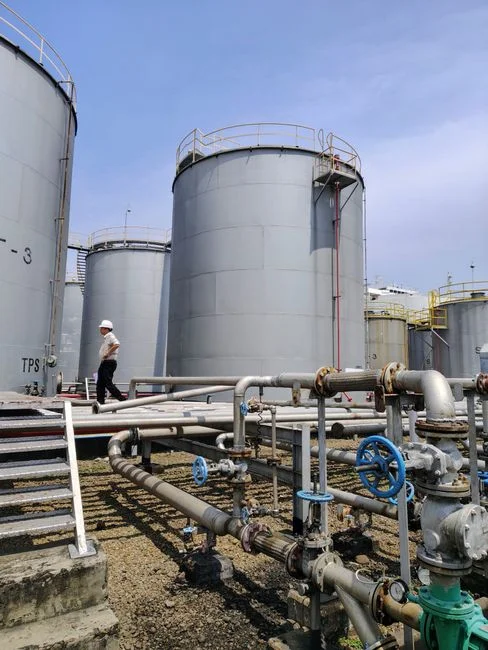
Both reuse trains start with oil removal, but the equipment stacks diverge fast. The RO path is skim/CPF → DAF for free and emulsified oil removal (4–300 m³/h) → 0.1 µm 0.03 µm hollow-fiber UF pretreatment → 5 µm cartridge → HydropureWater industrial RO at up to 95% recovery → degasser (CO₂/H₂S strip) → mixed-bed polish or EDI → cooling-tower make-up tank. The IX path is skim → DAF → multimedia filter → industrial water softener (Na-form cation) → strong-base anion → mixed-bed → make-up tank, plus a brine day tank, a neutralization tank, and a regeneration chemical dosing room that the RO train simply does not need.
Two equipment-scope differences drive the OPEX gap. First, the RO train has a continuous brine reject stream equal to (1 – recovery) × feed flow — at 95% recovery on a 50 gpm feed that's only 2.5 gpm of concentrate, small enough to send to a Class II disposal well, an evaporation pond, or a crystallizer. The IX train has zero recovery gain: every gallon polished is matched by a gallon of brine from the softener and the anion unit, and that brine is itself a high-TDS waste that often needs treatment before disposal. Second, the RO train's footprint is dominated by the RO skid and pretreatment, while the IX train carries twin regeneration tanks, a day brine tank, a caustic/acid dosing skid, and a neutralization basin — easily 1.5–2× the plot area of an equivalent RO skid.
| Unit Operation | RO Train | IX Train |
|---|---|---|
| Primary oil removal | DAF → 0.1 µm UF | DAF → multimedia filter |
| Desalination / ions | Reverse osmosis (up to 95% recovery) | Cation softener + strong-base anion + mixed-bed |
| Reagent chemicals | Antiscalant, CIP acid/alkali, SMBS | NaCl, HCl, NaOH, neutralization salt |
| Waste stream | 5–25% of feed as RO concentrate (depending on recovery) | ~5–10% of feed as brine per regeneration, plus rinse water |
| Footprint relative | 1.0× baseline (RO skid dominant) | ~1.5–2.0× baseline (twin tanks, brine, neutralization) |
| Permeate conductivity | 5–50 µS/cm typical | 0.5–5 µS/cm with mixed-bed polish |
| Silica handling | Recovery-limited; rarely reaches 0.1 µS/cm alone | Strong-base anion + HF-resistant resin removes to <0.02 mg/L |
One nuance: if your end use is high-pressure boiler make-up rather than cooling-tower blowdown, IX (or EDI on RO permeate) wins on silica. For cooling-blowdown reuse, the RO permeate at <500 µS/cm is already over-spec, and the 95% recovery advantage is real money.
OPEX Showdown: Chemicals, Energy, Replacements, and Brine Handling
On a midstream oily-PW duty, RO OPEX is dominated by energy and membrane life; IX OPEX is dominated by regeneration chemicals and brine disposal. That structural difference is the answer to the OPEX question before you run a single dollar through a calculator.
RO operating costs on oily feed: high-pressure pumping at ~0.7–1.2 kWh/m³, antiscalant dose of 2–5 mg/L, sulfite or SMBS for residual chlorine control if any oxidant carryover exists, and CIP with alkaline then acid surfactant every 4–12 weeks depending on flux decline. Membrane replacement on oily PW runs ~15–20% of the membrane inventory per year, so a 5-year lifecycle assumes one full membrane change-out. Energy dominates on RO, and at industrial power rates the pumping line item is the most sensitive variable.
IX operating costs on oily feed: sodium chloride at 150–300 g/L of resin per regeneration cycle for the softener, 4–8% HCl for the cation and 4–8% NaOH for the strong-base anion at 1.5–3× stoichiometric excess, plus neutralization salt (typically NaOH to neutralize the spent HCl to pH 6–9) before discharge. Resin life is 3–7 years for cation and 2–5 years for anion, shorter when feed organics are high. The killer line item is the regeneration wastewater: 5–10% of feed flow per cycle, at TDS often higher than the feed itself, requiring deep-well injection, hauling, or on-site evaporation — three costs that RO's smaller concentrate stream simply does not carry at the same scale.
The OPEX verdict, stated plainly: at a midstream site producing oily PW with TDS >2,000 mg/L and silica >30 ppm, RO is the lower-OPEX path on a 5-year lifecycle because IX OPEX is dominated by regeneration chemicals and brine disposal, while RO OPEX is dominated by membrane life and energy — and on this feed the energy delta is smaller than the chemical delta. If you need <0.1 µS/cm polish for high-pressure boiler make-up rather than cooling blowdown, add EDI polishing of RO permeate and skip mixed-bed IX altogether; EDI consumes ~0.2–0.4 kWh/m³ of electricity, no acid, no caustic, no brine.
| OPEX Line Item | RO Train (oily PW, 5-yr lifecycle) | IX Train (oily PW, 5-yr lifecycle) |
|---|---|---|
| Energy | ~0.7–1.2 kWh/m³ high-pressure pumping | ~0.1–0.3 kWh/m³ (pumps only, no HP pump) |
| Regeneration / CIP chemicals | Antiscalant 2–5 mg/L + CIP acid/alkali every 4–12 weeks | NaCl 150–300 g/L resin; HCl + NaOH at 1.5–3× stoichiometric |
| Neutralization salt | None (RO concentrate is near feed pH) | NaOH to neutralize spent HCl before discharge |
| Membrane / resin replacement | 15–20% of membrane inventory per year | Cation 3–7 yr, anion 2–5 yr life on oily PW |
| Waste stream for disposal | 5–25% of feed as RO concentrate at 1–3× feed TDS | 5–10% of feed per regen cycle, often higher TDS than feed |
| Disposal sensitivity | Lower — smaller volume, smaller trucking or well injection | Higher — brine volume tracks regeneration frequency, not recovery |
| Hidden OPEX | CIP downtime, membrane inventory carrying cost | Na⁺ leakage → higher cooling-tower blowdown rate → more chemical treatment |
Spare parts and consumables — cartridges, instruments, valves — are similar on both trains; sourcing them through a consolidated water-treatment parts and media inventory cuts stockroom OPEX by 5–10% regardless of which technology you run.
Decision Framework: When RO Wins, When IX Wins, When to Hybridize
Use this rule on Monday morning before you run a pilot:
- RO wins when feed TDS >2,000 mg/L, silica >20–30 mg/L, oil can be pretreated to <1 mg/L with a DAF + UF pair, or when brine-hauling or injection costs are above ~$0.05/L. This is the default for most Permian, Bakken, and Eagle Ford gathering stations.
- IX wins when feed TDS <500 mg/L, oil & grease <5 mg/L with no swings, silica <10 mg/L, and the site already operates a brine injection well with spare capacity. This is rare on raw PW but common on a desalter wastewater side stream or a post-RO concentrate polishing duty.
- Hybridize when (a) you need boiler-grade polish — run RO as the primary desalination step and a small mixed-bed IX as the final polisher, or (b) you want to extend RO recovery — use weak-acid cation IX upstream of RO to strip hardness, cut antiscalant dose, and lift recovery from ~75% to ~85% on high-scaling feed.
The U.S. recycling share is still only 13% of the 24.4 Bbbl/yr produced water stream (Water, 2023). The technology decision in front of you is the lever that moves that 13% upward, one gathering station at a time.
Implementation Checklist for a Midstream RO-Reuse Project
Four steps move a reuse project from conceptual to operable:
- Pull a 30-day composite PW analysis. TDS, hardness, silica, barium, strontium, oil & grease, and TOC — never design on a one-shot sample. PW chemistry swings 2–5× week to week on most unconventional wells.
- Pilot a UF/RO skid for 60–90 days. Validate flux, CIP interval, silica recovery, and oil tolerance before committing CAPEX. Use manufacturer-supplied RO/UF membranes and filter elements rated for oily feed rather than municipal spec.
- Line up the brine destination first. Class II disposal well, evaporation pond, or crystallization. This single line item — the cost per liter of concentrate disposal — usually decides the OPEX winner before any other variable is locked.
- Size the cooling-tower blowdown rate to the RO permeate supply and lock the conductivity controller setpoint to <500 µS/cm. A higher setpoint means more chemical blowdown, more corrosion inhibitor dose, and a quietly larger OPEX line that has nothing to do with the RO skid itself.
Frequently Asked Questions
What feed conditions make RO the clear winner over ion exchange for oily produced water?
RO wins when feed TDS exceeds 2,000 mg/L, silica exceeds 20–30 mg/L, or oil & grease can be pretreated to under 1 mg/L with a DAF + UF pair. Below 500 mg/L TDS with low silica and no oil swings, IX becomes competitive because its regeneration chemicals stay manageable.
How much does ion-exchange regeneration waste add to OPEX on a produced-water duty?
IX regeneration typically discharges 5–10% of feed flow per cycle at TDS often higher than the feed itself, plus neutralization salt to bring pH to discharge range. On a 50 gpm PW feed with daily regenerations, that is hundreds of gallons per day of brine requiring disposal well capacity, hauling, or evaporation — costs that RO's smaller concentrate stream does not carry at the same scale.
Can RO permeate meet a cooling-tower blowdown spec without a mixed-bed IX polisher?
Yes. A single-pass RO on oily PW typically produces permeate at 5–50 µS/cm conductivity and <50 mg/L silica after antiscalant dose, which meets the <500 µS/cm industrial cooling-tower make-up target without further polishing. A mixed-bed or EDI polisher is only required if the end use is high-pressure boiler make-up demanding <0.1 µS/cm.
What pretreatment is mandatory before RO on oily produced water?
DAF followed by 0.1 µm UF is the standard pair. DAF drops free and emulsified oil to under 20–30 mg/L; UF polishes to under 1 mg/L oil & grease and under 0.1 NTU turbidity, which is the flux-stability envelope for a brackish-water RO element. Skipping the UF step is the most common cause of premature membrane fouling on PW duty.