What Robertsdale Chemical Plants Are Up Against in 2026
Robertsdale sits in the heart of the Baldwin County industrial corridor, where chemical batch operations, specialty-formulation lines, and agrochemical blending share outfalls with light manufacturing. A typical Robertsdale chemical plant in 2026 runs batch reactions followed by solvent washes, surfactant-based cleaning, and pH swings that can move from 2 to 12 within a single shift. That profile drives FOG, emulsified reagents, and metal-hydroxide floc into the same waste train, and it is exactly the stream that exposes a single-technology clarifier or DAF to a permit violation.
The controlling federal category is 40 CFR Part 414 — the Organic Chemicals, Plastics, and Synthetic Fibers (OCPSF) effluent limits — which sets subgroup-by-subgroup caps on BOD, TSS, COD, and priority pollutants such as total residual chlorine, hexavalent chromium, and zinc. Alabama Department of Environmental Management (ADEM) administers these through individual NPDES permits and through pretreatment agreements with the local POTW, and the 2026 renewal cycle has tightened monitoring on PFAS precursors and total residual chlorine beyond the prior baseline. For procurement, that translates into a real decision: the primary clarification step you specify in 2026 has to absorb the surfactant load today and the tighter PFAS precursor scrutiny tomorrow, or your renewal consent order will be the line item that breaks the project budget. For a parallel look at how hydrocarbon-bearing plants handle the same renewal pressure, the 2026 pretreatment compliance playbook for hydrocarbon-bearing plants lays out the same ADEM logic for a different stream.
How a DAF and a Clarifier Actually Work
A DAF system generates 10–100 micron microbubbles by saturating a pressurized recycle stream (typically 60–80 psig) with air and then releasing that pressure through a needle valve or nozzle array into the flotation cell. The bubbles attach to particles or oil droplets, reducing their effective density below that of water so the agglomerate rises to the surface, where a top-mounted mechanical skimmer drives the float into a discharge hopper. A saturated recycle ratio of 20–40% of forward flow is the typical operating window, and the saturator, recycle pump, and air-dissolving tube are the three pieces of rotating equipment that define DAF CAPEX (per Komline-Sanderson process documentation).
A clarifier — including the inclined-plate lamella design used in chemical service — relies on gravity sedimentation. A lamella clarifier stacks parallel plates at 55–60° from horizontal and operates at 20–40 m/h surface loading rate, so a 2-meter plate spacing gives roughly 2.5× the effective settling area of an equivalent-footprint conventional basin. Sludge is recirculated to a flocculation zone to build contact floc, and the underflow leaves as a 1–3% solids stream from the bottom hopper. A HydropureWater lamella clarifier in FRP or super-duplex construction is the standard chemical-stream configuration because it tolerates low-pH streams that would attack carbon steel.
Choosing the right technology requires addressing density reversal. DAF wins on anything lighter than water — free and emulsified oils, low-density organics, surfactant micelles, and reagent droplets that resist settling. A clarifier wins on anything denser than water — metal hydroxides, catalyst fines, calcium sulfate, and settled salt crystals. Chemical streams that carry both phases are the reason neither technology, alone, is the right answer for many Robertsdale sites. A HydropureWater DAF system handles the float fraction; a lamella clarifier handles the settle fraction; and a properly sized hybrid train handles both within the same hydraulic envelope.
DAF vs Clarifier: Head-to-Head for Chemical Wastewater
The 2026 Ecologix selection data anchors the headline numbers for performance metrics. DAF delivers 95% FOG removal against 70% for a clarifier on the same oily stream, and a conventional clarifier removes 85–92% of dense inorganic TSS against 60–75% for an equivalently sized DAF. That gap is the entire procurement argument, and the rest of the table tells you which technology to buy for which sub-stream.
| Parameter | DAF | Lamella Clarifier |
|---|---|---|
| FOG / emulsified oil removal | 90–95% (Ecologix 2026) | 60–70% (Ecologix 2026) |
| Dense inorganic TSS removal | 60–75% | 85–92% |
| Surface loading rate | 10–25 m/h hydraulic | 20–40 m/h on plate area |
| Typical footprint for 50 m³/h | ~8–12 m² | ~6–10 m² incl. plate pack |
| CAPEX drivers | Saturator, recycle pump, skimmer drive | Plate pack, FRP or super-duplex tank, sludge recirculation pump |
| OPEX drivers | Compressed air, polymer, saturator power | Polymer, sludge recirculation power |
| Materials of construction | Carbon steel / 304 SS standard; exotic alloys premium | FRP or super-duplex standard for low-pH streams |
| Operator attention | Low (lubrication, wear parts — Komline) | Low–moderate (blanket control, polymer tuning) |
| Common failure mode | Foam carryover on high-surfactant load | Sludge blanket bulking on shifting cation ratios |
| Best compliance fit (40 CFR 414) | FOG, oil & grease, light TSS | TSS, settleable solids, metal hydroxides |
Three operational realities do not show up in a parameter table. First, a mobile trailer DAF can be brought online within a single day (WesTech mobile DAF documentation), which is the right way to pilot a new chemistry before committing to permanent equipment. Second, both technologies are essentially hands-off once conditioned — DAF maintenance reduces to drive lubrication and wear-part replacement (Komline), and a clarifier only needs sludge-blanket monitoring plus periodic polymer tuning. Third, under 40 CFR Part 414 Tables 2 and 3, an undersized clarifier fails on TSS and oil & grease, while an undersized DAF fails on soluble COD and TDS — which is why the hybrid DAF-primary + lamella-secondary train is the actual best-in-class answer for most Robertsdale chemical streams.
Which Streams Map to Which Technology
Mapping the stream profile is required before sizing a tank to avoid potential consent orders. The chemical industry is not a single waste profile, and the decision matrix below covers the six profiles you will see most often on a Robertsdale outfall.
| Stream Profile | Recommended Primary | Rationale |
|---|---|---|
| Emulsified oil + low TDS (cosmetic, lubricant blending) | DAF | 95% FOG removal vs 70% for clarifier (Ecologix 2026) |
| Heavy metal hydroxide precipitation sludge (catalyst recovery) | Lamella clarifier | 85–92% settleable solids removal; FRP or super-duplex tolerates low pH |
| Surfactant-rich cleaning wastewater (CIP) | DAF then clarifier polish | DAF strips foam and micelles; clarifier polishes residual floc |
| Salt brine with low organics (ion-exchange regenerate) | Lamella clarifier | Low FOG, high density, no benefit from float chemistry |
| Mixed batch reactor discharge (typical specialty chemical) | Hybrid DAF + lamella | Captures both phases in one train |
| Polymer emulsion production (latex, PVOH) | DAF with chemical conditioning | Emulsions resist settling; coagulant + flocculant feed before DAF is the standard |
Jar testing and pilot DAF rental units (Komline) are the final step before any capital commitment, and a PLC-controlled coagulant and flocculant dosing skid between the two stages is the simplest way to hold the chemistry in spec across a 2–12 pH shift. For a structured way to think about an oily industrial stream that is not strictly chemical, the DAF vs clarifier decision framework for oily industrial streams walks through the same scoring logic in a different vertical.
2026 Cost, Compliance, and Hybrid Configuration
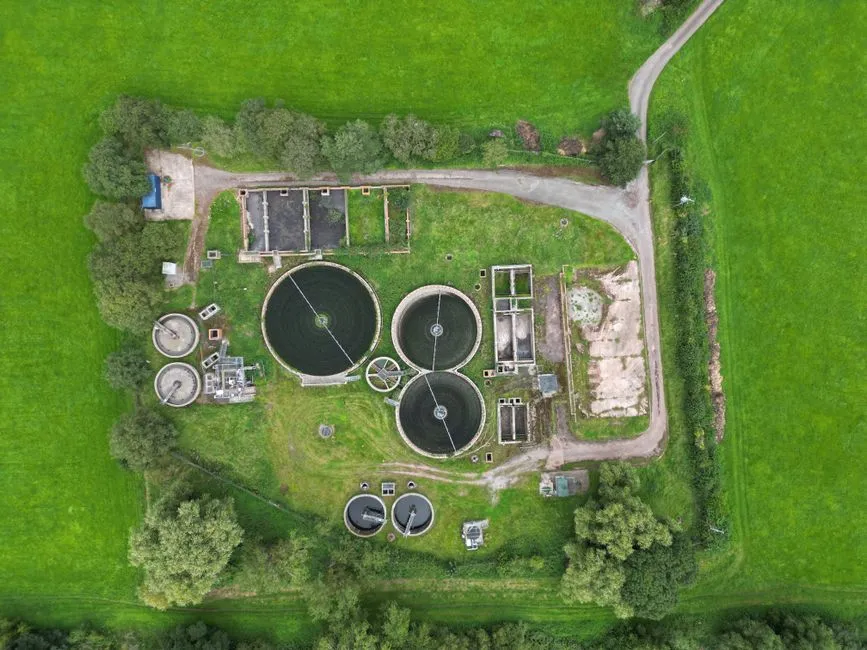
DAF CAPEX runs higher than a lamella clarifier of equal hydraulic capacity because of the saturator, recycle pump, and skimmer drive, but it cuts downstream biological load by stripping oil and floatables upstream. A lamella clarifier, by contrast, uses inclined plates at 20–40 m/h surface loading and can reduce chemical consumption by up to 30% relative to a conventional basin because the plate pack improves floc–particle contact (HydropureWater lamella clarifier spec). For the typical Robertsdale chemical plant — batch reactions, surfactant cleaning, pH swings, mixed inorganic and organic load — the defensible 2026 recommendation is a hybrid DAF-primary + lamella-secondary train with a chemical dosing skid between them. The DAF strips FOG and emulsified reagents, the lamella catches the dense floc that slips through, and the dosing skid holds both stages inside their operating envelopes across the daily pH swing.
This configuration pays back in compliance risk avoidance. 40 CFR Part 414 violations in Alabama typically trigger ADEM consent orders with stipulated penalties, and a single TSS or oil-and-grease excursion in a renewal year is enough to wipe out the entire incremental CAPEX of a properly sized DAF. On the sludge side, floated DAF float is typically 3–5% solids against 1–3% for clarifier underflow, which dewaters more cleanly on a plate-and-frame press and reduces hauling cost per ton. A HydropureWater plate and frame filter press is the compatible downstream unit on either sludge stream, and the downstream sludge dewatering comparison for DAF float and clarifier underflow is the right reference if you are also re-evaluating the dewatering step in the same 2026 capital plan.
Frequently Asked Questions
Should a chemical plant in Robertsdale choose DAF or clarifier in 2026?
Choose DAF when the waste stream carries emulsified oils, surfactants, or low-density reagents — Ecologix 2026 data shows 95% FOG removal for DAF against 70% for a clarifier on the same stream. Choose a lamella clarifier when the load is heavy inorganic solids with low oil — the same data set shows 85–92% sediment removal for a clarifier against 60–75% for an equivalently sized DAF. Most Robertsdale chemical facilities benefit from a hybrid DAF-primary + lamella-secondary train to meet 40 CFR Part 414 OCPSF effluent limits enforced through ADEM-administered NPDES permits.
What is the controlling regulation for chemical plant primary clarification in Alabama?
40 CFR Part 414 (Organic Chemicals, Plastics, and Synthetic Fibers) sets the federal effluent limits, and ADEM enforces them through individual NPDES permits and local POTW pretreatment agreements. The 2026 ADEM renewal cycle has added PFAS precursor and total residual chlorine monitoring, which is pushing chemical plants to add or upgrade primary clarification rather than rely on the existing biological step to absorb a surfactant or oil excursion.
Can a DAF and a clarifier be used together for chemical wastewater?
Yes, and for most Robertsdale chemical plants it is the best-in-class answer. A DAF-primary stage captures emulsified oils, surfactants, and floatable reagents at 90–95% efficiency, and a lamella-secondary stage polishes the settleable solids and metal hydroxide floc that slip through. A PLC-controlled coagulant and flocculant dosing skid between the two stages holds the chemistry inside the operating envelope across a 2–12 pH shift.
How do I size a DAF or clarifier for a chemical waste stream?
The standard selection method is a wastewater