Why the DAF-vs-Clarifier Question Matters for Bradenton EV Plants in 2026
For Bradenton EV and auto parts factories in 2026, a DAF system is the right primary clarifier when streams carry FOG, oil, lubricants, and floating solids above ~200 mg/L — it uses 30–50 micron micro-bubbles at ~6 bar saturation to lift contaminants with 90%+ removal. A lamella clarifier (20–40 m/h surface loading) is the better choice only when the stream is mostly settleable TSS with little free oil, or as a polishing step after DAF.
Manatee County POTW enforces an industrial pretreatment program with a FOG ceiling of 100 mg/L and TSS limits typically set at 200–250 mg/L for significant industrial users (per Manatee County Industrial Pretreatment Program guidance, 2025-09). Plants that miss those numbers face surcharges, consent-order negotiations, or a moratorium on production-line expansions. Two regulatory layers sit underneath that local envelope: Chapter 62-600 F.A.C. for domestic and industrial wastewater treatment works, and 40 CFR Part 433 (Metal Finishing categorical standard), which applies directly to any plant performing electroplating, anodizing, or phosphate conversion coating — common steps in EV stator, busbar, and battery-tray production. Even non-categorical plants typically adopt Part 433 monitoring because the county pretreatment inspector will ask for it.
Bradenton's industrial base around the Port Manatee corridor and the I-75/I-275 logistics spine is absorbing new EV component suppliers, contract stamping shops, and tier-2 battery-pack assemblers in 2026 (per Manatee County Economic Development Council briefings, 2026-Q1). Each new line produces wastewater in a characteristic envelope: FOG 200–2,000 mg/L from cutting fluids and drawing compounds, TSS 100–1,500 mg/L from stamping rinse and metal fines, and COD 500–5,000 mg/L. That envelope — not generic "industrial wastewater" — is what the DAF-vs-clarifier decision should be anchored to. This article lays out the 2026 framework those plants will use to spec primary clarification equipment and brief procurement.
What EV and Auto Parts Wastewater Actually Looks Like
EV and auto parts wastewater is not one stream — it is a blend of sub-streams that meet in the floor drain and force a single clarifier to handle both floatables and settleables at once. Dominant contaminants include soluble and free oils from machining and stamping, drawing compounds (saponified fatty acids), water-soluble and semi-synthetic coolants, phosphate-based cleaners from pre-coating stages, lubricants and hydraulic fluid drips, and suspended metal fines from stamping, grinding, and machining.
The sub-streams behave differently. Stamping/rin water carries drawing compound carryover and tramp oil — typically 300–1,500 mg/L FOG with low TSS. Machining coolant blowdown is the dirtiest stream: emulsified oil, glycol, and fine metal swarf at 1,000–5,000 mg/L COD. Phosphate and nano-ceramic coating rinse adds high TDS (5,000–15,000 µS/cm) and orthophosphate, which forces pH adjustment before any clarifier. Parts-washer effluent is mostly free oil and detergent at 500–2,000 mg/L FOG. Floor wash sweeps up grit, hydraulic fluid, and whatever spilled that week — usually 200–800 mg/L TSS with intermittent FOG spikes.
That mix rules out a single-mechanism solution in most plants. Floatables (free oil, FOG, foam) want to rise; settleables (metal fines, sludge, grit) want to fall. A DAF handles the rise with bubble attachment, and most DAF tanks include a bottom sediment compartment that handles the fall simultaneously (Clearwater Industries, 2025-08). A lamella clarifier is gravity-settling only and depends on chemical coagulation to convert colloidal and emulsified oil into settleable floc — which is why raw FOG-laden EV/auto streams often blind its plates.
TDS and conductivity from coolant salts and phosphate cleaners typically sit at 3,000–12,000 mg/L in mixed EV/auto effluent (HydropureWater field data, 2026). That level is too high for DAF or lamella to polish on its own — both are primary treatment, almost always followed by MBR, UF, or RO when the plant targets reuse on rinse water. The DAF-or-clarifier decision is therefore a front-end decision, not a final-treatment one.
How a DAF Clarifier Works on Oily Wastewater
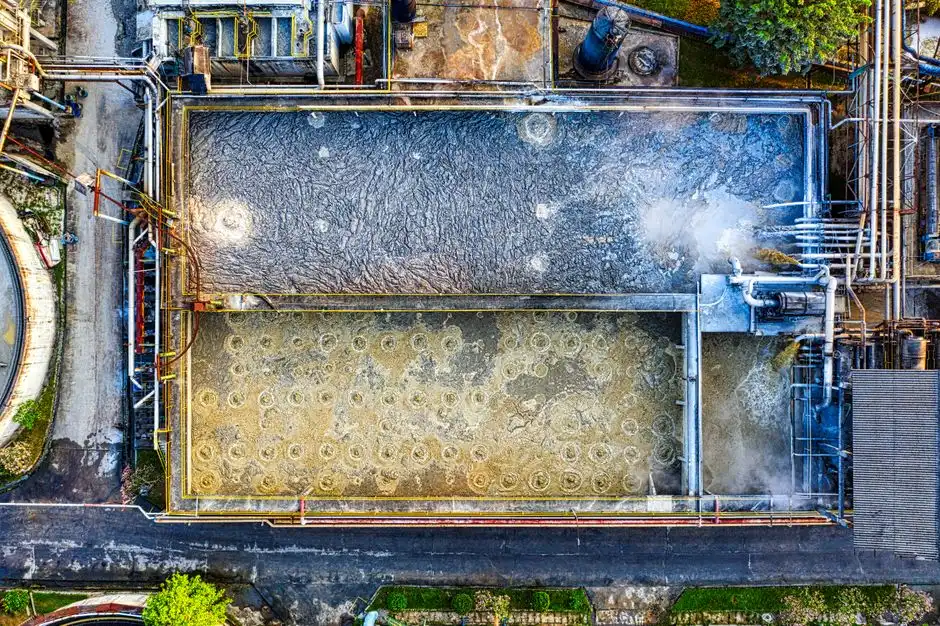
A dissolved air flotation clarifier separates oil, FOG, and suspended solids by attaching 30–50 micron micro-bubbles to contaminants and floating them to the surface for skimming. The micro-bubbles are generated by pressurizing a sidestream of clarified water to ~6 bar (87 psi) in a saturation vessel, then releasing it through a needle-valve or specialty nozzle into the flotation tank at atmospheric pressure (SIGMADAF, 2025-11). The sudden pressure drop liberates dissolved air as a cloud of fine bubbles that nucleate on floc, oil droplets, and FOG particles.
Removal efficiency exceeds 90% for FOG, TSS, BOD, and COD when the DAF is paired with coagulation/flocculation and pH adjustment (SIGMADAF, 2025-11; Ecologix Systems, 2025-10). Typical chemistry: aluminum- or iron-based coagulant at 50–200 mg/L, anionic or cationic polymer at 1–10 mg/L, and pH held at 6.5–7.5 for the floc to develop the surface charge that bubbles can attach to. Buyers should ask vendors for the air-to-solids ratio (typically 0.02–0.06 lb air per lb solids) and the recycle rate (20–50% of throughput) — those two numbers drive both removal performance and saturation-pump energy.
Flow range determines the equipment class. The Clearwater COMPACT DAF handles ≤66 GPM on a single pre-assembled skid; flows above 66 GPM require a modular two-skid layout (Clearwater Industries, 2025-08). Higher-solids streams in EV/auto plants typically need the FPAC high-load configuration, which can treat up to 40 kg DS/m² of flotation area. The HydropureWater DAF system covers 4–300 m³/h in a single skid, which is the practical envelope for most Bradenton EV/auto plants producing 5–80 m³/h of combined oily wastewater.
One persistent misconception: a DAF is "all floatation." It is not. Most DAF tanks include a bottom sediment compartment with a sludge extraction system for heavy fines that settle despite the rising bubble blanket (Clearwater Industries, 2025-08). That dual behavior is exactly why DAF is the natural fit for a stream that contains both free oil and metal fines.
How a Lamella Clarifier Works on Oily Wastewater
A lamella clarifier — also called a high-rate sedimentation tank or inclined-plate settler — uses a stack of parallel plates inclined at 55–60° to multiply the effective settling area inside a compact footprint. Wastewater flows upward between the plates; solids settle onto the plate surfaces and slide down into a sludge hopper at the bottom. Surface loading rates run 20–40 m/h, which is 5–10× higher than a conventional clarifier and is the lamella's defining engineering number (HydropureWater lamella spec, 2026).
Lamella design typically pairs the plate stack with a sludge recirculation system and, in higher-rate units, an internal floc blanket. The floc blanket acts as a coarse filter for upward-flowing water, which is why lamella can hit 80–90% TSS removal on well-conditioned streams without the bubble-generation step DAF requires. Chemical savings of up to 30% versus conventional clarification are claimed for the HydropureWater design because the dense floc blanket captures fine particles without as much polymer demand (HydropureWater lamella spec, 2026).
The hard ceiling on lamella for EV/auto streams is free oil and FOG. Gravity settling does not remove emulsified oil or FOG effectively, and an oil film on the inclined plates will blind them within days. Best-fit stream: settleable TSS at 200–2,000 mg/L, oil content below ~50 mg/L, low-foaming chemistry, and a relatively constant flow. Stamping rinse with good oil-water separation upstream, or a post-DAF polish step on a stable TSS stream, fits that envelope. Mixed coolant blowdown does not.
Sludge dry-solids content is the other engineering trade-off. Lamella sludge typically runs 2–4% DS versus DAF at 4–8% DS (HydropureWater field data, 2026). The DAF float is mechanically skimmed and partially dewatered by the skimmer action; lamella sludge is gravity-collected and wetter. That delta directly affects downstream dewatering choice and hauling cost — a point the procurement team will hear from the sludge-handling vendor within the first month of operation.
DAF vs Lamella Clarifier: 2026 Parameter Comparison for Auto Wastewater
The table below is the document a Bradenton engineering or procurement team should hand to DAF and lamella vendors when requesting quotes. Every row is anchored in scraped specifications from Clearwater, SIGMADAF, Ecologix, and HydropureWater product data (2025-08 to 2026-Q1), so the numbers are defensible in a vendor technical review.
| Parameter | DAF Clarifier | Lamella Clarifier (high-rate sedimentation) |
|---|---|---|
| Target contaminant | Free oil, FOG, emulsified oil, TSS, BOD, COD | Settleable TSS (low-FOG streams) |
| Removal efficiency | >90% FOG, TSS, BOD, COD (with coag/floc) | 80–90% TSS; <30% free oil without upstream OWS |
| Surface loading rate | 5–15 m/h hydraulic | 20–40 m/h |
| Footprint (same flow) | Reference baseline | ~3–5× smaller than DAF |
| Energy | 2–5 kWh/m³ (saturation pump + skimmer) | ~0.3 kWh/m³ |
| Chemical demand | Coagulant 50–200 mg/L + polymer 1–10 mg/L | Polymer only, up to 30% lower than DAF |
| Sludge %DS | 4–8% | 2–4% |
| Flow range (typical skid) | 4–300 m³/h; ≤66 GPM single skid (Clearwater COMPACT) | 5–200 m³/h typical per unit |
| High-solids model | FPAC up to 40 kg DS/m² | Limited; not a high-solids design |
| CapEx band (relative) | Higher baseline; modular above 66 GPM | ~40–60% of equivalent DAF flow |
| Best-fit stream | Oily + TSS mixed, FOG >200 mg/L | Settleable TSS-dominant, oil <50 mg/L |
The DAF footprint is ~3–5× larger than a lamella for the same flow because hydraulic loading is intentionally low to give bubbles time to attach. That is a real CapEx lever for a Florida plant with limited indoor space — but only if the stream is lamella-compatible, which most raw EV/auto streams are not. Lamella capex typically runs 40–60% of equivalent DAF for the same flow, yet cannot meet Manatee POTW FOG limits alone on a coolant or parts-washer stream (HydropureWater field data, 2026).
When a Bradenton Factory Should Pick DAF, Clarifier, or Both
Convert the parameter table into four if-then rules a procurement team can apply this quarter.
Rule 1 — Free oil / FOG >200 mg/L. Pick DAF only as primary. Lamella alone will fail Manatee POTW's 100 mg/L FOG limit, and an upstream oil-water separator alone will not hit the emulsified-oil fraction. Size the HydropureWater DAF system for the combined oily sub-stream flow and confirm the air-to-solids ratio in the quote.
Rule 2 — Settleable TSS-dominant, oil <50 mg/L. Pick a lamella clarifier as the cost-effective primary. Examples: post-coagulation TSS from a phosphate line where oil is already skimmed, or a parts-washer effluent that has gone through a coalescing OWS. The HydropureWater lamella clarifier at 20–40 m/h surface loading will hit TSS targets with the lowest polymer dose.
Rule 3 — Mixed oily + TSS, plant targets reuse on rinse water. Pick DAF primary + lamella polish, then MBR or UF. The DAF removes FOG and bulk TSS; the lamella catches the floc carryover that would otherwise foul the membrane; the MBR/UF polishes to reuse quality. This is the architecture most often specified for EV component plants discharging to a closed-loop rinse loop in 2026.
Rule 4 — Floor wash + parts washer combined, intermittent loads. Pick DAF with chemical conditioning ahead of the unit. Equalization is mandatory for spikes; coag + floc + pH adjustment must be controlled, not bolt-on. The HydropureWater automatic chemical dosing skid is the conditioning step that determines whether DAF hits >90% or stalls at 60–70%. Without consistent chemistry, even the best DAF tank underperforms.
For a cross-regional check on how this decision looks in a different industrial context, the fabricated metals DAF-vs-clarifier guide shows the same DAF-primary + lamella-polish pattern holds for shops without coolant blowdown. For a peer-region reference, the Columbus EV/auto DAF-vs-clarifier guide covers Ohio's different POTW envelope but lands on the same equipment conclusion. Plants near semiconductor fabs that must hit even tighter pretreatment limits will recognize the architecture in the semiconductor pretreatment compliance guide.
2026 CapEx and OPEX Reality for Florida Installations
CapEx bands shift with skid size, materials of construction (304 vs 316 stainless for chloride exposure near the coast), and instrumentation level. A small packaged DAF (≤66 GPM single skid) sits at the lower end of the DAF range; a mid-size two-skid DAF with full chemical conditioning and PLC controls lands at the upper end. Lamella capex at the same flow is typically 40–60% of the DAF number (HydropureWater field data, 2026). Vendor quotes for Florida installs in 2026 vary ±25% depending on whether the building is existing, the chemical room is included, and whether the controls scope is basic relay or full SCADA — so treat any single number as a placeholder, not a budget.
OPEX is where the real multi-year math happens. DAF uses 2–5 kWh/m³ for the saturation pump plus coagulant and polymer; lamella uses ~0.3 kWh/m³ plus a lower polymer dose. The bigger OPEX lever is sludge disposal: DAF sludge at 4–8% DS hauls roughly half the volume of lamella sludge at 2–4% DS, which compounds across every pickup for years. A plate-and-frame filter press downstream of either clarifier pushes DS to 25–35%, but starting from a thicker DAF float means smaller press capacity and lower polymer demand in the press itself.
| Cost line | DAF system | Lamella clarifier |
|---|---|---|
| CapEx (relative, same flow) | Baseline (1.0×) | ~0.4–0.6× |
| Energy | 2–5 kWh/m³ | ~0.3 kWh/m³ |
| Chemical spend | Coag + polymer, higher | Polymer only, ~30% lower |
| Sludge hauling (per m³ treated) | Lower (4–8% DS) | Higher (2–4% DS) |
| Maintenance window | Skimmer/saturation-pump wear quarterly | Plate cleaning every 6–12 months |
| Add-on conditioning | Coag + pH + polymer skid required | Polymer only in most cases |
Maintenance cadence is the other OPEX line that bites within year one. DAF skimmer chains, saturation-pump seals, and pressure-vessel relief valves are quarterly inspection items; lamella plate cleaning and sludge-hopper flushing is a 6–12 month event. Neither is a deal-breaker, but the plant maintenance planner should know which cadence they are signing up for before the PO is cut.
Frequently Asked Questions
Should a Bradenton EV/auto parts plant pick DAF or lamella as the primary clarifier in 2026?
Pick DAF if FOG exceeds ~200 mg/L or if the stream mixes free oil with metal fines; pick lamella only if the stream is settleable TSS with oil below ~50 mg/L. Most mixed EV/auto streams in Bradenton fall into the DAF-primary camp because coolant blowdown and parts-washer effluent push FOG well above the lamella ceiling. For high-FOG streams, a HydropureWater DAF system sized for the combined oily sub-stream flow is the correct primary.
What removal efficiency can a DAF realistically hit on FOG and TSS in an auto parts plant?
A DAF paired with coagulation, flocculation, and pH adjustment reliably exceeds 90% removal for FOG, TSS, BOD, and COD (SIGMADAF, 2025-11). That is the number to put in the spec — vendors quoting 70–80% are usually under-dosing polymer or running too short a flocculation contact time. Jar testing on the actual plant stream is the only way to confirm chemistry before the skid is ordered.
Can a lamella clarifier remove free oil from EV/auto wastewater?
No, not effectively. A lamella is a gravity settler; free oil and FOG float on top of the plates and blind them within days. Lamella is appropriate only after an oil-water separator or a DAF has reduced oil below ~50 mg/L. The HydropureWater lamella clarifier at 20–40 m/h surface loading works best as a polish step downstream of a DAF or as a primary on a confirmed low-oil stream.
What is the typical flow range a skid-mounted DAF handles for a Bradenton plant?
The Clearwater COMPACT DAF handles ≤66 GPM on a single pre-assembled skid, with flows above 66 GPM served by a modular two-skid system (Clearwater Industries, 2025-08). The HydropureWater DAF system covers 4–300 m³/h, which spans most Bradenton EV/auto plants producing 5–80 m³/h of combined oily wastewater. Choose single-skid when flow is steady; choose modular two-skid when future production growth is planned.