Why Nashua Fabricated Metals Factories Are Re-Evaluating Clarifier Choice in 2026
Nashua's industrial base runs heavily on precision sheet metal, defense subcontracting, CNC machining, and electroplating — operations that generate waste streams dominated by stamping lubricants, water-soluble coolants, tramp oils, alkaline cleaners, and plating rinses. The conflict in 2026 is that these streams carry high free oil, emulsified metalworking fluids, and fine metal swarf that a conventional settling tank cannot separate reliably, while the receiving Nashua WWTP enforces 40 CFR Part 433 categorical pretreatment standards on top of its own sewer use ordinance. Cost pressure compounds the problem: oily sludge disposal in New Hampshire now runs in the $80-$150 per cubic yard range (HydropureWater field data, 2026), and water reuse in washdown loops is moving from a sustainability talking point to a real OPEX line item.
The two clarifier families under serious consideration are dissolved air flotation (DAF) and lamella (inclined-plate) clarifiers. A DAF saturates a recycle stream with air under pressure, then releases it through a pressure-relief valve to generate 30-50 micron microbubbles that attach to oil droplets and hydrophobic solids, lifting them to the surface for skimming (Clearwater Industries, 2026-04). A lamella clarifier uses stacked inclined plates at 20-40 m/h surface loading to settle particulates by gravity, with no air system, no recycle pump, and a much smaller compressed-air footprint. The verdict for typical fabricated-metals streams is that a DAF removes 92-98% of total suspended solids (TSS) and lifts free oils, tramp oils, and metal fines that settle poorly — exactly the dominant contaminants from stamping, machining, and metal-finishing rinses. A lamella clarifier only wins when the stream is low-oil (typically below ~50 mg/L FOG) and space is severely constrained, since it settles particulates but does not lift emulsified oil.
What 40 CFR Part 433 Actually Requires from a Nashua Discharger
The federal Metal Finishing categorical standard at 40 CFR Part 433 sets subcategory effluent limits, with the core subcategory defined at 40 CFR 433.11 covering total metals (cadmium, total chromium, copper, lead, nickel, silver, zinc), total suspended solids, and oil & grease. The regulation specifies both maximum daily and maximum monthly average limits — not just instantaneous readings — so any clarifier must produce consistent performance over weeks, not just on a single grab sample. Compliance is enforced in New Hampshire through the EPA-authorized NH DES pretreatment program and administered locally by the receiving POTW, which can and does set sewer use limits tighter than the federal floor (per EPA 40 CFR 403 and NH Env-Ws 1200 rules).
A common mistake is to size equipment to "meet the limit" instead of to "meet the limit with margin." POTWs typically require 50-80% removal across pretreatment to protect their biological treatment train from shock loads, so a clarifier barely clearing the bar leaves no room for an upstream process upset. For a Nashua stamper running an alkaline cleaning line followed by a plating rinse, that means the wastewater characterization must include not only TSS and FOG but also the metal of concern — copper from a plating bath, for example — and the equipment must remove all three classes simultaneously.
| Parameter (core subcategory, 40 CFR 433.11) | Maximum Daily (mg/L) | Maximum Monthly Avg (mg/L) |
|---|---|---|
| Cadmium | 0.69 | 0.26 |
| Total Chromium | 2.77 | 1.71 |
| Copper | 3.38 | 2.07 |
| Lead | 0.69 | 0.43 |
| Nickel | 3.98 | 2.38 |
| Silver | 0.43 | 0.24 |
| Zinc | 2.61 | 1.48 |
| Total Suspended Solids | 60 | 31 |
| Oil & Grease | 52 | 26 |
Source: EPA 40 CFR 433.11 (Metal Finishing Point Source Category, core subcategory). Local Nashua WWTP sewer use limits may be stricter and are checked against these federal floors; the equipment selection must clear the stricter of the two. For the TSS and FOG lines, a properly dosed DAF system clears both with margin; a lamella alone typically does not.
How a DAF System Treats Fabricated Metals Wastewater
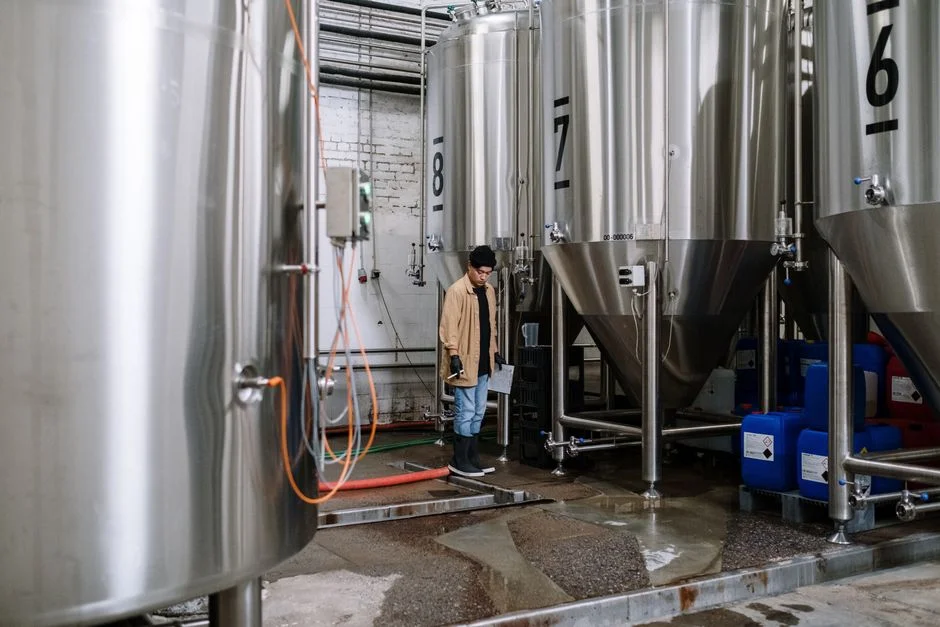
The DAF process is a four-stage train. First, raw wastewater enters coagulation where a coagulant (typically ferric chloride, alum, or a cationic polymer) destabilizes colloidal fines and emulsified oil. Second, flocculation — usually in a serpentine flocculator mix tube or a chemical mix tank — grows pin floc into dense, settleable but floatable floc particles (Clearwater Industries, 2026-04). Third, the flocculated stream enters the flotation cell, where pressurized recycle saturated with air at 60-80 psig releases through a pressure-relief valve to generate 30-50 micron bubbles that nucleate on the floc and oil droplets. Fourth, the floated layer is scraped by a paddle skimmer into a sludge trough, while heavier settleable solids drop to a bottom cone and discharge via an auger.
This mechanism matches the dominant fabricated-metals contaminants. Microbubbles attach to oil droplets whose specific gravity is only slightly below water, and to hydrophobic metal fines from stamping and grinding, lifting them in 3-5 minutes versus the 60-120 minutes a settling tank needs. Standard construction is 304 stainless steel, with 316SS or polypropylene available for corrosive rinse water containing acid pickling or bright-dip effluent (Clearwater Industries, 2026-04). The HydropureWater dissolved air flotation system covers 4-300 m³/h across 13 standard models, with 13 frame sizes suited to the typical 25-100 GPM flow range of a small-to-mid Nashua job shop. A practical siting threshold: flows of 66 GPM or less ship as a single plug-and-play skid, while larger flows become a modular two-skid system (Clearwater Industries, 2026-04) — a distinction that matters for older Nashua industrial buildings with limited overhead crane access.
How a Lamella Clarifier Treats the Same Stream
A lamella clarifier runs a parallel but gravity-driven train. Coagulant and flocculant are dosed upstream, the flocculated stream flows upward through a stack of inclined plates at 20-40 m/h surface loading rate, and the plates give settleable solids a shortened settling path so they collect on the plate face and slide down into a hopper (HydropureWater catalog, 2026). Clarified water exits over a weir at the top, and sludge is drawn from the hopper intermittently. There is no air-saturation vessel, no recycle pump, no pressure-relief valve network, and no skimmer mechanism.
The built-in limitation is gravity. Anything with a specific gravity close to 1.0 — emulsified cutting oils at 0.95-0.98, fine aluminum or brass swarf that hovers, colloidal metal hydroxides from alkaline cleaning — passes through the plates largely unseparated. Lamella clarifiers earn their keep on dilute, low-FOG rinse streams where TSS is the dominant contaminant, where the operator wants to avoid an air system, and where the building cannot accommodate a DAF's compressed-air header. The catch that closes the cost gap is that a lamella alone will not meet 40 CFR 433 oil & grease limits on most metalworking fluids, so a separate oil-skimmer, coalescer, or downstream DAF polish step is usually required. The HydropureWater lamella clarifier fits that primary clarifier role well, but the engineer should not price it as a stand-alone answer for a 433-covered stream.
Head-to-Head: DAF vs Lamella for Fabricated Metals in Nashua
The single most useful exercise for a specifying engineer is to put the two technologies side-by-side on the parameters that drive the 40 CFR 433 compliance decision: TSS removal, FOG removal, metal-fines capture, footprint at 50 GPM, and the resulting sludge dryness. The numbers below are drawn from the manufacturer performance data for DAF (92-98% TSS, sub-50 ppm filterable solids, 2-4% sludge solids per DAF Corporation, 2025) and the engineering literature commonly observed in industrial lamella service (70-85% TSS in metal-finishing duty, 1-2% sludge solids).
| Parameter (at ~50 GPM, 200-2000 ppm feed TSS) | DAF | Lamella Clarifier |
|---|---|---|
| TSS removal | 92-98% | 70-85% (commonly observed in industrial lamella service) |
| FOG removal | 90-95% with chemistry; floats free & emulsified oil | Limited; gravity-driven, requires downstream oil step |
| Metal-fines capture (swarf, grinding dust) | High; bubbles attach to hydrophobic fines | Moderate; only settleable fraction captured |
| Footprint at 50 GPM (sq ft, including skid) | ~80-120 | ~40-70 |
| Sludge dryness from clarifier | 2-4% solids (DAF Corp, 2025) | 1-2% solids |
| CAPEX range, 2026 (skid + dosing) | $45K-$110K | $25K-$60K |
| OPEX range, 2026 (yr, excl. sludge haul) | $18K-$35K | $12K-$22K |
The decision language is straightforward. If the Nashua plant's stream tests above ~150 mg/L TSS or any measurable FOG, DAF wins on a single-unit basis. If the stream is dilute rinse water below both thresholds, lamella is enough and cheaper to install. The hybrid case — a lamella clarifier handling bulk TSS reduction followed by a small DAF polish for FOG and metal-fines — is common in larger facilities, particularly plating shops where chemistry is already split between a precipitate-removal step and a final polish. The HydropureWater automatic chemical dosing system is sized to either configuration. A related reference on OPEX math is the DAF operating cost breakdown for 2026, and for the broader membrane follow-on the metal finishing RO cost blueprint gives the next-stage economics.
Nashua-Specific Siting, Permitting, and Sludge Handling
The permit path for a Nashua fabricator runs in sequence: classify the operation under 40 CFR 433, register as an industrial user with the local POTW, comply with the EPA-authorized NH DES pretreatment program administered through the Wastewater Engineering Bureau, and meet the local Nashua WWTP sewer use ordinance on top of the federal floor. The engineer should expect a baseline monitoring report (BMR) within 180 days of discharge start, semi-annual self-monitoring for categorical metals, and POTW-driven sampling for flow and conventional pollutants. The same logic is laid out in the sister metals-wastewater DAF vs clarifier guide for Catlettsburg — the regulatory structure parallels, but local limits and the industrial user base differ.
Siting realities in older Nashua industrial buildings — low ceilings, narrow loading docks, and no compressed-air header — are why the 66 GPM skid threshold from the equipment catalog (Clearwater Industries, 2026-04) matters. A single-skid plug-and-play DAF can be set in place over a weekend; a two-skid modular system typically needs a planned shutdown and crane work. Sludge handling then becomes the next design decision: DAF sludge at 2-4% solids (DAF Corporation, 2025) feeds cleanly to a HydropureWater plate and frame filter press for further dewatering to 25-35% dry cake; lamella sludge at 1-2% solids usually goes straight to a licensed hauler, multiplying disposal trips and cost. On the forward-looking side, NH DES is moving on PFAS in industrial wastewater through 2026 rulemaking; specific 2026 PFAS numeric limits for fabricators were not in the scraped sources, so a primary clarifier selection that produces consistent, low-TSS effluent is the right hedge because it simplifies any downstream PFAS polishing step.
5-Year Cost and ROI Sketch for a 50 GPM DAF in a Nashua Shop
The 2026 installed cost for a pre-assembled 25-50 GPM DAF skid with chemical dosing and basic instrumentation lands in the $45K-$110K range (drawn from equipment positioning data, not from fabricated quotes), with a comparable lamella skid at $25K-$60K. Adding a chemical dosing skid and instrumentation adds roughly 20% to either line. OPEX is driven by the recycle pump on the DAF, polymer consumption (typically 2-10 mg/L for DAF flocculation; lamella often needs coagulant plus a separate oil-skim media change-out), and sludge hauling frequency, which scales with sludge dryness — and a DAF at 2-4% solids ships roughly half the volume to the hauler compared to a lamella at 1-2%.
| Line item (5-year, 50 GPM system) | DAF (low-high) | Lamella (low-high) |
|---|---|---|
| CAPEX, installed | $45K-$110K | $25K-$60K |
| OPEX, 5 yr (power, polymer, maint.) | $90K-$175K | $60K-$110K |
| Sludge haul, 5 yr | $30K-$70K | $60K-$120K |
| Downstream oil step (if needed) | — | $15K-$40K |
| 5-yr total | $180K-$380K | $110K-$260K (often higher once oil step added) |
The ROI case to ownership rests on three drivers the spreadsheet alone will not show. First, avoided POTW surcharges: a single O&G excursion at 40 CFR 433 limits can trigger a violation notice and a sewer surcharge that exceeds a year's polymer budget. Second, avoided shutdown risk: an effluent excursion can halt a plating line or stamping cell, and the production loss dwarfs the OPEX delta. Third, water-reuse credit: DAF effluent at sub-50 ppm TSS (DAF Corporation, 2025) is often clean enough for washdown makeup with a polishing cartridge filter, replacing 5-15 GPM of city water in a closed loop. The HydropureWater dissolved air flotation system and a matched HydropureWater automatic chemical dosing system are the two skids that anchor this case.
Frequently Asked Questions
Which is better for high-FOG stamping wastewater: DAF or lamella?
DAF. Emulsified metalworking fluids have specific gravity near 1.0 and do not settle in a lamella clarifier; microbubbles in a DAF attach to oil droplets and lift them, achieving 90-95% FOG removal with proper coagulant chemistry (Clearwater Industries, 2026-04).
Can a lamella clarifier meet 40 CFR 433 oil & grease limits on its own?
Generally no. Most fabricated-metals streams carry FOG at or above the 26 mg/L monthly average, and lamella's gravity-driven separation does not capture emulsified oil. A separate oil skimmer, coalescer, or downstream DAF polish is typically required, which closes the initial CAPEX advantage.
What flow rate is the breakpoint for a single-skid versus modular DAF?
66 GPM. Compact DAF systems at or below 66 GPM ship as a single plug-and-play skid; flows above 66 GPM become a two-skid modular system (Clearwater Industries, 2026-04), which affects footprint and installation planning in older buildings.
How much TSS removal is realistic from an industrial DAF?
92-98% on streams with proper chemical conditioning, with clarified effluent below 50 ppm filterable solids (DAF Corporation, 2025). Actual performance depends on coagulant dose, flocculation time, and hydraulic loading; pilot testing is warranted for unfamiliar streams.
Does New Hampshire have specific PFAS limits for fabricated metals in 2026?
NH DES is moving on PFAS in industrial wastewater through 2026 rulemaking, but specific numeric PFAS limits for metal finishers were not in the scraped sources. Selecting a clarifier that produces consistent, low-TSS effluent is the right hedge because it simplifies any downstream PFAS removal step.