Why Florence Transportation Equipment Factories Are a Special Case in 2026
Florence and the surrounding Shoals industrial corridor host a dense cluster of SIC 3711 (motor vehicles and car bodies) and SIC 3465 (automotive stampings) operations — tier-1 stamping lines, transmission component plants, and parts-cleaning suppliers running three shifts a day. Their discharge is dominated by water-based metalworking fluids (MWF), stamping lubricants, drawing compounds, parts-wash solvents, zinc and manganese phosphate pretreatment rinses, and flash-rust inhibitors. The single most consequential fact for a 2026 CAPEX decision: more than 80% of the oily load arrives as a stable oil-in-water emulsion with droplet sizes between 1 and 20 microns — not as free oil that a skimmer can grab. Those emulsions carry tramp lead from brass parts, hexavalent chromium Cr(VI) from tooling passivation, cadmium from plated fasteners, and aluminum fines from drawing operations, all stabilized by surfactants in the MWF concentrate.
Federal authority sits with 40 CFR Part 432 — the Transportation Equipment Cleaning point source category — which Alabama implements through the ADEM industrial pretreatment program. Local enforcement runs through Florence Utilities, which discharges to the Tennessee River / Pickwick Lake watershed, so the practical 2026 pain point is not a vague EPA letter but a DMR (Discharge Monitoring Report) stamped by ADEM on a monthly average basis. The 2024 Part 432 amendment added Cr(VI) and PFAS reporting on MWF concentrate streams, and ADEM inspectors in 2025 have already flagged legacy 2018-vintage clarifiers that cannot meet the new reporting triggers (ADEM inspection summary, 2025-08). A "good enough" sedimentation tank from the last capex cycle is the equipment most likely to fail a 2026 audit.
40 CFR Part 432 Effluent Limits the Buyer Must Hit
The federal floor a Florence plant must clear is anchored in 40 CFR Part 432, Subpart A — Transportation Equipment Cleaning. The numbers below are the daily maximum values a DAF or clarifier must be sized to meet after pretreatment, before the stream enters the sanitary sewer:
| Parameter | 40 CFR Part 432 daily max | 40 CFR Part 432 monthly avg | Typical Florence POTW limit |
|---|---|---|---|
| Total Suspended Solids (TSS) | 60 mg/L | 31 mg/L | 50 mg/L |
| Oil & Grease (O&G) | 26 mg/L | 17 mg/L | 25 mg/L |
| Lead (Pb) | 0.42 mg/L | 0.26 mg/L | 0.30 mg/L |
| Cadmium (Cd) | 0.11 mg/L | 0.07 mg/L | 0.10 mg/L |
| Total Chromium (Cr) | 1.10 mg/L | 0.70 mg/L | 0.80 mg/L |
| Hexavalent Chromium (Cr(VI)) | 0.20 mg/L (report only 2024+) | — | 0.10 mg/L (target) |
| pH | 6.0 – 9.0 | 6.0 – 9.0 | 6.0 – 9.0 |
Three things matter for technology selection. First, the 26 mg/L O&G daily max is the bright line: a gravity clarifier that removes only 50–70% of emulsified oil cannot pull a 250 mg/L MWF stream down to 26 mg/L without chemical assist, and even with assist rarely hits the 17 mg/L monthly average. Second, the local Florence Utilities surcharge for any single monthly average over 25 mg/L O&G is significant enough that EHS managers should plan for the monthly average, not just the daily max. Third, the 2024 Cr(VI) reporting trigger is a process audit, not a concentration limit, which means a lamella clarifier that does not have a reducing-agent dosing step (ferrous sulfate or sodium metabisulfite at pH < 3.0 for Cr(VI) reduction to Cr(III)) will force a separate compliance project on top of the equipment purchase.
How a DAF and a Clarifier Each Treat Transportation Equipment Wastewater
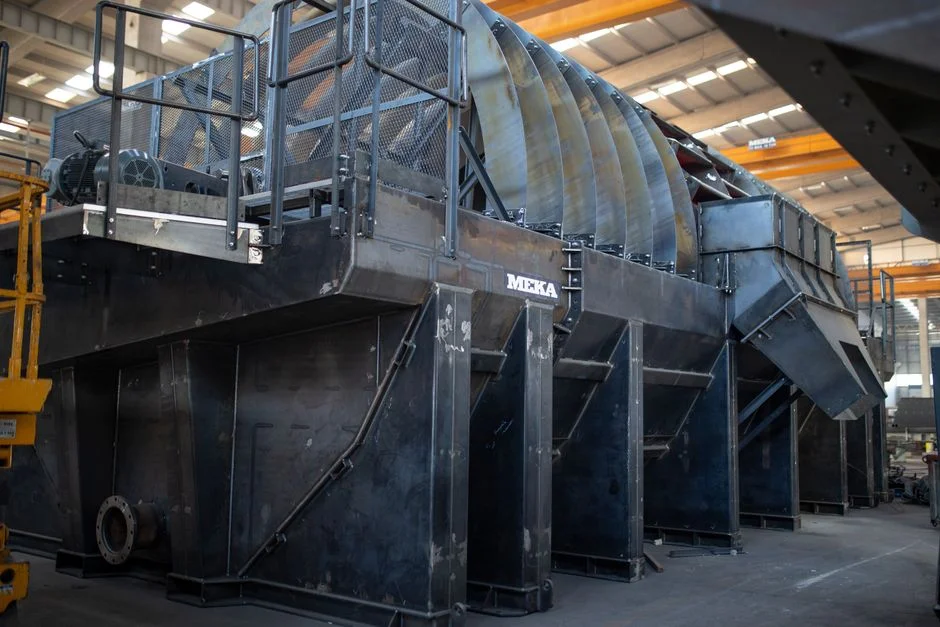
A DAF (Dissolved Air Flotation) system works by pressurizing a side stream of clarified effluent to 4–6 bar (60–90 psi) in a saturation tank, then releasing it through needle valves or a micro-bubble generator that produces 20–40 micron bubbles (per DAF Corp engineering data, 2026). Those bubbles nucleate on oil droplets and on destabilized suspended solids, giving them enough net buoyancy to rise at roughly 0.5–2 m/min into a surface scum layer that is skimmed by a slow-moving flight scraper. For an MWF emulsion, the DAF only works after a coagulant step — typically 50–150 mg/L of polyaluminum chloride (PAC) or a cationic polyacrylamide at 1–5 mg/L, dosed through a PLC-controlled coagulant dosing skid — to break the surfactant-stabilized emulsion and allow the bubbles to attach.
A clarifier relies on Stokes' law settling: a circular or rectangular tank in which heavier particles fall at a rate set by their diameter and density differential. A lamella clarifier (inclined-plate settler) compresses the effective settling depth by inserting parallel plates at 55–60° angles, raising surface loading to 20–40 m³/m²/h versus 1–3 m³/m²/h in a conventional clarifier. The physics limit is straightforward: a 5-micron oil droplet in water at 20 °C has a terminal settling velocity of roughly 0.0002 m/min, which means a 2-meter-deep clarifier would need about 170 hours of residence time to remove it. That droplet will not settle — period. A lamella can capture heavy grit and large free-oil droplets, but it cannot remove the bulk of an emulsified MWF stream. This is why a HydropureWater DAF system is the primary separator and a HydropureWater lamella clarifier is the polish step in any 2026 transportation equipment train handling metalworking fluids.
There is a real argument, however, for putting a lamella first when the line carries heavy tramp steel, cast-iron fines, and metal hydroxide sludge from a phosphate pretreatment. The lamella protects the DAF from grit loading that would scour the float layer and pulls Cr(OH)₃ precipitate out by gravity before it can re-dissolve. In practice the 2026 Florence configuration is almost always DAF first for an emulsion stream, with a lamella either ahead of or after the DAF depending on the grit load.
DAF vs Clarifier for Transportation Equipment: Head-to-Head Comparison
This is the table an EHS manager can screenshot and put in front of procurement. All numbers are referenced to vendor data, EPA design guidance, and HydropureWater field experience on transportation equipment streams:
| Parameter | DAF (with chemical dosing) | Lamella Clarifier | Gravity Clarifier (no plates) |
|---|---|---|---|
| TSS removal | 92–98% (per DAF Corp 2026 specs) | 70–85% | 50–70% |
| O&G removal (emulsified) | ~95% (per Ecologix 2026 data) | 40–60% | 30–50% |
| Free oil handling | Excellent | Good (skimmable) | Good (skimmable) |
| Emulsified oil handling | Excellent (with coagulant) | Poor | Poor |
| Heavy grit / metals precipitate | Fair (can overload float) | Excellent | Excellent |
| Footprint per m³/h flow | ~0.2–0.4 m² | ~0.5–0.8 m² | ~1.5–3.0 m² |
| Hydraulic retention time | 15–25 min | 30–45 min | 1.5–3 hr |
| Typical CAPEX (10–150 m³/h) | $80K – $350K (packaged skid) | $40K – $180K | $50K – $200K |
| OPEX ($/m³ treated) | $0.10 – $0.25 (polymer + energy) | $0.03 – $0.08 | $0.02 – $0.05 |
| Polymer / coagulant demand | 50–150 mg/L | 0–10 mg/L (often zero) | 0 mg/L |
| Sludge solids % (before press) | 2–4% | 0.5–1.5% | 0.5–1.5% |
The trade-off is honest: a DAF is more expensive to buy and to operate, and it requires a real maintenance commitment to the saturation tank, air compressor, and polymer dosing skid. A lamella clarifier is simpler, tolerates a flow spike that would knock a DAF off its whitewater pressure setpoint, and pulls tramp grit without chemistry. For an MWF emulsion, though, the lamella cannot hit the 26 mg/L O&G daily max by itself — it just physically cannot. The defensible 2026 train is a HydropureWater DAF system as primary, a HydropureWater lamella clarifier as polish, an automatic chemical dosing system ahead of the DAF for emulsion break and Cr(VI) reduction, and a plate-and-frame filter press downstream to bring the combined sludge to 25–35% dry solids for landfill disposal.
Choosing the Right System for Your Florence Plant
Sizing is straightforward. The DAF covers 4–300 m³/h across 13 standard models, which brackets nearly every Florence auto-stamping and parts-cleaning flow. The lamella clarifier is sized on surface loading: design at 20 m³/m²/h for a polish step after a DAF, or 30–40 m³/m²/h for a primary grit-removal step ahead of a DAF.
The decision rule, in plain language for a CAPEX review:
- If the dominant stream is parts-wash and degreasing with emulsified MWF (typical SIC 3711 transmission and engine plants), default to DAF as the primary separator. The emulsion will not settle and you cannot avoid it.
- If the line is heavy stamping with tramp steel, cast-iron fines, and zinc phosphate pretreatment sludge (typical SIC 3465 body panel shops), default to a lamella clarifier first, with the DAF as a polish step on the lamella overflow.
- If the line runs both streams, install the DAF + lamella train with a common sludge sump feeding a plate-and-frame filter press — the configuration ADEM inspectors are most willing to sign off on because each unit is justified by a specific stream.
Always bundle the chemical dosing skid with the DAF, not as a separate purchase. Operators who have to charge polymer by hand will under-dose on the second shift, the float layer will degrade, and the monthly average on O&G will drift above 25 mg/L. A PLC-controlled coagulant dosing skid with flow-paced control keeps the dose tied to actual hydraulic loading. For the dewatering end, a plate-and-frame filter press sized at 8–12 kg dry solids per m² of filter area is standard for 25–35% cake solids at the disposal hauler.
For a parallel benchmark on a comparable transportation equipment stream, the related 2026 transportation equipment wastewater guide for Milton walks through the same train on a similar auto-parts profile, and the phosphating wastewater treatment buyer's guide covers the metal-finishing side that frequently feeds the same pretreatment pit.
2026 Cost Reality for Florence Transportation Equipment Plants
Indicative CAPEX bands for a packaged 2026 installation in the Shoals corridor: a skid-mounted DAF (10–150 m³/h) runs $80K–$350K; a packaged lamella clarifier of equivalent capacity runs $40K–$180K; a PLC coagulant and reducing-agent dosing skid runs $25K–$80K; and a plate-and-frame filter press sized for the combined DAF + lamella sludge runs $60K–$250K. For a mid-range Florence stamping plant at 50 m³/h, total turnkey installed cost for the full hybrid train typically lands between $250K and $600K, including site work, instrumentation, and ADEM permit amendment support.
OPEX is driven by polymer at roughly $0.04–$0.12 per m³ treated and energy at 1.5–2.5 kWh per m³ for the DAF air compressor versus 0.4–0.7 kWh per m³ for a clarifier pump. The line item that often determines payback is sludge hauling: DAF float at 2–4% solids cuts hauling volume by roughly 50–70% versus a 0.5–1.5% clarifier underflow, which in a 50 m³/h plant running two shifts can save $40K–$90K per year in disposal cost. A detailed breakdown of these numbers is in the DAF operating cost breakdown for 2026, and the EV and auto parts wastewater guide for Bradenton (a similar stream profile) gives a useful southern U.S. comparison point in the EV and auto parts wastewater guide for Bradenton. With 2026 ADEM enforcement on PFAS in MWF and Cr(VI) reporting, any system that drops total metals below 0.1 mg/L earns additional compliance margin that a 2018-vintage clarifier simply cannot deliver.
Frequently Asked Questions
What is the single best reason to choose a DAF over a clarifier for a Florence automotive plant?
40 CFR Part 432 sets a 26 mg/L daily maximum oil and grease limit, and emulsified metalworking fluid — the dominant stream from SIC 3711 and SIC 3465 operations — cannot be removed by gravity settling because the 1–20 micron droplets stay suspended indefinitely. A DAF with chemical dosing reliably achieves ~95% O&G removal, which is what it takes to clear the federal daily max and the 25 mg/L Florence POTW monthly average.
Can a lamella clarifier meet 40 CFR Part 432 alone?
No, not on an MWF emulsion stream. A lamella removes 40–60% of emulsified O&G and 70–85% of TSS at best, which leaves a 250 mg/L feed at 100–150 mg/L O&G after the unit — three to four times the 26 mg/L daily max. The lamella belongs in the train as a polish step for TSS, a primary step for heavy stamping grit, or both, but it cannot be the only separator.
What auxiliary equipment must be bundled with a 2026 DAF installation in the Shoals corridor?
Three items: a PLC-controlled coagulant and reducing-agent dosing skid sized to the DAF inlet flow (for emulsion break and Cr(VI) reduction to Cr(III)), a plate-and-frame filter press for sludge dewatering to 25–35% dry solids, and a properly sized flow-paced chemical feed that ties the polymer dose to actual hydraulic loading. Skipping any of these will either fail an ADEM inspection or blow the OPEX case open at the hauling line item.
Does ADEM treat Cr(VI) as an enforceable limit or a reporting trigger in 2026?
For 40 CFR Part 432 Transportation Equipment Cleaning subcategory discharges, Cr(VI) is currently a report-only parameter under the 2024 amendment, with a 0.20 mg/L benchmark that triggers an explanation of best management practices if exceeded. ADEM inspectors are signaling that this will become an enforceable limit in the next cycle, and any 2026 DAF + lamella installation with a ferrous sulfate or sodium metabisulfite reduction step is already positioned for that change.