
Why Marshall Semiconductor Plants Need a Different Clarifier in 2026
Marshall, Texas sits inside the Longview–Marshall semiconductor corridor, where new fab capacity commissioned in 2025–2026 is pushing daily fab wastewater flows into the 5,000–15,000 m³/d range per facility, well above the volumes a generic industrial wastewater design basis assumes. The mix coming off those tools is not "industrial wastewater" in the textbook sense: colloidal silica and alumina from chemical-mechanical polishing (CMP), tetramethylammonium hydroxide (TMAH) from photoresist developers, hydrofluoric acid and buffered oxide etch (BOE) spent etchant, copper and nickel from plating rinses, and suspended photoresist and isopropyl alcohol (IPA) carryover. Each of those streams behaves differently in a gravity vessel than in a flotation vessel. Colloidal silica from CMP typically lands in the 10–80 nm range with a negative surface charge, and photoresist fragments run <20 μm; both stay in suspension long enough that gravity settling leaves them in the overflow. Fluoride and metals, by contrast, are removed chemically — CaF₂ precipitation at pH 8–9 with CaCl₂ and metal hydroxide floc — and the dense floc that results is the actual particle population the primary clarifier must capture.
That distinction is what makes the DAF-versus-lamella decision consequential in Marshall. A primary unit that lets CMP colloids and photoresist pass through pushes solids loading onto reverse osmosis (RO) and ion-exchange polishers, where silica scale, organic fouling, and short filter runtimes are the predictable downstream consequence. The same unit also has to keep the effluent inside 40 CFR Part 467 daily-maximum values (Semiconductor subcategory) before it reaches the Marshall POTW. Picking the wrong primary clarification step is therefore not a localized cost mistake — it is a downstream compliance and membrane-life problem set in motion at the head of the plant.
40 CFR Part 467 Limits That Drive the DAF-vs-Clarifier Decision
Semiconductor fab discharge into a publicly owned treatment works (POTW) is regulated at the federal level by 40 CFR Part 467, Semiconductor Subcategory, with daily-maximum values that set the design basis for any primary clarifier. The relevant federal numbers are: copper 0.118 mg/L, lead 0.054 mg/L, nickel 0.534 mg/L, fluoride 1.0 mg/L, and total suspended solids (TSS) 33 mg/L (40 CFR Part 467, Semiconductor Subcategory, daily-maximum values, as referenced in federal pretreatment guidance). The Marshall POTW's industrial pretreatment program can — and routinely does — set local limits tighter than the federal table, especially for fluoride and copper, so the design basis has to be confirmed with the local authority before any equipment is sized.
The second point is mechanism, not just number. Metals and fluoride are not removed by the clarifier directly; they are removed by chemical precipitation upstream, and the clarifier is asked to capture the resulting floc. CaF₂ precipitation requires stoichiometric CaCl₂ dosing at pH 8–9; copper and nickel precipitate as hydroxides at pH 9–10. The metal-hydroxide and CaF₂ floc that emerges is the actual particle the primary unit must separate. A poorly selected clarifier lets that floc bleed into the RO feed, where it fouls membranes and forces the plant to over-dose polymer downstream to compensate. The same applies to total suspended solids at the 33 mg/L daily maximum — that number is the ceiling the primary unit must hit, and it is the metric the design review will be measured against.
| Parameter | 40 CFR 467 Daily Max (mg/L) | Notes for Marshall sizing |
|---|---|---|
| Copper (Cu) | 0.118 | Precipitate as Cu(OH)₂ at pH 9–10; floc is the separator's job |
| Lead (Pb) | 0.054 | Co-precipitates with iron-based coagulant; tight local limit possible |
| Nickel (Ni) | 0.534 | Precipitates at pH 9.5–10; confirm with Marshall POTW |
| Fluoride (F⁻) | 1.0 | CaCl₂ dosing at pH 8–9; verify local limit before sizing |
| TSS | 33 | Primary clarifier effluent must hit this daily |
How DAF and Lamella Clarifiers Actually Separate Solids
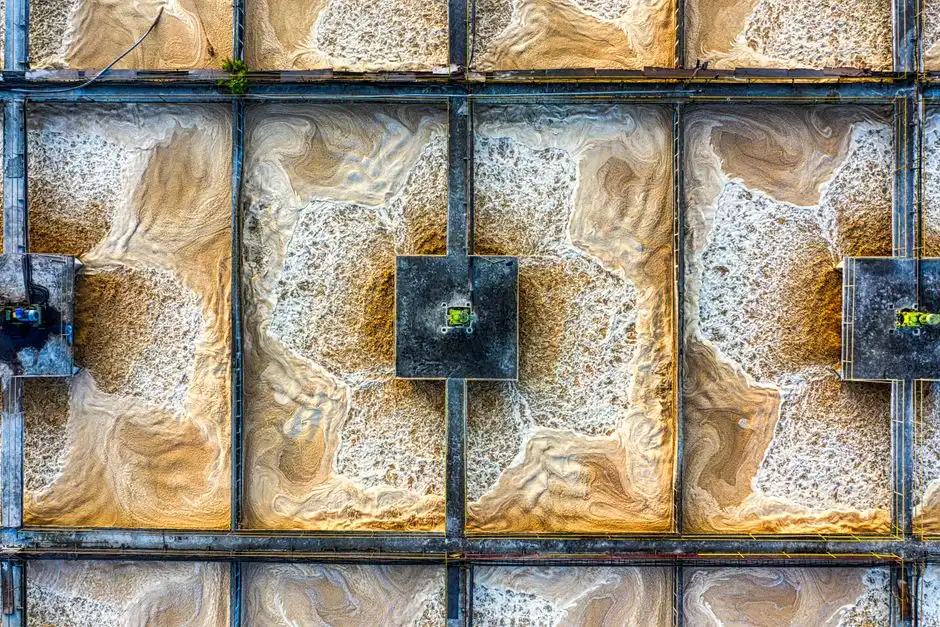
A dissolved air flotation system saturates a recycle stream with air at 4–6 bar, then releases the pressure through needle-valve or nozzle headers, generating micro-bubbles in the 10–100 μm range. Those bubbles attach to floc particles in the contact zone, reducing the bulk density of the agglomerate below that of water so the particle rises to the surface for skimming (IDE Tech 2026 process description). Capture of sub-50 μm colloids — the CMP silica and photoresist fraction — is the specific mechanism that makes DAF the right tool for fab wastewater: gravity simply cannot resolve particles in that size band in a reasonable retention time.
A high-efficiency lamella clarifier is an inclined-plate gravity settler. Wastewater flows between plates at 20–40 m/h surface loading, and particles that exceed the plate spacing's settling velocity drop onto the plate face and slide into a sludge hopper (HydropureWater 2026 product specification). It is mechanically simple and footprint-efficient, but it depends on the floc being large, dense, and fast-settling — the opposite of the colloidal fraction that dominates fab streams.
Hydraulic design matters as much as chemistry. The 2021 Sigma/ITAINNOVA CFD study on a DAF FPHF 750 unit found that the design inlet velocity of 90 cm/s produced a near-horizontal impingement on the inclined inlet plate, with rising particles partly carried back down by recirculation along the lamellae. At the customer-operated inlet velocity of 50–60 cm/s, a short-circuit flow path formed between the inlet and outlet windows, transporting floc directly toward the bottom of the tank and degrading performance. The lesson for a Marshall retrofit is that DAF performance is sensitive to feed-pipe geometry, elbow configuration, and inlet baffling — not just to air-to-solids ratio. A monocrystalline silicon ZLD 2026 design built around the same chemistry faces the same hydraulic-sensitivity issue.
Head-to-Head Comparison: DAF vs Lamella Clarifier for Fab Effluent
For a procurement conversation, the comparison matrix below is the one to put on the screen. The numbers are drawn from IDE Tech's 2026 process descriptions, HydropureWater's 2026 product range, and the Sigma/ITAINNOVA CFD findings, and they apply to a 50 m³/h feed upstream of RO/ion-exchange polishing. The DAF column reflects the dissolved air flotation system; the lamella column reflects the high-efficiency lamella clarifier.
| Criterion | DAF (50 m³/h) | Lamella Clarifier (50 m³/h) |
|---|---|---|
| TSS removal (fab effluent) | 80–95% | 50–70% |
| FOG / trace oil removal | High (designed for) | Low–moderate (skimming only) |
| Colloidal silica <20 μm capture | Effective (bubble attachment) | Poor (slow-settling) |
| Footprint | 0.5–1.0 m² per m³/h | 0.2–0.4 m² per m³/h |
| Hydraulic sensitivity | High — inlet design critical (CFD 2021) | Moderate — depends on floc density |
| CAPEX (relative) | 1.6–1.9× | Baseline |
| OPEX (relative) | Lower (less polymer, less sludge) | Higher (sludge recirculation, more polymer) |
| Chemical demand | Polymer + coagulant | Coagulant with sludge recirculation (up to 30% higher spend) |
Two engineering observations are worth flagging. First, the 30% chemical-spend advantage for DAF over lamella in fab service is driven by the way each unit handles sludge: a lamella clarifier recirculates sludge to maintain a floc blanket, which consumes coagulant continuously, while a DAF pushes float to a separate skimmer and uses polymer more efficiently (HydropureWater 2026 lamella spec). Second, the CFD-derived hydraulic-sensitivity finding applies to DAF, not lamella — which is why a 2026 retrofit that drops a DAF into an existing equalization tank with a tight 90° elbow can underperform even when air-to-solids ratio is correct.
Cost Reality Check: 2026 CAPEX and OPEX Ranges for Marshall Fabs
Translating specs into 2026 dollars for a Marshall 50 m³/h primary treatment skid: a dissolved air flotation system in the 50 m³/h configuration carries an indicative CAPEX of roughly 1.6–1.9× a similarly rated high-efficiency lamella clarifier at the same flow, but OPEX runs 25–40% lower once polymer dose, sludge yield, and hauling are totaled (HydropureWater 2026 product range). The lamella's lower CAPEX is offset by higher polymer consumption, larger sludge mass to dewater, and additional downstream polymer dosing to compensate for the colloidal fraction that escapes. Sludge dewatering downstream — typically a plate-and-frame filter press — is where the OPEX gap widens, because the lamella produces 1.3–1.5× the wet-cake mass that a DAF does at the same TSS loading.
Site-cost considerations in Marshall add 20–35% to installed cost regardless of which unit is selected. Civil works, chemical-room tie-ins, and connection to a ZLD evaporation pond tie-in all need budget lines that are easy to overlook at the equipment-quote stage. Energy is a smaller line item: a lamella uses no saturator or recycle pump, while a DAF needs 2–4 kWh per m³ for the saturator and skimmer (HydropureWater DAF spec range). On a 50 m³/h basis that is 2,400–4,800 kWh/d, or roughly $200–$400/d at Texas industrial rates — meaningful but not decisive against the chemical and sludge-hauling savings.
| Cost line (50 m³/h, 2026, Marshall) | DAF | Lamella Clarifier |
|---|---|---|
| Equipment CAPEX (relative) | 1.6–1.9× | Baseline |
| Installed cost adder (civil, tie-ins) | +20–35% | +20–35% |
| Polymer + coagulant OPEX | Lower | Up to 30% higher (sludge recirculation) |
| Wet-cake mass to dewater | Baseline | 1.3–1.5× baseline |
| Saturator / skimmer power | 2–4 kWh/m³ | None |
| Net 5-yr OPEX delta | −25 to −40% | Baseline |
Decision Framework: Which Should a Marshall Fab Choose in 2026?
The cleanest rule a Marshall engineer can take to procurement is: match the unit operation to the dominant particle population, not to the cheapest line item. Three rules of thumb follow.
Choose DAF when the influent is dominated by CMP slurry, photoresist fragments, or trace oil/FOG — i.e., when a meaningful fraction of the TSS is colloidal (<20 μm) or buoyant. DAF's micro-bubble attachment is the only mechanism in this comparison that resolves that particle band. This is the typical case for any front-end wafer-processing fab in the Marshall corridor.
Choose lamella when the plant is primarily a back-end test/assembly site with a low colloidal fraction, or when the lamella sits after equalization and is followed by DAF polishing. In that configuration, the lamella does the bulk sludge settling cheaply and the DAF handles the residual colloids — a hybrid that is the most common 2026 fab configuration in Central Texas retrofits (HydropureWater 2026 integration notes). The lamella-only case is also defensible when the local pretreatment program does not impose FOG limits stricter than the federal table.
Hybrid (lamella → DAF → RO) is the configuration to default to when the influent carries both HF-neutralized metal sludge and residual CMP colloids, and the design needs to stay inside 40 CFR 467 daily-maximum values for copper, nickel, fluoride, and TSS simultaneously. In every case, pair the primary unit with a PLC-controlled chemical dosing skid to hold the upstream chemistry stable. Without that, neither DAF nor lamella performs to spec when influent pH and fluoride load drift, and the chip fab wastewater reuse 2026 framework downstream of the primary unit cannot be defended in design review.
Frequently Asked Questions
Which is better for CMP slurry in a Marshall fab — DAF or lamella?
DAF. CMP colloidal silica at 10–80 nm stays in suspension under gravity; DAF micro-bubbles 10–100 μm attach and float the floc, delivering 80–95% TSS removal vs. 50–70% for lamella in fab service (per IDE Tech 2026).
What is the 40 CFR Part 467 daily-maximum fluoride limit for semiconductor fabs?
1.0 mg/L as a daily maximum under the Semiconductor Subcategory, with Marshall POTW pretreatment limits often tighter — confirm the local number before sizing any primary clarifier (40 CFR Part 467).
How much does a 50 m³/h DAF cost in 2026 versus a lamella clarifier?
Indicative 2026 CAPEX is roughly 1.6–1.9× lamella at the same flow, with 25–40% lower 5-year OPEX once polymer dose, sludge yield, and hauling are totaled (HydropureWater 2026 product range).
Does a Marshall fab need both a lamella clarifier and a DAF?
Often yes. The most common 2026 retrofit pairs a lamella as a bulk settler for HF-neutralized metal sludge with a DAF for residual colloids before RO, hitting 40 CFR 467 daily-maximum values for Cu, Ni, F⁻, and TSS simultaneously.