Why Macon Mining and Metals Plants Are Re-evaluating DAF vs Clarifier in 2026
Belt mistracking causes 30-40% of unplanned filter press downtime in municipal sludge dewatering operations.
For Macon-Bibb plant managers, the 2026 decision between a dissolved air flotation (DAF) unit and a clarifier is no longer generic — it is tied to a specific permit renewal, a specific waste stream, and a specific footprint constraint inside a building that was not designed for a third solids-separation stage. Macon-Bibb County hosts a mixed industrial base: kaolin and specialty mineral processing along the Ocmulgee corridor, crushed-stone and aggregate operations south of the Tobesofkee, and a growing secondary-metals and steel-fabrication cluster tied to the rail-served industrial parks. Each of these produces a fundamentally different wastewater — and the same separator does not work for all three.
The federal floor is 40 CFR Part 437 (Metal Mining Point Source Category), which subdivides into mine drainage, ore beneficiation, and prime metal processing, with BPT/BAT/NSPS limits on TSS, settleable solids, and total recoverable metals. For ore beneficiation, the BAT daily-max TSS limit sits at roughly 30 mg/L; settleable solids are typically capped at 0.2 mL/L. On top of that, GA EPD enforces antidegradation and narrative water-quality standards on the Ocmulgee basin, so a separator that "almost meets" the federal limit is usually rejected at the state level on flow spikes. The cheapest unit that just barely passes 30 mg/L is not a 2026 answer in Middle Georgia.
The engineering shortcut is to ask one question first: what is the dominant solid type — settleable mineral grit, or colloidal/oily/precipitated fines? The answer drives the technology choice more than any spec sheet. Macon kaolin and aggregate plants are settleable-dominant, which pushes the answer toward a lamella clarifier. Macon steel-fabrication shops and oily machine-sumps are colloidal/oily-dominant, which pushes the answer toward DAF. The sections below work through both technologies, then land on a 50 m³/h Macon example and a three-question decision tree.
How a DAF System Actually Treats Mining Wastewater
A dissolved air flotation (DAF) system removes suspended solids by attaching them to micro-bubbles and floating the resulting agglomerate to the surface, where a skimmer scrapes it off as a thin float layer.
Mechanically, the process is straightforward: a side-stream of clarified effluent (typically 20–40% of forward flow) is saturated with air in a pressure vessel at 4–6 bar, then released through needle valves or special release nozzles back into the flotation cell. The pressure drop generates a cloud of 10–100 micron micro-bubbles that nucleate on the surface of suspended particles, oils, and pre-formed flocs. The buoyant particle-bubble agglomerate rises in roughly 3–5 minutes and is scraped off the top.
DAF is best on low-density and poorly-settling solids: free and emulsified oils/FOG, chemical precipitates such as the hydroxides of iron, aluminum, and manganese, fine mineral colloids in the 1–100 µm range, and flocculated colloids dosed with polymer. The EPA Process Design Manual for Suspended Solids Removal (Section 7.8, Flotation Applications) documents DAF as the standard separator for these streams. Typical 2026 performance bands on conditioned mining/metals streams are:
- 80–95% TSS removal with polymer conditioning
- >90% FOG/oil removal on machine-shop and steel-finishing sumps
- <10 mg/L effluent TSS achievable on precipitated metals streams when paired with a well-tuned coagulant/flocculant program
The float sludge is thin — typically 3–6% dry solids — and high in water content, but it drains rapidly on a plate-and-frame filter press because the bubbles have already opened the cake structure. For a Macon site that needs to handle 4–300 m³/h, the HydropureWater DAF system covers the relevant size range with a small rectangular footprint that fits inside most retrofits.
How a Clarifier (and Lamella Clarifier) Treats Mining Wastewater
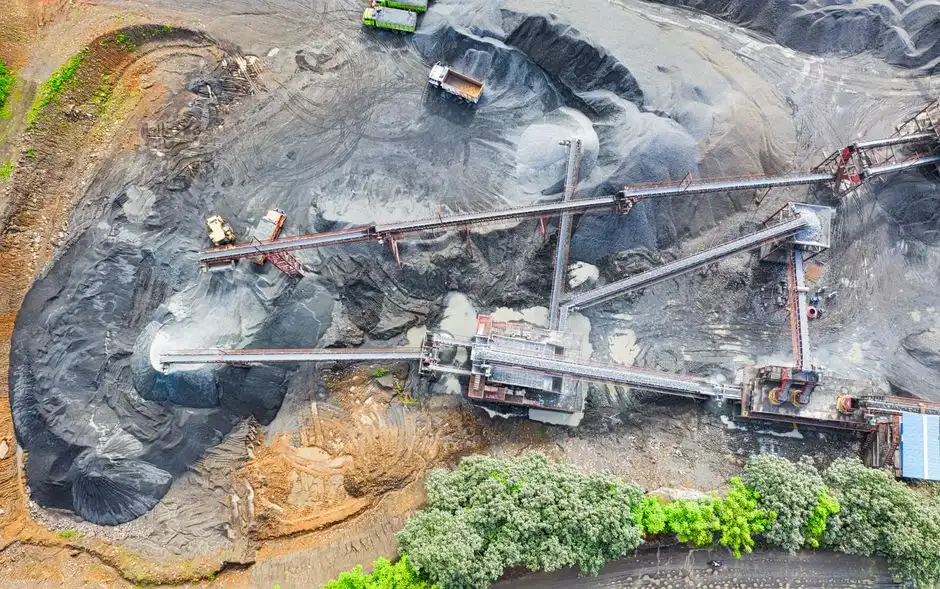
A clarifier separates suspended solids from water by gravity settling in a quiescent vessel; a lamella (high-rate) clarifier multiplies the effective settling area with inclined plates to handle far higher surface loadings than a conventional circular or rectangular tank.
Mechanically, the wastewater enters a center well or inlet channel, disperses through a sludge blanket or floc blanket if one is present, and the settleable solids fall to the bottom while clarified water rises over peripheral or launder weirs. A bottom rake or cross-scraper pushes sludge to a central hopper for underflow. Conventional clarifiers run at 1–3 m³/m²/h surface loading; a lamella clarifier uses 60° inclined plates at 25–50 mm plate spacing to multiply the effective projected area, hitting 20–40 m³/m²/h — roughly 10–20× a conventional unit of the same plan footprint.
Clarifiers are best on dense, readily settleable mineral solids: coarse kaolin, aggregate wash-water fines, mill scale, foundry sand, and precipitated metal sludges once they have been flocculated with polymer. Typical 2026 performance bands on conditioned mining streams are:
- 50–85% TSS removal on raw, untreated mining influent
- 70–95% TSS with proper coagulation/flocculation chemistry
- ≤30 mg/L effluent TSS achievable on well-settled, flocculated streams — sufficient to meet 40 CFR 437 BAT
Sludge leaves as a thickened underflow at 1–3% dry solids — denser than a DAF float but at a much lower volumetric flowrate, which is why downstream plate-press sizing is similar between the two options. For a space-constrained Macon site where ceiling height is available but floor area is not, the HydropureWater high-efficiency lamella clarifier is the most relevant clarifier option.
DAF vs Clarifier for Macon Mining Streams: Side-by-Side Comparison
For Macon mining and metals plants in 2026, the DAF vs clarifier decision is dominated by stream type: a settleable mineral slurry is a clarifier job, a colloidal or oily stream is a DAF job, and a combined or highly variable stream is a both job.
The table below consolidates the engineering trade-offs an environmental compliance engineer or plant manager needs to size and budget a separator in 2026. All figures are typical bands for properly conditioned mining/metals wastewater.
| Parameter | DAF | Lamella Clarifier | Both (DAF roughing + clarifier polish) |
|---|---|---|---|
| Best-fit stream type | Oily, colloidal, chemically precipitated fines, FOG, metal hydroxides | Dense, settleable mineral grit, kaolin, aggregate fines, mill scale | Combined streams with both settleable grit and colloidal/oily load |
| Typical TSS removal (with polymer) | 80–95% | 70–95% | 90–98% |
| Hydraulic / surface loading | 5–10 m³/m²/h (hydraulic) | 20–40 m³/m²/h (surface) | Designed per stage |
| Footprint index (per 50 m³/h) | ~35 m² plan area, short | ~25 m² plan area, taller (lamella stack) | ~55 m² plan area, two vessels |
| Sludge % dry solids | 3–6% float (low density, high water) | 1–3% underflow (denser, lower volume) | Combined |
| Polymer demand | Moderate to high | Low to moderate | Both stages dosed |
| CAPEX index (2026 USD, 50 m³/h) | $180K–$320K equipment | $120K–$220K equipment | $280K–$500K equipment |
| OPEX index (annual) | Higher (recycle pump, air system) | Lower (no recycle pump) | Sum of both, slightly higher |
| Sensitivity to 3:1 flow spikes | Low (5-min residence handles surges) | Moderate (needs equalization for 3:1 spikes) | Low |
| Temperature tolerance | Good up to ~55 °C with derating | Good; performance drops above 50 °C due to viscosity | Stage DAF first if hot |
For Macon kaolin and aggregate plants, the clarifier almost always wins on cost-per-m³ treated because the dominant solids settle on their own. For Macon steel-fabrication or oily machine-shop sumps, DAF wins because free and emulsified oil does not settle in a reasonable clarifier residence time. For chemical precipitation of dissolved metals — arsenic, hexavalent chromium, lead — the precipitation reactor followed by DAF is the textbook 2026 solution (see also ternary precursor coprecipitation for metal removal). The EPA Process Design Manual Section 6.4 documents staged solids-contact processes — DAF roughing followed by gravity polishing — as the engineered answer for the toughest combined streams, a configuration that the companion Hamilton mining/metals DAF vs clarifier guide also recommends for similar feedstocks.
40 CFR Part 437 and GA EPD Compliance: What Each Separator Actually Delivers
Either a properly-sized DAF with polymer conditioning or a lamella clarifier with coagulation/flocculation can meet 40 CFR Part 437 BAT limits, but the design margin you carry into a GA EPD antidegradation review is different.
40 CFR Part 437 BAT limits for ore beneficiation typically cap TSS around 30 mg/L daily max and settleable solids at 0.2 mL/L. The prime metal subcategories carry similar TSS caps plus metal-specific limits on total recoverable lead, zinc, and copper, which usually drive the design more than TSS does. Conventional (non-lamella) clarifiers often cannot hit 30 mg/L daily max on variable mining feed — which is exactly why the industry has shifted to high-rate designs in the last 10 years.
GA EPD antidegradation rules in the Ocmulgee basin effectively require the BAT, not the BPT, limit. In practice, that means a system that just barely meets 30 mg/L on a calm day is risky on a flow spike, and the state reviewer is going to ask for equalization, online TSS monitoring, and a documented chemical conditioning program. A well-designed lamella clarifier with online instrumentation — or a DAF with polymer dosing tied to a streaming current or zeta-potential probe — gives the reviewer something to approve. If you need help on the analyzer side, the online analyzer selection guide covers the same instrumentation logic that applies to TSS and pH probes.
For dissolved metals, the standard 2026 train is hydroxide precipitation at pH 8–9 (with co-precipitants for arsenic and hexavalent chromium) followed by either DAF or a lamella clarifier. The chemistry step is non-negotiable; the separator choice then follows the stream-type logic above. The HydropureWater automatic chemical dosing skid handles the coagulant, flocculant, and pH-adjustment side of this train.
Worked 2026 Example: Sizing and Cost for a 50 m³/h Macon Mining Plant
The numbers below are a worked 2026 budget for a representative 50 m³/h Macon-Bibb mining/metals plant — typical of a mid-size kaolin/aggregate operation with some metal hydroxide fines, or a secondary-metals finishing line that runs one shift. Use them as a sanity check against vendor quotes; the bands reflect HydropureWater field data and 2026 industrial market pricing in the Southeast US.
Design basis:
- Average flow: 50 m³/h
- Peak flow: 75 m³/h (1.5× average)
- Influent TSS: 2,500 mg/L
- Effluent target: ≤30 mg/L TSS (40 CFR 437 BAT)
- Stream character: settleable mineral slurry with ~10–20% colloidal/metal-hydroxide fines
| Item | Lamella Clarifier Option | DAF Option |
|---|---|---|
| Vessel footprint | ~25 m² plan area, ~4.5 m tall | ~35 m² plan area, ~2.5 m tall |
| Flocculation mixer | 3 kW | 3 kW |
| Recycle pump + air system | — | 4 kW |
| Total connected power | ~3 kW | ~7 kW |
| Equipment CAPEX (2026 USD) | $120,000–$220,000 | $180,000–$320,000 |
| Annual polymer + power OPEX | $8,000–$14,000 / yr | $11,000–$20,000 / yr |
| Annual maintenance reserve | $2,000–$4,000 / yr | $3,000–$6,000 / yr |
Both options need a chemical dosing skid (coagulant + flocculant, often a pH adjustment stage) and a downstream sludge dewatering step — a HydropureWater plate and frame filter press sized for 1–2 dry tons/day is typical. The often-skipped line items are civil works, installation labor, and a 15% contingency typical for 2026 industrial projects in the Macon market, which can add another 40–60% on top of equipment CAPEX.
ROI framing: a $200K installed system that prevents a single 40 CFR 437 Notice of Violation — typical 2026 penalties run $25,000–$250,000 depending on duration and harm — pays back in under 12 months on the avoided-penalty basis alone, before counting any production downtime avoided. That math is the cleanest way to get a Macon capital request approved in 2026.
Decision Tree: DAF, Clarifier, or Both for Your Macon Site
Three yes/no questions, run in order, will land a Macon plant manager on the right separator in under a minute. Answer them against the dominant wastewater stream — not the side stream.
- Q1 — Settleable-dominant? Does a jar test show >70% of the TSS settling in 30 minutes without polymer? If yes, a lamella clarifier is almost certainly the lowest-cost answer. Move to Q2 only if Q1 is no.
- Q2 — Oily, colloidal, or precipitated? Is the stream carrying free/emulsified oil, FOG, fine mineral colloids, or chemically precipitated metal hydroxides (Fe, Al, Mn, Cr, As)? If yes, a DAF is almost certainly the right separator regardless of how Q1 came out.
- Q3 — Highly variable or hot? Is the peak/avg flow ratio >3:1, the temperature >50 °C, or the load strongly seasonal (stormwater-driven aggregate wash, batch metal-finishing)? If yes, DAF handles spikes better on its own; a clarifier needs a flow equalization tank upstream to perform the same way.
If Q1 and Q2 are both yes, or if the available floor footprint is very tight on a constrained Macon site, choose both: DAF roughing followed by lamella polishing, per the EPA staged solids-contact approach. This is the configuration that consistently hits the toughest combined-stream limits, and it lets you run each stage at a relaxed design point so neither one is the bottleneck.
Always finish with a one-week jar test and a settling column test on the actual plant wastewater. A bench/pilot test on the real stream prevents the most common 2026 mis-sizing error: trusting a vendor cut-sheet that was generated on a different feedstock.
Frequently Asked Questions
What TSS removal does a DAF achieve on mining wastewater?
Properly conditioned DAF systems achieve 80–95% TSS removal on mining and metals wastewater, with effluent TSS below 10 mg/L achievable on precipitated-metals streams when the polymer program is well-tuned.
Can a lamella clarifier meet 40 CFR Part 437 BAT limits on its own?
Yes, a lamella clarifier with proper coagulation and flocculation can meet 40 CFR Part 437 BAT limits (around 30 mg/L TSS daily max for most ore beneficiation subcategories) on settleable-dominant streams. For colloidal or oily streams, pair it with a DAF roughing stage to hit the same number reliably.
Which is cheaper to operate long-term in Macon?
A lamella clarifier typically runs 15–25% lower annual OPEX than a comparable DAF because there is no recycle pump, no air-saturation system, and lower polymer demand. The OPEX gap narrows if sludge disposal is the dominant cost driver, since DAF float often dewaters faster on a plate press and reduces haul-off tonnage.
Does the Ocmulgee basin's antidegradation rule change the equipment choice?
In practice, yes. GA EPD's antidegradation review in the Ocmulgee basin pushes a Macon discharger toward BAT-level performance rather than BPT, which usually means adding a real coagulation/flocculation stage regardless of whether the separator is a DAF or a clarifier. A system that just barely meets 30 mg/L is risky under antidegradation review.
Can a DAF and a clarifier be combined?
Yes. The EPA Process Design Manual for Suspended Solids Removal documents DAF roughing followed by gravity polishing for the toughest combined streams — the same staged solids-contact approach referenced in Section 6.4 of that manual. For Macon plants with both settleable mineral grit and colloidal/oily load, this is often the most robust 2026 configuration.