Why Plastics and Rubber Wastewater Is Different in Calhoun
Calhoun's plastics and rubber cluster—anchored by extrusion coating, latex compounding, and polymer finishing lines—produces three characteristic waste streams that respond poorly to generic clarifier sizing rules: polymer-fines washwater from pellet and film-cleaning operations, latex and rubber emulsion overflow from dipping and coagulation lines, and extrusion/coating line blowdown carrying uncured polymer residues and process lubricants. The chemistry is dominated by buoyant polymer particles with specific gravity often between 0.92 and 1.02, emulsified latex droplets that resist gravity settling, and intermittent high-TSS slugs (often 2,000-5,000 mg/L) triggered by line washouts and product changeovers. Temperature swings of 15-25 °F between extrusion cooling water and ambient washwater further destabilize floc formation, which is why 40 CFR Part 463 (Rubber Manufacturing) effluent limits on TSS, O&G, and COD drive equipment selection in 2026 rather than flow capacity alone.
These characteristics make clarification technology a stream-by-stream decision. A lamella clarifier that handles a 500 GPM cooling-tower blowdown cleanly will discharge 200-400 mg/L TSS from a latex washwater stream because the buoyant particles never reach the inclined plates. Treating all plastics/rubber wastewater as one generic "industrial" stream is the most common cause of permit excursions at Calhoun facilities, and the reason dissolved air flotation for plastics wastewater has become the default for the latex-rich portion of the flow.
How DAF and Clarifiers Actually Separate Solids
A dissolved air flotation unit works by pressurizing a recycle stream of clarified effluent (typically 20-40% of forward flow) to 60-90 psig in a saturation vessel, then releasing it through a pressure-relief valve near the tank center. The pressure drop generates microbubbles in the 20-40 micron range (per DAF Corporation's Micro Bubble Generator spec sheet) that attach to suspended solids, oil droplets, and latex particles, lifting them to the surface where a rotating skimmer sweeps them into a sludge hopper. The float layer forms within 3-5 minutes of hydraulic residence time, which is why a dissolved air flotation system achieves 85-98% TSS removal in roughly one-tenth the footprint of an equivalent clarifier. DAF thickened sludge typically discharges at 2-4% total solids (per DAF Corp's FC Maximizer operating envelope), which simplifies downstream dewatering.
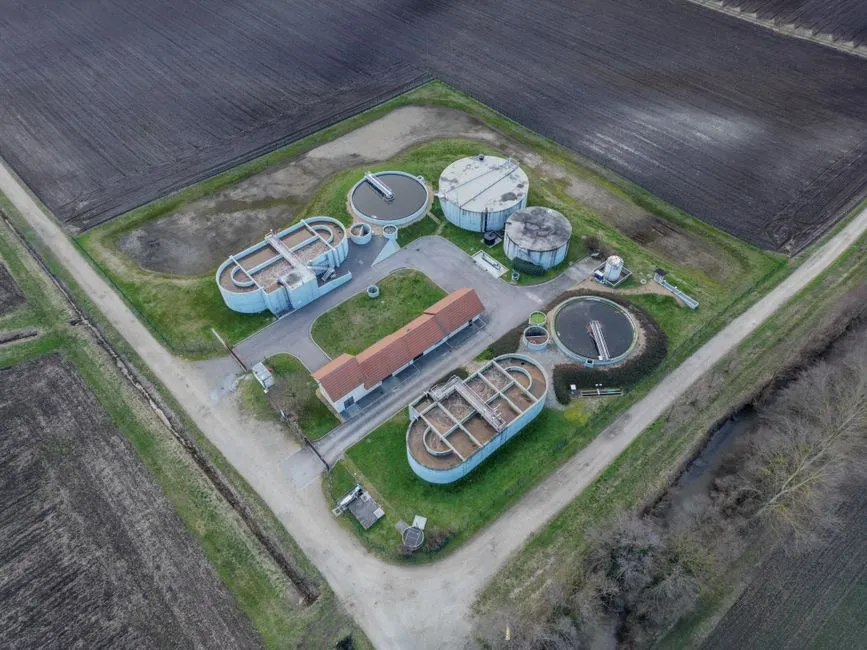
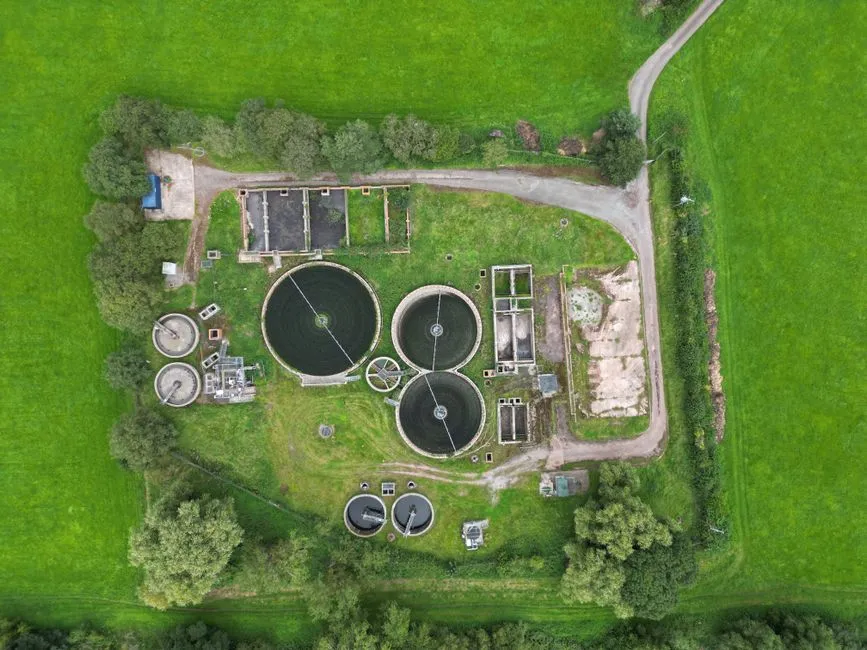
Understanding these distinct separation mechanisms helps engineers match the right technology to specific particle behaviors. A gravity clarifier relies on Stokes' law settling: particles with specific gravity above 1.0 sink to the bottom over 1-3 hours of residence time, and the clarified overflow exits over peripheral weirs. A lamella clarifier—the high-efficiency sedimentation tank variant—multiplies the effective settling area by stacking inclined plates at 55-60° angles, which shortens the distance a particle must fall before it contacts a plate surface. Surface loading rates of 20-40 m/h are achievable with chemical flocculation, but the technology only captures particles that actually sink. Buoyant polymer fines and emulsified latex pass through largely untouched, which is why unaided lamella performance on plastics/rubber streams typically lands at 40-70% TSS removal. Underflow solids discharge at 1-2% concentration, requiring a thickener or sludge dewatering press downstream of the clarifier before disposal.
DAF vs Lamella Clarifier: Head-to-Head Parameter Comparison
The table below consolidates the operating parameters that drive a 2026 DAF-vs-clarifier decision for a Calhoun plastics or rubber line. Numbers are drawn from manufacturer specifications and typical industrial DAF installation data; your specific jar-test results should always be used to confirm.
| Parameter | Dissolved Air Flotation (DAF) | Lamella / Gravity Clarifier |
|---|---|---|
| TSS removal efficiency | 85-98% (per DAF Corp FC Maximizer); 85-90% (RC UniMax rectangular) | 40-70% unaided; up to 80% with optimized flocculation on dense solids only |
| FOG / latex capture | Strong — float mechanism lifts emulsified oils and buoyant latex droplets | Weak — buoyant particles pass through; FOG accumulates as scum, not removed cleanly |
| Footprint (GPM per m²) | 20-40 GPM/m² (compact, ~50-200 sq ft for 100-500 GPM units) | 5-10 GPM/m² (lamella); 1-3 GPM/m² (conventional gravity) |
| Surface loading rate | N/A — flotation-driven, not settling-driven | 20-40 m/h (lamella with flocculation) |
| Chemical demand | Coagulant (alum/ferric) + flocculant polymer, typically 5-50 mg/L each | Lower — coagulant only on difficult streams; polymer optional |
| Sludge consistency | 2-4% total solids (per DAF Corp) — ready for filter press | 1-2% underflow — requires thickening or additional dewatering |
| Flow range (standard offerings) | 48-11,000 GPM (DAF Corp FC Maximizer, 6-70 ft diameters); 10-2,000+ GPM (FRC Systems PCL/PCCS/PWL series) | Wide range, but capacity scales linearly with footprint |
| Effluent TSS target | <20 ppm filterable solids achievable in single stage (DAF Corp operating envelope) | 30-80 ppm typical; polish stage usually required to hit <30 mg/L |
| CAPEX signal (2026) | Tens of thousands USD for skid pilots; several hundred thousand USD for multi-GPM packaged systems | Lower unit CAPEX, but larger civil/structural cost for footprint |
| OPEX signal (2026) | Air-saturation pump energy + polymer dosing + sludge hauling | Lower energy; higher sludge-disposal volume; lower chemical cost |
The 2026 capacity ceiling is not a constraint: DAF Corp's FC Maximizer covers 10-11,000 GPM with 6-70 ft diameters, and FRC Systems' DAF line covers up to 2,000+ GPM with 5-500+ sq ft of free area. The real decision variable is stream chemistry, not flow rate.
Which Stream Wins: Scenario Matching for 2026
The fastest way to make the 2026 DAF-vs-clarifier call in a Calhoun plant is to map each waste stream against a single decision rule: if the dominant solids are buoyant or emulsified, float them; if they are dense and dissolved-heavy, settle them.
- Latex and rubber emulsion washwater (high FOG, buoyant solids, 1,000-5,000 mg/L TSS slugs): DAF is the 2026 default. Microbubbles attach to emulsified latex and unreacted polymer droplets, lifting them in 3-5 minutes rather than waiting for gravity to act on near-neutral-buoyancy particles.
- Low-TSS cooling-tower blowdown (mostly dissolved solids, <50 mg/L TSS): Lamella or sand filtration is sufficient and cheaper. Spending DAF capital here is over-specification.
- Mixed lines — polymer coating plus cooling water: A DAF primary followed by a lamella clarifier for low-TSS polishing gives you redundancy during washout slugs. The lamella acts as a guard band if the DAF polymer dosing system is briefly offline.
- Permit-driven 40 CFR 463 limits with effluent TSS <~30 mg/L: Single-stage DAF is the lower-risk choice. Clarifiers usually need a polish stage (sand filter, multimedia, or membrane) to clear the same limit, which adds footprint and OPEX.
For plants already running a clarifier and seeing permit excursions on TSS or O&G, retrofitting a DAF upstream as a primary clarifier is a common 2026 path—the existing lamella becomes the polish stage, and the DAF carries the bulk solids load.
2026 Compliance, Footprint, and Cost Signals
40 CFR Part 463 (Rubber Manufacturing) sets daily maximum and monthly average limits for TSS, O&G, BOD₅, and COD across subcategories including tire production, general rubber goods, and latex-based manufacturing. A DAF tuned to the DAF Corp operating envelope of <20 ppm filterable solids clears those limits in a single stage for most subcategories, with chemical conditioning typically using 5-50 mg/L coagulant and 1-5 mg/L anionic flocculant. Plants whose permits enforce 40 CFR 463 daily-maximum values should confirm their specific subcategory limits with their NPDES permit writer before sizing equipment.
Footprint is where DAF wins decisively in 2026 retrofits. Skid-mounted DAF packages from FRC and DAF Corp ship as 6-15 ft diameter circular units (48-450 GPM) that fit through standard plant doors and into existing Calhoun bay layouts. Industrial DAF CAPEX ranges from roughly USD 25,000-60,000 for small skid units (under 100 GPM) to USD 150,000-500,000+ for high-rate multi-GPM systems with integrated saturation tanks, skimmers, and control panels—your specific flow, influent TSS, and effluent target will narrow that range. Civil and installation costs often equal equipment cost, so a packaged skid usually beats a stick-built concrete clarifier on total installed price once footprint is priced in.
OPEX breaks differently. DAF carries continuous air-saturation pump energy (typically 5-15 HP for mid-size units) plus automatic coagulant and flocculant dosing consumables, but generates 2-4% thickened sludge that drops hauling cost. Clarifiers carry lower energy and lower chemical use, but produce 1-2% underflow that multiplies sludge-hauling volume 2-4× and usually requires a downstream sludge dewatering press to reach a disposable cake. For most Calhoun plastics/rubber plants in 2026, the DAF OPEX premium is recovered within 2-4 years through lower disposal costs and avoided permit excursions. For a useful cross-industry benchmark, see our global BOD and TSS discharge limit comparison, and for a related DAF-vs-clarifier application outside plastics, the DAF vs clarifier for pulp and paper wastewater guide covers similar trade-offs in a different chemistry.
Frequently Asked Questions
Should a Calhoun plastics plant choose DAF or a clarifier for latex washwater in 2026?
DAF is the preferred choice for this application. Latex droplets have specific gravity near 1.0 and resist gravity settling; DAF microbubbles in the 20-40 micron range (per DAF Corp specs) attach to those droplets and lift them, delivering 85-98% TSS removal versus 40-70% for an unaided clarifier.
How does 40 CFR Part 463 affect the DAF vs clarifier decision?
40 CFR Part 463 sets effluent limits on TSS, O&G, BOD
Frequently Asked Questions
Should a plastics factory in Calhoun choose DAF or a clarifier in 2026?
The choice depends on the specific gravity and surface chemistry of the polymer resins produced. In 2026, DAF systems are preferred for plastics wash lines generating low-density polyethylene (LDPE) or polypropylene (PP) fines that remain buoyant. Clarifiers are generally reserved for facilities processing heavier materials like PVC or PET, where gravity-based sedimentation is efficient and chemical coagulant costs can be minimized.
What TSS removal can DAF achieve on latex wastewater?
Dissolved Air Flotation (DAF) systems, when optimized with appropriate polymer dosing and micro-bubble saturation, typically achieve Total Suspended Solids (TSS) removal efficiencies between 85% and 98% for latex-based wastewater. These systems are specifically designed to address the emulsified nature of latex, which often defeats traditional gravity settling by remaining suspended in the water column.
Is a lamella clarifier enough to meet 40 CFR 463 rubber manufacturing limits?
A lamella clarifier alone is rarely sufficient to meet the stringent 40 CFR 463 effluent guidelines for rubber manufacturing without supplemental treatment. While lamella plates increase effective settling surface area, they do not address dissolved organic pollutants or fine colloidal rubber particles. Compliance typically requires a multi-stage approach involving chemical coagulation, flocculation, and secondary filtration or membrane treatment following the clarification stage.
How much does a DAF system cost for a small rubber plant in 2026?
In 2026, the capital expenditure for a skid-mounted DAF unit suitable for a small rubber facility ranges from $85,000 to $160,000, depending on flow capacity and material of construction (typically 304 or 316 stainless steel). This estimate excludes site-specific installation costs, chemical feed skids, and sludge handling infrastructure, which can add an additional 30% to 50% to the total project budget.
Can a clarifier handle buoyant polymer fines from a plastics wash line?
Standard clarifiers are ineffective at handling buoyant polymer fines because these materials possess a specific gravity less than 1.0, causing them to float rather than settle. Attempting to use a clarifier for these applications often leads to surface scum buildup and massive carryover into the effluent stream. Facilities processing buoyant resins must utilize flotation-based technologies, such as DAF or induced gas flotation, to effectively remove these contaminants.