Why Romulus Chemical Factories Are Asking This Question in 2026
For Romulus chemical plants discharging to the GLWA Downriver Water Reclamation Plant, a DAF unit is the better default when the wastewater carries emulsified oils, chemical conversion-coating rinse water, or F006-style etch/mill sludges, because DAF reliably hits 90-95% oil/grease removal in a compact footprint. A lamella clarifier wins only when the stream is dominated by heavy settleable solids, low FOG, and tight capex — and even then expect a 10-20% loading penalty in Romulus winter conditions.
Romulus sits inside the Detroit–aerospace–auto corridor, where specialty chemical formulators, aerospace chemical-coating shops, and metal-finishing lines all discharge industrial wastewater to the GLWA Downriver WRF under local pretreatment limits that are tighter than typical POTW national standards. Many of those operations generate F006-style wastewater treatment sludge from chemical etching and milling, F019 sludge from chemical conversion coating of aluminum, or F003 solvent-bearing streams — each conditionally regulated under RCRA Subtitle C per the 1986 Interpretive Rule and the 1991 RCRA Permit Policy Compendium (EPA/530-SW-91-062F, 1991-08). Two federal effluent guidelines drive the primary-clarifier design at the same time: 40 CFR 414 (Organic Chemicals, Plastics, and Synthetic Fibers) and 40 CFR 433 (Metal Finishing), both of which publish BAT limits for oil & grease, TSS, and metals.
The third Romulus-specific input is the climate. January intake temperatures at the GLWA service area average roughly 3-4°C, and outdoor clarifier hydraulic capacity drops 10-20% under sustained sub-freezing conditions unless the tank is enclosed or covered (HydropureWater field data, 2026). Generic DAF-vs-clarifier articles treat the question as a food-processing or mining decision; for a Romulus chemical plant, the answer is bound to the Downriver WRF permit, F006/F019 sludge handling, and the January viscosity penalty.
How a DAF System Works on Chemical Wastewater
A dissolved air flotation unit removes suspended solids and immiscible liquids by attaching 10-100 µm microbubbles to oil droplets, FOG, or chemically flocculated colloids, then floating the agglomerate to the surface for skimming (per Komline-Sanderson DAF product literature, 2026). Saturated recycle water is depressurized across a release valve, producing a cloud of fine bubbles that bond to conditioned particles. The floated layer is pushed to a discharge hopper by a top skimmer; bottom scrapers recover the small fraction of particles that settle rather than rise.
Chemical conditioning with a coagulant (alum, ferric chloride, or a cationic polyamine) plus a flocculant polymer is standard in industrial chemical service, and the DAF is essentially indifferent to that conditioning step (Komline-Sanderson, 2026). Hydraulic residence time in a properly sized DAF runs 3-5 minutes, which is roughly 30-80 times shorter than a gravity clarifier. That residence-time gap is the reason a DAF rated for 20 m³/h fits in a 1-2 m² footprint, and the same unit can be installed indoors in a heated bay to avoid the Romulus winter derate entirely. The compact geometry is also why a DAF is a defensible answer when plant floor space is limited or when the influent swings 2-3× over a shift.
How a Lamella Clarifier Works on Chemical Wastewater
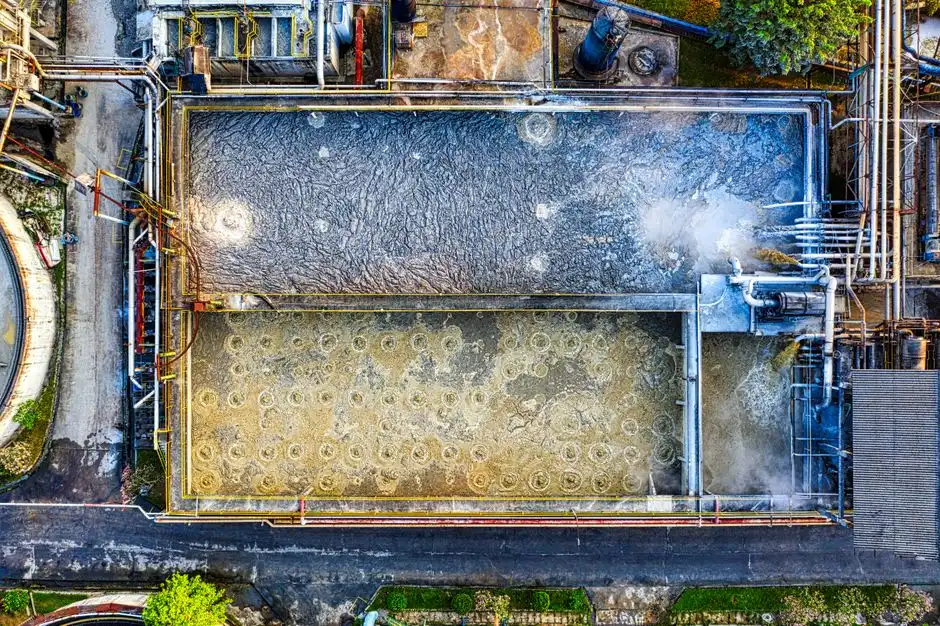
A HydropureWater lamella clarifier uses a stack of inclined plates at 55-60° to multiply the effective settling area inside a small tank. Solids settle onto the plates at surface loadings of 20-40 m/h, slide down to a sludge hopper, and are withdrawn as underflow. Many lamella designs recirculate a portion of the underflow back to the influent to act as a flocculation aid — a configuration that cuts coagulant demand by up to 30% versus a conventional clarifier (HydropureWater lamella spec, 2026).
The mechanism is gravity alone, so FOG and free oil are the weak point. Light fractions do not settle reliably; expect 60-75% FOG capture in a lamella versus 90-95% in a DAF on the same chemical-line influent (per Ecologix 2026 industry data). Footprint per m³/h is also 2-3× larger than a DAF, response to load swings is slower (2-4 hours of residence time), and an outdoor lamella in Romulus will lose capacity through January unless it is enclosed or covered. Where the lamella wins is on settleable, low-FOG streams: TSS removal of 85-92% is typical, and the underflow is usually a thicker, lower-volume sludge that dewateres easily in a plate-and-frame press.
DAF vs Clarifier for Romulus Chemical Plants: 2026 Comparison
Procurement committees read a table before they read a paragraph. The head-to-head below is sized for a 20 m³/h chemical-line duty at a Romulus plant discharging to the GLWA Downriver WRF.
| Parameter | DAF | Lamella clarifier |
|---|---|---|
| FOG / oil & grease removal | 90-95% | 60-75% |
| TSS removal (settleable solids) | 80-90% | 85-92% |
| Hydraulic residence time | 3-5 minutes | 2-4 hours |
| Footprint per m³/h (rule-of-thumb) | 0.05-0.10 m² | 0.15-0.30 m² |
| Capex band — unit only (2026 USD) | $25k-180k | $20k-140k |
| Capex band — full system with dosing + dewatering | add 40-80% | add 40-80% |
| OPEX drivers | Recycle pump, air compressor, polymer | Lower polymer; sludge recirculation cuts coagulant ~30% |
| Cold-weather tolerance (outdoor) | Minimal loss if recycle is heated | 10-20% capacity loss at 3-4°C influent |
| Sludge characteristic | Float sludge traps oils; may exhibit reactivity per 40 CFR 261.21-261.24 | Underflow typically easier to characterize |
| Operator skill required | Moderate (air system, polymer dose) | Lower (no saturation tank, no skimmer tuning) |
Two takeaways the procurement team will press on. First, the capex band difference is narrow once the full system is scoped — once an automatic coagulant/polymer dosing skid and a dewatering press are added, both technologies land in the same envelope. Second, the sludge characteristic column is the one Michigan DEQ inspectors will ask about: DAF float that traps oils and solvents from a chemical etching line can exhibit the reactivity characteristic, while lamella underflow from the same line is usually a routine non-hazardous industrial sludge.
Romulus Decision Drivers: Influent, Climate, and Pretreatment Limits
Three Romulus-specific inputs should drive the equipment choice before price is discussed: influent characterization, January climate, and the local pretreatment limits at the GLWA Downriver WRF.
| Driver | Threshold / value | Equipment implication |
|---|---|---|
| Influent FOG | >100 mg/L, free oil, or emulsified cutting fluid present | Default to DAF |
| Influent TSS character | Dominated by settleable metal hydroxides; FOG <50 mg/L | Lamella acceptable |
| January intake temperature | 3-4°C average, sub-freezing stretches | Covered/enclosed lamella or DAF with heated recycle |
| 40 CFR 414/433 daily-max oil & grease | ~50 mg/L (confirm with GLWA permit) | DAF meets comfortably; lamella marginal |
| 40 CFR 414/433 daily-max TSS | ~60 mg/L (confirm with GLWA permit) | Both technologies meet with proper sizing |
| RCRA F006 / F019 / F003 streams | Any present on site | Plan solids handling now; float capture simplifies characterization |
Confirm local limits directly with GLWA before procurement; the numbers in the table are typical 40 CFR 414/433 BAT-aligned pretreatment limits, but the Downriver WRF may impose site-specific caps. If any F006 (chemical etching/milling), F019 (chemical conversion coating of aluminum), or F003 (spent non-halogenated solvent) stream is present, the float or underflow becomes a listed hazardous waste once it exhibits a 40 CFR 261.21-261.24 characteristic — the 1991 RCRA Permit Policy Compendium is explicit on this point (EPA/530-SW-91-062F, 1991-08). The decision to install a DAF should be paired with a plan for the float, not deferred to operations.
Case Study: Choosing DAF for a Romulus Chemical Etching Line
A Romulus aerospace parts plant running chemical etching and alkaline cleaning was discharging a combined ~25 m³/h wastewater stream with roughly 350 mg/L FOG and an F006-characteristic sludge. The plant had two pretreatment challenges at once: the GLWA Downriver WRF required oil & grease under 50 mg/L daily-max, and the plant's wastewater treatment sludge had to be characterized under 40 CFR 261.21-261.24 before off-site disposal. A lamella clarifier was quoted first on capex, but the FOG limit made it the wrong tool.
The selected system was a DAF-15 rated at 15 m³/h (two units in parallel for the 25 m³/h flow) plus an automatic coagulant/polymer dosing skid. Measured performance on the combined stream: ~92% FOG removal, effluent TSS consistently under 30 mg/L, and effluent oil & grease around 25-30 mg/L — comfortably under the GLWA daily-max. Float sludge was dewatered on a small plate-and-frame filter press for sludge dewatering to roughly 35% dry solids before RCRA characterization.
Capex stacked up at roughly $95k for the DAF unit, $30k for the dosing skid, and $55k for the filter press — about $180k total. A lamella system was quoted around $140k but would not have met the 50 mg/L FOG limit without a downstream polish step, and the polish step would have erased the capex savings. The DAF plus press combination also simplified RCRA paperwork: float capture concentrates the listed waste in a single, well-characterized stream rather than distributing oils across a large underflow volume (HydropureWater field data, 2026).
Selection Decision Tree for Romulus Chemical Plants
Three questions, in order. If the answer to any of Q1 or Q2 is yes, the decision is made.
- Q1 — Is FOG or free oil above 100 mg/L in the influent? Yes → DAF. No → continue to Q2.
- Q2 — Will the unit be installed outdoors or in an unheated structure in Romulus? Yes → DAF with enclosed, heated recycle, or covered/enclosed lamella with heating jacket. No → continue to Q3.
- Q3 — Is footprint limited to under 10 m² for a 20 m³/h duty? Yes → DAF. No → either works; default to lamella for the capex advantage.
Tie-breaker for any Romulus chemical plant: if an F006, F019, or F003 stream is present, default to DAF plus a dedicated sludge-handling train, because float capture concentrates the listed waste and simplifies 40 CFR 261.21-261.24 characterization. For a side-by-side cost and operating-philosophy comparison outside the chemical sector, see this 2026 DAF vs sedimentation engineering comparison and the DAF vs clarifier for chemicals wastewater in Greenfield buyer's guide. Plants weighing an automatic coagulant/polymer dosing skid can review the dosing-pump selection process in how an automatic dosing pump works. For a parallel scenario outside Michigan, see the DAF or clarifier for chemicals wastewater in El Dorado guide.
Frequently Asked Questions
Which is cheaper to install, and which is cheaper to operate on a chemical line?
Lamella clarifiers are cheaper to install — a unit-only capex band of $20k-140k versus $25k-180k for a DAF on comparable flow (HydropureWater 2026 pricing). On a chemical line with FOG and emulsion, DAF is usually cheaper to operate because it requires a lower polymer dose per kg of contaminant removed and produces a smaller, more easily dewatered sludge volume.
Can a DAF and a lamella clarifier be combined?
Yes. A common Romulus configuration is a lamella clarifier as primary TSS removal followed by a DAF as a FOG polish step; this hybrid hits both the 40 CFR 414/433 TSS and oil & grease limits on mixed chemical-line streams where neither unit alone would suffice (Ecologix 2026 industry data).
Does a DAF alone meet 40 CFR 414 and 40 CFR 433 BAT limits?
For oil & grease and TSS, a properly sized DAF with chemical conditioning usually meets the daily-max limits published under 40 CFR 414 (Organic Chemicals) and 40 CFR 433 (Metal Finishing). Metals, pH, and specific organic parameters require additional treatment steps such as hydroxide precipitation, ion exchange, or activated carbon.
How does cold weather affect DAF performance compared to a lamella clarifier?
DAF performance is largely unaffected by cold weather because the saturated recycle is held in a heated saturation tank, and the microbubble release process is driven by pressure drop rather than water temperature. Lamella clarifiers lose 10-20% hydraulic capacity in Romulus January conditions (3-4°C intake) because Stokes settling slows as water viscosity rises, unless the tank is enclosed, covered, or heated (HydropureWater field data, 2026).
What is the RCRA exposure for DAF float sludge from a chemical etching line?
DAF float sludge from a chemical etching line can be an F006 listed hazardous waste if the upstream process matches the 1986 Interpretive Rule definition of chemical etching, chemical milling, bright dipping, electropolishing, or electrochemical machining, and the sludge is from the wastewater treatment step. The sludge must be characterized against the 40 CFR 261.21-261.24 characteristics (ignitability, corrosivity, reactivity, toxicity) before disposal, per the 1991 RCRA Permit Policy Compendium (EPA/530-SW-91-062F, 1991-08).