Why Newington Transportation Equipment Plants Are Re-Evaluating Primary Treatment in 2026
At 06:40 on a Monday in a Newington, CT stamping cell, a coolant line ruptures and 200 gallons of emulsified drawing compound hit the floor drain before the operator hits the E-stop. By 07:15, the parts-washer overflow has pushed a frothy slug of FOG into the equalization tank. By 08:00, the environmental manager is on the phone with Hartford WPCF pretreatment, asking whether their discharge is still in compliance with 40 CFR Part 432. That is the decision cycle a transportation equipment plant now lives in.
The Newington–Hartford industrial corridor is anchored by rail equipment builders, aerospace sub-assembly shops, heavy-truck component plants, defense vehicle fabricators, and Tier-1 automotive suppliers. Each of these sub-sectors generates oily wastewater, and each is regulated under 40 CFR Part 432 (Transportation Equipment Point Source Category) once the stream crosses the metal-finishing line — with 40 CFR Part 433 frequently applying to parts-wash effluents that drain to the same header. The 2026 EPA effluent guideline framework continues to set Best Available Technology (BAT) and New Source Performance Standards (NSPS) limits on oil and grease, TSS, and metals; above that federal floor, the CT DEEP industrial discharge permit and the Hartford WPCF pretreatment program impose local limits that are routinely stricter than the federal numbers.
As Ecologix notes in its 2026 selection guide, the choice of primary solids-removal technology is driven by wastewater composition, treatment goals, and operational constraints — not by equipment preference. And as Doosan (2018) frames the broader problem, oily industrial wastewater almost always demands a combination of physical, chemical, and biological treatment, not a single unit. That framing is what is forcing Newington plants to revisit whether DAF alone, a clarifier alone, or a hybrid stack is the right primary train for 2026.
Transportation Equipment Wastewater Character: What Comes Off the Floor
Transportation equipment plants do not run a single waste stream; they run a portfolio of streams that hit the pretreatment system at different temperatures, oil-to-solids ratios, and flow rates. The composite feed that arrives at primary treatment typically carries oil and grease from 200 mg/L on the clean side to 1,500 mg/L when coolant sumps and parts-washer overflows both dump in the same hour. TSS lands in the 300–3,000 mg/L band, driven by metal fines from stamping, shot-blast dust from wheel-abrasion prep, and drawing compound residues. COD runs 500–5,000 mg/L and pH sits between 6 and 9 unless an acid pickle line is on the same header. Tramp oils, cutting fluids, drawing compounds, and phosphates from metal-finish prep are the four constituents that determine which technology will actually work.
The dominant stream types are stamping coolant overflow, parts-washer discharge, shot-blast dust washdown, assembly lube drips, and floor wash. Each behaves differently in a primary clarifier. Stamping coolant and parts-washer effluent are emulsified oils — the precise "materials that normally settle slowly, persist by remaining in suspension, or have a tendency to float" that Komline identifies as the dissolved air flotation sweet spot. Shot-blast dust and metal fines are heavy, settle readily under Stokes law, and skim poorly in a DAF without chemistry. Assembly lube drips and floor-wash floatables skim easily with no chemistry at all. That three-way split — floatable oils, emulsified oils, and heavy particulate — is the technical reason a single unit rarely covers the whole stream.
| Stream Source | Typical FOG (mg/L) | Typical TSS (mg/L) | Behavior in Primary | Best-Fit Unit |
|---|---|---|---|---|
| Stamping coolant overflow | 500–1,500 | 300–1,000 | Emulsified, slow-settling | DAF with coagulant/flocculant |
| Parts-washer discharge | 200–800 | 200–600 | Emulsified + surfactants | DAF with chemistry |
| Shot-blast dust washdown | <100 | 1,000–3,000 | Heavy particulate, settles fast | Lamella clarifier |
| Assembly lube drips / floor wash | 300–1,000 | 200–800 | Free oils + floatables | DAF (no chemistry needed) |
| Composite equalized flow | 200–1,500 | 300–3,000 | Mixed | DAF → lamella clarifier |
DAF vs Clarifier: How Each Technology Actually Works
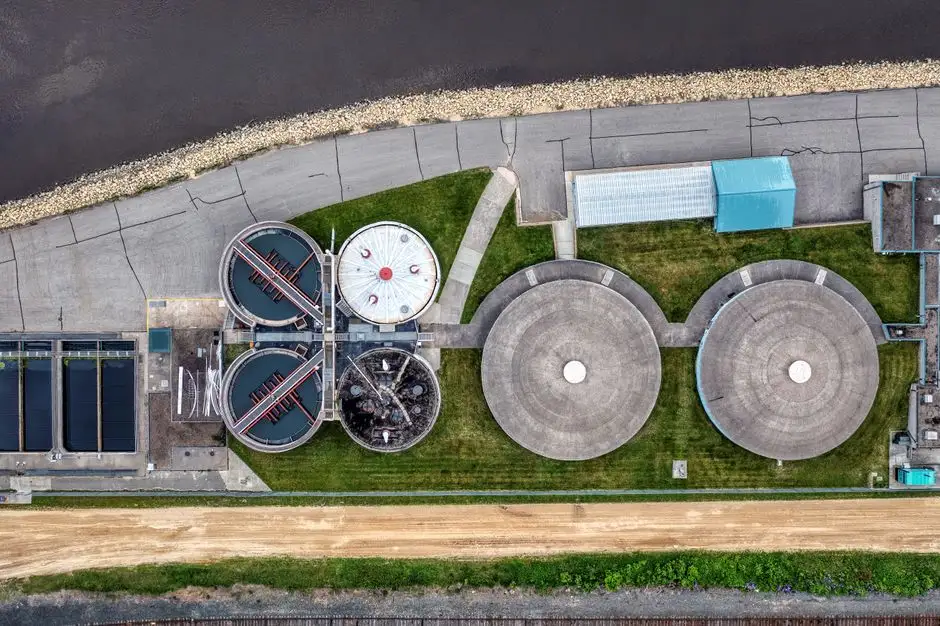
A dissolved air flotation system pressurizes a side-stream of recycle water (typically 20–50% of throughput) with air at 4–6 bar, saturates it, then releases the pressure through needle valves at the bottom of the flotation tank. The pressure drop nucleates a cloud of 10–80 micron micro-bubbles that attach to suspended particles and oil droplets, reducing their effective density and floating them to the surface. A top skimmer drives the float to a discharge hopper; clarified underflow exits the bottom. Per Komline, "the DAF is essentially a hands-off machine that requires little operator attention," and chemical conditioning is often used to increase effectiveness on emulsified streams.
A clarifier relies on Stokes-law settling: denser particles fall through quiescent water and accumulate as sludge on the floor, where a scraper mechanism drives them to a central sump. A conventional circular clarifier is footprint-hungry because surface overflow rate is the binding parameter. A lamella clarifier stacks inclined plates at 55–60° inside the tank, shortening the effective settling path and pushing surface loading to 20–40 m/h per HydropureWater product data — typically a 5–10× footprint reduction over an equivalent circular clarifier. Komline also documents a hybrid "Dissolved Air Flotation Clarifier" that uses a DAF shell with bottom collectors, removing any settleable fraction that survives the float.
The two technologies therefore compete on mechanism: DAF wins on light, hydrophobic, or emulsified material; clarifiers win on heavy, inorganic particulate. DAF runs at hydraulic retention times of roughly 15–30 minutes and demands a recycle pump, air compressor, and (for emulsified oils) chemical pretreatment. Clarifiers run at 1–3 hours HRT, need no compressor, but punish sloppy feed with sludge carryover and floating scum. Ecologix's 2026 cost framing is direct: DAF carries higher upfront and operating cost (air compressor, recycle pump, polymer system) while clarifiers trade lower energy for a much larger footprint.
Head-to-Head: FOG, TSS, Footprint, OPEX, and Compliance
On FOG, the Ecologix 2026 selection guide reports a food-processing case at 95% oil and grease removal with a DAF versus 70% with a clarifier on the same feed. Transportation equipment streams run hotter in FOG than food processing and the oil is more often emulsified, which widens that gap rather than narrows it. On TSS, Ecologix cites a mining/sediment case at 90% removal with a clarifier, and DAF typically removes only the floatable plus coagulated fraction — DAF residuals downstream of the float step still need a clarifier or a polishing filter if the daily-max TSS limit is tight.
On footprint, a packaged HydropureWater DAF system covers 4–300 m³/h in a single skid — an order of magnitude smaller than a comparably rated conventional clarifier, and roughly 5–10× smaller than a comparably rated circular clarifier when measured against a HydropureWater lamella clarifier. On OPEX, the lamella clarifier wins on energy (no compressor, no recycle pump), but loses on polymer consumption for fine colloids and on sludge-handling frequency; DAF wins on throughput per m², float-handling simplicity, and stable performance on emulsified feeds. On operator skill, DAF is hands-off in normal operation but is chemistry-dependent — get the coagulant wrong and the float blanket collapses. A clarifier tolerates a sloppy feed but punishes it with sludge carryover and a rising sludge blanket that triggers an effluent excursion. On compliance, 40 CFR Part 432 daily-max and monthly-average limits on oil and grease and TSS are easier to defend with DAF as primary; a clarifier alone is rarely a defensible answer for transportation equipment oily streams in 2026.
| Selection Axis | Dissolved Air Flotation (DAF) | Lamella Clarifier | Hybrid DAF → Lamella |
|---|---|---|---|
| FOG removal efficiency | ~95% (Ecologix 2026 food case; conservative for emulsified streams) | ~50–70% on free oils, poor on emulsified | >97% combined |
| TSS removal efficiency | 60–80% (floatable + coagulated) | ~90% (Ecologix 2026 mining case) | >95% combined |
| Hydraulic retention | 15–30 min | 1–3 h | ~1.5–3.5 h total |
| Footprint (relative) | 0.1–0.3× (smallest) | 1× baseline | 1.2–1.5× |
| Energy / OPEX | Higher (compressor + recycle pump) | Lower (no compressor) | Higher than clarifier alone, lower than oversized DAF |
| Chemistry requirement | Required for emulsified oils | Optional; aids colloidal TSS | Required on DAF stage only |
| 40 CFR 432 defensibility | Strong on oil & grease | Weak on oil & grease alone | Strongest on both oil & grease and TSS |
Decision Matrix: When to Pick DAF, Clarifier, or the Hybrid Stack
The binary "DAF or clarifier" framing fails Newington plants because the waste stream is rarely binary. A decision rule that holds up in 2026 procurement reviews: if your wastewater has any free or emulsified oil, DAF first; only skip DAF if your stream is purely heavy particulate.
Pick DAF as the standalone primary when FOG is consistently above 200 mg/L, free or emulsified oils dominate the stream, TSS is largely floatable, the plant footprint is constrained, or the 40 CFR Part 432 daily-max oil and grease limit is the binding compliance number. Pick a lamella clarifier as the standalone primary when FOG is consistently below 100 mg/L, the stream is dominated by metal fines or shot-blast dust, the plant has the footprint to spare, and an upstream oil-removal step (skimmer, coalescer, or DAF) is already in place. Pick the hybrid DAF → lamella clarifier stack when the stream carries both floatables and settleables, when the plant is a Tier-1 supplier with audit-driven zero-carryover requirements, or when the operator wants a single process train that hits both the oil-and-grease and the TSS daily-max simultaneously. Ecologix's 2026 guide explicitly endorses this configuration: "hybrid systems can address complex wastewater streams, combining DAF's oil removal with clarifiers' sedimentation capabilities." For new transportation equipment facilities in 2026, the hybrid stack has become the default rather than the exception.
| Stream Profile | FOG (mg/L) | TSS Character | Footprint | Recommended Primary |
|---|---|---|---|---|
| Machining + parts-wash heavy | 500–1,500 | Mixed floatable + fines | Constrained | DAF → lamella clarifier |
| Stamping + light assembly | 200–600 | Floatable-dominant | Constrained | DAF only (with chemistry) |
| Shot-blast + weld shop only | <100 | Heavy inorganic | Spare | Lamella clarifier only |
| Tier-1 multi-process plant | 300–1,200 | Mixed | Any | DAF → lamella clarifier (2026 default) |
| Aerospace sub-assembly (clean) | <150 | Light fines | Any | Lamella clarifier + polishing filter |
2026 Implementation Checklist for Newington Plants
The fastest way to kill a 2026 capex case is to size a DAF or clarifier on a nameplate flow and a single grab sample. Komline is explicit: "a simple lab test will generally determine if the use of a DAF is feasible. Further testing can be done to simulate the operation of the DAF under specific operating conditions." Start with a composite sampling campaign across at least two production shifts and one weekend cooldown, then run jar tests to screen coagulant/flocculant pairs — emulsified stamping and parts-wash streams typically need a cationic coagulant (alum, PAC, or a cationic polymer) paired with an anionic flocculant for the float blanket, with doses dialed in during piloting. Lock the chemistry before you size the unit; resizing a DAF for missed chemistry is the most expensive change order in this equipment class.
Confirm the local envelope before you commit. Hartford WPCF's pretreatment program and the CT DEEP industrial discharge permit impose local limits that are routinely stricter than the 40 CFR Part 432 federal floor on oil and grease, TSS, and several metals — pull the latest local limits from Hartford WPCF and CT DEEP and reflect them in the design basis, not the federal numbers. Match materials of construction to the stream: carbon steel is acceptable for plain oily wastewater per Komline, but parts-wash streams with chlorides, low-pH excursions, or aggressive cleaning chemistries should be specified in 304 or 316 stainless. Plan for downstream solids handling: both DAF float and clarifier underflow need a dewatering step — a HydropureWater plate and frame filter press typically drives the cake to 25–35% DS, which is what most Newington haulers require. And lock the chemical feed train early: a HydropureWater automatic chemical dosing system tied to a flow-paced signal is the difference between stable FOG removal and a daily-max excursion. For capex anchoring on a comparable hybrid installation, the advanced packaging wastewater resource recovery ROI breakdown is a useful reference. For a peer benchmark in a related sub-sector, the fabricated metals wastewater DAF vs clarifier guide applies the same decision logic to a different ELG category.
Frequently Asked Questions
Does a DAF system remove emulsified oil without chemical pretreatment?
No. Free and floatable oils skim in a DAF with no chemistry, but emulsified oils from stamping coolants and parts-wash streams require a coagulant/flocculant pair to break the emulsion before the micro-bubbles can attach. Komline notes that chemical conditioning is often used to increase DAF effectiveness, and piloting is the only reliable way to dial in the dose (Komline).
Can a lamella clarifier alone meet 40 CFR Part 432 oil and grease limits?
Rarely. Ecologix's 2026 data shows a clarifier at roughly 70% FOG removal on a comparable stream versus 95% for a DAF. Because transportation equipment streams often run 200–1,500 mg/L FOG, a clarifier alone rarely defends a daily-max oil and grease limit under 40 CFR Part 432, especially after the local Hartford WPCF and CT DEEP overlay.
What is the 2026 default primary-treatment configuration for a Newington Tier-1 transportation equipment plant?
The DAF → lamella clarifier hybrid stack. DAF strips 95%+ of FOG (Ecologix 2026) while the downstream lamella clarifier polishes residual settleables and TSS to defend the daily-max limit. Ecologix explicitly endorses hybrid systems for complex wastewater streams, and Doosan (2018) frames oily industrial wastewater as requiring a combination of physical, chemical, and biological treatment rather than a single unit.
How do CT DEEP and Hartford WPCF pretreatment rules change the DAF-vs-clarifier decision?
Both impose local discharge limits that are routinely stricter than the 40 CFR Part 432 federal floor for oil and grease, TSS, and several metals. That overlay pushes most Newington plants away from a clarifier-only design and toward a DAF-led or hybrid train, because the local daily-max and monthly-average numbers are the binding compliance numbers in a Hartford WPCF discharge scenario, not the federal effluent guideline numbers.