Why the DAF-vs-Clarifier Question Hits Hard for Wooster Food Plants
For a Wayne County dairy, meat, bakery, or grain plant in 2026, the choice between a dissolved air flotation system and a primary clarifier is no longer a textbook exercise — it is a permit conversation. Ohio EPA's NPDES pretreatment program typically caps industrial FOG at 100 mg/L and TSS at 250 mg/L at the discharge point, and the City of Wooster WWTP enforces those limits through its sewer use ordinance and surcharge schedule. A single missed parameter on a monthly compliance report is enough to trigger a compliance inspection, and a chronic exceedance is enough to trigger an EPO (enforcement order) that names the plant manager.
The local contaminant mix makes that conversation harder than it would be in a generic guide. Wooster and the surrounding Wayne County townships host fluid-milk and smoked-cheese operations discharging BOD 800–2,000 mg/L with FOG 200–600 mg/L, meat and poultry processors with blood and emulsified fat, bakeries and grain mills running starch-heavy streams at BOD 1,500–6,000 mg/L, and beverage lines with intermittent clean-in-place surges. The streams that hit a Wooster headworks on any given Monday look nothing like each other, which is why a one-size-fits-all "primary treatment" recommendation is dangerous.
Then there is the climate. North-Central Ohio routinely drops below −10 °C for stretches in January and February, and open clarifier surfaces ice over on food-plant duty. The S1 EPA case history on Plant A documented exactly this failure mode: an integral clarifier froze in winter until it was enclosed in a metal structure with warm air blown across the liquid surface (per EPA 600/2-78-188, 1978-08). An enclosed DAF tank or a covered lamella clarifier does not have that problem. The decision rule for a Wooster plant is therefore: FOG-heavy stream → DAF first, clarifier downstream only for biological sludge; heavy settleable solids with low FOG and a covered tank budget → clarifier; mixed load with any free oil → DAF upstream, even if a clarifier eventually sits behind it.
How a DAF System and a Clarifier Actually Treat Food-and-Beverage Water Differently
Both units are primary solids-removal steps, but they exploit opposite physics. A DAF unit saturates a 20–35% side stream of clarified effluent with air at 4–6 bar in a pressure vessel, then releases that stream through needle valves or nozzles at the bottom of the main flotation cell. The pressure drop nucleates 10–80 µm micro-bubbles that attach to oil droplets, floc, and floated colloids; the bubble-particle aggregate has a bulk density below water and rises in 3–5 minutes to form a surface scum that is scraped or skimmed off. Hydraulic residence in the cell itself is short — 20–40 minutes — but the unit needs a reaction/flocculation zone ahead of it and a saturated recycle loop beside it.
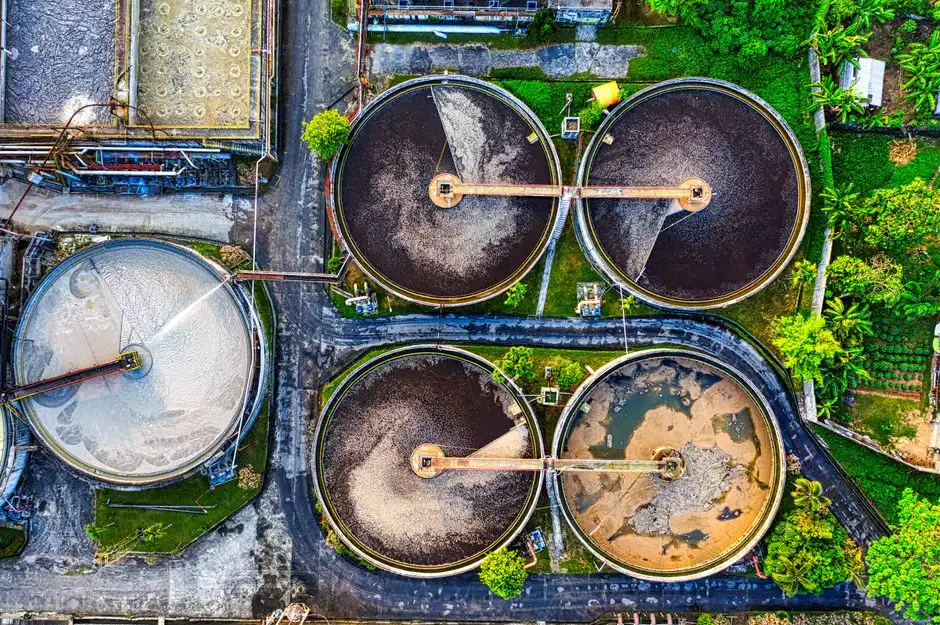
A primary clarifier is a quiescent tank in which gravity does the work. Performance is set by the surface overflow rate (SOR), measured in m³/day per m² of tank surface, and the sidewater depth. The S1 EPA Plant A case logged 19.5 m³/day/m² (400 Igpd/ft²) on a working food-plant clarifier with an integral extended-aeration basin, and that figure is the cleanest documented SOR for a F&B clarifier in the public record. Particles whose settling velocity exceeds the overflow rate are removed; everything else leaves with the effluent.
The contaminant-by-contaminant split explains why a Wayne County plant rarely picks one or the other:
- FOG: oil and grease are buoyant. DAF lifts them; a clarifier without a dedicated skimming device lets free oil pool at the surface and escape over the weirs. Where a clarifier has a half-round scum beach and a mechanical skimmer, FOG removal improves but rarely matches DAF's 90–95% range on emulsified streams.
- Settleable TSS: grain fragments, fruit pulp, meat trimmings, and finished-product spill drop out readily in either unit, but a clarifier handles dense, sandy grit and bone fines that would blind a DAF's sludge scraper.
- Colloidal protein, starch, and emulsified fat: these do not settle. A DAF with coagulant + flocculant dosing captures them; a clarifier with no chemistry ahead of it passes most of them through.
- Polymer demand: DAF almost always needs a coagulant (alum, PAC, or ferric) and a flocculant (cationic polyacrylamide, 3–10 mg/L typical) to build a floatable floc. Primary clarifiers in F&B often run chemistry-free unless surface scum accumulation is chronic.
Side-by-Side: DAF vs Clarifier on the Numbers That Matter
Use the table below as the artifact you paste into the recommendation memo. DAF FOG removal is anchored at 90–95% per a published 2026 DAF-vs-clarifier industry comparison (source: ecologixsystems.com DAF-vs-clarifier selection guide, 2026) that documented 95% DAF vs 70% clarifier oil-and-grease removal on the same F&B stream. Clarifier BOD and TSS are anchored to the S1 EPA Plant A integrated clarifier at >95% BOD and >90% SS overall, with the understanding that those figures include the extended-aeration basin upstream of the clarifier — as a pure primary unit with no biology ahead of it, a clarifier's BOD removal typically sits in the 30–50% range. Footprint, climate tolerance, and cost are triangulated against the same EPA case and current 2026 packaged-unit market pricing.
| Parameter | DAF system | Conventional / lamella clarifier |
|---|---|---|
| FOG removal (as primary) | 90–95% | 50–70% (with skimmer) |
| TSS removal (as primary) | 70–90% with polymer | 85–95% settleable; poor on colloids |
| BOD removal (as primary) | 40–60% | 30–50% |
| Footprint per 10 m³/h flow | 5–10 m² | Conventional 25–40 m²; lamella clarifier 2–4 m² |
| Hydraulic residence | 20–40 min | 1.5–4 hr |
| Operator attention | Moderate–high (polymer, recycle, scraper) | Low (rake torque, periodic pump-out) |
| Freeze tolerance (Wayne County winter) | Enclosed; no issue | Open tank ices; needs enclosure or cover |
| Polymer / coagulant demand | Almost always required | Often none; required only for high scum |
| CAPEX range 2026 (packaged) | $60K–$250K (304/316 SS) | $40K–$180K (lamella); site-built concrete only above 2,000 m³/day |
| OPEX drivers | Compressed air, polymer, sludge handling | Sludge pumping, rake maintenance |
Matching the Technology to Wooster Wastewater Profiles
The sub-industry you operate determines which unit goes first.
Dairy (fluid milk, cheese, whey). A Wooster-area fluid-milk plant typically discharges 200–600 mg/L FOG, 800–2,000 mg/L BOD, and a steady flow of casein fines that look like colloids. DAF with cationic polymer pulls both the fat and the casein in a single pass; a clarifier alone leaves the fat floating and the protein in the overflow. The S1 Plant A and Plant B cases both sit in this dairy-and-poultry neighborhood — Plant B at 1,900 m³/day and 38,000 birds/day explicitly used pre-DAF air flotation for grease recovery before extended aeration (per EPA 600/2-78-188, 1978-08). That is the Wooster model: DAF first, biology second, clarifier only as a waste-activated-sludge thickener if one is even needed.
Meat and poultry. Blood, feathers, offal, and emulsified fat are present in the same stream. The FOG fraction dominates the design, and DAF is again the right first step. The clarifier shows up only after the extended-aeration basin, in the same role it plays at S1 Plant A — a sludge-separation step, not a free-oil step.
Bakery, snack, and grain. Starch and gluten are the load. These are dense enough to settle, but they are also colloidal enough to carry BOD out of a clarifier. DAF with coagulant captures the colloidal starch; a clarifier downstream of the biological reactor handles the biosolids. A bakery with a CIP surge at 5 a.m. needs the surge tanking that a DAF cell provides by default.
Beverage bottling. Low TSS but high BOD from sugars, with intermittent CIP chemical surges. DAF handles the colloidal fraction and the CIP swings; a clarifier underperforms on the sugary/colloidal load. This is also the only sub-segment where a heated, covered clarifier (renderers, tallow handlers) can match DAF on FOG, because the stream arrives hot and free-oil separates readily without chemistry.
Sizing, Footprint, and What to Budget in 2026
Use the table below as the budget block for the memo. DAF sizing in food duty is typically driven by hydraulic loading: 25–35 m³/h per 10 m³ of effective tank volume, with a 20–30% recycle ratio. A 100 m³/day (≈4.2 m³/h average) Wooster plant therefore needs a 5–8 m³/h packaged DAF, plus an automatic polymer dosing skid sized at 5–15 mg/L on the design flow. Clarifier sizing is set by surface overflow rate: the S1 EPA Plant A value of 19.5 m³/day/m² works as a design ceiling, and lamella plates in a high-efficiency sedimentation tank cut the footprint by roughly 4–6× by multiplying the effective settling area.
| Item | DAF | Lamella clarifier |
|---|---|---|
| Sizing rule | 25–35 m³/h per 10 m³ cell volume | SOR ≤ 19.5 m³/day/m²; lamella multiplies area 4–6× |
| 100 m³/day plant — equipment size | 5–8 m³/h packaged unit, 304 or 316 SS | 5–6 m² surface (lamella); ≈25 m² conventional |
| Footprint (incl. reaction tank, skid) | 20–40 m² | 10–20 m² (lamella), 80–150 m² (conventional) |
| CAPEX 2026 (packaged, installed) | $60K–$250K | $40K–$180K (lamella); site-built concrete above 2,000 m³/day |
| Electricity | 0.3–0.8 kWh/m³ | 0.05–0.15 kWh/m³ |
| Polymer / coagulant OPEX | $0.02–$0.06/m³ | Typically $0 |
| Historical anchor (S1 Plant A, 1977) | n/a (DAF not used at Plant A) | $0.75/m³ treated; $1.32/kg BOD removed (per EPA 600/2-78-188, 1978-08, 1977 dollars) |
Plant A's $0.75/m³ and $1.32/kg-BOD figures are 1977 numbers, so 2026 OPEX is several times higher once labor, electricity at industrial Ohio rates, and polymer are layered in. Treat the 1977 values as a load-factor benchmark, not a current cost. To budget for 2026, assume packaged DAF installed cost in the $60K–$250K band depending on flow and stainless grade, and lamella clarifier at $40K–$180K; conventional concrete clarifier only becomes economical above 2,000 m³/day.
Building the Right Hybrid Train for a F&B Plant
Most Wayne County plants end up running both technologies — DAF upstream, clarifier downstream — because the wastewater is too mixed to let either unit do the job alone. The 2026 F&B train looks like this: screening → grit removal → DAF primary treatment → equalization → biological step (MBR downstream of DAF or SBR) → secondary clarifier or membrane separation → disinfection. DAF sits ahead of the aeration tanks because free oil coats biomass and fouls MBR membranes; the S1 Plant B train in the EPA case history is the same logic with an extended-aeration basin in place of the MBR.
Clarifier placement in this train is dual-purpose. As a primary pre-sedimenter, it is appropriate only in low-FOG lines (some grain mills, some beverage plants) where the surface scum load is light. As a sludge thickener or secondary clarifier after biological treatment, it is standard — the S1 Plant A clarifier operated in exactly this role and achieved less than 30 mg/L BOD and less than 40 mg/L SS in its effluent (per EPA 600/2-78-188, 1978-08). For solids handling after the DAF, a plate-and-frame filter press typically dewaters the floated sludge to 18–25% dry solids, which is the range most Wooster haulers accept for landfill or land-application disposal.
For a plant discharging to the City of Wooster WWTP, this train typically meets the 100 mg/L FOG and 250 mg/L TSS pretreatment limits in a single pass off the DAF, which simplifies the local-limits conversation considerably. The clarifier's job then becomes protecting the biological step, not chasing the permit numbers.
For a useful cross-check on how the same decision reads in a different climate, the Portland F&B DAF-vs-clarifier guide and the Naknek F&B DAF-vs-clarifier guide walk through the same selection under milder and sub-arctic winter conditions, respectively. The broader food-processing wastewater engineering guide is the right reference when the question shifts from primary treatment to the full biological train.
Frequently Asked Questions
How much does a DAF system cost versus a clarifier for a small Wooster food plant in 2026?
A packaged DAF unit for a 50–200 m³/day F&B plant lands in the $60K–$250K installed range in 2026, depending on flow and stainless grade (304 vs 316). A packaged lamella clarifier for the same flow runs $40K–$180K; a site-built concrete clarifier only pencils out above 2,000 m³/day. DAF OPEX is higher (0.3–0.8 kWh/m³ plus $0.02–$0.06/m³ polymer), while a clarifier runs closer to 0.05–0.15 kWh/m³ with little or no chemical cost.
Will a DAF system get a Wooster dairy below the 100 mg/L FOG and 250 mg/L TSS pretreatment limits in one pass?
Yes, on a typical Wayne County dairy stream at FOG 200–600 mg/L and BOD 800–2,000 mg/L, a properly sized DAF with cationic polymer reaches 90–95% FOG removal and 70–90% TSS removal, putting the effluent well under the 100 mg/L FOG and 250 mg/L TSS Ohio EPA pretreatment caps that the City of Wooster WWTP enforces through its sewer use ordinance.
Does an open clarifier actually freeze in a Wooster winter?
It can. The S1 EPA Plant A case documented freezing on a working food-plant clarifier that was only resolved by enclosing the tank in a metal structure and blowing warm air over the liquid surface (per EPA 600/2-78-188, 1978-08). At Wooster's latitude, where −10 °C stretches are routine in January and February, enclose the clarifier or switch to a covered DAF cell.
I run a small craft beverage or bottling line under 50 m³/day — do I need a DAF or just a clarifier?
For a small bottling line with low TSS but sugary/colloidal BOD and intermittent CIP surges, a small packaged DAF (3–5 m³/h) outperforms a clarifier because the clarifier cannot catch the colloidal fraction. The CAPEX delta between the two at this scale is small enough that DAF is usually the right call.
Can I retrofit a clarifier ahead of an existing biological reactor instead of adding DAF?
Only if the stream has minimal free oil and the existing primary screens are catching the gross solids. If free oil is present — and on a Wayne County dairy, meat, or bakery line it usually is — the clarifier will pass oil forward into the aeration basin, coat the biomass, and drop the MBR or SBR performance. Retrofit the DAF ahead of the clarifier; do not skip the DAF.