Why Cleburne Chemical Plants Are Re-evaluating Primary Clarification in 2026
For a chemical plant discharging to the City of Cleburne/Johnson County POTW, the binding federal driver in 2026 is 40 CFR 414 — the Organic Chemicals, Plastics, and Synthetic Fibers (OCPSF) category — which sets Best Practicable Control Technology (BPT) and Best Available Technology (BAT) effluent limits on total suspended solids (TSS), oil and grease (O&G), and priority pollutants depending on the subcategory. A TCEQ TPDES permit (or an industrial pretreatment permit issued through the Johnson County POTW program) is the Texas-side wrapper that enforces those limits locally; the POTW's typical local limits on a chemical discharger sit at roughly 250-500 mg/L TSS and 100-200 mg/L O&G at the headworks, with site-specific metals caps negotiated against the receiving treatment plant's sludge quality.
What changed in 2026 is the waste envelope. Cleburne's specialty-batch, adhesive, resin, and chemical-blending facilities are running higher surfactant and polymer loadings, which produces more stable emulsions and lower-density flocs than the 2008-2018 design basis assumed. A typical chemical-plant influent now arrives at TSS 200-3,000 mg/L, FOG 50-500 mg/L, with pH swinging from 2 to 12 across batch cycles and temperatures between 20-50°C. Conventional sedimentation tanks that were acceptable a decade ago routinely lose their floc blanket on a Monday morning emulsion release — which is the moment a clarifier re-evaluation usually gets scheduled. For broader context on the regulatory push shaping 2026 discharge decisions, see the UNDP-backed Vietnam guideline on treated wastewater reuse at Dinh Vu (2026-08).
How a DAF System Actually Works on a Chemical Stream
A dissolved air flotation system separates particles by making them buoyant instead of waiting for them to sink. The hydraulic core is the saturator-and-recycle loop: a sidestream of clarified effluent (typically 10-50% of forward flow) is pressurized to 4-6 bar in a packed saturator, dissolving 70-100 mg/L of air into the water, then released through a pressure-reduction valve back into the flotation cell at atmospheric pressure. The drop in solubility forces the air out of solution as a cloud of 10-100 µm microbubbles (Clean Technology Post, 2026-08).
Those microbubbles attach to emulsified oil droplets and polymer flocs by hydrophobic attraction; for hydrophilic particles, coagulants (ferric chloride, polyaluminum chloride) neutralize surface charge and a flocculant polymer bridges particles into aggregates large enough for bubble attachment to lift. The single most important operating lever is the air-to-solids (A/S) ratio, normally 0.005-0.06 mL of air per mg of suspended solids — underdose and removal collapses, overdose and the blanket churns. Hydraulic loading sits at 5-30 m³/m²·h on conventional units, and 30-50 m³/m²·h on high-rate designs with inclined plate packs (Clean Technology Post, 2026-08).
DAF produces a thick float — typically 2-6% dry solids — which is the property that drives the 2026 economics for any plant that already runs a downstream dewatering stage. Sizing a unit for a chemical stream starts with a jar-and-pilot campaign, not a catalog page. See the operating envelope on a HydropureWater dissolved air flotation system for the saturator, recycle, and skimmer configuration used on chemical-plant duties.
How a Lamella Clarifier Handles the Same Stream
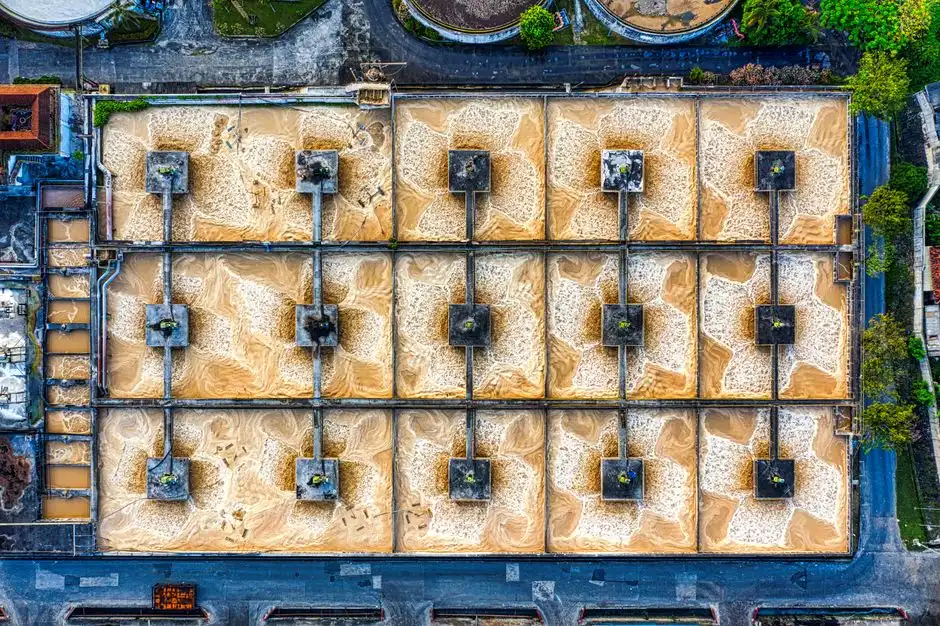
A lamella clarifier is gravity sedimentation compressed into a small footprint. Influent flows upward between inclined plates set at roughly 60°, giving each particle an effective settling path measured in centimeters rather than the meters a conventional basin would require. Solids slide down the plate face into a hopper while clarified water exits over the top weir. Hydraulic loading runs 20-40 m/h on the projected plate area (HydropureWater product data, 2026).
This mechanism wins when the contaminant is already self-flocculating: heavy-metal hydroxides from pH adjustment, sulfate or phosphate precipitates, calcium carbonate, silica, and dense inorganic TSS all settle rapidly under gravity and need no bubble lift. A properly flocculated hydroxide stream reaches 90%+ TSS removal with chemical consumption roughly 30% below a conventional clarifier (HydropureWater product data, 2026). Output sludge sits at 1-3% DS, so the downstream plate-and-frame press must be sized larger than for a DAF at the same solids load.
The footprint penalty versus a DAF is real: a lamella at 20-40 m/h still needs 2-5× the plan area of a DAF cell at the same flow, even though it is roughly 1/3 the area of a conventional clarifier. The geometry, plate spacing, and sludge hopper arrangement for this duty are detailed on the HydropureWater lamella clarifier for chemical plants page.
DAF vs Clarifier for Chemicals Wastewater: The 2026 Parameter Match-Up
This is the table the procurement team can screenshot into the 2026 CAPEX memo. None of the top three competing articles publish a consolidated chemical-stream head-to-head; the closest is the 1975 EPA Process Design Manual (S1), which is still cited by reviewers but predates modern polymer chemistry. The numbers below combine the Clean Technology Post 2026 DAF design ranges (S5) with the HydropureWater 2026 lamella product specifications and field installation data.
| Parameter | DAF | Lamella Clarifier | Hybrid: DAF + Lamella Polish |
|---|---|---|---|
| Removal mechanism | Microbubble flotation (10-100 µm bubbles) | Gravity sedimentation on 60° inclined plates | Flotation primary, sedimentation polish |
| Best-fit influent TSS | 100-3,000 mg/L | 200-10,000 mg/L | 200-5,000 mg/L (full envelope) |
| Best-fit FOG / O&G | 50-5,000 mg/L (emulsified oil OK) | <100 mg/L, free oil only | 50-2,000 mg/L |
| Hydraulic loading | 5-30 m³/m²·h (HR-DAF up to 50) | 20-40 m/h projected plate area | DAF at 20-30, lamella polish at 20-30 |
| Sludge %DS | 2-6% (thick float) | 1-3% (bottom underflow) | 2-5% blended |
| Chemical demand | Moderate-high (coagulant + polymer + saturator chemistry) | Low-moderate | Moderate (shared dosing) |
| Footprint per m³/h | Small (≈0.05-0.1 m²) | Medium (≈0.2-0.4 m²) | Medium-large |
| Energy kWh/m³ | 0.05-0.15 (recycle pump + compressor) | 0.02-0.05 (rake + sludge pump) | 0.07-0.18 |
| Typical 2026 CAPEX (US$/m³/day installed, typical market band, verify with vendor quotes) | US$3,500-7,000 | US$1,800-3,500 | US$5,500-10,000 |
The hybrid train is the 2026 default for mixed chemical streams where a batch release can swing the influent from emulsion to hydroxide floc within a single shift. A shared HydropureWater PLC-controlled coagulant and polymer dosing skid feeding both vessels keeps the chemistry coherent and lets one operator tune A/S and polymer dose from a single HMI.
Matching the Technology to Your Cleburne Stream: A Decision Framework
Three questions, ten minutes, plant floor:
Q1 — What is the dominant contaminant? Free or emulsified oil, surfactants, or polymer floc points to DAF. Heavy-metal hydroxide, calcium sulfate, silica, or any dense inorganic precipitate points to lamella. A stream that alternates between the two (the Cleburne specialty-batch reality) almost always runs DAF primary, lamella polish.
Q2 — What is the influent TSS band? Under 1,000 mg/L and a tight footprint matters: DAF wins on consistency and area. Over 2,000 mg/L and chemical cost dominates: lamella wins, unless the same stream also carries oil, in which case DAF primary remains the right call because the float blanket handles both phases.
Q3 — Where does the water go? Discharge to the Cleburne POTW means confirming the local limits on FOG, metals, and pH before sizing — the Johnson County pretreatment program is the binding local rule, and the EPA Process Design Manual (1975) still defines the design basis reviewers expect to see on the calc sheet. On-site evaporation or zero-liquid-discharge almost always defaults to DAF as primary because the 2-6% DS float cuts evaporator feed volume significantly. The same triage logic appears in our 2026 chemicals-wastewater DAF vs clarifier guide for Morristown plants.
2026 CAPEX, OPEX and Pilot-Test Checklist for a Cleburne Plant
The 2026 installed-cost band the procurement team can defend in front of operations leadership: DAF US$3,500-7,000 per m³/day, lamella US$1,800-3,500 per m³/day, hybrid DAF + lamella US$5,500-10,000 per m³/day — all as typical 2026 market bands, to be verified with vendor quotes against the specific Cleburne site, tariff, and structural constraints (HydropureWater field data, 2026). OPEX rule of thumb: DAF consumes 2-3× the electricity of a lamella per cubic meter treated because of the saturator and recycle pump, but it produces 2-3× thicker sludge, which cuts downstream dewatering and disposal cost back down. The 1975 EPA Process Design Manual is still the cited source for O&M cost curves when permit reviewers ask.
Pilot-test checklist to hand to the vendor before signing:
- Run a 4-6 week on-site jar + pilot trial, not a benchtop-only study.
- Measure A/S ratio sweep, polymer dose, residual TSS and FOG, sludge %DS, and polymer carryover at the pilot outlet.
- Capture at least one upset event (emulsion breakthrough, pH swing) and record recovery time.
- Require the vendor to provide a mass balance and a downstream dewatering guarantee tied to the HydropureWater plate-and-frame filter press for chemical sludge dewatering cake target.
- Reject any vendor that will not support a pilot — for chemical streams, a pilot is the only defensible basis for sizing.
For an outside-region sanity check, the companion 2026 guide on DAF vs clarifier for chemical plants in Bishop runs the same framework against a different influent envelope.
Frequently Asked Questions
What TSS and FOG removal can a DAF realistically hit on a chemical stream in 2026?
A correctly sized DAF on an emulsified chemical stream removes 80-95% FOG and 70-90% TSS at hydraulic loadings of 5-30 m³/m²·h (Clean Technology Post, 2026-08), with sludge at 2-6% dry solids.
Is a lamella clarifier ever the right primary for a chemical plant?
Yes — when the dominant contaminant is heavy-metal hydroxide, calcium sulfate, silica, or another dense inorganic precipitate, a lamella at 20-40 m/h reaches 90%+ TSS removal with chemical consumption roughly 30% below a conventional basin (HydropureWater product data, 2026).
Does 40 CFR 414 force a specific technology choice?
No. 40 CFR 414 sets BPT/BAT effluent limits for the Organic Chemicals, Plastics, and Synthetic Fibers category but is performance-based; the local TCEQ TPDES or Johnson County POTW pretreatment permit then enforces those limits, leaving the equipment selection to the discharger.
How long should a chemical-stream DAF or lamella pilot run before a CAPEX commitment?
Plan a 4-6 week on-site pilot that covers normal batches plus at least one upset event, with A/S ratio, polymer dose, residual TSS/FOG, and sludge %DS logged — anything shorter does not give the vendor a defensible mass balance.