Why Plastics and Rubber Wastewater in Huntington Is a Different Problem
Huntington's plastics and rubber plants — most of them in the Kanawha Valley industrial corridor and falling under SIC codes 3086 (plastics foam products) and 3089 (plastics products, not elsewhere classified) — discharge a wastewater profile that generic food-and-beverage or petroleum comparisons do not capture. Four stream archetypes drive the DAF-vs-clarifier decision: extrusion washwater with plastic pellet and fiber fines, injection molding coolant contaminated with mold-release oil, tire and rubber vulcanization blowdown carrying carbon black and zinc, and latex processing overflow with buoyant unvulcanized rubber. The contaminants are not interchangeable: pellet density sits near water at 0.92-1.05 g/cm³, free oils from mold release form a stable surface layer, and polymer additives such as TiO₂ and carbon black behave as fine colloids rather than settleable grit. Trace organotins from PVC heat stabilizers add a chemical risk that physical primary treatment cannot resolve on its own.
For 2026 capital planning, two regulatory and risk frames apply simultaneously. Nationally, 40 CFR Part 414 (the Plastics Point Source category) governs SIC 3086-3089 discharges; locally, Huntington plants sending wastewater to a POTW must also satisfy 40 CFR Part 403 categorical limits and West Virginia Department of Environmental Protection pretreatment program rules. Microplastics from plastics manufacturing washwater are an active research and regulatory concern, as documented in a 2021 review in Reviews in Environmental Science and Bio/Technology (sources: 10.1007/s11157-021-09609-6, 2021) — meaning primary solids capture is no longer just a permit checkbox, it is an ESG reporting line. For a broader 2026 effluent-limits reference, see this petrochemical wastewater discharge standard comparison.
DAF vs Clarifier: How Each Technology Actually Separates Solids
A dissolved air flotation (DAF) unit saturates a portion of clarified effluent with air at 4-6 bar, then releases that pressure inside the flotation tank. Microscopic bubbles in the 30-70 μm range nucleate on or attach to suspended particles, lowering their effective density and floating them to the surface, where a mechanical skimmer removes the thickened float. Per the EPA Process Design Manual for Suspended Solids Removal (Section 7.8, Table 7-4), DAF is the indicated technology for oils, greases, and low-density solids — exactly the latex, mold-release oil, and unvulcanized rubber fraction typical of plastics and rubber plants. A gravity clarifier does the opposite work: it relies on quiescent conditions so that particles denser than water settle under Stokes' law, with sludge collected on the floor by a rotating scraper mechanism. Per EPA Table 7-2, primary clarifier overflow rates run 1-3 m/h with detention times of 1.5-2.5 hours, optimized for particles whose specific gravity exceeds roughly 1.05.
The practical differences for a space-constrained Huntington facility are large. DAF surface loading rates of 20-40 m/h are 5-10× higher than clarifier rates, so a single skid-mounted DAF cell replaces a much larger concrete basin. Sludge character diverges sharply: DAF float typically runs 3-6% dry solids and can feed a filter press directly, while clarifier underflow is 0.5-2% DS and almost always needs thickening. On the chemistry side, DAF commonly uses 1-5 mg/L of anionic or non-ionic polymer to bridge fine bubbles onto particles; clarifiers generally require higher coagulant doses to weight floc and accelerate settling. For a 2026 reference on coagulant selection, see the PAC dosing for plastics wastewater coagulation guide.
| Parameter | Dissolved Air Flotation (DAF) | Gravity Clarifier |
|---|---|---|
| Separation mechanism | Buoyancy-driven (30-70 μm micro-bubbles) | Gravity sedimentation |
| Surface loading rate | 20-40 m/h | 1-3 m/h |
| Typical detention time | 20-40 minutes | 1.5-2.5 hours |
| Best-fit particle density | <1.0 g/cm³ (oils, latex, fines) | >1.05 g/cm³ (mineral fillers, heavy grit) |
| Sludge dry solids | 3-6% (float, pre-thickened) | 0.5-2% (underflow, requires thickening) |
| Footprint for 50 m³/h | ~6-10 m² (skid) | ~50-80 m² (basin) |
| Polymer/coagulant demand | Low (1-5 mg/L polymer typical) | Higher coagulant dose for floc weighting |
| EPA reference | Section 7.8, Table 7-4 | Section 7.5, Table 7-2 |
Plastics and Rubber Stream Performance: DAF vs Clarifier Head-to-Head
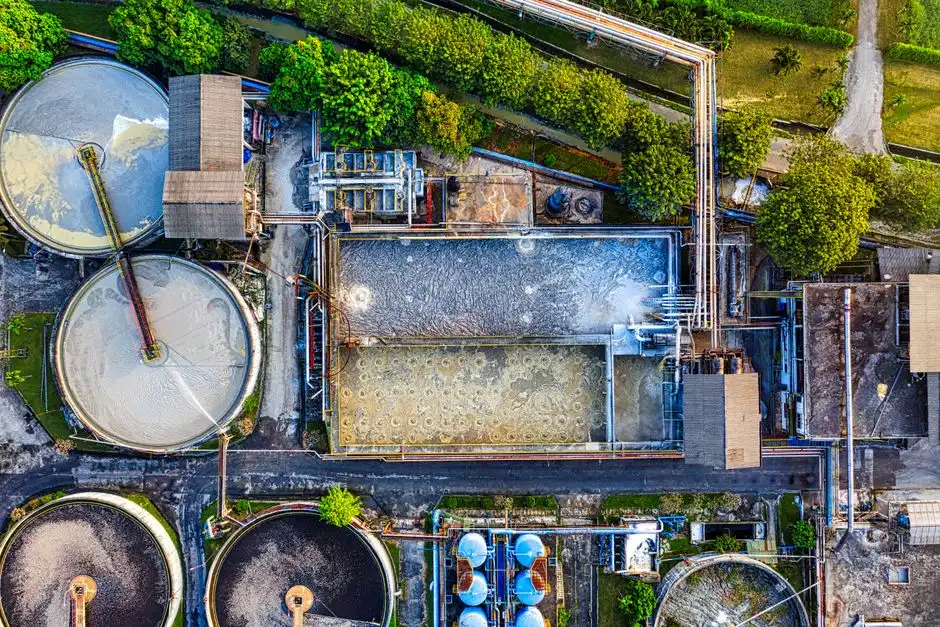
For latex carryover and unvulcanized rubber overflow, DAF is the clear winner. HydropureWater field data from polymer and rubber processing clients (2026) shows DAF achieving 90-95% FOG and TSS removal on buoyant streams, while a clarifier struggles below 50% on the buoyant fraction because the particles either float or stay in suspension rather than settle. Injection molding coolant streams with mold-release oil behave the same way: the free-oil phase floats regardless of detention time, and DAF with low-dose polymer is the only primary step that pulls it out consistently. A 95% DAF vs 70% clarifier gap is documented in food-grade oil applications (per S3 industry comparison) and translates directly to mold-release oil behavior, since both are emulsified neutrally buoyant oils at the particle scale.
Plastic pellet and fiber fines from extrusion washwater are a different problem. Pellet density of 0.92-1.05 g/cm³ means some fractions sink and some stay neutrally buoyant; DAF still works but polymer demand rises because bridging neutrally buoyant particles is harder than attaching to a buoyant oil droplet. A quiescent gravity clarifier or lamella settler handles the heavier pellet fraction at lower chemical cost, making it the right primary choice when the stream is dominated by fines and heavy mineral additives. Tire and vulcanization blowdown with carbon black and zinc is genuinely hybrid: clarifier is favored when CAPEX dominates and footprint is available, while DAF is favored when floor space is constrained. For organotin-contaminated PVC streams, neither technology is sufficient on its own — both are physical primary steps, and full organotin removal requires downstream chemical precipitation per the 2021 microplastics literature (source: 10.1007/s11157-021-09609-6, 2021). The 2026 spec most Huntington plants end up with is a hybrid: DAF primary for oil and latex, equalization, then a lamella clarifier or DAF-polish step before biological or tertiary treatment. For a parallel 2026 comparison on a different industry, see the DAF vs clarifier for food and beverage wastewater guide.
| Plastics/Rubber Sub-Stream | Key Contaminant | Density / Phase | DAF Removal | Clarifier Removal | Recommended Primary |
|---|---|---|---|---|---|
| Latex / unvulcanized rubber overflow | Buoyant latex, FOG | <1.0 g/cm³ | 90-95% | <50% on buoyant fraction | DAF |
| Injection molding coolant | Mold-release oil, fines | Emulsified oil | 90-95% FOG/TSS | 50-70% | DAF |
| Extrusion washwater | Plastic pellet/fiber fines | 0.92-1.05 g/cm³ | 70-85% | 60-75% | Clarifier / lamella (or hybrid) |
| Vulcanization blowdown | Carbon black, zinc, rubber | Mixed density | 80-90% | 70-80% | Either; DAF if footprint-limited |
| PVC stabilizer stream | Organotins (trace) | Dissolved / colloidal | Marginal alone | Marginal alone | Physical primary + chemical precipitation |
Huntington, WV Compliance and Site Considerations for 2026
Federal applicability is the first filter. 40 CFR Part 414 sets plastics SIC 3086-3089 effluent limits for direct discharges, and any plant sending wastewater to a POTW in the Huntington area also triggers 40 CFR Part 403 categorical standards and local limits enforced by the West Virginia Department of Environmental Protection pretreatment program. For rubber manufacturers under SIC 3011 (tires) or 3021 (rubber footwear), 40 CFR Part 428 (Rubber Processing Point Source category) is the parallel federal driver, with direct-discharge limits on BOD, TSS, and zinc — the last being a frequent pretreatment concern in tire plants. A useful cross-industry reference for heavy-metal precipitation in industrial wastewater is the chromium reduction and precipitation guide, which uses comparable hydroxide precipitation chemistry to zinc control.
Site constraints in the Huntington/Kanawha Valley corridor favor compact, enclosed equipment. Many legacy buildings have limited floor area and combined sewer overflow sensitivity, which works against large open clarifier basins. Discharge to Ohio River tributaries adds another reason to keep primary solids capture tight. Pellet loss prevention has also tightened: with microplastics research and state-level microplastics action plans gaining momentum (per the 2021 review at 10.1007/s11157-021-09609-6), primary solids capture is now both a compliance and ESG metric. Huntington winter conditions do not meaningfully impair DAF or clarifier performance, but indoor installation is preferred for DAF so the saturation tank stays at a stable temperature and microbubble formation remains consistent year-round.
Cost and Selection Framework: DAF or Clarifier for Your 2026 Project

Directionally — and these are directional, not quoted, figures — skid-mounted DAF systems carry lower installed cost at flows below roughly 200 m³/h because they eliminate the civil work of a concrete clarifier basin. Above that flow, cast-in-place clarifiers tend to win on raw CAPEX. On OPEX, clarifiers have lower energy and consumable costs, but DAF reduces downstream sludge handling expense because the float leaves the unit at 3-6% dry solids versus 0.5-2% for clarifier underflow, which directly cuts filter press cycle time and polymer consumption downstream. A useful rule of thumb for the 2026 specification: choose DAF if the stream contains more than ~20% buoyant material (oil, latex, unvulcanized rubber), if footprint is constrained, or if downstream sludge thickening is a bottleneck; choose a clarifier if the stream is dominated by heavy mineral fillers or plastic pellet fines, if flow is high, and if CAPEX must be minimized. For the 10-150 m³/h range typical of mid-sized Huntington plastics SIC 3086 plants, the most common 2026 specification is a packaged dissolved air flotation system as primary, followed by a high-efficiency lamella clarifier as polish, with a plate and frame filter press handling the combined sludge stream.
Mobile DAF is also worth specifying for 2026 capital reviews: a single-day-deploy trailer unit (typical 47'6" to 51'7" footprint) covers pilot testing, peak-load events, and maintenance bypass without committing to permanent civil work. This is the route several Huntington plants have used to validate DAF performance on their actual latex stream before locking in a permanent installation.
| Decision Driver | Choose DAF | Choose Clarifier |
|---|---|---|
| Stream buoyancy | >20% buoyant (oil, latex, unvulcanized rubber) | Mostly heavy / mineral solids |
| Design flow | Best at 4-200 m³/h per skid | Best at >200 m³/h with civil basin |
| Footprint | Compact skid (5-10× higher surface loading) | Requires large basin area |
| Sludge handling downstream | 3-6% DS float (filter-press ready) | 0.5-2% DS (needs thickening) |
| CAPEX priority | Lower installed cost at small-mid flow | Lower installed cost at high flow |
| OPEX priority | Higher energy; lower sludge OPEX downstream | Lower energy; higher downstream sludge cost |
| 2026 typical spec for Huntington SIC 3086 (10-150 m³/h) | DAF primary + lamella polish | Clarifier (if stream is heavy-fines dominated) |
Frequently Asked Questions
Is DAF the right primary for latex wastewater in a plastics or rubber plant?
Yes. DAF is the preferred primary for latex and unvulcanized rubber because those particles are buoyant (specific gravity <1.0) and attach readily to 30-70 μm micro-bubbles, delivering 90-95% FOG and TSS removal in compact skid form. A dissolved air flotation system with 1-5 mg/L polymer is the standard 2026 specification for latex carryover streams.
Can a clarifier handle plastic pellet fines from extrusion washwater?
Yes, for the heavier fraction. Pellet density of 0.92-1.05 g/cm³ means a quiescent gravity or lamella clarifier will settle 60-75% of fines at lower chemical cost than DAF. For mixed-density streams or where footprint is tight, DAF still works but polymer demand rises because bridging neutrally buoyant particles is harder than floating an oil droplet.
Does 40 CFR Part 414 apply to a plastics plant discharging to a Huntington POTW?
Yes, with an additional layer. 40 CFR Part 414 governs SIC 3086-3089 plastics manufacturing effluent limits nationwide; any plant discharging to a POTW must additionally satisfy 40 CFR Part 403 categorical pretreatment standards and the West Virginia Department of Environmental Protection's local limits. Rubber manufacturers under SIC 3011 or 3021 are covered instead by 40 CFR Part 428, which adds zinc limits to the BOD/TSS baseline.
What is the typical 2026 capital spec for a mid-sized Huntington plastics plant?
For 10-150 m³/h, the dominant 2026 specification is a packaged DAF primary for oil and latex removal, followed by a lamella clarifier polish for fines, with a plate and frame filter press for combined sludge dewatering. This hybrid balances the 5-10× footprint advantage of DAF against the lower chemical cost of gravity settling for the heavy-fines fraction.
Can a mobile DAF unit be used for pilot testing before committing to a permanent install?
Yes. Mobile DAF trailers (typical 47'6" to 51'7" footprint, single-day deployment) are widely used in 2026 for pilot testing latex and oil streams, covering peak-load events, and providing maintenance bypass. They let a plant validate removal performance on its actual wastewater chemistry before locking in a permanent capital specification.
Related Equipment
- HydropureWater automatic chemical dosing system — specifications, capacity range, and technical data