
What Hampton Chemical Plants Are Actually Discharging in 2026
Hampton's chemical manufacturing base — paints and coatings, adhesives, specialty batch reactors, resins, and agrochemical formulation — generates a wastewater profile that does not match the food-processing or refinery case studies most DAF vs clarifier articles are written for. A typical 2026 composite influent from a Hampton chemical plant runs pH 3–11 across batch campaigns, COD 1,000–15,000 mg/L, TSS 200–3,000 mg/L, and FOG 100–2,000 mg/L, with episodic spikes of copper, nickel, and zinc from catalyst residues and occasional solvent carryover from cleaning cycles (HydropureWater field data, 2026). Free oils, emulsified cutting fluids, and surfactant-stabilized dispersions all show up in the same sewer, often commingled with carbonate or hydroxide metal precipitates from pH neutralization.
The federal framework that governs this discharge is 40 CFR Part 414 — the Effluent Limitations Guidelines for the Organic Chemicals, Plastics, and Synthetic Fibers (OCPSF) point source category. Subpart C covers resins, subpart D covers thermoplastics, and the remaining subparts govern paints, adhesives, agrochemical formulating, and specialty batch operations typical of the Hampton Roads corridor. The numerical limits in Part 414 (BOD, TSS, COD, and selected metal and solvent parameters) define the floor of what a pre-treatment train must hit before flow reaches the local authority.
On the local side, the receiving POTW is almost always the Hampton Roads Sanitation District (HRSD) under a VPDES (Virginia Pollutant Discharge Elimination System) permit, and HRSD's industrial pretreatment program imposes its own local limits — typically tighter than the federal categorical standards for FOG, sulfide, and certain metals. Any 2026 capital project has to clear both gates: 40 CFR 414 categorical limits and the HRSD local limits on the discharge permit.
DAF vs Clarifier: How Each Technology Actually Treats Chemical Wastewater
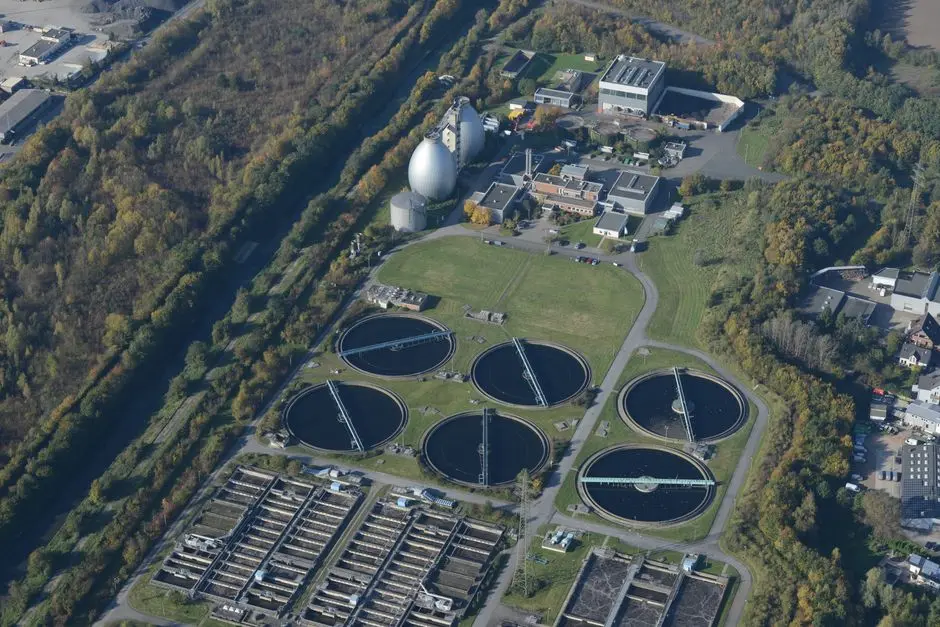
Dissolved air flotation (DAF) systems generate a saturated recycle stream — typically 20–40% of forward flow — in a pressure vessel, then release it into the flotation tank at atmospheric pressure. The pressure drop produces 20–80 µm micro-bubbles that attach to oil droplets, FOG globules, and pre-flocculated colloids, lifting them to the surface where a skimmer removes the float layer. The mechanism depends on bubble–particle contact, not particle density, which is why DAF works on materials that will never settle: sub-100 µm oil droplets stabilized by surfactants, and fine colloidal solids with density near that of water.
Gravity clarifiers — circular, rectangular, or lamella (inclined-plate) — rely on Stokes-law settling. Particles with density appreciably greater than water drop to the sludge bed under quiescent conditions; lamella plates shorten the effective settling path and boost surface loading, but the physics still requires particle density > water. A lamella clarifier for heavy-solids chemical streams is mechanically simple: no saturator vessel, no recycle pump, no air compressor, and sludge is raked or scraped to a central hopper.
The chemistry-aware framing is this: emulsified oils, surfactant-stabilized dispersions, and FOG are below the density threshold for gravity settling and will report through a clarifier into the overflow. Heavy-metal hydroxides, calcium carbonate, and other high-density inorganic precipitates settle cleanly and economically in a clarifier; forcing them through a DAF consumes polymer and air for no removal benefit. The technology choice is a function of which contaminant physically drives the discharge problem, not a generic preference for one device over the other.
Neither technology alone covers the 40 CFR 414 envelope. Both DAF and clarifier are pre-treatment steps that strip a fraction of BOD, TSS, FOG, and metals before the flow reaches biological polishing — typically an activated-sludge or MBBR unit downstream of equalization.
Removal Performance on the Contaminants That Drive 40 CFR 414 Compliance
The following table maps the dominant contaminants in a Hampton chemical plant discharge to the removal performance each technology delivers with proper chemical pretreatment. The numbers come from installed-system data: DAF FOG and TSS at 95–97% with coagulant/flocculant dosing (per I&E Services, 2026), and clarifier settleable-solids removal at 85–90% with FOG at 65–75% (per Ecologix, 2026).
| Contaminant | DAF removal (with chemical pretreatment) | Clarifier removal (with chemical pretreatment) | 40 CFR 414 driver |
|---|---|---|---|
| FOG (fats, oils, grease) | 90–97% | 65–75% | Local HRSD limit; indirectly BOD/TSS |
| Free oils (un-emulsified) | 95%+ | 70–80% | Local HRSD limit; BOD load |
| Emulsified oils / surfactants | 85–95% | <40% | BOD, COD, pass-through to POTW |
| Total suspended solids (TSS) | 90–97% | 85–90% settleables only | 40 CFR 414 TSS daily max |
| Heavy metals (Cu, Ni, Zn) as hydroxides | 70–90% with coagulant | 85–95% as settled precipitate | 40 CFR 414 metals; HRSD local |
| Settleable solids | 80–90% | 85–90% | TSS, sludge volume |
| Particulate BOD | 70–85% | 60–75% | 40 CFR 414 BOD daily max |
The two structural blind spots are visible in the table. Emulsified oils are the clarifier's weak point — below 40% removal because the droplets do not settle. Heavy-metal precipitates are the DAF's higher-cost case, because they settle well and forcing them through a DAF trades capital and polymer for no removal gain. A 40 CFR 414-driven train reads directly off this table: the row that contains the plant's permit-limiting parameter points to the technology that hits the number.
A 2026 Decision Framework: DAF, Clarifier, or Hybrid for Hampton Chemical Plants
The decision reduces to three branches, set by the dominant contaminant in the composite influent.
- FOG- and emulsified-oil-dominant stream. Paints, coatings, adhesives, and agrochemical formulating plants typically run this profile. Specify a DAF system for chemical wastewater pretreatment sized at 10–25 m/h hydraulic surface loading, with a coagulant/flocculant dosing train in front of it. A clarifier alone will not meet FOG limits on this stream.
- Heavy-metal-precipitate and settleable-solids-dominant stream. Plants with large acid-wash or catalyst-recovery operations produce high-density inorganic sludge that settles cleanly. A lamella clarifier for heavy-solids chemical streams delivers 85–95% metal removal at lower OPEX, with no air compressor or saturator vessel in the scope.
- Mixed stream, or any 2026 expansion sized to a 40 CFR 414 envelope that includes both FOG and metals. Run a DAF first to strip FOG and colloids, then a clarifier (often lamella) to polish settleables and capture the metal-precipitate load the DAF passes through. This hybrid is the default configuration for new chemical-plant pre-treatment in 2026 and is the configuration most HRSD permit reviewers expect to see in a design basis.
Selecting the right technology often depends on spatial constraints and operating costs. DAF surface loading runs 10–25 m/h versus a conventional circular clarifier at 1–2 m/h, so a DAF occupies roughly 1/10th the footprint for the same hydraulic load. On a Hampton site with constrained bay space, a DAF or lamella clarifier beats a conventional circular clarifier every time.
OPEX runs the other direction. A clarifier has no recycle pump, no air compressor, and a lower polymer dose; a DAF's energy and consumable budget is materially higher. The DAF offsets part of that with a thicker float — typically 3–6% solids versus clarifier underflow at 1–3% — which reduces downstream sludge-hauling or dewatering cost per ton.
Cost, Footprint, and Operating Reality in 2026
The 2026 capital and operating picture for a small-to-mid Hampton chemical plant (50–500 m³/d influent) tracks the table below. Numbers are order-of-magnitude ranges drawn from installed-system data; site-specific quotes vary with tank material, instrumentation, and HRSD permit conditions.
| Cost / operating dimension | DAF unit (skid-mounted) | Lamella clarifier | Hybrid DAF + clarifier |
|---|---|---|---|
| Relative CAPEX (same hydraulic load) | High (1.0–1.4× baseline) | Low–moderate (0.6–0.9×) | Highest (1.5–2.0×) |
| Footprint | Small (10–25 m/h loading) | Small with lamella; large if circular | Moderate; two units in series |
| Power draw (kW·h/m³) | 0.3–0.6 (recycle pump, saturator) | 0.05–0.15 (rake drive only) | Sum of both trains |
| Polymer / coagulant consumption | Higher | Lower | Moderate; DAF stage drives most dose |
| Float / sludge solids | 3–6% (thick float) | 1–3% (thin underflow) | 3–6% from DAF, 1–3% from clarifier |
| Sludge dewatering cost / ton | Lower (thicker feed) | Higher (thinner feed) | Blended |
| Maintenance labor | Skimmer, recycle pump, saturator service | Rake and drive service | Sum of both |
Two design points are worth carrying into a capital review. First, the DAF float's higher solids content cuts downstream sludge dewatering downstream of DAF or clarifier cost per ton by reducing cake-handling volume, which partially offsets the higher DAF OPEX. Second, an automated coagulant and flocculant dosing skid in front of either technology is no longer optional in 2026 — HRSD permit reviewers expect to see jar-test-derived dose setpoints and trending on the P&ID, not a manual feed drum.
For Hampton chemical teams comparing this to the same decision in other regions, the DAF-vs-clarifier logic is consistent, but the receiving-permit envelope changes — see the same DAF vs clarifier decision for chemical plants in Bishop and the Morristown chemical plant DAF vs clarifier 2026 guide for comparable frameworks outside Virginia. For petroleum and refinery streams the trade-off shifts toward the API separator side of the DAF/clarifier question, as covered in the DAF vs clarifier for petroleum and refinery streams guide.
Frequently Asked Questions
Does a DAF or a clarifier meet 40 CFR Part 414 limits on its own?
Rarely. 40 CFR Part 414 sets BOD, TSS, and COD daily maximums that no single physical pre-treatment step reliably hits on a chemical-plant composite. A DAF or clarifier is pre-treatment in front of a biological polishing stage (activated sludge or MBBR) sized to deliver the final
Frequently Asked Questions
Should a chemical plant in Hampton choose DAF or clarifier in 2026?
The choice between Dissolved Air Flotation (DAF) and conventional clarification depends primarily on the density and settling velocity of the chemical contaminants. In 2026, Hampton facilities with high concentrations of light, non-settleable particles, oil emulsions, or hydrophobic organic compounds typically favor DAF units due to their superior performance in removing low-density solids that otherwise resist gravity settling.
Conversely, if the wastewater stream contains high-density inorganic solids or heavy metal precipitates, a conventional circular or rectangular clarifier remains the industry standard. Many modern Hampton plants are opting for DAF systems as a primary pretreatment step to reduce the hydraulic and solids loading on downstream biological treatment processes, ensuring compliance with tightening local discharge ordinances.
What is the typical FOG and TSS removal for a DAF in chemical wastewater?
When properly optimized with coagulants and flocculants, a well-designed DAF system typically achieves Fats, Oils, and Grease (FOG) removal rates between 85% and 98%. The performance depends heavily on the air-to-solids ratio and the specific chemical characteristics of the waste stream.
For Total Suspended Solids (TSS), DAF units generally achieve removal efficiencies ranging from 70% to 90%. While these numbers are consistent with current 2026 performance benchmarks, achieving the higher end of this range requires precise control of the recycle flow rate and bubble size distribution, typically targeting 30 to 50 microns to maximize particle attachment.
Does a DAF system meet 40 CFR 414 effluent limits for organic chemicals?
A DAF system acts as a critical pretreatment technology to assist in meeting 40 CFR 414 effluent guidelines, but it is rarely a standalone solution for complex organic chemical streams. While DAF is highly effective at removing particulate-bound pollutants that contribute to COD and BOD loads, it does not remove dissolved organic compounds or volatile organic chemicals (VOCs).
To comply with specific Organic Chemicals, Plastics, and Synthetic Fibers (OCPSF) standards, the DAF must be integrated into a treatment train that includes secondary biological treatment or advanced oxidation processes. The DAF ensures that the influent to these secondary systems stays within the design parameters required to satisfy the stringent numeric effluent limitations set by 40 CFR 414.
Can a DAF and a clarifier be used together for chemical plant wastewater?
Yes, utilizing both systems in a serial configuration is a common high-performance design for chemical plants with complex waste streams. In this setup, the clarifier is often used as a primary settler to remove heavy, bulk solids, while the DAF follows to polish the effluent by floating lighter, emulsified, or colloidal particles that the clarifier cannot capture.
This hybrid approach protects the DAF from excessive grit and heavy sludge loading, which extends the operational life of the DAF’s saturation system and skimmer mechanisms. Furthermore, this combined configuration significantly improves the consistency of the final effluent quality, providing a robust buffer against process upsets or fluctuations in raw wastewater characteristics.
How much does an industrial DAF system cost for a chemical plant?
As of 2026, the capital cost for an industrial-grade DAF system tailored for chemical wastewater typically ranges from $150,000 to over $600,000. This price variance is driven by the required flow capacity, the use of corrosion-resistant materials like 316L stainless steel, and the level of automation integrated into the control system.
Beyond capital expenditure, operators should budget for annual operating costs, which include chemical consumption (coagulants, polymers, and pH adjusters), power for the recycle pump and air compressor, and sludge disposal fees. When evaluating the total cost of ownership, chemical plants must account for the reduction in surcharges paid to municipal treatment works and the potential for water reuse, which can significantly improve the project's return on investment.