Why Dixon's Rock River Mills Are a Special Case in 2026
A Dixon, Illinois pulp and paper mill sits inside one of the most under-rated cold-climate envelopes in the U.S. paper industry. Lee County sits in USDA hardiness zone 5b, with January mean lows around 12°F (-11°C) and process-water temperatures on the Rock River routinely dropping into the mid-30s°F (1-3°C) from December through March (NOAA normals, 1991-2020). At those temperatures, water viscosity rises by roughly 50% versus 20°C, which clips a gravity clarifier's effective surface loading by 20-35% on the same stream (per Krofta Engineering, 2022). The Rock River carries a dissolved-oxygen TMDL, and Illinois EPA enforces 35 IAC 309 receiving-water standards alongside the federal 40 CFR Part 430 BAT envelope — a tighter regulatory bar than a generic Lewiston, Maine reading of the same rule set. Dixon's mill mix is dominated by tissue, recycled-fiber, and coated paper, which is exactly the neutrally-buoyant, fines-dominated stream where Stokes' Law fails: fibers, FOG, stickies, and titanium dioxide filler all settle at near-zero velocity.
How a DAF Clarifier Works on Paper-Mill Whitewater
A dissolved air flotation (DAF) clarifier separates by floating particles rather than settling them. A side stream of clarified effluent is pressurized to 60-80 psig in a saturator packed with air, then released at atmospheric pressure into the flotation cell. The pressure drop nucleates a cloud of 10-100 micron micro-bubbles that attach to fibers, fillers, FOG, and stickies — particles whose density sits within roughly 5% of water (Krofta, 2022). The bubble-particle agglomerate rises in 3-5 minutes and forms a 3-6% solids float that an automatic skimmer scrapes to a sludge trough; clarified underflow exits below through launder weirs at 20-30 mg/L TSS. The 2-3% thickened float requires no further thickening before a plate-and-frame press, which is the unit's economic centerpiece: fiber returns to the paper machine or to a ceiling-tile market, and the water loops back to the shower nozzles. For Dixon tissue and recycled-fiber lines specifically, the Supracell-style circular DAF with dual Air Dissolving Tubes absorbs broke-pulper dumps and coating-color spills without washing out, holding effluent TSS steady through 1.5-4.0 GPM/sqft hydraulic loading. A packaged DAF like the HydropureWater dissolved air flotation system covers 4-300 m³/h across 13 standard models and ships as a self-contained unit on a small pad.
How a Gravity or Lamella Clarifier Works on the Same Stream
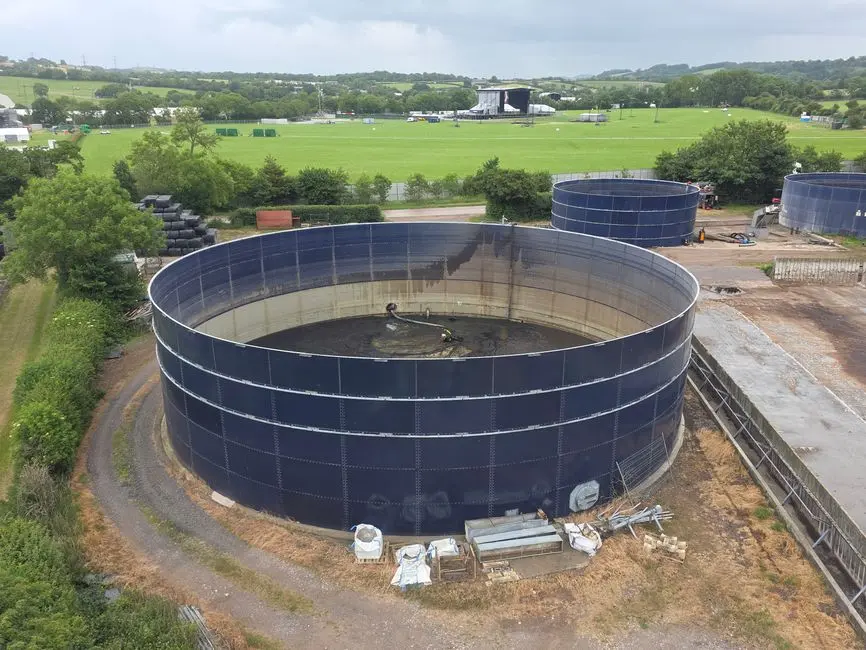
A gravity clarifier, or its higher-rate cousin the lamella clarifier, separates by settling. Polymer-conditioned floc enters a flocculation zone where cationic or anionic polyacrylamide bridges fines into heavier flocs, then flows into a settling zone where solids drop to a hopper bottom and clarified water spills over peripheral V-notch weirs. Lamella (inclined-plate) designs multiply the effective settling area: a well-designed inclined-plate unit packs 20-40 m/h of surface loading into roughly one-fifth the footprint of a conventional clarifier (HydropureWater lamella spec, 2026). The fundamental constraint is Stokes' Law — terminal settling velocity is inversely proportional to viscosity, so as the Rock River's winter intake water drops from 20°C to 4°C, the same clarifier settles its floc roughly one-third slower. Underflow leaves at 1-3% solids, which means a gravity belt thickener or rotary drum thickener sits between the clarifier and any downstream press, adding tankage, polymer, and OPEX. The HydropureWater high-efficiency sedimentation tank (lamella clarifier) is typically deployed as a primary TSS-reduction stage in a hybrid train where footprint is constrained and the stream is settleable.
DAF vs Clarifier: Parameter Matrix for a Dixon Paper Mill
The following table provides data for a 2026 capital-review slide.
| Parameter | DAF (Supracell / HydropureWater) | Gravity / Lamella Clarifier |
|---|---|---|
| TSS removal on fiber/filler streams | 70-95% (Ecologix, 2025; Krofta, 2022) | 50-80% on settleable solids; poor on fines |
| Hydraulic retention | 3-5 minutes | 1-3 hours |
| Effluent TSS (unit only) | 20-30 mg/L | 30-60 mg/L before polish |
| Footprint | Packaged unit, small pad; <150 lb/sqft when filled (Krofta, 2022) | Substantial civil works; stilling, floc tank, hoppers |
| Solids out | 3-6% float — press-ready | 1-3% underflow — needs thickening |
| Cold-weather sensitivity | Low; 10-15% recycle boost covers down to 34°F (1°C) | High; 20-35% loss of surface loading 20°C → 4°C |
| Fiber recovery | Built-in via float; back to machine or sold | Limited; watery underflow hard to re-fiber |
| Hydraulic loading | 4-5 GPM/sqft specific clarification capacity | Lamella 20-40 m/h; conventional 1-2 m/h |
| Siting / community risk | Float storage can trigger pushback if uncovered | Low profile; covered basins community-friendly |
| CapEx / OPEX bias | Higher air + polymer; lower sludge hauling | Lower equipment cost; higher civil + sludge volume |
The Illinois Permit Envelope: 40 CFR Part 430, 35 IAC 309, and the Rock River TMDL
The federal floor is 40 CFR Part 430, which sets Best Available Technology (BAT) effluent limits for TSS, BOD, and color by subcategory. What changes for a Dixon plant is the receiving-water envelope layered on top. Illinois 35 IAC 309.141 sets narrative and numeric water-quality standards, and the Rock River's dissolved-oxygen TMDL tightens the requirements during the July-September low-flow window. The failure mode the EPA's 1973 Gehm report (EPA-R2-73-184) flagged remains the same one Dixon operators see in January: "finely dispersed pigments and debris… in very low concentration impart opalescence to receiving waters. Present treatment methods are not adequate to handle this problem." Opalescence is what a settling-only train cannot fix. A 2026 Dixon spec should be benchmarked against the Part 430 BAT numbers in January, as winter is when the clarifier path is most likely to fall short of the permit during Lee County compliance checks.
Sized Recommendation for a 500-2,000 GPM Dixon Whitewater Line
For a 500 GPM tissue or recycled-fiber whitewater line, a single packaged DAF envelopes the flow inside one tank on a small pad, with no floc tank and no hopper excavation. For 1,000-2,000 GPM, two DAF cells in parallel or a single Supracell-style circular unit is the standard configuration; a documented 7,290 GPM (28,000 m³/day) single-unit Krofta installation (Krofta, 2022) confirms the technology is not the flow bottleneck. A lamella clarifier can match those flows in a smaller footprint than a conventional clarifier, but it still requires influent stilling, a floc tank, sludge hoppers, and a downstream thickening step. Because lamella underflow cannot hit the BAT color and TSS targets on coated or recycled-fiber streams alone, a polishing DAF or a multimedia filter is often added, which usually negates the capital-cost advantage of the lamella system. Where footprint truly forces a clarifier path, oversize the surface loading by 30% to absorb the winter viscosity penalty, and pair it with the HydropureWater dissolved air flotation system as a polish, the HydropureWater plate and frame filter press for dewatering, and a HydropureWater automatic chemical dosing system to keep polymer feed consistent across the winter-to-summer viscosity swing.
| Flow (GPM) | Recommended Primary | Notes |
|---|---|---|
| 500 | 1× packaged DAF | Single tank, small pad, no floc tank |
| 1,000 | 1× Supracell DAF or 2× DAF in parallel | Add covered float storage; press-ready 3-6% float |
| 2,000 | 1× large Supracell DAF | Documented up to 7,290 GPM single-unit (Krofta, 2022) |
| 500-2,000 (clarifier-forced) | Lamella, oversize 30% + DAF polish | Oversize to absorb 20-35% winter viscosity loss |
Float-Storage Siting: The Permit Risk Nobody Puts on the P&ID
The clarification technology is rarely the permit problem; the float storage tank is. Covered or enclosed DAF float tanks, scheduled haul-out, and early community engagement represent 2026 best practices. In February 2024, the Caroline County, Maryland commissioners imposed a temporary moratorium on new DAF storage facilities after resident complaints about odor, truck traffic, and visual impact during sludge removal. For Dixon, this means checking Lee County zoning, the local odor-nuisance ordinance, and the distance to the nearest residential receptor before the P&ID freezes. Pair the DAF with covered sludge storage and a HydropureWater plate and frame filter press to compress float to a stackable cake, shorten haul intervals, and minimize neighbor complaints. For regional mill profiles, see the DAF or clarifier for pulp and paper wastewater in Lewiston 2026 factory guide and the DAF or clarifier for pulp and paper wastewater in Jacksonville 2026 factory guide; for capital-cost context, the inclined plate settler cost price 2026 buyer's guide and ROI analysis reviews the lamella-side numbers.
Frequently Asked Questions
What effluent TSS can a DAF clarifier reliably hit on a Dixon tissue whitewater?
A properly sized DAF on a Dixon tissue or recycled-fiber whitewater delivers 20-30 mg/L TSS from the unit alone, with 70-95% removal across the full range of broke-pulper and coating-color upsets (Krofta, 2022; Ecologix, 2025). For a 500 GPM line, a single packaged unit from the HydropureWater dissolved air flotation system range covers the flow and hits that envelope.
How much does cold winter water actually reduce clarifier performance on the Rock River?
Water viscosity rises about
Frequently Asked Questions
What is the best clarifier for a pulp and paper mill in Dixon, Illinois?
The optimal choice depends on the specific fiber source and hydraulic load. For mills handling high-density recycled fiber or heavy solids loading, a primary circular gravity clarifier is generally preferred for its robustness and lower operational energy requirements. However, if the Dixon facility focuses on lightweight tissue or fine paper grades with significant colloidal solids, a Dissolved Air Flotation (DAF) unit is superior due to its high surface overflow rates and ability to achieve 90-95% suspended solids removal efficiency.
Can a gravity clarifier replace a DAF on a tissue or recycled-fiber line?
In most cases, a gravity clarifier cannot effectively replace a DAF in a tissue or recycled-fiber application because these processes generate significant amounts of low-density, hydrophobic fibers and fillers that do not settle readily by gravity. While a gravity clarifier typically operates at surface overflow rates of 0.5 to 1.0 gpm/sq ft, a DAF system can handle rates between 2.0 and 4.0 gpm/sq ft, allowing for a much smaller footprint while simultaneously achieving the necessary clarification for process water recycling.
How much does a DAF system cost for a 1,000 GPM paper mill in 2026?
As of 2026, a turnkey DAF installation for a 1,000 GPM flow rate, including the flotation tank, air saturation system, and chemical feed skids, typically ranges from $450,000 to $750,000. This estimate varies based on material selection—such as 304 vs. 316 stainless steel—and the level of automation required for integration with existing plant PLC systems. Factoring in site-specific civil works and piping connections in Illinois, total project capital expenditure often reaches the $1.2 million mark.
What is the TSS limit for pulp and paper mills in Illinois?
Pulp and paper mills in Illinois must comply with Illinois EPA Title 35 requirements and site-specific NPDES permits. While federal categorical standards (40 CFR Part 430) set baseline effluent guidelines, many Illinois discharge permits now mandate Total Suspended Solids (TSS) limits ranging from 20 mg/L to 50 mg/L on a monthly average, depending on the receiving stream's classification and local water quality standards. Mills discharging to municipal sewers must also adhere to local limits, which often cap TSS at 250-300 mg/L to avoid surcharges.
Does DAF work in cold winter weather below freezing?
DAF systems are highly effective in sub-freezing conditions provided the equipment is properly winterized. Because the flotation process relies on pressurized air saturation rather than temperature-dependent sedimentation velocity, the system performance remains stable even when ambient temperatures drop below 32°F. To prevent freezing of the inlet piping and the air saturation skids, external units should be housed in climate-controlled enclosures or equipped with heat tracing and insulation to maintain process water temperature above the freezing point.