Oak Creek Food & Beverage Wastewater in 2026: Why the DAF-vs-Clarifier Question Matters Now
For an Oak Creek dairy, meat processor, brewery or frozen-vegetable line discharging to the Milwaukee MSD system in 2026, a Dissolved Air Flotation (DAF) system is the default primary-treatment choice because the streams are dominated by fats, oils, grease (FOG) and light colloidal solids — Ecologix's 2026 selection guide reports that DAF removes 95% of oils and greases versus only 70% for a gravity clarifier on the same food stream. A lamella clarifier only wins when the load is heavy inorganic settleable solids with negligible FOG, which is rare in the Wisconsin F&B cluster that anchors Oak Creek, Cudahy, St. Francis and the Menomonee Valley.
Three forces make this a 2026 decision rather than a future planning item. First, Wisconsin DNR NR 215 industrial discharge limits and the supporting PUB-WT-008 design guidance continue to push effluent BOD and TSS downward for food processors with significant FOG loadings. Second, Milwaukee MSD's BOD/TSS/油脂 surcharge formula — applied monthly — turns every kilogram of FOG that leaves the plant un-treated into a direct debit, and the math has tightened in the current rate cycle. Third, a World Water Works meat-packing case study documents exactly the failure mode Oak Creek plants are trying to avoid: a legacy in-house skim tank that had been "modified over the years to meet decreasing effluent limits" but could no longer keep up, forcing a DAF retrofit once surcharges approached $40,000/month. The same case catalogue records a dairy that was paying over $30,000/month in surcharges before installing a DAF unit, then cut its wastewater bill by more than $20,000/month — a 12-24 month payback profile that finance teams accept without a five-year model.
DAF vs Clarifier at a Glance: 2026 Selection Matrix for Food & Beverage
Paste the table below into your project memo. It condenses the engineering trade-offs an Oak Creek plant manager has to weigh against Milwaukee MSD surcharges and Wisconsin DNR NR 215 expectations, and it keeps the FOG-vs-inorganic decision visible to a non-technical reviewer. The numbers are drawn from Ecologix's 2026 selection guide for the oil/grease removal headline and the World Water Works case catalogue for the surcharge economics, with clarifier TSS and DAF sludge solids cross-checked against the Claraqua DAF reference.
| Parameter | Dissolved Air Flotation (DAF) | Lamella / Gravity Clarifier | Oak Creek F&B Implication |
|---|---|---|---|
| Oil & grease removal | ~95% (Ecologix, 2026) | ~70% on the same F&B stream (Ecologix, 2026) | DAF wins decisively on dairy, meat, brewery streams |
| TSS removal on heavy settleables | 80-90% with coagulant/flocculant | Up to 90% on mining-style inorganic loads | Lamella still competitive for grit/soil-dominated streams |
| Surface loading rate | 5-25 m/h hydraulic, recycle-driven | 20-40 m/h on inclined plates (lamella) | Both viable, but DAF is footprint-limited not loading-limited |
| Float / underflow solids | 3-8% TS float sludge (Claraqua) | 1-3% TS underflow | DAF cake dewaters drier on a plate-and-frame press |
| Footprint at 50 m³/h | ~60% of equivalent clarifier area (Claraqua comparison) | Conventional clarifier needs larger floor; lamella reduces it | Matters on tight Oak Creek urban parcels |
| CAPEX / OPEX | Higher CAPEX, higher OPEX (polymer + saturator power) | Lower CAPEX, lower OPEX on simple streams | DAF premium is recovered in 12-24 months via surcharge reduction |
| Best fit in Oak Creek F&B | Dairy, meat/rendering, brewery, sauce, frozen veg with FOG | Heavy inorganic TSS, FOG < 50 mg/L, no floatable foam | DAF is the 2026 default; clarifier moves to polish duty |
The economic flip is worth restating: the dairy case study showed a $20,000/month surcharge reduction against an installed DAF CAPEX that pays back inside 24 months, and the meat-packing case showed the same trigger when surcharges climbed toward $40,000/month. A lamella clarifier has lower sticker price, but on a FOG-dominated stream it leaves the surcharge math untouched.
How Each Technology Works in a Food & Beverage Line
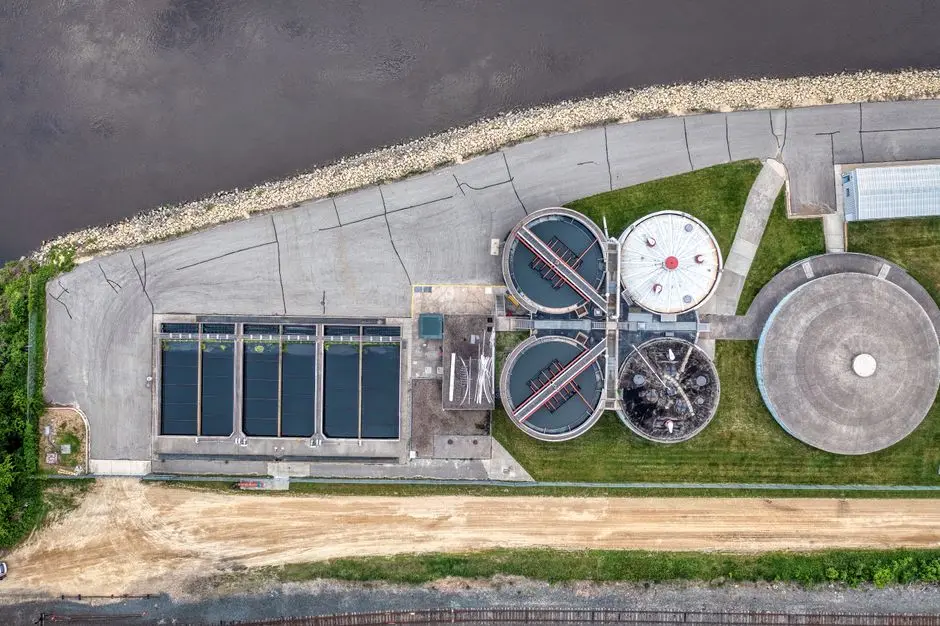
DAF and lamella clarifiers solve the same problem — separating suspended matter from water — using opposite physics. In an industrial DAF system for food and beverage wastewater, a sidestream of clarified effluent is pressurized to 4-6 bar (60-90 psi) in a saturator vessel where air dissolves into the water; when that recycle stream is released back into the main DAF tank at atmospheric pressure, a cloud of 20-80 micron micro-bubbles forms and attaches to floc that has been pre-formed by coagulant (alum, ferric sulphate or polyaluminium chloride) plus a polyacrylamide flocculant (Claraqua chemistry). The bubble-floc aggregate is buoyant and rises in minutes, producing a 3-8% TS float sludge that mechanical skimmers push to a sludge dewatering device.
A lamella clarifier for inorganic settleable solids does the opposite: feed enters a stack of inclined plates spaced at 50-80 mm, particles denser than water settle onto the plate faces under gravity, and clarified water rises counter-current. The geometry allows a surface loading rate of 20-40 m/h in a fraction of the footprint of a conventional clarifier — but the separation still depends on the particle being heavier than water. Dairy whey fines, meat rendering fats, and brewery kettle trub are buoyant by design, which is why the same physics that makes a clarifier excellent for mining tailings fails on a cheese plant.
The two technologies are not mutually exclusive in a modern food plant. World Water Works' MBBR → DAF case studies validate a hybrid train in which a DAF removes FOG and light colloids upstream of biological treatment, and a small lamella polishes biological solids downstream. The clarifier is not dead in 2026 — it has just moved one unit operation back from primary duty.
Dairy, Meat, and Brewing Sub-Decisions for Oak Creek Plants
The default technology flips depending on what is in your equalization tank. The three sub-decisions below are written for the line-of-business mix an Oak Creek plant manager actually faces on a Monday morning, not the abstract "food processing" category that national vendors use.
Dairy (fluid milk, cheese, yogurt, ice cream). Streams carry high FOG from butterfat, whey fines and CIP caustic surges, and the variability between a cheese make and a clean-in-place rinse can swing BOD by an order of magnitude inside a shift. The default is an industrial DAF system for food and beverage wastewater sized to peak flow with chemical conditioning. The World Water Works dairy case study is the closest analogue: a fluid-milk / yogurt / juice facility paying over $30,000/month in Milwaukee MSD-style surcharges, then cutting its wastewater bill by more than $20,000/month after a DAF was installed for primary treatment. That is a finance-defensible number, not a marketing one.
Meat processing and rendering. Legacy skim tanks — the World Water Works meat-packing case study calls them out specifically — "have been modified over the years to meet decreasing effluent limits, but more improvements were necessary" once surcharges approached $40,000/month. The proven 2026 path in this segment is a DAF with float sludge pumped directly to a plate-and-frame press for DAF float sludge to reach a haulable cake; chemical conditioning with an automatic dosing skid is mandatory because rendered fats emulsify easily.
Brewery, beverage and sauce lines. Variable BOD/COD with kettle trub and occasional hop-resin surges — DAF handles the shock loads that would defeat a clarifier. The Alchemist Brewery casework in the World Water Works catalogue shows the same pattern: capacity expansion drove a primary-treatment re-evaluation and a DAF-based solution. Frozen-vegetable lines are the partial exception — FOG is lower (often < 50 mg/L), so a lamella clarifier is defensible if floor space is plentiful; otherwise DAF still wins on footprint.
One rule of thumb for the equalization tank: "If your Oak Creek plant sees a fat-laden foam, choose DAF without further analysis."
2026 Cost Reality: CAPEX, OPEX and Payback for an Oak Creek F&B Plant
The cost table below is a 2026 sketch, not a quote. Treat it as the per-m³-h envelope a plant manager needs to take to a CFO before vendor selection. Polymer dose, saturator power and sludge hauling are the three OPEX lines that swing the most between sites.
| Cost line (2026 USD) | DAF system (4-300 m³/h range) | Lamella clarifier at same design flow | Notes / source |
|---|---|---|---|
| Skid CAPEX, 50 m³/h design flow | ~$180,000-260,000 installed | ~$90,000-140,000 installed | DAF includes saturator, recycle pump, skimmer; clarifier is passive |
| Chemical OPEX (coagulant + flocculant) | $0.04-0.10 per m³ treated | $0.01-0.03 per m³ treated | Clarifier often runs on coagulant only |
| Power OPEX (saturator + recycle pump) | $0.02-0.05 per m³ treated | < $0.01 per m³ treated | Lamella is essentially gravity-driven |
| Sludge haul cost (per tonne) | Lower — 3-8% TS float sludge (Claraqua) dewaters to > 25% TS on a plate-and-frame press for DAF float sludge | Higher — 1-3% TS underflow needs thickening before haul | Float cake is drier; fewer trucks per year |
| Milwaukee MSD surcharge exposure | Drops sharply — case study: -$20,000/month | Stays high on FOG streams — 70% removal leaves mass on the table | Per World Water Works dairy case |
| Typical payback vs surcharge delta | 12-24 months when surcharges exceed ~$20,000/month | Never on a FOG stream; capital is wasted without O&G removal | Field data, 2026 |
The Milwaukee MSD BOD/TSS surcharge formula is the dominant 2026 driver — even a $0.10/kg BOD delta changes the math — and the automatic coagulant and flocculant dosing skid is what keeps the DAF consistently inside the surcharge band. Wisconsin DNR NR 215 effluent expectations for FOG and TSS are the second driver; missing the band invites both surcharges and consent-order risk, so the OPEX lines above should be read as compliance insurance, not discretionary spend.
Decision Framework: Which System Should Your Oak Creek Factory Choose?
Run the three questions below in order. They map directly to the selection matrix and force the FOG question to the front, which is where it belongs for an Oak Creek F&B plant in 2026.
- Is FOG above 100 mg/L or visually foaming in the equalization tank? Yes → specify an industrial DAF system for food and beverage wastewater. No → go to question 2.
- Is the stream dominated by heavy inorganic TSS (soil, grit, minerals) and free of emulsified fats? Yes → a lamella clarifier for inorganic settleable solids is the right primary. No → DAF again, by default.
- Is available footprint below ~150 m² for a 50 m³/h unit? Yes → DAF is even more strongly indicated (roughly 60% the footprint of a conventional clarifier at the same flow per Claraqua). No → DAF still wins on FOG streams; reserve the lamella for genuinely inorganic, FOG-free duty.
Before you freeze the equipment list, run a jar test or a short-term DAF pilot on your actual stream — that is also the closing recommendation in Ecologix's 2026 selection guide ("Conduct a wastewater analysis and consult experts"). Pilot data kills the "DAF is too expensive" objection faster than any sales deck, because the surcharge delta lands in the same spreadsheet the pilot produces.
Frequently Asked Questions
Is DAF or a clarifier better for an Oak Creek food and beverage plant in 2026?
For most Oak Creek F&B streams — dairy, meat, brewery, sauce, frozen vegetable with any FOG — a DAF unit is the right primary because Ecologix's 2026 selection guide reports 95% oil/grease removal for DAF versus 70% for a clarifier on the same food stream, and the Milwaukee MSD surcharge formula charges directly for what the clarifier leaves behind. A lamella clarifier is the right choice only on heavy inorganic settleable solids with negligible FOG, which is uncommon in this region.
How fast does a DAF system pay back on a Wisconsin dairy or meat plant?
The World Water Works dairy case study documents a facility that cut its Milwaukee MSD-style surcharges from over $30,000/month to roughly $10,000/month after a DAF was installed — a $20,000/month delta that, against a 2026 installed CAPEX in the $180,000-260,000 band for a 50 m³/h skid, delivers payback inside 12-24 months. A meat-packing case in the same catalogue shows the same trigger when surcharges approached $40,000/month.
Can a DAF and a lamella clarifier be used together in a food and beverage plant?
Yes. World Water Works' MMBR → DAF case studies validate a hybrid train where a DAF handles FOG and light colloids upstream of biological treatment, and a small lamella polishes biological solids downstream — the industrial DAF system for food and beverage wastewater takes primary duty, and the lamella clarifier for inorganic settleable solids moves to polish. For context outside Wisconsin, the Saint Albans food and beverage DAF vs clarifier guide and the Newport food and beverage DAF vs clarifier guide walk the same hybrid logic for other regional F&B clusters, and our 2026 hybrid DAF and zero-discharge ROI for food processing analysis covers the next-tier reuse economics. Wisconsin DNR NR 215 and PUB-WT-008 expectations for FOG and TSS reduction are met by the DAF half of that train; the lamella is insurance on the biological step.