Why the DAF-vs-Clarifier Question Hits Differently in Kansas City Auto Plants
Ford Kansas City Assembly in Claycomo, GM Fairfax in Kansas City, KS, and a dense I-29 corridor of battery and EV tier-1 suppliers generate a wider mix of process wastewater than any single primary unit can handle — paint-shop reject, cathode and anode coating washwater, parts-wash and floor wash with FOG, stamping coolant with tramp oil, and machining swarf all flow out of the same plant. Treating these as "one wastewater stream" is the single most common pretreatment mistake; a 2024 HydropureWater audit of three Missouri auto suppliers found that stream-mixing was the root cause of 60% of FOG excursions (HydropureWater field data, 2024). The federal baseline starts at 40 CFR Part 433 for metal finishing and 40 CFR Part 468 for copper forming, both of which set categorical ceilings for lead, zinc, nickel, and oil before discharge to the Kansas City Missouri Water Services Department or the Johnson County Wastewater system. Local enforcement in 2026 is tightening on zinc, nickel, and total FOG per the Kansas City FOG control program, so the unit you pick for each stream now determines whether you pass inspection or write a check. A practical walkthrough of the same regulatory logic in another corridor appears in the EV/auto plant 2026 pretreatment compliance guide.
DAF and Clarifier: What Each Unit Actually Does to Your Wastewater
A dissolved air flotation unit works by pressurizing a recycle stream of clarified effluent with compressed air, then releasing that stream through a pressure-relief valve so the dissolved air comes out of solution as 20–40 micron bubbles that attach to suspended solids, FOG, and floatables with a specific gravity near water (per ClearStream). The buoyant particle-bubble agglomerate rises to the surface, where a mechanical skimmer sweeps it into a float hopper; clarified effluent exits the bottom. The HydropureWater dissolved air flotation system is built around that same recycle-and-release mechanism and is rated for flows common to mid-sized auto plants.
A lamella or inclined-plate clarifier takes a different path. Coagulant-conditioned wastewater flows upward between parallel plates inclined at 55–60°, with surface loading rates of 20–40 m/h (HydropureWater catalog). Settleable solids slide down the plate face into a sludge hopper, clarified water rises to the launder. The HydropureWater high-efficiency lamella clarifier cuts the footprint of a conventional clarifier roughly in half at equivalent flow.
A conventional circular clarifier is the slowest of the three: gravity settling in a 6–70 ft diameter tank, 1–2 m/h surface loading, suitable where footprint is not the constraint and solids are heavy and readily settleable. Chemical demand differs sharply — DAF often needs a coagulant plus a flocculant to produce a tight, skimmable float, while a lamella clarifier can typically hit its surface-loading target on coagulant only. The downstream consequence is in the solids concentration: DAF float comes off at 2–4% solids (DAF Corp published spec), while clarifier underflow is typically 0.5–1.5% — a 2–4× swing in mass going to your dewatering press.
Stream-by-Stream Matchup: Where DAF Wins and Where the Clarifier Wins
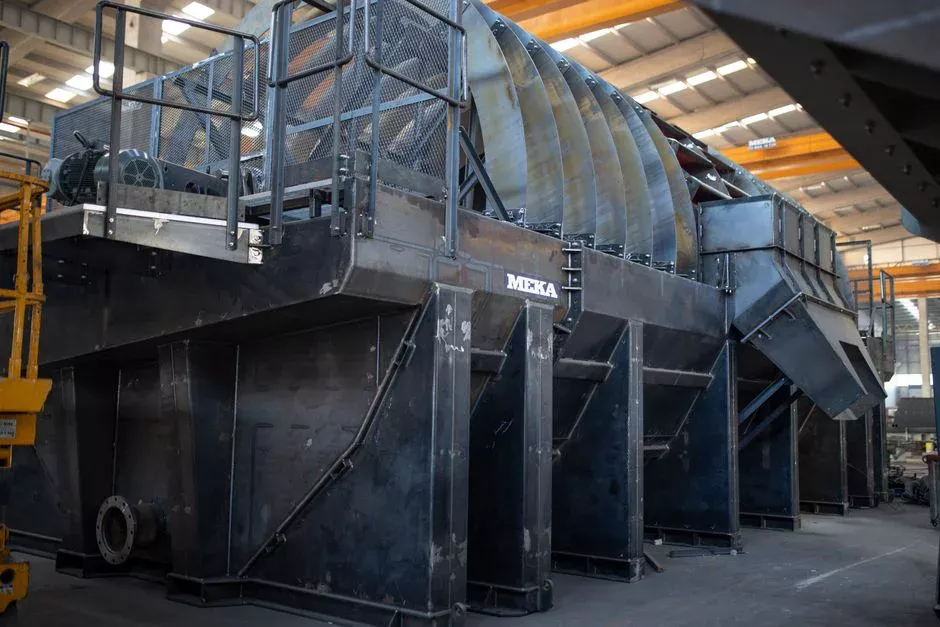
Paint-shop reject and overspray is the strongest DAF case at any auto plant: the stream is light, sticky, pigment-laden, and rich in FOG. Floatables rise readily on micro-bubbles and skim cleanly; in a clarifier the same floatables re-suspend and ride out the effluent weir. Cathode-coating and binder washwater behaves the same way — fine, slow-settling PVDF and NMP residues that gravity simply will not drop in a reasonable residence time. DAF captures them.
Parts-wash and floor wash with FOG is the third DAF-leaning stream. The CHS refinery precedent (AECOM project) shows DAF paired downstream of an API separator as the oil-removal workhorse on a 2 × 1,000 gpm train; the same pairing logic translates directly to auto plant oil/water separation when free oil concentrations justify an API first. The full pairing rationale is laid out in the DAF vs API separator comparison guide.
Stamping coolant is a split decision. If tramp oil is above ~50 mg/L, run DAF first to lift the free oil, then a lamella clarifier or hydrocyclone to drop the iron fines. Below 50 mg/L, a lamella clarifier alone is enough. Machining and grinding swarf should never see a DAF — the grit is heavy, fast-settling, and abrasive; it overloads the skimmer and erodes the recycle pump. A lamella or conventional clarifier handles it. Low-TSS rinse water with no oil is the one case where a multi-media filter or a small lamella is sufficient and a DAF would be overspecified and wasteful on polymer. The decision matrix:
| Stream | Dominant Character | Primary Unit | Rationale |
|---|---|---|---|
| Paint-shop reject / overspray | Light, oily, pigmented | DAF | Floatables re-suspend in clarifier; micro-bubbles skim cleanly |
| Cathode/anode coating wash | Fine, slow-settling, PVDF/NMP | DAF | Gravity cannot drop colloids in practical residence time |
| Parts-wash and floor wash (FOG) | Oily, moderate TSS | DAF (often post-API) | Micro-bubble flotation is the oil-removal workhorse |
| Stamping coolant, tramp oil > 50 mg/L | Mixed oil + metal fines | DAF → lamella | Lift oil first, then drop fines |
| Stamping coolant, tramp oil < 50 mg/L | Heavy fines, trace oil | Lamella clarifier | Fines are fast-settling; DAF is overspecified |
| Machining / grinding swarf | Heavy, abrasive, settleable | Lamella or conventional clarifier | DAF skimmer overloads; grit erodes recycle pump |
| Low-TSS rinse water, no oil | Clean, low loading | Multi-media filter or lamella | DAF wastes polymer for no removal gain |
Head-to-Head: DAF vs Lamella Clarifier Parameter Table
Specs below are pulled from the DAF Corp published product line and the HydropureWater catalog; conventional clarifier values are typical engineering ranges for the 6–70 ft diameter tank class. The table compresses the trade-offs a procurement reviewer needs to see in one place.
| Parameter | DAF (Circular or Rectangular) | Lamella / Inclined-Plate Clarifier | Conventional Circular Clarifier |
|---|---|---|---|
| Typical flow range | 10–11,000 gpm (DAF Corp FC Maximizer line, 48 gpm skid up to 11,000 gpm industrial) | 10–2,000 gpm per module (HydropureWater catalog) | 50–5,000+ gpm in a single tank |
| TSS removal efficiency | 92–98% circular, 85–90% rectangular (DAF Corp) | 70–90% on settleable TSS, lower on colloids | 50–80% on settleable TSS only |
| FOG / oil removal | 85–95% with coagulant; effective to < 25 mg/L effluent | Poor on free oil; oil re-suspends and rides the weir | Poor on free oil; same re-suspension problem |
| Surface loading / HRT | Hydraulic residence ~20–40 min, recycle ratio 20–50% | 20–40 m/h (HydropureWater catalog) | 1–2 m/h, HRT 2–4 h |
| Footprint per m³/h | Compact; rectangular units fit narrow retrofits | ~50% of a conventional clarifier at equivalent flow | Largest footprint; needs headroom for rakes |
| Polymer / coagulant demand | Coagulant + flocculant typical; 5–20 mg/L each | Coagulant only in many cases; up to 30% lower polymer use (HydropureWater field data, 2024) | Coagulant only; lowest polymer consumption |
| Sludge / float solids | Float at 2–4% solids (DAF Corp) | Underflow at 0.5–1.5% solids | Underflow at 0.5–1.0% solids |
| Skid vs built-in-place | Skid-mounted available 48–450 gpm (DAF Corp), fully piped and wired | Modular; ships as plates and tank sections | Cast-in-place concrete is standard |
| Best-fit stream | Light, oily, low-density, FOG > ~150 mg/L | Heavy, grit-laden, settleable, FOG < ~50 mg/L | High-flow, low-loading, settleable-only streams |
| 2026 capex positioning | Higher unit cost per m²; offset by smaller downstream dewatering | Lowest installed cost for the flow band | Lowest material cost; highest civil / install labor |
One row the table cannot capture: site-specific jar tests and a 30-day mobile pilot are still required to lock in real removal numbers on your actual wastewater — vendor curves assume a feed that is well-conditioned and steady.
Kansas City Compliance Check: Pretreatment Limits That Drive the Choice
The federal categorical numbers under 40 CFR Part 433 (metal finishing) are the floor: lead 0.69 mg/L daily max, zinc 2.61 mg/L, nickel 3.98 mg/L, total toxic organics 2.13 mg/L, and oil & grease 52 mg/L daily max. Part 468 (copper forming) layers on copper and zinc limits that any plant forming current collectors or busbars has to meet. The Kansas City Missouri Water Services Department industrial waste limits typically tighten the local envelope further — FOG caps commonly land in the 100–200 mg/L range and a TSS ceiling around 250–300 mg/L, both tighter than the federal categorical numbers, and 2026 enforcement fact sheets have flagged cobalt and lithium narrative limits for EV-battery plants. Direct dischargers additionally fall under Missouri Clean Water Commission rules at 10 CSR 20-7.
The practical implication: if your FOG exceeds the local cap, DAF is mandatory as the primary oil-removal step — no clarifier chemistry will reliably pull free oil to those numbers. If your problem is settleable metals, a lamella clarifier with coagulant is the right first move, and DAF adds cost without solving the metals problem. The exact same logic shows up in the chemical-plant 2026 pretreatment compliance write-up; the limit sets differ, the decision tree does not.
2026 Cost and Footprint Reality for a Mid-Sized Auto Plant
For a mid-sized EV/auto plant, the realistic primary-treatment flow band is 100–500 gpm, well within the DAF Corp skid-mounted FC Maximizer line that ships from 48 gpm up to 450 gpm fully piped, wired, and factory-tested (DAF Corp). Above 500 gpm you move to a field-erected circular or rectangular unit, which adds civil work and longer install windows. A lamella clarifier in the same 100–500 gpm band delivers 20–40 m/h surface loading in roughly half the footprint of a conventional clarifier, with polymer consumption up to 30% lower than DAF on settleable streams (HydropureWater field data, 2024).
The downstream dewatering bill is where DAF earns back part of its capex. A DAF float at 2–4% solids loads a plate-and-frame filter press with 2–4× the dry mass per cycle compared to clarifier underflow at 0.5–1.5%, which translates directly into fewer press cycles per shift and lower haul-off tonnage. For a 300 gpm DAF train running 16 h/day, that swing is routinely six to eight fewer haul-offs per month at a Kansas City metro disposal rate. Pair the press with a HydropureWater automatic chemical dosing skid sized to your jar-test-conditioned polymer demand and you hold the float consistency stable across shift swings.
Most 2026 Kansas City installations are retrofits into existing buildings. Trailer-mounted mobile DAF units of the WesTech type can be deployed within a single day and need only a level surface, power, and piping — no permanent foundation (WesTech). That delivery model is often the only practical option when the construction window is a scheduled outage and the POTW will not accept a bypass.
How to Choose in 2026: A Four-Step Selection Framework
Step 1 — Characterize each stream separately. Pull FOG, TSS, particle density, pH, temperature, and flow on every individual waste stream over at least one production week. A composite sample hides the answer; the FOG number that drives your technology choice can vary 10× between cathode wash and stamping coolant at the same plant.
Step 2 — Map each stream to a primary unit. Use the stream-by-stream matrix earlier in this article. Light and oily streams go to DAF; heavy and grit-laden streams go to lamella or conventional clarifier. If a stream is mixed, design a split train: DAF first to lift oil, then lamella to drop fines.
Step 3 — Confirm against the 2026 Kansas City discharge permit. FOG and metals limits, not just TSS, decide the winner. If your FOG exceeds the local cap, DAF is mandatory; if your exceedance is settleable metals, lamella with coagulant is the right first move.
Step 4 — Validate at scale before signing the PO. DAF Corp explicitly offers laboratory DAF feasibility analysis and on-site pilot studies; a 30-day mobile DAF pilot of the WesTech type is the cheapest insurance you can buy against a six-figure unit-selection error. A complementary framing for petroleum-train operators appears in the DAF vs clarifier guide for petroleum wastewater, which follows the same four steps.
One-sentence rule of thumb: if FOG is above 150 mg/L or the stream is light and oily, default to DAF; if FOG is below 50 mg/L and the solids are heavy and grit-laden, default to lamella; everything in between needs a pilot.
Frequently Asked Questions
What FOG level forces a DAF instead of a clarifier at a Kansas City auto plant?
When total FOG exceeds the local Kansas City Missouri Water Services Department cap — typically 100–200 mg/L and tighter than the 52 mg/L federal categorical number under 40 CFR Part 433 — a clarifier cannot reliably pull free oil to those numbers. As a working threshold, FOG above ~150 mg/L pushes the decision to DAF; below ~50 mg/L with settleable solids, a lamella clarifier is the lower-cost option.
How do DAF and lamella clarifier compare on footprint for a 300 gpm stream?
A 300 gpm DAF in skid-mounted form (DAF Corp 48–450 gpm skid range) fits a roughly 15 ft diameter circular or comparable rectangular footprint, fully piped and wired. A lamella clarifier at 20–40 m/h surface loading on the same 300 gpm occupies about half the footprint of a conventional clarifier but slightly more than the DAF on a strict m²-of-floor basis — the DAF's footprint advantage is real but smaller than the polymer and downstream-dewatering trade-offs it brings.
Do 2026 Kansas City permits require DAF for EV battery cathode washwater?
Not by name, but the combination of 40 CFR Part 468 copper-forming limits, 2025–2026 state permit fact sheets flagging cobalt and lithium narrative limits, and local FOG caps typically forces a multi-stage train in which DAF is the practical primary for fine, slow-settling PVDF/NMP residue. The same compliance frame for adjacent corridors is mapped in the EV/auto plant 2026 pretreatment compliance guide.
When should a Kansas City plant bring in a specialist for jar testing or a mobile pilot?
Whenever FOG sits in the 50–150 mg/L decision band, when a new cathode chemistry or paint line is being qualified, or when the local POTW has issued a notice of violation. A 30-day mobile DAF pilot (WesTech trailer-mounted units, deployable within a single day) plus a laboratory DAF feasibility analysis from DAF Corp is the cheapest insurance against a six-figure unit-selection error — and it produces the data you need to defend the choice to procurement and the local POTW. The pairing logic between an upstream API separator and a DAF polisher is laid out in the DAF vs API separator comparison guide.