Why Petroleum Wastewater in Chattanooga Is a Different Problem
A sheen violation on a quarterly POTW composite sample is how most Chattanooga refinery and lubricant-blending plant managers first learn that oil-water separation is a phase problem, not just a flow problem. Tennessee's petroleum sector under NAICS 32411 is concentrated along the I-75/I-24 corridor and in Hamilton County, with refinery, terminal, and lubricant/blending operations all discharging to the City of Chattanooga POTW system — primarily the Moccasin Bend WWTP and the South Chickamauga basin. Both TDEC Rule 0400-40-14-.04 and the local pretreatment ordinance enforce oil & grease limits typically set at 100 mg/L daily max at the discharge sampling point, with lower limits for categorical industries in the refined petroleum SIC 2911 group.
Petroleum wastewater contains three oil phases that respond to separation forces differently: free oil with droplet diameters above 100 µm that rises readily under gravity, emulsified oil in the 20–100 µm band that resists Stokes-law settling because surfactants and shear keep droplets stable, and dissolved or soluble oil below 20 µm that no mechanical separator can remove without advanced oxidation or biological polishing. Refinery tank-farm drawdown and lubricant blending washwater also carry high BOD/COD, sulfides, and suspended sediment slugs after storm events. The same pretreatment compliance guide written for Gulf Coast chemical plants applies in principle, but the Tennessee land-cost baseline and the Moccasin Bend discharge permit change the economic weighting of the technology decision.
How DAF and Clarifiers Actually Separate Oil and Solids
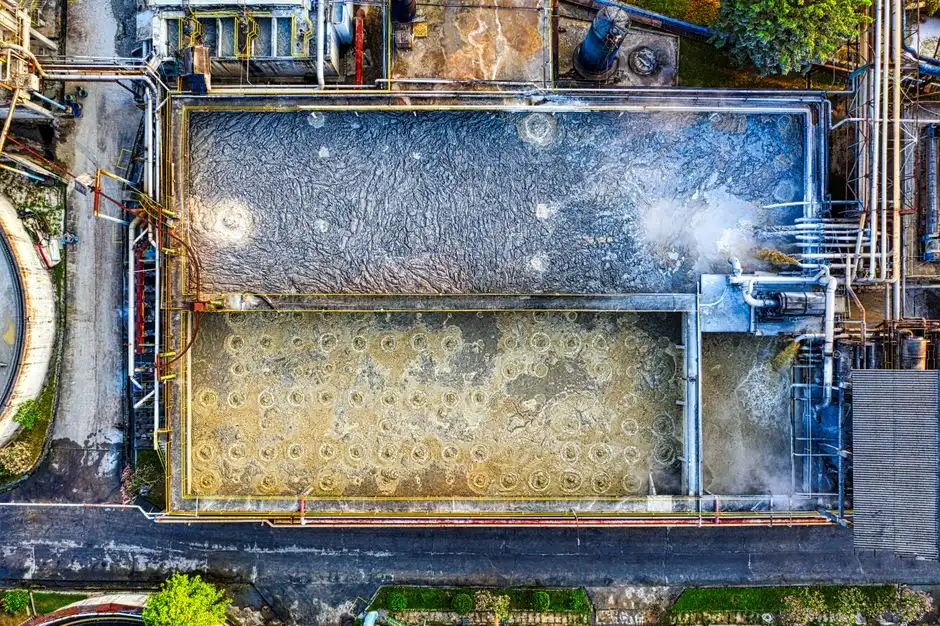
A dissolved air flotation (DAF) unit saturates a pressurized side stream (typically 60–80 psig) with air, then releases it through specialized nozzles at near-atmospheric pressure inside the flotation cell. The pressure drop nucleates 10–100 µm micro-bubbles that attach to oil droplets and buoyant solids, lifting them to the surface in 15–30 minutes where a skimmer removes the float layer. The clarified underflow exits through bottom launders, while the float sludge drops to a hoppered scum collection trough for downstream dewatering. In a chemical conditioning train ahead of the cell, coagulants like polyaluminum chloride (typically 50–150 mg/L) destabilize the emulsion, and anionic polyacrylamide flocculant (1–5 mg/L) bridges the destabilized droplets into larger aggregates that micro-bubbles can lift efficiently.
A clarifier slows influent through an energy-dissipating inlet and feedwell, then lets gravity settle heavier particles over a hydraulic retention time of 1.5–2.5 hours. Circular units use slowly rotating scraper arms at tip speeds around 10 ft/min to sweep settled sludge toward a central hopper; rectangular units rely on chain-and-flight collectors. Clarified water exits over peripheral weirs, and a surface skimmer separately removes floating scum.
The mechanism choice is decisive for petroleum service because oil is buoyant rather than heavy, meaning gravity settling captures only the largest free-oil droplets and entrained solids. Emulsified droplets in the 20–100 µm band carry over the clarifier weir almost completely, yet these are exactly the droplets a properly conditioned DAF cell targets. For Chattanooga plants, a clarifier alone is rarely a defensible primary separator for streams with emulsified oil content, such as lubricant blending washwater with cutting-fluid carryover. The DAF conditioning chemistry is where the real engineering happens, and a properly integrated automatic chemical dosing system makes the difference between 90% and 60% oil removal on the same hardware.
DAF vs Clarifier for Petroleum: Head-to-Head Comparison
The 95% versus 70% oil-removal gap documented in petroleum service (per Ecologix 2026 guide) is the primary factor in this comparison, which informs the data in the table below. The cost numbers are order-of-magnitude figures drawn from EPA 821-R-98-016 cost curves indexed to 2026 as planning baselines.
| Parameter | Dissolved Air Flotation (DAF) | Gravity Clarifier |
|---|---|---|
| Target contaminant | Free oil, emulsified oil, FOG, light suspended solids | Heavy settleable solids, free oil only (large droplets) |
| Typical oil & grease removal (petroleum) | 90–95% | 60–75% |
| Typical TSS removal | 70–90% with chemical conditioning | 50–70% |
| Hydraulic retention time | 15–30 minutes | 1.5–2.5 hours |
| Footprint (per m³/h treated) | Compact, vertical cell | Large, shallow basin |
| Capex (packaged, 2026, equivalent flow) | Low-to-mid six figures USD installed | ~30–50% lower than DAF |
| O&M complexity | Air compressor, saturation tank, skimmer, polymer system | Scraper drive, sludge pump, weir maintenance |
| Chemical demand | Coagulant + flocculant routinely required | Minimal unless CEPT is added |
| Flow surge sensitivity | Moderate; equalization strongly recommended | High; rising sludge blanket risk under variable loading |
| Heavy-sediment performance | Poor without upstream grit removal; grit damages recycle pump | Strong; tolerates high sediment without carryover |
DAF strengths are concentrated in the categories of oil removal efficiency, retention time, and footprint, while clarifier strengths center on capex, simplicity, and tolerance for heavy settleable solids. For a Chattanooga plant with both free oil and episodic sediment slugs from tank-farm stormwater runoff, the DAF serves as the optimal primary stage with a lamella clarifier for polish. The HydropureWater lamella clarifier for sediment polish uses inclined plates to shorten effective settling distance, multiplying clarifier capacity inside a much smaller footprint than a conventional basin.
Matching the Technology to Your Chattanooga Plant's Influent
Influent character drives the selection process, and the mapping below provides a decision rule for procurement managers based on 24-hour composite data.
| Petroleum stream character | Dominant oil phase | Typical influent O&G | Recommended primary | Optional polish |
|---|---|---|---|---|
| Refinery desalter brine, tank-farm drawdown | Free oil + sulfides | 200–2,000 mg/L | DAF with chemical conditioning | Lamella clarifier for sediment slugs |
| Lubricant blending washwater, cutting-fluid carryover | Emulsified oil (20–100 µm) | 500–5,000 mg/L | DAF is essentially mandatory | Not usually required |
| Pipeline terminal / truck-rack runoff with stormwater | Free oil + sediment surge | 100–1,000 mg/L (variable) | DAF with upstream grit removal | Lamella clarifier downstream |
| Used-oil re-refining condensate | High TSS + variable O&G | 300–2,000 mg/L | Lamella clarifier primary | DAF polish for residual emulsion |
Wherever emulsified oil constitutes a meaningful fraction of the load, DAF is necessary as the primary stage. Clarifier-only treatment of a stream containing emulsified oil will produce a sheen, fail the 100 mg/L daily max at the POTW sampling point, and trigger a TDEC compliance schedule. Cases where a clarifier is prioritized typically involve high settleable solids loading; even then, a lamella-inclined-plate geometry delivers the same separation in a fraction of the basin footprint.
Capex, Footprint, and 2026 Cost Reality for Chattanooga Plants
EPA 821-R-98-016 remains the primary public cost baseline for DAF and clarification systems, though figures must be escalated to 2026 dollars using ENR construction cost indices. For a 2026 Chattanooga procurement memo, treat the EPA curves as the floor and add 50–80% to account for inflation, stainless construction for petroleum service, and Tennessee-specific installation factors.
Order-of-magnitude 2026 capex for a packaged DAF in the 4–300 m³/h capacity range sits in the low-to-mid six figures USD installed, while equivalent-flow clarifiers run roughly 30–50% lower. The gap closes when adding equalization tanks, polymer systems, and chemical dosing skids required for the DAF to achieve 95% oil removal. DAF O&M is dominated by compressor power, polymer consumption, and periodic skimmer/scraper service, whereas clarifier O&M focuses on sludge pumping, dewatering, and solids handling.
Land cost influences the comparison, but because the South region has lower unimproved suburban land costs than the Northeast or West, the DAF's footprint advantage is less punitive in Chattanooga. This makes a DAF + lamella hybrid economically viable here in a way it would not be in a space-constrained facility. The 20-year lifecycle math favors DAF-primary configurations for petroleum service where land is not the binding constraint. For a parallel cost analysis, the DAF vs clarifier for chemicals wastewater piece provides a contrast for high-land-cost environments.
Compliance, Monitoring, and the Hybrid DAF + Lamella Option
Secondary treatment standard 40 CFR 133.102 caps effluent TSS at 30 mg/L on a 30-day average and 45 mg/L on a 7-day average, with at least 85% removal required for all Chattanooga petroleum plants. A properly conditioned DAF hits these targets for oil and light FOG, but may require a lamella clarifier polish for settleable solids during tank-farm stormwater surges. This hybrid configuration ensures the combined effluent remains stable across variable refinery loading.
The sludge train is as critical as the separator. Float sludge from the DAF and settled sludge from the lamella clarifier should converge at a single dewatering stage, such as a plate-and-frame filter press, to produce the 15–25% dry-solids cake required for disposal. Inline chemical conditioning for the DAF is best managed by an integrated automatic chemical dosing system linked to flow-proportional set points. Before committing to permanent installation, run a 30-day on-site pilot using a trailer-mounted mobile DAF to obtain actual removal data and chemical consumption metrics.
Frequently Asked Questions
What is the oil and grease discharge limit for a petroleum plant discharging to the Chattanooga POTW?
TDEC Rule 0400-40-14-.04 and the City of Chattanooga POTW pretreatment program enforce an oil and grease limit of 100 mg/L daily max at the discharge sampling point, with categorical limits for SIC 2911 facilities potentially tighter; secondary treatment standard 40 CFR 133.102 also caps effluent TSS at 30 mg/L on a 30-day average with at least 85% removal required.
Why does a DAF remove oil better than a clarifier in petroleum service?
DAF generates 10–100 µm micro-bubbles that attach to oil droplets as small as ~20 µm and float them in 15–30 minutes, whereas gravity clarifiers rely on Stokes-law settling over 1.5–2.5 hours; this leaves emulsified oil in the 20–100 µm band to carry over the effluent weir, resulting in the documented 95% versus 70% removal gap.
How should a Chattanooga plant pilot a DAF before committing to permanent installation?
Rent a trailer-mounted mobile DAF for a 30-day on-site