Why the DAF vs Clarifier Question Is Different for Chemicals Plants
NAICS 325 organic chemicals, plastics, and synthetic fibers plants generate a wastewater matrix no generic separator comparison covers: solvent emulsions, reactor carryover, catalyst fines, gypsum or salt slurries, and pH swings from 1 to 13 across a single shift (HydropureWater field data, 2026). Decatur chemical plants discharging to the Tennessee River watershed face Alabama Department of Environmental Management (ADEM)-administered categorical standards under 40 CFR Part 414, the Organic Chemicals, Plastics, and Synthetic Fibers (OCPSF) regulation — tighter than the 40 CFR 433 oil & grease focus of fabricated metals. The OCPSF rule sets daily-maximum limits on acrolein, acrylonitrile, benzene, carbon tetrachloride, chloroform, 1,1-dichloroethane, and total phenols that no DAF or clarifier alone can meet, but that change which primary separator earns its place upstream of biological polishing. Ecologix 2025 split the decision cleanly: high-oil streams favor DAF at 95% removal, high-sediment streams favor clarifier at 90% — and chemical plants usually sit between those poles. The three failure modes that punish the wrong primary separator are free-solvent breakthrough to the sewer, emulsified-solvent overload on the downstream biotreater, and salt-shock kill of the biomass when a clarifier underflow carries 30,000+ mg/L TDS into the aeration basin.
What a DAF Actually Does in a Chemical Plant
A dissolved air flotation (DAF) system saturates a side-stream of clarified effluent with air at 60-80 psig, then releases it through needle valves into the main flotation tank where the pressure drop generates micro-bubbles in the 20-40 µm range (DAF Corp Micro Bubble Generator spec) or 30-50 µm range (SigmaDAF documentation). Those bubbles attach to oil droplets and light floc, dropping bulk density below water so the float rises to the surface for skimming. On a chemical stream the DAF's job is to lift free and emulsified solvent before it reaches the equalization basin, which is the only way to keep the downstream biotreater's mixed liquor from going solvent-shock on the first slug load. DAF Corp's round FC Maximizer delivers 92-98% TSS removal at flows from 10 GPM to 11,000 GPM with effluent TSS below 20 ppm on a 2,000 ppm feed, while the rectangular RC UniMax runs 85-90% at 10-1,000 GPM (DAF Corp operating data, 2025). The DAF line occupies the 4-300 m³/h window — roughly 18-1,320 GPM — which covers most mid-sized NAICS 325 plants in the Decatur corridor. Chemical conditioning is non-optional on chemical streams: high-ionic-strength effluent demands a cationic polymer plus a ferric-based coagulant before the floc will attach to bubbles. Skipping charge neutralization is the single most common reason DAF units underperform in chemical service. Float character runs 2-4% dry solids versus clarifier sludge at 1-2%, which cuts dewatering press capacity by roughly 30-50% downstream.
What a Lamella Clarifier Does Differently
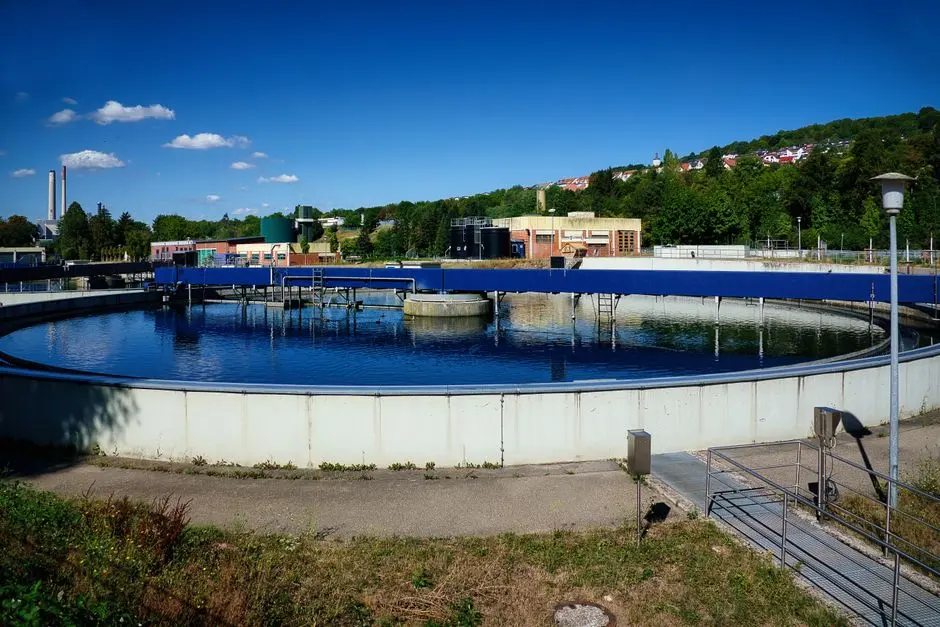
A HydropureWater high-efficiency sedimentation tank (lamella clarifier) lets gravity pull heavy particles out of suspension, but stacks inclined plates at 55-60° inside the tank to multiply effective settling area. Surface loading reaches 20-40 m/h — roughly 20× a conventional clarifier's 1-2 m/h — in a footprint small enough to retrofit inside an existing NAICS 325 process building. For chemical streams dominated by gypsum, sodium sulfate, calcium carbonate, or catalyst fines, the lamella routinely hits 80-90% TSS removal, the heavy fast-settling fraction that a DAF would also lift but at higher power cost. The lamella geometry reduces polymer consumption by up to 30% versus a conventional clarifier because the inclined plates give more efficient solids contact in less volume (HydropureWater high-efficiency sedimentation tank data). The weak spot is emulsified organics: a clarifier typically removes only 60-70% of oil & grease (Ecologix benchmark, 2025) because emulsified droplets are too small and too close to water density to settle without very long residence times. Sludge from a clarifier runs 1-2% dry solids and still needs a dewatering press before hauling, so a NAICS 325 plant pairing lamella with a downstream HydropureWater plate and frame filter press is the standard configuration for catalyst-fines and gypsum-slurry streams.
DAF vs Clarifier: 2026 Parameter Table for Chemicals Plants
The table below puts the two technologies side by side on the parameters a Decatur procurement manager or process engineer actually negotiates — removal efficiency, hydraulic loading, footprint, sludge character, capital, operating cost, and operator skill — re-scoped for NAICS 325 effluent rather than fabricated metals or food processing.
| Parameter | Dissolved Air Flotation | Lamella Clarifier (High-Efficiency Sedimentation Tank) |
|---|---|---|
| Target contaminant | Emulsified solvent, free oil, light TSS, organic reactor carryover | Gypsum, salt slurry, catalyst fines, heavy settable TSS |
| Oil & grease removal | 85-95% (Ecologix 2025; up to 95% on high-oil streams) | 60-70% (Ecologix 2025 ceiling) |
| TSS removal | 85-98% (FC Maximizer 92-98%, RC UniMax 85-90%) | 80-90% on metal fines, gypsum, catalyst particles |
| Surface / hydraulic loading | 5-25 m/h depending on bubble attachment time | 20-40 m/h (lamella); 1-2 m/h (conventional) |
| Footprint | ~6-15 m² (tank + saturator + skimmer) | ~3-8 m² (inclined-plate pack only) |
| Sludge dry solids | 2-4% float + bottom cone fines | 1-2%, requires dewatering press |
| CAPEX (2026, unit-only) | USD 40,000-180,000 | USD 25,000-120,000 (plate press adds USD 15,000-80,000) |
| OPEX drivers | Air compressor 5-15 kW + polymer USD 0.02-0.06/m³ | Low power 1-3 kW + polymer USD 0.01-0.03/m³ |
| Operator skill | Moderate (saturator pressure, bubble quality, skimmer speed) | Lower (sludge blowdown, plate cleaning) |
| Chemical-industry fit | Reactor carryover, condensate, organics, plasticizer washwater | Gypsum, Na₂SO₄, CaCO₃, catalyst recovery, brine clarifier |
A hybrid DAF → lamella → plate press train is the 2026 default for full-service NAICS 325 plants running both organic reactors and inorganic finishing or crystallization under one roof.
Decision Tree: When Each Technology Wins in Decatur
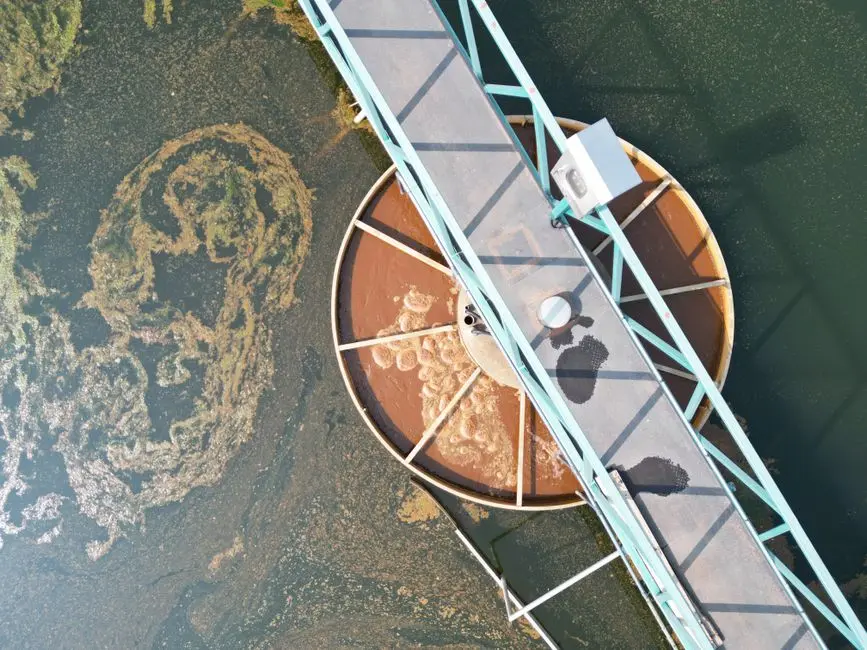
Three routing rules cover roughly 90% of NAICS 325 influent signatures seen in the Decatur corridor, and they run on the previous week's wastewater characterization rather than vendor deck slides.
Route 1 — DAF primary. Solvent-bearing condensate, organic reactor carryover, plasticizer washwater, oil & grease above 100 mg/L, pH swings of 2-11, light TSS below 500 mg/L. The dissolved air flotation (DAF) system at 50-150 m³/h covers most mid-sized Decatur plants in a single unit. Pair it with a HydropureWater automatic chemical dosing system to hold polymer dose consistent across shift changes — critical on chemical streams where conductivity swings from 2,000 to 25,000 µS/cm will defeat a manually set pump.
Route 2 — Lamella clarifier primary. Gypsum, sodium sulfate, or calcium carbonate slurries, catalyst fines, TSS above 1,000 mg/L, oil below 100 mg/L. A HydropureWater high-efficiency sedimentation tank (lamella clarifier) handles the heavy fraction at 20-40 m/h surface loading and 80-90% TSS removal at lower OPEX than a DAF on the same flow. Accept that a downstream coalescer or a small DAF polish may still be needed for trace organics, and add a HydropureWater automatic chemical dosing system upstream to keep floc size controlled when the slurry composition shifts between batches.
Route 3 — Hybrid DAF → clarifier → plate press. Full-service organic chemicals, plastics, or synthetic fibers plants running reactors, separation, and finishing under one roof. The DAF pulls solvent and light TSS off the top, the lamella catches the heavy inorganic slip-through, and a HydropureWater plate and frame filter press dewaters the combined sludge to 25-35% dry solids for hauling. This is the 2026 default for most NAICS 325 Decatur facilities discharging to the Tennessee River watershed.
Red-flag conditions where neither technology works alone. Free-phase solvent layers above 1% v/v need an API separator upstream of either unit. Strong oxidizer carryover (residual peroxide, chlorine dioxide, persulfate) needs equalization with a reducing step before any DAF or clarifier — oxidizers destroy polymer and bleach floc. High-temperature effluent above 60 °C needs quench or cooling to protect the saturator on the DAF and to keep clarifier hydraulics stable.
2026 Compliance Frame: 40 CFR 414 and ADEM Pretreatment
ADEM administers the Industrial Pretreatment Program for Decatur chemical plants and incorporates 40 CFR Part 414 OCPSF categorical standards into discharge permits. The OCPSF parameters most likely to drive a 2026 capital request in a NAICS 325 plant are benzene, carbon tetrachloride, chloroform, 1,1-dichloroethane, acrolein, acrylonitrile, and total phenols. The table below lists the daily-maximum limits a Decatur plant engineer should be designing against when sizing the primary separator and the biological or carbon-polish train downstream.
| 40 CFR 414 OCPSF parameter | Daily-max limit (mg/L, regulatory citation) | What the primary separator can do |
|---|---|---|
| Acrolein | 0.05 (40 CFR 414.65) | Strips with free-oil float; no meaningful removal once dissolved |
| Acrylonitrile | 0.10 (40 CFR 414.65) | Partial float on monomer-bearing streams; needs biological or carbon |
| Benzene | 0.037 (40 CFR 414.65) | Free-phase removal only; needs air stripping, bio, or GAC |
| Carbon tetrachloride | 0.025 (40 CFR 414.65) | No removal by primary separator; downstream GAC required |
| Chloroform | 0.025 (40 CFR 414.65) | No removal by primary separator; downstream GAC required |
| 1,1-Dichloroethane | 0.025 (40 CFR 414.65) | No removal by primary separator; downstream GAC required |
| Total phenols | 0.10-0.30 range by subcategory (40 CFR 414.65) | Partial float on oily carrier; biological oxidation finishes it |
The primary separator is responsible for free-phase solvents, TSS, and oil & grease — it is not where the OCPSF VOC or phenol limits get hit. VOC stripping, biological degradation, and carbon adsorption happen downstream. What the 40 CFR 414 daily-max limits do is push most NAICS 325 plants toward either DAF (for organic-rich streams where the float path reduces load on the bio stage) or hybrid trains, because the alternative — a clarifier alone on an organic-rich stream — lets too much emulsified solvent through to the biological stage and starves or poisons the biomass.
Pilot Testing Protocol Before 2026 Capital Commitment
Before signing a 2026 capital PO, run a 5-10 GPM pilot on the actual plant stream for at least two shifts. DAF Corp and SigmaDAF both offer pilot rentals, and DAF Corp's pilot FC-60 runs at 48 GPM on a 2,000 ppm suspended-solids feed while the RC UniMax pilot runs 80-100 GPM at the same loading (DAF Corp operating data, 2025). A two-week pilot typically answers 80% of the questions a desk study cannot. Measure influent and effluent TSS, oil & grease, COD, TOC, pH, conductivity, and temperature on both units, plus air-to-solids ratio and bubble-size distribution on the DAF side. Jar tests alone are insufficient for DAF sizing because the air-to-solids ratio and bubble-attachment kinetics only appear under continuous flow with a real saturator. Run the lamella clarifier pilot on the DAF underflow to confirm the 80-90% heavy-solids claim before sizing the HydropureWater plate and frame filter press downstream. Capture three days of overnight data — chemical plants discharge most of their slug loads during the night shift when reactor regeneration, catalyst changeout, and batch cook-down happen back-to-back, and the pilot numbers from a 9-to-5 day shift will undersize the production unit.
Frequently Asked Questions
Is a DAF or clarifier better for chemical plant wastewater in Decatur?
For most NAICS 325 plants in 2026, the answer is a hybrid DAF → lamella clarifier train, with the DAF driven by 40 CFR 414 OCPSF limits on benzene, acrylonitrile, and total phenols that punish a clarifier-alone design. A DAF removes 85-95% of emulsified solvent and 92-98% TSS on DAF Corp FC Maximizer-class units, while a clarifier alone leaves 30-40% of emulsified organics in the stream and overfeeds the downstream biotreater.
What size DAF do I need for a 100 m³/h chemical plant?
For a 100 m³/h NAICS 325 plant, a single 100-150 m³/h dissolved air flotation (DAF) system sits inside the standard envelope, but the practical floor is a 5-10 GPM pilot (roughly 1-2.5 m³/h) rented from DAF Corp or SigmaDAF to characterize the actual stream before committing to a 100 m³/h PO. Anything below a 10-25 m³/h full-scale unit makes the saturator and skimmer inefficient.
Can a lamella clarifier alone meet 40 CFR 414 limits?
Usually not on an organic-rich NAICS 325 stream. A lamella clarifier removes only 60-70% of oil & grease (Ecologix 2025) and provides no meaningful removal of dissolved benzene, carbon tetrachloride, chloroform, or 1,1-dichloroethane, so a clarifier-only design forces the biological and carbon-adsorption stages to do work the primary separator should have done. For low-organic streams under 100 mg/L oil & grease, a clarifier followed by equalization and biological treatment can meet OCPSF limits — but that is not the common case in Decatur's NAICS 325 corridor.
How much does a chemical-industry DAF system cost in 2026?
A 2026 DAF unit-only runs USD 40,000-180,000 depending on flow, alloy construction (304L stainless versus carbon steel with epoxy lining), and skid versus field-assembled configuration, with the downstream HydropureWater plate and frame filter press adding another USD 15,000-80,000. Add USD 0.02-0.06 per m³ for polymer and coagulant, plus 5-15 kW continuous compressor load, and the OPEX line item scales with flow.
When does a hybrid DAF and clarifier train make sense for a chemical plant?
A hybrid DAF → clarifier → plate press train makes sense whenever the plant runs both organic reactors and inorganic finishing or crystallization under one roof — the typical NAICS 325 full-service configuration in the Decatur corridor. The DAF handles solvent and light TSS, the lamella clarifier catches gypsum, salt, and catalyst fines that pass through or settle in the DAF bottom cone, and the filter press dewaters the combined sludge to 25-35% dry solids. For a 2026 capital request this is the default train that meets both 40 CFR 414 organics and TSS limits without tertiary filtration, and it pairs with a HydropureWater automatic chemical dosing system for stable polymer dose across batch swings.