Why Daytona Beach Metal Shops Hit the DAF-vs-Clarifier Question
Daytona Beach fabricated metals plants should choose a DAF over a clarifier whenever the wastewater carries free or emulsified tramp oil — typical of stamping, machining, and parts-wash streams — because a DAF lifts oil, grease, and low-density solids a clarifier cannot settle. Use a lamella clarifier only for low-oil, high-TSS rinse streams, or downstream of a DAF for metal-hydroxide polishing. Confirm limits under 40 CFR Part 413 (metal finishing) and local Volusia County / City of Daytona Beach pretreatment rules before specifying.
The fabricated-metals waste stream is fundamentally different from the food, dairy, or refinery streams most DAF-vs-clarifier articles assume. A stamping cell pushes tramp oil and drawing compound into the floor drain. A CNC machining center discharges cutting fluid with emulsified mineral oil at 3–8% concentration. A parts-wash station sends alkaline detergent, broken emulsion, and grinding swarf down the same trench. The combined stream is typically high in oil and grease (200–2,000 mg/L) and TSS (200–1,500 mg/L), but low in BOD compared to a food plant — usually under 500 mg/L because the organic load is petroleum-based, not carbohydrate. Free iron fines, aluminum chips, and occasional hydraulic-fluid releases from press leaks round out the pollutant mix.
The 2026 decision driver is not just chemistry — it is enforcement. USEPA categorical pretreatment standards under 40 CFR Part 413 (Metal Finishing) regulate oil and grease, TSS, and heavy metals (zinc, copper, nickel, lead, chromium, cadmium) for any facility discharging to a POTW. The City of Daytona Beach Utilities Department, which operates the receiving POTW for the industrial corridor along Mason Avenue and the US-1 manufacturing zone, runs its own industrial pretreatment program with local limits layered on top of the federal categorical standards. A shop that chose a clarifier in 2018 because the stream "looked clear" is now getting FOG surcharge invoices and notice-of-violation letters. That is the question on the table.
One terminology point: when this article says "clarifier," it means gravity settling — including lamella/inclined-plate, rectangular, and circular configurations. It does not mean the "air flotation clarifier" some vendors market, which is a DAF under a different name. A lamella clarifier settles by density differential and cannot remove emulsified oil because the specific gravity of an oil-in-water emulsion (0.95–1.02) is too close to water (1.00) for gravity to overcome.
How a DAF and a Clarifier Actually Work on Oily Metalworking Water
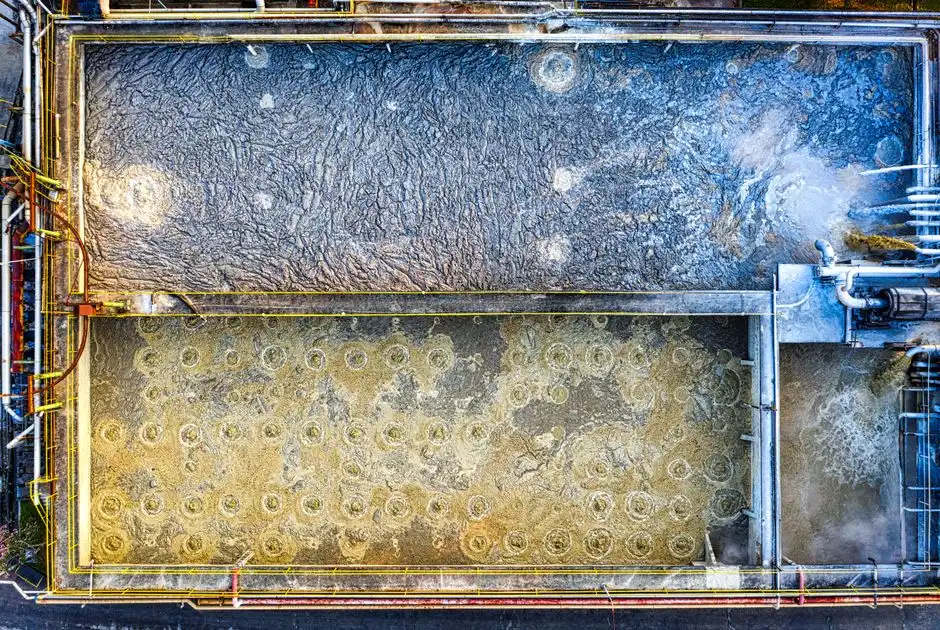
A dissolved air flotation unit saturates a pressurized recycle stream of clarified effluent with air at 60–80 psig, then releases that stream through a pressure-reduction valve at the inlet of the flotation cell. The dissolved air comes out of solution as a cloud of 10–80 micron microbubbles that attach to oil droplets, grease colloids, and chemically conditioned suspended solids. The bubble-particle agglomerate has an effective density lower than water, so it rises to the surface in 3–5 minutes, where a skimmer removes the float layer. A typical HydropureWater DAF system is built across 13 standard models covering 4–300 m³/h, which brackets the entire fabricated-metals flow envelope from a single 50 gpm wash station up to a 1,300 gpm multi-cell stamping plant.
A gravity clarifier — including the lamella/inclined-plate variant — relies on Stokes' Law settling. A particle settles when its density exceeds the surrounding fluid by enough that gravitational force overcomes drag. Metal fines (steel swarf at 7.8 g/cm³, aluminum at 2.7 g/cm³) settle readily. Metal hydroxides from pH-adjustment precipitation settle well. Emulsified oil does not, because the droplet is stabilized by surfactant and its effective density sits within 2–5% of water. The DAF-vs-clarifier contrast is mechanical, not preferential: DAF adds buoyancy where gravity cannot. For a high-rate installation, a HydropureWater lamella clarifier operates at 20–40 m/h surface loading, which is the throughput benchmark for any new gravity-settling specification in this market.
Both units almost always need coagulant and flocculant chemistry to break the oil emulsion and bridge fine particles into settleable or floatable agglomerates. A DAF without a properly dosed cationic coagulant (typically a quaternary polyamine or ferric-based coagulant at 50–200 mg/L) and an anionic flocculant (0.5–5 mg/L of a high-molecular-weight polyacrylamide) will produce a cloudy effluent and pass-through oil. Spectrum Water puts it bluntly: a DAF is "only as good as its coagulant and polymer dosing." That chemistry is normally delivered by a packaged HydropureWater automatic chemical dosing skid, which meters the coagulant and polymer based on flow-proportional signals from a magmeter and provides the repeatability a manual drum-pump system cannot.
Three FRC DAF layouts cover most fabricated-metals installations: high-rate units with crossflow plate packs (PCL-series, for plants that need maximum TSS removal in a small footprint), compact skids that ship in a 20-ft ISO container (PCCS-series, for shops with constrained site access), and open-tank designs (PWL-series, for heavy-solids streams like stamping press pits). Selecting among them is a site-specific decision driven by influent TSS, available floor area, and whether the unit needs to be relocated for a phased installation.
Side-by-Side: DAF vs Lamella Clarifier for Fabricated Metals
Procurement teams and pretreatment coordinators need a single matrix they can hand to a CFO and a regulator. The table below consolidates the engineering parameters, 2026 cost bands, and regulatory fit for both unit types against a typical Daytona Beach fabricated-metals stream.
| Parameter | Dissolved Air Flotation (DAF) | Lamella / Gravity Clarifier |
|---|---|---|
| Primary removal target | Free and emulsified oil, FOG, low-density TSS | High-density TSS, metal fines, metal hydroxides |
| Typical removal efficiency | 80–95% oil and grease; 70–90% TSS (with coagulation) | 50–70% TSS; <30% emulsified oil (essentially none without emulsion-breaking chemistry) |
| Hydraulic retention time | 5–15 minutes | 60–180 minutes (lamella reduces basin volume but not overflow rate) |
| Footprint (50 gpm duty) | ~40–60 sq ft (skid-mounted) | ~120–200 sq ft (concrete basin or packaged steel tank) |
| CAPEX band (50 gpm, 2026) | $90,000–$180,000 (skid, with chemical dosing) | $40,000–$90,000 (packaged steel); $120,000+ (poured concrete basin) |
| OPEX drivers | Polymer + coagulant, saturated-air pump, sludge hauling, ~3–5 kW | Polymer, sludge hauling, scraper drive, no compressed-air system |
| Flow surge handling | Tolerant of 2× design flow for short periods; recycle pump compensates | Sensitive — overflow carries unsettled solids; HRT collapses |
| Oil surge handling | Designed for it; skimmer re-engages after slug passes | Cannot respond — emulsified oil passes through |
| 40 CFR Part 413 fit (O&G limit) | Primary compliance unit | Polishing only — will not hit O&G limit alone |
| Footprint envelope (2026 catalogs) | FRC: up to 2,000+ GPM, 5–500+ sq ft free area; Spectrum: 50–1,000 gpm skid | HydropureWater lamella: 20–40 m/h surface loading benchmark |
Spectrum's product language is the quotable mechanism proof point: DAF handles "free and emulsified oil, grease, fiber and low-density solids that will not fall out of suspension under gravity." A lamella clarifier does the opposite job — it removes material that will fall out of suspension, faster than a conventional basin because the inclined plates shorten the settling path. A fabricator who tries to use a clarifier as a primary oil-removal step is using the wrong tool and will pay for it in surcharge invoices and permit violations.
One clarification on the "clarifier" category itself: it is a family, not a single box. ClearStream's catalog lists inclined plate settlers, reaction clarifiers (with internal mixing zones for coagulation), rectangular clarifiers, segmented blade clarifiers, and suction header/pipe clarifiers. For a fabricated-metals polishing step downstream of a DAF, an inclined-plate or reaction clarifier is the typical choice. For TSS reduction on a low-oil rinse stream, a simple rectangular or circular clarifier is sufficient.
2026 Compliance Lens: 40 CFR Part 413 and Daytona Beach Pretreatment
Federal categorical pretreatment standards set the ceiling. 40 CFR Part 413 covers the Metal Finishing category and applies to most fabricated-metals shops discharging to a POTW — it regulates oil and grease, TSS, pH, and the priority pollutants most relevant to metalworking: zinc, copper, nickel, lead, chromium (total and hexavalent), and cadmium. Daily maximum and monthly average limits apply; a single excursion can trigger a compliance audit. Confirm the current numeric limits against the e-CFR publication before specifying, as the 2026 values are not the topic of this article.
For larger forming operations, 40 CFR Part 433 (Metal Molding and Casting, Aluminum Forming, Copper Forming, Ferrous Forging, and the nonferrous metal forming subcategories) may also apply. Part 433 has historically been associated with oil and gas extraction central waste treatment, but its metal-forming subcategories are often overlooked by shops that fall under Part 413. The pretreatment coordinator at the City of Daytona Beach Utilities is the authoritative voice on which category applies to a given facility.
Operationally, this regulatory frame drives a two-stage treatment train for most fabricated-metals plants: DAF as the primary oil-and-grease removal step, followed by pH adjustment and a clarifier or filter press to remove precipitated metal hydroxides and remaining TSS. DAF float is typically 2–5% solids by weight, while clarifier underflow runs 1–3% — both are too thin to landfill directly. A plate-and-frame filter press dewatered to 25–35% dry solids cuts disposal volume by 80–90% and is the standard downstream step for both streams. The full 2026 O&G regulatory picture across jurisdictions is laid out in the 2026 oil and grease discharge compliance guide.
Decision Framework: Which Unit Wins at Your Flow and Oil Loading
Four rules cover roughly 90% of fabricated-metals selections in the Daytona Beach industrial corridor.
- Rule 1 — High oil: If free or emulsified oil exceeds 50 mg/L or you see a visible sheen on the trench water, DAF is the only viable primary unit. A lamella clarifier alone will not meet 40 CFR Part 413 oil and grease limits. Add a downstream clarifier or filter press for metal-bearing TSS.
- Rule 2 — Low oil, low flow, mostly fines: If flow is under 30 m³/h, oil is consistently under 30 mg/L, and the stream is dominated by machining fines or grinding swarf, a lamella clarifier at 20–40 m/h loading is the cheaper and simpler choice. Capital cost runs 40–60% of an equivalent DAF installation.
- Rule 3 — Mixed flow (typical): For the common stamped-parts + wash + rinse combination, run a DAF primary sized to raw influent, then a lamella clarifier polishing step sized to DAF effluent — not to raw flow. This protects the clarifier from oil slug events and lets it run at design HRT.
- Rule 4 — Small shops under 10 m³/h: A packaged chemical-dosing + DAF skid is faster to permit than a concrete clarifier basin, requires no excavation, and can be relocated if the lease ends. The 50 gpm entry point on a compact DAF skid is the realistic 2026 floor for this segment.
For a parallel look at how a similar metals-fabrication corridor solved the same problem in a different regulatory environment, the fabricated metals DAF vs clarifier guide for Birmingham provides a useful cross-check. For the underlying mechanism and efficiency data behind both technologies, the DAF clarifier mechanism and efficiency data page is the technical reference.
Frequently Asked Questions
Can a clarifier alone meet 40 CFR Part 413 oil and grease limits for a Daytona Beach metal finishing shop?
No. Emulsified tramp oil has a specific gravity within 2–5% of water and will not settle under gravity. A lamella or rectangular clarifier can remove free oil with a skimmer, but emulsified oil passes through. A DAF is required as the primary oil and grease removal step to meet Part 413 categorical limits.
What flow rate makes a DAF more economical than a clarifier for fabricated metals wastewater?
The break-even sits around 30 m³/h (roughly 130 gpm). Below that flow, a lamella clarifier with polymer addition is 40–60% cheaper to install. Above that flow, the cost gap narrows because the DAF's smaller footprint, faster HRT, and oil-slug tolerance outweigh the higher unit cost.
Should a Daytona Beach stamping plant run a DAF and a clarifier in series?
Yes, for most multi-stream plants. Use the DAF as the primary FOG removal step on the combined waste stream, then a lamella clarifier or filter press downstream to capture metal-bearing TSS after pH adjustment. The clarifier should be sized to DAF effluent flow, not raw influent.
What chemical dosing system pairs with a DAF for emulsified oil in metalworking wastewater?
A two-stage system: a cationic coagulant (typically a quaternary polyamine or ferric-based product at 50–200 mg/L) to break the emulsion, followed by an anionic flocculant (0.5–5 mg/L high-molecular-weight polyacrylamide) to bridge fines. An automatic chemical dosing skid tied to a flow-proportional magmeter signal is the standard 2026 specification.