Why Port Allen Chemical Plants Face a Different DAF-vs-Clarifier Calculus in 2026
Port Allen sits inside the Baton Rouge industrial corridor between petrochemical complexes along LA-1 and the Mississippi River docks, and chemical plant wastewater here is rarely a single stream. Operators typically blend process washwater, batch reactor dumps, scrubber blowdown, and cooling-tower side-stream into one equalization basin, producing a feed with pH swings of 2–12, total dissolved solids (TDS) routinely above 5,000 mg/L, surfactant emulsions, and dissolved metals (per HydropureWater field data, 2026). Those four features — pH, TDS, emulsified organics, metals — penalize any single-technology choice and explain why generic DAF-vs-clarifier comparisons written for food or mining plants fall short for Louisiana's chemical corridor.
Discharge to the West Baton Rouge Parish POTW triggers LAC 33:IX Chapter 11 categorical pretreatment requirements, and facilities classified as Significant Industrial Users (SIU) under SIC 28 (chemicals) and 2911 (petroleum refining) face local limits on oil & grease, TSS, pH 5–10, and total metals (per LAC 33:IX Chapter 11, current as of 2026-01). Where applicable, EPA categorical standards under 40 CFR Part 414 (organic chemicals), Part 415 (inorganic chemicals), and Part 419 (petroleum refining) sit on top of the local program. Procurement in 2026 is therefore not just a CAPEX decision; it is a compliance decision with both the West Baton Rouge Parish industrial waste coordinator and the Louisiana DEQ. For related context on pretreatment compliance drivers, see chemical plant pretreatment compliance in 2026.
How DAF and Clarifiers Actually Remove Contaminants
A dissolved air flotation (DAF) unit saturates a pressurized side stream with air at 60–90 psi, then releases that stream through needle valves into the flotation cell. The pressure drop nucleates 10–80 µm micro-bubbles that attach to oil droplets, FOG, and fine flocs, lifting them to the surface where a skimmer removes the float (per S2 Ecologix selection guide, 2026 update; mechanism consistent with S5 WesTech mobile DAF documentation). Coagulant and flocculant addition upstream enlarges floc and improves float quality, which is why DAF performance on chemical streams is so chemistry-dependent.
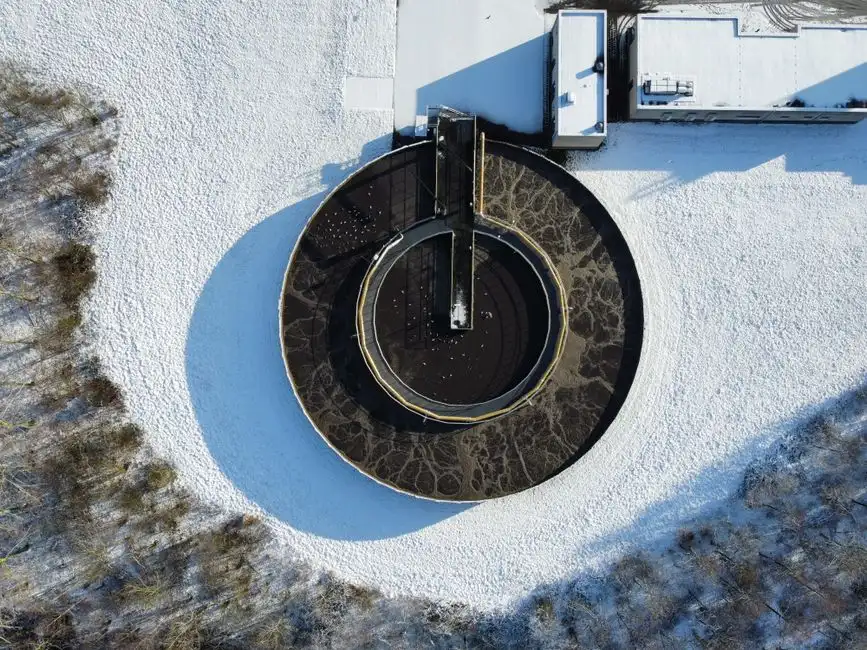
A clarifier relies on gravity settling. In a conventional circular or rectangular basin, surface loading rates sit at 1–2 m³/m²·h, but lamella (inclined-plate) designs compress the effective settling distance and push hydraulic loading to 20–40 m³/m²·h (per lamella clarifier product specification, 2026). Flocculation helps a clarifier, but it is less sensitive to micro-bubble contact than DAF and more sensitive to particle density. Hybrid DAF + MBBR pilots on synthetic oily wastewater confirm DAF as a robust primary step for emulsified oil before biological polishing (per S3, SSRN/Elsevier, 2024). The operating principle is also why DAF tolerates lower-density flocs, surfactant-stabilized emulsions, and oils that would never settle in a clarifier.
DAF vs Clarifier: Head-to-Head Comparison for Chemical Plant Wastewater
The table below summarizes the parameter ranges a Port Allen chemical EHS manager can hand directly to procurement. Removal figures are drawn from industrial DAF and lamella clarifier references and re-framed for chemical streams; the 70% oil figure in the clarifier column is the conservative Ecologix food-case benchmark (S2), which chemical streams will under-perform against because of surfactant stabilization.
| Parameter | DAF (DAF system) | Lamella Clarifier (inclined-plate) | Conventional Clarifier |
|---|---|---|---|
| Best contaminant fit | Emulsified oils, FOG, fine suspended solids, surfactants | Settleable TSS, precipitated metals, biomass | Heavy settleable solids, high-density inorganics |
| FOG / oil removal | 80–95% with proper chemistry | 40–60% (clarifier 70% benchmark per S2 is food-stream; chemical streams lower) | 30–50% |
| TSS removal | 70–90% with chemical conditioning | 85–95% on settleable TSS | 60–80% |
| Surface / hydraulic loading | 10–25 m³/m²·h | 20–40 m³/m²·h (per lamella spec) | 1–2 m³/m²·h |
| Footprint at 50 m³/h | ~6–10 m² cell area | ~3–5 m² with plate pack | ~25–50 m² basin area |
| CapEx band (10–100 m³/h, 2026 industrial) | USD 60,000–250,000 | USD 25,000–90,000 | USD 80,000–250,000+ (civil works heavy) |
| OpEx drivers | Air compressor, saturation pump, polymer feed, skimmer drive | Sludge pump, periodic sludge wasting, lower energy | Sludge pump, rake torque, lower energy |
| Sludge yield / solids capture | Float 2–6% dry solids (DS) | Underflow 1–3% DS | Underflow 1–3% DS |
| Downstream dewatering | Plate-and-frame filter press typical | Plate-and-frame filter press typical | Plate-and-frame filter press typical |
| pH tolerance (typical operating window) | pH 4–10 with stainless wetted parts | pH 5–9; metals precipitation favored at pH 8–9.5 | pH 5–9 |
| Feed variability tolerance | Handles pH swings, surfactant pulses, slug loads | Sensitive to density inversions and emulsions | Sensitive to hydraulic surges and density inversions |
For procurement, the headline is straightforward: a HydropureWater dissolved air flotation (DAF) system commands higher CapEx than a lamella clarifier but wins on emulsified-oil and FOG removal, which is precisely the parameter West Baton Rouge POTW enforcement targets. A HydropureWater lamella clarifier / high-efficiency sedimentation tank is the cheaper, denser-solids workhorse and pairs naturally with metal precipitation at pH 8–9.5.
Matching the Unit to the Chemical Stream: Three Realistic Scenarios
The matrix above is only useful when matched to the actual stream. The three scenarios below are representative of what we see in the Port Allen / West Baton Rouge corridor.
| Scenario | Stream profile | Recommended primary unit | Polishing / downstream |
|---|---|---|---|
| A — Organic / batch specialty chemicals | FOG 200–800 mg/L, surfactants present, COD 1,500–5,000 mg/L, pH 4–9, low metals | DAF (95% oil/grease benchmark from S2 food case is achievable with proper chemistry; expect 80–90% on stabilized chemical emulsions) | Biological (MBBR or SBR) if BOD > 300 mg/L, then clarifier-thickener, sludge to plate-and-frame filter press |
| B — Inorganic / acid-alkali washwater with metals | TSS 500–2,000 mg/L, metals (Ni, Cu, Zn, Cr) 5–50 mg/L each, pH 1–13 swings, low FOG | Lamella clarifier with pH adjustment (target pH 8–9.5) and metal precipitation, coagulant/flocculant feed | Sand/ multimedia filter for residual TSS, sludge to plate-and-frame filter press |
| C — Mixed organics + metals (most common at Port Allen sites) | FOG 100–400 mg/L, TSS 300–1,500 mg/L, metals 1–20 mg/L, COD 800–3,000 mg/L, pH 3–10 | DAF primary for organics/FOG → clarifier-thickener for precipitated metals and biomass | pH trim, final polish filter, sludge to plate-and-frame filter press |
Scenario A lines up with the food-plant benchmark in S2 (95% oil/grease on DAF) but only when jar testing confirms the chemistry. Scenario B is where a clarifier-thickener is non-negotiable because metals precipitation drives solids generation that DAF float would struggle to capture efficiently. Scenario C is the hybrid case the Ecologix guide (S2) flags explicitly and is the most common plant configuration we encounter in the Louisiana chemical corridor. Jar testing on actual plant wastewater remains the gating step before any of these are sized; no chemical plant should skip it in 2026.
2026 Regulatory Lens: LAC 33:IX, West Baton Rouge POTW, and EPA Categorical Standards
Louisiana DEQ's LAC 33:IX Chapter 11 governs industrial pretreatment in the state, and chemical plants discharging to the West Baton Rouge Parish POTW fall under both the local limits and the federal SIU framework (per LAC 33:IX Chapter 11, current as of 2026-01). Locally enforced parameters include oil & grease (typically 100 mg/L daily max), pH 5–10, TSS, total metals, and BOD/COD. Where a facility is a categorical industrial user under 40 CFR Part 414 (organic chemicals), Part 415 (inorganic chemicals), or Part 419 (petroleum refining), the categorical limits apply in addition to local limits — and the more stringent standard controls.
For 2026 capex, three regulatory actions belong on the project schedule: (1) submit a baseline monitoring report to the West Baton Rouge Parish POTW industrial waste coordinator before pilot data is finalized; (2) request a written jurisdictional determination confirming whether your SIC code triggers SIU status and which 40 CFR subparts apply; (3) document jar-test and pilot data in a way that maps each removal efficiency claim back to a specific compliance parameter. Plants that skip step (1) typically discover local limit surprises after the equipment is on order.
Procurement Decision Framework: Specifying a DAF or Clarifier in 2026
The framework below is the one a Port Allen procurement team can run from Monday morning and still be in vendor selection by end of quarter. Each step closes a specific gap in the typical chemical-plant CAPEX process.
| Step | Action | Output / deliverable |
|---|---|---|
| 1 — Characterize the feed | 24-hour composite samples across at least three production campaigns; analyze TSS, FOG, COD, pH, temperature, metals, surfactants | Feed characterization memo with worst-case envelopes |
| 2 — Jar test | Lab-scale DAF saturator + settle columns; benchmark float vs settle performance on the real stream with at least three polymer programs | Jar-test report identifying the controlling mechanism (float or settle) and the chemistry that wins |
| 3 — Pilot | Trailer-mounted mobile DAF (WesTech S5 confirms ≤1-day setup, 47'-6" × 8'-6" trailer) is the fastest path for chemical plants; run 4–6 weeks at full-scale flow | Pilot data, design loading rate, polymer dose, float solids % |
| 4 — Confirm chemistry integration | Specify polymer/coagulant feed; HydropureWater PLC-controlled automatic chemical dosing system integrates with both DAF and clarifier feed lines | P&ID with dosing points and control narrative |
| 5 — Size for reality | Size for 110% of average flow plus 1.5× peak; confirm downstream sludge handling via a HydropureWater plate-and-frame filter press sized to match float + underflow solids | Sized equipment list and sludge mass balance |
| 6 — Specify materials | 304 SS preferred for chemical service; carbon steel acceptable only for non-corrosive streams; confirm gasket and seal materials against solvent compatibility | Materials specification with chemical compatibility matrix |
The expected output at the end of step 6 is a complete bid package: a sized HydropureWater dissolved air flotation (DAF) system or HydropureWater lamella clarifier / high-efficiency sedimentation tank, a matched HydropureWater PLC-controlled automatic chemical dosing system, and a HydropureWater plate-and-frame filter press for sludge dewatering. For a parallel decision in a different industry, see DAF vs clarifier for pulp & paper wastewater in Crossett and DAF vs clarifier for fabricated metals wastewater in Sharon.
Frequently Asked Questions
When is DAF clearly better than a clarifier for chemical wastewater?
When the stream carries emulsified oils, surfactants, or fine buoyant solids that will not settle under gravity. DAF wins on FOG (80–95% removal with proper chemistry) where a clarifier typically lands at 40–60% on the same feed (per S2 Ecologix selection guide, 2026 update).
Can a chemical plant run DAF and clarifier in series?
Yes. Hybrid trains are common at mixed-stream chemical sites: DAF primary for organics, FOG, and surfactants, followed by a clarifier-thickener for precipitated metals and biological solids. The Ecologix selection guide (S2) flags this configuration as the standard answer for complex wastewater streams.
What removal efficiency should we expect for FOG on a Port Allen chemical DAF?
80–95% with proper chemistry and jar-test verification. The 95% upper bound is documented in food-plant DAF case studies (S2) and is achievable on chemical streams when polymer program, pH, and hydraulic loading are matched to the feed.
How long does a mobile DAF pilot take to deploy in West Baton Rouge Parish?
Typically within one day on a prepared site. WesTech's mobile DAF clarifier ships on a 47'-6" × 8'-6" trailer and requires only a level surface, power, and piping connections for influent, effluent, float, and drain (per S5 WesTech mobile DAF product page, 2026).
Which Louisiana regulations govern chemical plant discharge to the West Baton Rouge POTW?
LAC 33:IX Chapter 11 for industrial pretreatment, plus the West Baton Rouge Parish POTW's local discharge limits (oil & grease, pH 5–10, TSS, metals, BOD/COD). Where the facility is a categorical industrial user, 40 CFR Part 414 (organic chemicals) or Part 415 (inorganic chemicals) applies in addition to local limits, with the more stringent standard controlling.