Crossett Pulp & Paper Mills: The 2026 Decision Context
Three pulp and paper complexes anchor the Crossett, Arkansas industrial base: a kraft linerboard operation, a paperboard mill, and adjacent converting assets discharging to the Ouachita River basin. Each generates a distinct wastewater signature — brown stock washer filtrate, bleach plant effluent, paper machine white water, and deinking or coated broke streams — and each must satisfy the Arkansas Department of Energy and Environment, Division of Environmental Quality (ADEQ) Regulation 22 for industrial discharge. Regulation 22 sets the technology floor for any 2026 capital decision on primary solids removal.
The historical baseline is documented: more than 75 of 118 U.S. kraft mills still operated mechanical clarifiers in the EPA's most recent mill census, with another 21 running settling basins (per EPA 1973, Draft Second Report on Waste Profiles of the Paper Industry). That data confirms gravity clarification is a legitimate, in-use technology for primary treatment of pulp and paper effluent. The same EPA source also documents that clarification fails on streams from filled and coated paper manufacture and from waste paper reclamation because "finely dispersed pigments and debris… in very low concentration impart opalescence to receiving waters… present treatment methods are not adequate to handle this problem" (EPA-R2-73-184).
Selecting the right primary treatment technology requires evaluating the gap between existing clarifier performance and the specific requirements of DAF-compatible streams.
How a DAF Clarifies Pulp & Paper Wastewater
A dissolved air flotation unit clarifies pulp and paper wastewater by attaching microscopic air bubbles to suspended fibers, fillers, and FOG, then floating that agglomerate to the surface for skimming. The mechanism is straightforward: a side-stream of clarified effluent is saturated with air at 4–6 bar in a pressurized pipe, then released into the flotation cell at atmospheric pressure. The pressure drop nucleates millions of micro-bubbles 10–50 µm in diameter, which attach to particles whose density is close to or below water.
This density match is exactly why DAF is so effective on paper mill streams. Wood fibers, cellulose fines, coating pigments (clay, calcium carbonate, titanium dioxide), and deinking residues are difficult to remove by conventional sedimentation because they remain in suspension rather than settling (per the commercial overview of DAF for pulp and paper). The micro-bubbles give those particles enough buoyancy to rise in 3–5 minutes instead of settling slowly or not at all. A skimmer blade then removes the float layer at 3–5% dry solids — a thick, dewaterable sludge that can be returned to the paper machine as furnish on white-water applications, which directly offsets virgin furnish cost.
For 2026 mill sizing, the dissolved air flotation system covers 4–300 m³/h across 13 standard models with micro-bubble generation and automatic skimming, so capacity tracks closely to actual flow rather than oversized budget padding. The 2026 process detail for fiber return is laid out in our DAF fiber recovery from paper mill white water guide.
How a Gravity Clarifier Handles Pulp & Paper Wastewater
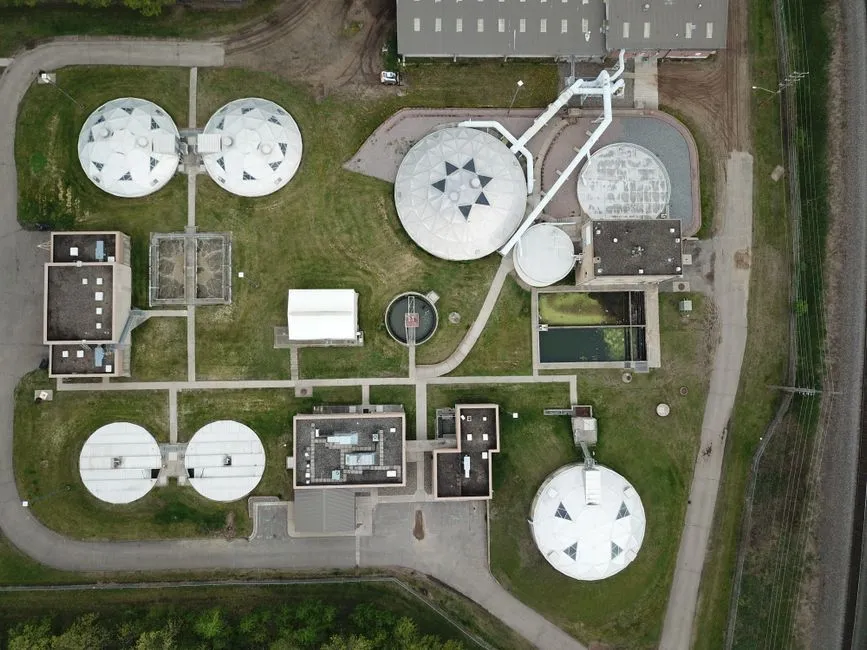
A primary mechanical clarifier removes settleable solids by letting them fall out under gravity in a quiescent basin. Flow enters a flocculation or center well, disperses across a settling zone where a sludge blanket forms, and exits over peripheral weirs. Sludge is collected by rotating scraper arms or inclined plates and densified in a hopper before being pumped to dewatering. A modern high-efficiency lamella clarifier compresses the same mechanism into inclined-plate packs running at 20–40 m/h surface loading, recovering coarse settleables and heavy ash in a footprint roughly one-third of a conventional clarifier.
The EPA 1973 state-of-the-art review concluded that "satisfactory methods are available for removing the bulk of the suspended solids from most pulp and paper mill effluents" — but qualified that conclusion by mill type. Tissue and fine-paper mills, which carry most of their BOD in suspended solids and have low dissolved organics, show high BOD5 reductions by settling in the EPA's own curves. Pulp mills and waste-paper operations, where dissolved organics dominate, show low BOD5 reduction by settling. The same report explicitly identifies "finely dispersed pigments and debris" from filled and coated papers and from waste paper reclamation as streams where "present treatment methods are not adequate" (EPA-R2-73-184).
Engineers must evaluate the specific solids profile of the mill stream to determine if gravity settling provides sufficient separation or if flotation is necessary.
Head-to-Head: DAF vs Clarifier on the Metrics That Matter
The comparison that drives a Crossett capital decision is based on parameter-by-parameter analysis against the mill's specific stream. The matrix below lines up the six metrics an engineer will defend in front of procurement and the ADEQ file reviewer.
| Parameter | Dissolved Air Flotation (DAF) | Gravity / Lamella Clarifier |
|---|---|---|
| Best-fit stream | Fiber-rich white water, deinking, coated broke, FOG-bearing effluent | High-flow coarse kraft and NSSC with heavy settleables |
| Mechanism advantage | Buoyancy lift of low-density fibers, fillers, and FOG via micro-bubbles | Gravity settling of high-density ash, grit, and fiber bundles |
| Hydraulic footprint | Compact skid; 4–300 m³/h across 13 models | 20–40 m/h surface loading on inclined plates (lamella catalog) |
| Polymer / coagulant dose | Typically lower on fiber streams; optimized for floc-bubble attachment | Lamella cuts coagulant use by up to 30% vs conventional clarifier (per lamella product data) |
| Fiber yield / by-product value | Float returned to paper machine as furnish — a direct furnish-cost offset | Underflow is wet, low-value, routed to sludge handling |
| Sludge dryness / dewatering | 3–5% DS float; dewaterable on a plate and frame filter press | 1–2% DS underflow; same press handles it but with more cycles per ton DS |
| CAPEX direction | Higher unit CAPEX, smaller civil footprint, lower polymer/sludge-disposal cost per m³ | Lower CAPEX, larger basin or lamella pack, lower fiber-yield revenue |
| 2026 fit for Crossett | New build on white-water or deinking lines; retrofit where fiber recovery is a stated KPI | Brownfield replacement of aging clarifier where CAPEX is constrained and stream is coarse |
The qualitative TSS and BOD5 contrast is anchored in the EPA's own BOD5-reduction-by-settling curves (Figure 3, EPA 1973): tissue and fine-paper mills respond well to settling; pulp and waste-paper mills respond poorly. DAF's micro-bubble mechanism was specifically developed for the latter category — particles that will not settle no matter how long the basin is. Polymer demand is typically managed through a PLC-controlled coagulant and polymer dosing skid paired with either technology, but DAF float is a usable furnish stream in a way that clarifier underflow is not.
Match the Technology to the Mill Type: A 2026 Selection Matrix
Translating the head-to-head into a defensible mill-by-mill choice is the difference between a technology comparison and a capital decision. Use the table below to anchor the recommendation in writing.
| Crossett-area mill type | Dominant stream | 2026 primary-treatment recommendation | Why |
|---|---|---|---|
| Kraft pulp / linerboard | Brown stock washer filtrate, decker filtrate, bleach effluent | DAF preferred for fiber capture; existing clarifier acceptable for greenfield expansion if CAPEX is constrained | EPA baseline confirms >75 of 118 kraft mills run clarifiers; for high-TSS fiber recovery a DAF skid is the modern upgrade |
| Tissue and fine paper | Paper machine white water, low dissolved organics | Modern lamella clarifier, technically sufficient, lowest total cost | EPA Figure 3 shows high BOD5 reduction by settling on tissue/fine paper — DAF is over-specified for this stream |
| Paperboard / deinking / coated broke | Coating pigments, deinking fines, broke | DAF is the correct answer | EPA 1973 explicitly flags these streams as inadequately handled by clarification due to finely dispersed pigments |
| NSSC and packaging (mixed) | NSSC evaporator condensate, paper machine white water, broke | DAF-then-lamella train — DAF pulls floatable fiber, lamella polishes overflow | Combines fiber recovery with polishing in a tight bay footprint; pairs with existing biological stage downstream |
| Compliance overlay (all mills) | Discharge to Ouachita basin under ADEQ Reg 22 | Selection must be defensible against Reg 22 TSS / BOD5 / pH limits in addition to internal fiber KPI | Per the 2026 U.S. pulp and paper pretreatment compliance guide, primary-treatment technology choice must be supported by stream-specific performance data |
The decision rule is simple: if the stream is fiber-rich, coated, or FOG-bearing, DAF wins. If the stream is high-flow, coarse, and CAPEX-constrained, a modern lamella clarifier is the defensible answer. A broader equipment context is available in our 2026 suspended solids removal buyer's guide.
Installation, Footprint, and 2026 ROI Sketch for a Crossett Retrofit
A representative retrofit in a Crossett-area mill is a 200 m³/h white-water line adjacent to an existing primary clarifier. A DAF skid in the 50–100 m³/h module class fits inside a typical mill bay, ties into the existing white-water chest, and discharges float to a plate and frame filter press for cake to boiler or landfill. A lamella retrofit, by contrast, usually replaces an aging basin in place, reusing the existing civil work and weirs.
The 2026 ROI levers an engineer can audit are: polymer and coagulant savings (DAF float is typically dewatered with less conditioning than clarifier underflow), avoided sludge-disposal cost per ton of dry solids (DAF float at 3–5% DS means fewer truckloads than 1–2% DS underflow), and the value of fiber returned to furnish — which for a 200 m³/h white-water line at typical consistency can offset a meaningful fraction of virgin furnish. The dissolved air flotation system scales from 4 to 300 m³/h across 13 models, so CAPEX tracks actual flow rather than budget padding. Avoided ADEQ Regulation 22 excursion risk is the final, non-trivial lever: a TSS excursion on the Ouachita discharge triggers notice and corrective-action cost that dwarfs the polymer delta in any given month.
The exact dollar ROI depends on mill flow, current polymer dose, hauling cost, and furnish price — all of which a site audit must confirm — but the directional answer holds: DAF wins on fiber-rich streams, lamella wins on coarse streams under tight CAPEX, and either technology must be supported by stream-specific performance data to satisfy ADEQ Regulation 22.
Frequently Asked Questions
Should a Crossett pulp and paper mill choose DAF or a clarifier for primary treatment in 2026?
For fiber-rich white water, deinking effluent, or coated broke, choose DAF — micro-bubbles lift low-density fibers, fillers, and FOG that a clarifier will not capture, and the float returns to the paper machine as furnish (per the DAF process overview for pulp and paper). For high-flow coarse kraft and NSSC streams under tight CAPEX, a modern lamella clarifier remains a defensible choice
Frequently Asked Questions
Should a Crossett pulp and paper mill install a DAF or a clarifier in 2026?
The selection depends on the specific influent stream characteristics and site footprint constraints. For mills targeting high-rate fiber recovery and smaller footprints, DAF systems are superior due to their ability to handle low-density suspended solids. However, for high-volume primary treatment of raw effluent where settling velocity is high and operational simplicity is prioritized, conventional gravity clarifiers remain the industry standard for cost-effective, high-volume solids removal.
What TSS removal does a DAF give on paper mill white water compared to a clarifier?
A Dissolved Air Flotation (DAF) unit typically achieves 90% to 98% Total Suspended Solids (TSS) removal on white water, often producing an effluent TSS concentration below 50 mg/L. In contrast, a well-operated primary gravity clarifier typically achieves 70% to 85% TSS removal, as it is limited by the settling velocity of the fine fibers and fillers that remain buoyant or neutrally buoyant in the water column.
Can a gravity clarifier recover fiber from paper mill wastewater?
Yes, a gravity clarifier can recover fiber, but it is less efficient than a DAF or a disc filter. Gravity clarifiers rely on sedimentation, which is effective for heavier cellulose fibers but often fails to capture fine fillers, clay, or lightweight fibers that do not settle within the typical 2 to 4-hour hydraulic retention time. Consequently, the recovered sludge from a clarifier often has a higher ash content and lower fiber quality compared to the float collected by a DAF.
Is a lamella clarifier good enough for a kraft mill in Arkansas under ADEQ Regulation 22?
While lamella clarifiers are efficient for footprint reduction, their suitability for a specific Arkansas kraft mill must be verified against ADEQ's stringent discharge permit requirements and the specific wastewater chemistry. Under ADEQ guidelines, the system must demonstrate consistent performance in meeting the facility's NPDES permit limits for TSS and BOD. Because kraft mill effluent often contains complex dissolved organics and potential scaling agents, the high-surface-area plates of a lamella system are prone to fouling, which may impede compliance during high-loading events.
How much does it cost to retrofit a DAF on an existing paper mill clarifier line?
Retrofitting a DAF unit into an existing clarifier line typically ranges from $500,000 to $2.5 million, depending on the required hydraulic capacity (GPM) and the complexity of integration into the existing hydraulic profile. This cost includes the DAF vessel, saturation system, chemical feed skids, and necessary piping modifications. Operational costs must also be factored in, as DAF systems require significant electricity for air saturation pumps and ongoing expenses for flocculant and coagulant polymers.