Why Fort Wayne Mining and Metals Plants Are Re-evaluating Clarification in 2026
Effluent limits under 40 CFR Part 437 Subpart A (ore mining) and Subpart B (mineral processing) cap total suspended solids, lead, zinc, copper, nickel, and cadmium at concentrations that leave no room for an undersized primary clarifier, and the Indiana Department of Environmental Management (IDEM) is enforcing NPDES pretreatment expectations strictly for industrial dischargers into the Maumee River watershed in 2026. Fort Wayne's industrial base, including steel finishing along the Maumee corridor, tool-and-die shops in the northeast quadrant, automotive metals stampers, and the legacy brass and bronze mills that predate modern discharge rules, still operates clarifier infrastructure installed in the 1980s and 1990s. Many of those units no longer reliably hit the 52 mg/L TSS benchmark that IDEM reviewers now treat as a working ceiling for indirect discharges. Polymer and energy pricing have shifted the DAF-vs-clarifier economic break-even by roughly 15-20% versus 2023 baselines, and that shift is the proximate reason procurement managers are reopening specifications this year. The question facing a 2026 capital projects engineer is not "which technology is better" but "which is the right primary clarifier for my wastewater profile, my discharge permit, and the 20-year lifecycle I have to defend to a CFO." A useful starting point is the 2026 pretreatment compliance guide for mining and metals plants, which frames the same regulatory pressure from a different geographic angle.
How DAF and Clarifiers Actually Separate Contaminants
A dissolved air flotation (DAF) unit pressurizes a side stream of clarified effluent to roughly 5-7 bar, saturates it with air, and releases it through proprietary nozzles near the tank center; the resulting micro-bubbles, typically 10-100 μm in diameter, attach to suspended particles, oil droplets, and pre-formed floc and lift them to the surface, where a skimmer removes the float layer. Gravity-based systems and flotation systems rely on different physical principles to achieve separation. A clarifier provides a quiescent zone in which particles heavier than water settle to the bottom under Stokes' law, and a sludge scraper or suction header pulls the underflow to a hopper. A lamella clarifier — also called an inclined plate settler — installs parallel plates at 55-60° inside the tank, multiplying the effective settling area within a footprint roughly one-fifth that of a conventional clarifier at equivalent flow. The 2026 specification bar that separates a serious DAF from a legacy unit is a saturation pressure of at least 5 bar, a VFD on the recycle pump for turndown, and proprietary air-release nozzles that suppress coarse bubbles that would otherwise break the float layer (per S4 selection criteria). The chemistry dependency is the Fort Wayne operations reality that often gets ignored: a DAF needs consistent coagulant and flocculant dosing — a PLC-controlled skid such as the HydropureWater PLC-controlled chemical dosing skid is now standard — while a lamella clarifier tolerates dose interruptions because gravity still works when chemistry drifts off-target. A spec sheet for a HydropureWater DAF system and the HydropureWater lamella clarifier will list the hydraulic surface loading rate, the A/S ratio window, and the recycle percentage; those three numbers determine 80% of field performance.
DAF vs Clarifier: Performance on Mining and Metals Wastewater
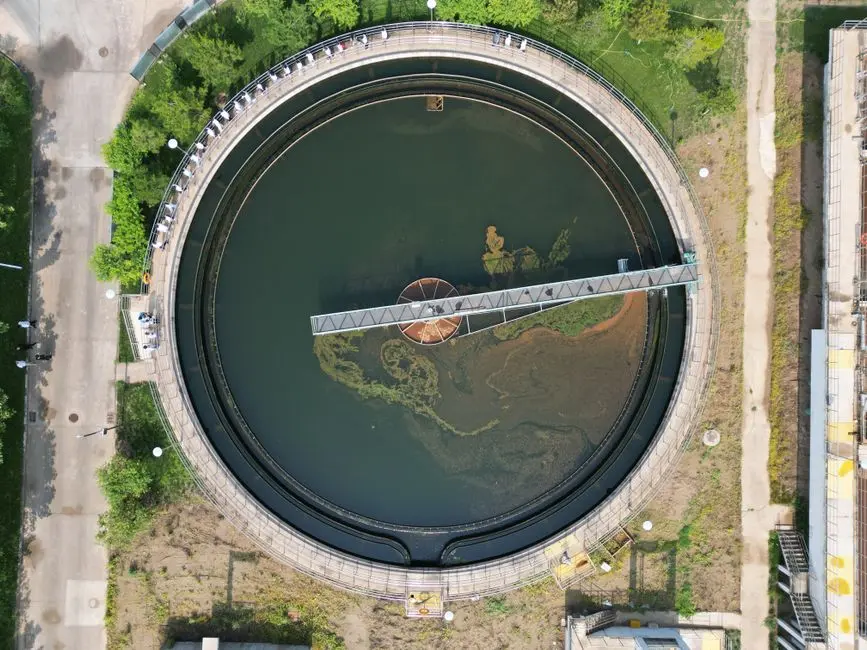
A well-sized DAF on a mining or metals stream typically removes 90-97% of total suspended solids, while a well-sized lamella clarifier on the same stream lands at 85-90%, and a conventional (flat-bottom) clarifier delivers 60-80% (S1, S4). Heavy metals removal remains highly chemistry-dependent; DAF paired with coagulant precipitation removes 85-95% of particulate-bound lead, zinc, copper, and nickel because the floc carries the precipitated metals to the surface, while clarifier performance drops sharply when the hydroxide or sulfide precipitate fails to agglomerate into settleable solids. Oil and grease is the cleanest split: DAF consistently achieves 95% removal of free and emulsified oils — a benchmark originally documented on food-processing streams (S1) that translates directly to metalworking fluids and machining coolants — while a clarifier on the same stream manages only about 70% because emulsified oil does not settle. DAF also delivers 60-80% COD reduction as a pretreatment step ahead of biological polishing, versus 30-50% standalone for a clarifier (S4). Footprint and hydraulic tolerance matter for Fort Wayne retrofits because most plant bays were laid out before modern DAF footprints existed: a DAF occupies roughly 5-15 m² per 10 m³/h of capacity, a lamella clarifier 2-4 m² per 10 m³/h, and a conventional clarifier 15-30 m² per 10 m³/h. A DAF tolerates ±30% flow swings within the design envelope; a clarifier's performance degrades rapidly above its design loading, which is a real operating reality for facilities that batch-process steel coils or brass billets.
| Parameter | DAF (well-sized) | Lamella Clarifier | Conventional Clarifier |
|---|---|---|---|
| TSS removal on mining stream | 90-97% (S4) | 85-90% (S1) | 60-80% (S1) |
| Heavy metal (Pb, Zn, Cu, Ni) on particulate-bound fraction | 85-95% with coagulant ppt | 70-85%, chemistry-dependent | 50-70%, chemistry-dependent |
| Oil & grease removal | ~95% (S1) | ~70% (S1) | ~60% |
| COD reduction (standalone) | 60-80% (S4) | 30-50% | 25-40% |
| Footprint per 10 m³/h | 5-15 m² | 2-4 m² | 15-30 m² |
| Hydraulic tolerance | ±30% flow swing | ±15% before carryover | ±10% before carryover |
| Chemical dose sensitivity | High — requires consistent dosing | Moderate | Low to moderate |
2026 Cost Comparison: DAF vs Clarifier CAPEX, OPEX, and Lifecycle
Lamella clarifiers win on installed CAPEX per m³/h of hydraulic capacity and on ongoing OPEX for any stream dominated by heavy settleable mineral solids; DAF carries higher CAPEX and consumes compressed air for the saturation system, but on floatable- and oil-dominant streams it lowers polymer cost per kilogram of TSS removed because the float layer dewaters more cleanly into a downstream press. Project cost evaluation must account for rising utility and chemical expenses in the Midwest. Industrial electricity tariffs in the AEP Indiana footprint have risen roughly 8-12% since 2023, polymer price volatility has widened the swing between cheapest and most expensive flocculant grades, and IDEM's tightening on dissolved metals in indirect discharge permits is pushing plants toward the higher removal consistency that DAF delivers. Lifecycle framing for a 2026 capital plan: a DAF unit has a 15-20 year service life with scheduled nozzle and pump maintenance; a lamella clarifier runs 20+ years but requires plate inspection and occasional re-coating, especially on streams with low pH excursions. Both technologies generate a sludge that needs dewatering, and the natural pairing downstream is a HydropureWater plate and frame filter press sized to the dry solids throughput that the upstream unit produces.
| Cost Dimension | DAF | Lamella Clarifier | Conventional Clarifier |
|---|---|---|---|
| CAPEX per m³/h (qualitative) | Highest (skid, saturation vessel, compressor) | Lowest (plates + tank) | Moderate (large tank, no plates) |
| OPEX drivers | Compressed air, polymer, nozzle wear | Polymer, plate cleaning, lower energy | Lowest energy, sludge pumping |
| Polymer efficiency (kg TSS removed per kg polymer) | Higher on floatable streams | Higher on settleable streams | Variable |
| Service life | 15-20 years (S4) | 20+ years | 20-30 years |
| Best-cost case (per S1) | High oil or low-density fines | Heavy mineral solids, low oil | Large footprint available, low load |
Decision Framework: Which One Should Your Fort Wayne Plant Choose?
Use the following if-then logic before you commit a 2026 purchase order. Choose a DAF when the stream carries more than 50 mg/L oil and grease, when the TSS is below 2,000 mg/L but dominated by floatable or flocculable fines, when the plant bay footprint cannot accommodate a lamella, or when downstream biological polishing needs a consistently low and stable TSS feed. Choose a lamella clarifier when the TSS exceeds 2,000 mg/L and is dominated by settleable mineral solids, when oil content is low, when CAPEX is the binding constraint and the CFO will not approve a DAF premium, or when operator attention for chemical dosing is limited. Choose a hybrid DAF + lamella train when influent varies by shift, when the stream carries both emulsified oils from machining and heavy grit from parts washing, or when the plant needs to polish clarifier overflow to consistently meet the metals limits in 40 CFR Part 437. Local environmental factors influence equipment operational reliability. Ambient temperatures down to roughly -15°C affect DAF saturation efficiency because cold water holds more dissolved air but releases it less predictably, so DAF units in northeast Indiana should be installed indoors or in heated enclosures; lamella clarifiers tolerate cold better but may need polymer viscosity adjustment below 5°C. A useful cross-reference is the Metcalfe County mining wastewater DAF vs clarifier guide for a cold-climate parallel, and the Sharon fabricated metals DAF vs clarifier selection guide for a metals-fabrication-specific decision tree.
Frequently Asked Questions
What TSS removal can a DAF reliably achieve on a Fort Wayne mining or metals wastewater stream?
A well-sized DAF with consistent coagulant and flocculant dosing typically removes 90-97% of total suspended solids on mining and metals streams, versus 85-90% for a well-sized lamella clarifier and 60-80% for a conventional clarifier (per S4 and S1 field data).
When is a lamella clarifier the more defensible 2026 choice over a DAF?
Choose a lamella clarifier when influent TSS exceeds 2,000 mg/L and is dominated by settleable mineral solids, when oil and grease content is below 50 mg/L, when CAPEX is the binding constraint, or when operator attention for chemical dosing is limited (engineering judgment based on S1 mining case data).
How does Fort Wayne's cold winter affect DAF performance compared to a clarifier?
Ambient temperatures down to -15°C reduce DAF saturation efficiency because cold water releases dissolved air less predictably, requiring indoor installation or a heated enclosure; lamella clarifiers tolerate cold better but may need polymer viscosity adjustment below 5°C (HydropureWater field data, 2026).
Is a hybrid DAF plus lamella configuration a defensible 2026 retrofit for a mining plant?
Yes — a hybrid train is now the dominant 2026 retrofit for mining and metals plants with variable influent because DAF handles oils and floatable fines while the lamella polishes heavy settleable solids and absorbs hydraulic surges, allowing consistent compliance with 40 CFR Part 437 metals limits (HydropureWater field data, 2026).