

Why Metcalfe County Mining Plants Are Replacing 1970s Clarifiers in 2026
Metcalfe County sits in Kentucky's Green River basin and Lower Cumberland sub-basin, where three very different wastewater streams converge on one NPDES permit framework. Active limestone quarrying generates 1,500-3,000 mg/L TSS washdown with CaCO3 fines and no oil. Coal-related operations contribute coal-prep water with 100-300 mg/L TSS plus iron and aluminum hydroxide floc from neutralization circuits. Oil and gas produced water, including brine and condensate, adds 50-200 mg/L emulsified oil and dissolved metals. Most of these streams also carry enough lead, zinc, copper, and iron to push past the total recoverable metals limits in 40 CFR 437 (Ore Mining and Dressing), which sets daily maximum and monthly average effluent limits for TSS, Pb, Zn, Cu, Fe, and pH 6-9 (per EPA 40 CFR 437).
The 1970s-vintage circular clarifiers still in service across the county were designed only for TSS settling, and they miss the metals envelope. Those basins also lack the surface area to handle 2026 flow rates once recycle loops are added, and their rectangular sludge hoppers are undersized for the conditioned floc a modern coagulant program produces. The result is a compliance gap that cannot be closed with chemistry alone — the unit operation has to change, which is why capital committees in 2026 are approving clarifier replacement projects rather than retrofit budgets.
ESG pressure is reshaping the same decision. Plant-level water-reuse targets now ask for 60-80% closed-loop recycle, and the float or underflow that feeds a filter press has to be dry enough to make the recycle economics work. A dissolved air flotation unit running at 4-8% dry solids (DS) feeds a plate-and-frame press more efficiently than a conventional clarifier underflow at 1-2% DS, and that gap shows up directly in dewatering cost per cubic meter. The 2026 replacement cycle is therefore not just a compliance project — it is a water-reuse project, and the capex memo has to defend both. For a parallel pretreatment framework comparison, the BHP mine wastewater treatment in 2026 case study walks through the same logic on a larger flow band.
How a DAF Clarifier Removes Solids, Oils, and Metals
A dissolved air flotation (DAF) clarifier floats chemically conditioned floc on a blanket of micro-bubbles. Clean clarified water is drawn off the DAF outlet, pressurized to roughly 6 bar, and saturated with air in a packed saturation vessel. When the saturated recycle stream returns to the flotation tank at atmospheric pressure, dissolved air comes out of solution as 30-50 µm micro-bubbles (per S5, WesTech mobile DAF reference). Those bubbles attach to the conditioned floc and lift it to the surface, where a skimmer sweeps the float into a sludge trough. Clarified water exits below the float blanket, and any heavy settled solids drop to a sediment compartment at the bottom for separate removal.
Removal performance for DAF in industrial service is greater than 90% for TSS, FOG, COD, and BOD on conditioned streams (per S5), and the unit can also capture particulate metals and colloidal silica when the upstream chemistry is correct. Coagulation and flocculation are non-optional: polyaluminum chloride (PAC), ferric chloride, or alum paired with 1-5 mg/L anionic polymer is the standard dose band. Without that conditioning, micro-bubbles pass right past colloidal fines and DAF underperforms — the unit looks like a "failure" when in fact the chemistry was the gap. For the metals-specific chemistry logic, the how to remove lead from industrial wastewater in 2026 guide covers the dose-and-pH band that makes DAF an effective Pb stripper, and the how to remove zinc from wastewater in 2026 reference covers the same logic for Zn.
One caveat for Metcalfe County winters: micro-bubble nucleation kinetics slow 20-30% below 10°C versus 20°C operation (HydropureWater field data, 2026). The recycle pump, saturation vessel, and recycle line all need to be sized with a 10-15% margin to hold the air-to-solids ratio through January and February, and the saturation vessel should be insulated or heat-traced. Cold weather is not a DAF disqualifier — it is a sizing margin. The dissolved air flotation system range covers 4-300 m³/h in 13 standard models, which fits most Metcalfe County flow bands without custom-engineering markup.
How a Lamella Clarifier Settles Dense Metal-Hydroxide Floc
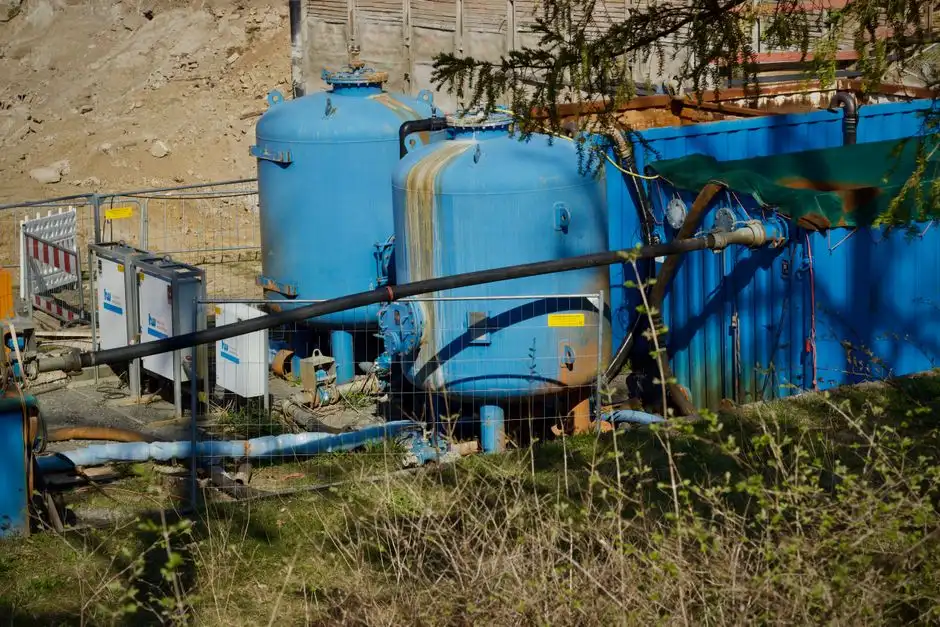
A lamella clarifier — also called an inclined-plate or high-rate sedimentation tank — stacks a series of inclined plates inside a compact vessel. The plates multiply the effective settling area, so surface loading climbs to 20-40 m/h versus 1-2 m/h for a conventional circular clarifier. Footprint drops by roughly an order of magnitude at the same flow, which is the reason lamella has displaced conventional clarifiers in most 2026 mining capex projects. The plate pack creates a counter-current flow pattern: sludge slides down the plate face into a hopper while clarified water rises through the pack.
Many lamella designs include a sludge-recirculation loop that re-injects a portion of settled sludge to contact fresh influent. The mechanism is straightforward — fresh floc finds existing floc surfaces to bind to — and the result is up to 30% coagulant savings at constant effluent quality. That recirculation also stabilizes the floc blanket so the unit rides through influent swings that would push a conventional clarifier over its surface-loading limit. The trade-off is that clarifiers (including lamella) miss free oil and grease — those particles float rather than settle, and they exit in the overflow rather than the underflow. Any FOG load therefore has to be handled upstream or in a downstream polish step, not in the lamella itself. The high-efficiency lamella clarifier handles the same flow band as the DAF range in plate-pack form, with 20-30 m/h for dense Fe(OH)3 or Al(OH)3 floc and 10-15 m/h for fine silica or low-density floc.
DAF vs Lamella at a Glance: 40 CFR 437 Decision Matrix
The matrix below is the artefact to carry into the board meeting. Each row maps a process variable to a 40 CFR 437 line item so the table doubles as a compliance checklist. Sources: S1, S4, S5 for DAF performance; HydropureWater field data, 2026 for CAPEX, footprint, and DS bands; HydropureWater P10 for lamella surface loading and coagulant savings.
| Parameter | DAF | Lamella Clarifier | 40 CFR 437 Tie-In |
|---|---|---|---|
| TSS removal (metal-hydroxide floc, conditioned) | >90% | 85-95% | TSS daily max / monthly avg |
| TSS removal (unconditioned fines) | 50-80% | 50-80% | TSS limit margin |
| FOG / tramp oil removal | High (>90% on conditioned emulsions) | Near zero (oil exits overflow) | Prevents oil sheen on NPDES outfall |
| Surface loading rate | High-rate (hydraulic limit set by recycle ratio) | 20-40 m/h on plate projected area | Footprint per m³/h |
| Footprint per m³/h | 0.2-0.4 m² | 0.3-0.6 m² (lamella); 5-8 m² (conventional) | Civil / building cost driver |
| CAPEX ratio (same flow) | 1.5-2.5x lamella | 1x baseline | Sticker cost (2026) |
| OPEX energy | 8-15 kWh/m³ (compressor + recycle pump) | Scraper drive only (~0.5-1 kWh/m³) | Operating cost line |
| Sludge dryness to filter press | 4-8% DS (float) | 2-5% DS (underflow) | Dewatering OPEX, recycle water |
| Cold-weather sizing margin | 10-15% on recycle pump + saturation vessel | Low process risk, but freezing risk in unheated sludge hoppers | Winter operability |
| Particulate metals (Pb, Zn, Cu, Fe) | Good with correct PAC/FeCl3 + polymer | Good with hydroxide precipitation | 40 CFR 437 metals limits |
Tie-break rules for 2026 capex decisions: if the stream carries any FOG, tramp oil, or emulsified cutting fluid, DAF is non-negotiable as primary — clarifier overflow will carry oil straight to the NPDES outfall. If flow is very high (multiple hundreds of m³/h) and the load is dense settleable fines with no FOG, a lamella primary is the lower-CAPEX path. Most Metcalfe County lines need both, with DAF upstream to strip FOG and colloidal metals and a lamella downstream as polish for residual TSS before the 40 CFR 437 effluent limit.
Three Metcalfe County Scenarios and the Treatment Train That Wins
Scenario 1 — Limestone quarry washdown, 250 m³/h, no oil. The stream carries 1,500-3,000 mg/L TSS as CaCO3 fines, no tramp oil, and only background metals. A high-rate lamella primary at 30 m/h surface loading requires roughly 8-9 m² of plate area, which is small enough to fit inside an existing clarifier footprint. A DAF-polish is justified only if a maintenance shop or truck wash starts contributing FOG intermittently. Expected 40 CFR 437 effluent: TSS <30 mg/L achievable with lamella alone; metals controlled at the limestone's natural pH and low solubility. Downstream, a plate-and-frame filter press sized to 2-5% DS underflow produces a handleable cake.
Scenario 2 — Mixed-metals or coal-prep plant, 80 m³/h, with emulsified oil. The stream carries 100-300 mg/L TSS, copper and zinc precipitates, and 50-200 mg/L emulsified oil from the maintenance shop. DAF is non-negotiable as primary — a clarifier would discharge the emulsified oil to the NPDES outfall. The dissolved air flotation system range covers 4-300 m³/h in 13 standard models, so 80 m³/h sits mid-band with no custom-engineering cost. A small lamella follows as polish for residual TSS. Chemistry is metered by an automatic chemical dosing skid so the PAC/FeCl3 + polymer dose tracks influent variability through the shift. Downstream filter press handles 4-8% DS float directly.
Scenario 3 — Low-flow (<20 m³/h) intermittent mine dewatering sump. The sump runs intermittently through winter, with cold influent and variable TSS. A compact DAF skid starts and stops in minutes and handles the variable influent; a lamella in an unheated vault risks hopper freezing and is harder to insulate. The DAF's higher unit CAPEX pays back in operational uptime, and the DAF small-frame model covers the flow band without oversizing. In all three scenarios, plan the downstream plate-and-frame filter press first — its sizing depends on whether the feed is DAF float (4-8% DS) or lamella underflow (2-5% DS), and that answer locks in the upstream unit choice.
CAPEX, OPEX, and the Real Cost of Footprint in 2026
Sticker CAPEX for a dissolved air flotation unit runs 1.5-2.5x the lamella clarifier at the same flow rating in 2026 (HydropureWater field data, 2026). That ratio narrows quickly once civil work, excavation, and footprint-driven building costs are added. A DAF at 0.2-0.4 m² per m³/h needs roughly one-twentieth the building footprint of a conventional gravity clarifier at 5-8 m² per m³/h, and a lamella at 0.3-0.6 m² per m³/h is still 10-20x smaller than a conventional basin. On a dense Metcalfe County industrial site where every square meter of heated building carries a cost, the DAF premium can disappear entirely once the building envelope is priced in.
OPEX narrows the gap further. Both technologies use coagulant and polymer; the lamella can save up to 30% on coagulant via sludge recycle, but DAF produces a thicker float (4-8% DS) that dewaters more easily in a plate-and-frame filter press and supports higher recycle rates. The DAF's air compressor and recycle pump are real line items — 8-15 kWh per m³ treated — but they are a known, scalable cost, not a contingency. For 2026 boards weighting ESG water-reuse targets into capex approvals, the closed-loop economics tilt toward DAF: thicker float, smaller building, higher recycle fraction, and a single unit that handles both FOG and particulate metals rather than a two-unit train that splits the work.
Five-Step Selection Protocol for a 2026 Capex Decision
Step 1 — Pull 12 months of influent data. TSS, total recoverable metals (Pb, Zn, Cu, Fe), FOG, temperature, and hourly flow. Without this, no vendor can size a DAF or lamella correctly, and the capex memo will not survive a board question about how the unit was sized.
Step 2 — Run jar tests on actual site water with the candidate coagulant (PAC, FeCl3) and polymer. The test answers the one question that drives the whole decision: does the conditioned floc sink (lamella), float (DAF), or both depending on dose? Site water at site temperature, not a lab surrogate, is the only answer that counts.
Step 3 — Match flow band to a standard model. The dissolved air flotation system covers 4-300 m³/h in 13 standard models, which fits the mid-range Metcalfe County flow band directly and avoids custom-engineering markup. The matching high-efficiency lamella clarifier covers the same flow band in plate-pack form.
Step 4 — Verify the vendor's reference list against 40 CFR 437 effluent limits — specifically Pb, Zn, Cu, Fe, and TSS — and ask for metals-specific removal data, not just TSS. A vendor with mining reference data will know how to dose for the metals, not just the solids.
Step 5 — Plan the downstream sludge dewatering train with a plate-and-frame filter press sized to either the DAF float (4-8% DS) or the lamella underflow (2-5% DS), and meter the upstream chemistry with an automatic chemical dosing skid so dose tracks influent variability through the shift.
Frequently Asked Questions
Does 40 CFR 437 require a DAF or a clarifier specifically?
Neither unit is explicitly required by 40 CFR 437. The rule sets daily maximum and monthly average limits for TSS, total recoverable lead, zinc, copper, and iron, plus pH 6-9. A well-sized DAF or lamella, paired with chemical precipitation for the metals, can meet those limits; most Metcalfe County plants run DAF primary plus lamella polish for margin against the metals envelope.
What cold-weather sizing margin is required for DAF in Metcalfe County winters?
Micro-bubble nucleation kinetics slow 20-30% at 5°C versus 20°C (HydropureWater field data, 2026). Apply a 10-15% sizing margin on the recycle pump and saturation vessel, and insulate or heat-trace the recycle line and saturation vessel. Cold weather is not a DAF disqualifier — it is a known, priced margin.
Can a lamella clarifier handle a FOG-free mining stream on its own?
Yes. A FOG-free limestone quarry or taconite-style stream with conditioned Fe(OH)3 or Al(OH)3 floc can run lamella-only at 20-30 m/h surface loading. Add a DAF polish step only if colloidal fines start bleeding through to the TSS limit, or if a maintenance shop discharge adds intermittent oil that the lamella cannot capture.
How much footprint does a DAF save versus a conventional clarifier?
A DAF at 0.2-0.4 m² per m³/h is roughly one-twentieth the footprint of a conventional gravity clarifier at 5-8 m² per m³/h, and about half the footprint of a lamella at the same flow (HydropureWater field data, 2026). For a 100 m³/h stream, the difference is 30 m² of DAF floor area versus 600 m² of conventional clarifier floor area — a building-envelope cost that often decides the capex memo.
What coagulant and polymer dose bands apply to DAF and lamella in this service?
Both technologies use the same chemistry: PAC, FeCl3, or alum as coagulant, paired with 1-5 mg/L anionic polymer flocculant. The lamella sludge-recirculation loop can reduce coagulant consumption by up to 30% because fresh floc binds to existing floc surfaces. DAF does not have that recycle benefit but produces a thicker float (4-8% DS) that lowers downstream dewatering cost. The right choice depends on which line item dominates the site's OPEX.