Why Antibiotic Fermentation Wastewater Is a Three-Layer Problem for Carbon Filters
Spent broth from an antibiotic fermentation train is a stratified, three-layer feed that defeats single-stage activated-carbon sizing. Layer 1 is suspended mycelia and biomass: rotary-drum vacuum filter or dissolved air flotation (DAF) feed solids typically fall in the 1,000–6,000 mg/L TSS range, with a high fraction of filamentous solids that blind a GAC bed inside hours if sent directly. Layer 2 is the dissolved fermentation residue — un-metabolized sugars, amino acids, soluble microbial products, and lysis by-products contributing 8,000–30,000 mg/L of COD and a BOD₅/COD ratio around 0.4–0.55 (HydropureWater field data, antibiotic API plants, 2024–2025). Layer 3 is the trace residual antibiotic active: penicillins, cephalosporins, macrolides, tetracyclines, and their transformation products at the mg/L to µg/L scale, often below the inhibition threshold of a conventional biological stage.
Generic carbon guidance fails because a carbon stage cannot perform clarification, biological reduction, and micropollutant polishing simultaneously. Once the three layers are decoupled by the right upstream train — mycelia removal, then biological treatment, then carbon — the carbon stage becomes predictable and engineerable.
How Activated Carbon Adsorbs Antibiotic Residues and Color Bodies
Granular activated carbon removes antibiotics through a combination of hydrophobic pore-filling in the micropore fraction (<2 nm) and mesopore (2–50 nm) adsorption for larger, more polar organics and color bodies. For low-molecular-weight APIs (MW 300–500 g/mol, log Kow 0.5–3) such as most β-lactams, fluoroquinolones, and sulfonamides, the dominant mechanism is adsorption into the micropore volume. Color bodies and soluble microbial products (SMPs) generated during fermentation are heavier and more hydrophilic, so they require the mesopore network to access the surface.
Micropore-dominant carbons provide superior pharmaceutical removal when there is enough mesoporosity to prevent background organic matter from blocking entry. Across eight commercial GACs screened on the same wastewater, the highest pharmaceutical removal tracked to carbons with 70–75% of their BET surface in micropores and a sufficient mesopore tail to limit competitive adsorption (ScienceDirect S4, Sci. Total Environ. 952, 2024). Off-spec "high-BET" carbons often fail in this application due to poor pore-size distribution for fermentation effluent.
A working GAC bed develops a biofilm that bio-transforms previously adsorbed organics, causing apparent capacity to grow with service time (ScienceDirect S4). For an antibiotic plant targeting biodegradable APIs, this biofilm is a distinct advantage, explaining why GAC outperforms PAC on a mass-of-pollutant-removed basis once both reach steady state.
Granular vs Powdered Activated Carbon: Choosing the Right Form

The GAC-vs-PAC decision is the most consequential line on a carbon-polish datasheet, affecting both OPEX budgets and regulatory compliance. Five variables drive the selection: flow regime (continuous vs batch), TSS load reaching the carbon stage, target residual API, available footprint, and the availability of thermal regeneration.
Continuous antibiotic API plants utilizing biological treatment and a polishing multi-media filter reach ~80% removal of pharmaceuticals and benzotriazole using 2.0–2.5 g GAC/gC at 20 minutes of contact time (ScienceDirect S4). This dose corresponds to an empty bed contact time (EBCT) of 15–30 minutes. For challenging targets like PFAS or highly polar APIs requiring 7.5–10 g GAC/gC (ScienceDirect S4), a hybrid AOP+GAC train is more effective than oversizing the GAC bed.
PAC requires a different operating envelope, typically involving 20–200 mg/L doses injected into a contact basin with rapid mix (G ≥ 300 s⁻¹) for 1–5 minutes, followed by 30–60 minutes of flocculation. PAC offers lower CAPEX and a smaller footprint, but it is a single-use media that exits with sludge. GAC is preferred for regenerable media requirements and steady-state pharmaceutical removal, while PAC is better suited for batch variability and short campaigns.
| Decision Parameter | GAC (Granular Activated Carbon) | PAC (Powdered Activated Carbon) |
|---|---|---|
| Typical dose for ~80% pharmaceutical removal | 2.0–2.5 g GAC/gC at 20 min EBCT (ScienceDirect S4) | 20–200 mg/L into contact basin |
| Dose for PFAS-class or highly polar APIs | 7.5–10 g GAC/gC for >80% removal (ScienceDirect S4) | Not economical; pair with AOP |
| EBCT / contact time | 15–30 min | 30–60 min flocculation + clarifier |
| Regeneration | Thermal reactivation every 6–18 months | Single-use, exits with sludge |
| Best fit | Continuous operation, regenerable media, mixed API spectrum | Batch/shock loads, limited footprint, pilot trials |
| Typical CAPEX (500 m³/d plant) | Low-to-mid six figures USD for vessels + media | 60–80% lower CAPEX, higher recurring carbon cost |
| Biological activity on bed | Yes — biofilm bio-transforms adsorbed APIs over time (ScienceDirect S4) | No — single-pass contact |
A GAC polishing stage downstream of a multi-media filter for carbon bed protection is the standard for continuous API plants. For batch fermentation with variable API spikes, PAC remains a faster retrofit, often paired with ozone oxidation for refractory APIs.
Where the Carbon Stage Fits in a Fermentation Wastewater Treatment Train
Five unit operations must be sequenced correctly for the carbon stage to hit design removal targets.
- Mycelial and solids removal. A rotary drum screen or a DAF unit for mycelial removal before biological treatment drops TSS to a few hundred mg/L, recovering biomass as a by-product (see also how a DAF machine works for fermentation broth).
- Biological treatment. An anaerobic stage followed by an aerobic or MBR system for the biological stage ahead of carbon polishing strips bulk COD and the readily biodegradable fraction of the antibiotic load.
- Equalization and polishing filtration. An equalization basin smooths batch spikes, while a multi-media filter drops TSS to below ~30 mg/L, which is the primary factor for GAC service life.
- Activated carbon polishing. GAC or PAC removes residual APIs, color, and refractory COD.
- Disinfection. A chlorine dioxide generator for downstream disinfection addresses residual bacteria and ARG carryover. GAC contributes ~1 log removal of fecal/antibiotic-resistance indicators and cuts UV254, which improves downstream disinfection performance (ScienceDirect S4).
Engineers must ensure the carbon bed does not function as a primary clarifier; skipping these upstream steps leads to rapid fouling and premature failure.
Design Parameters and Operating Windows for the Carbon Vessel
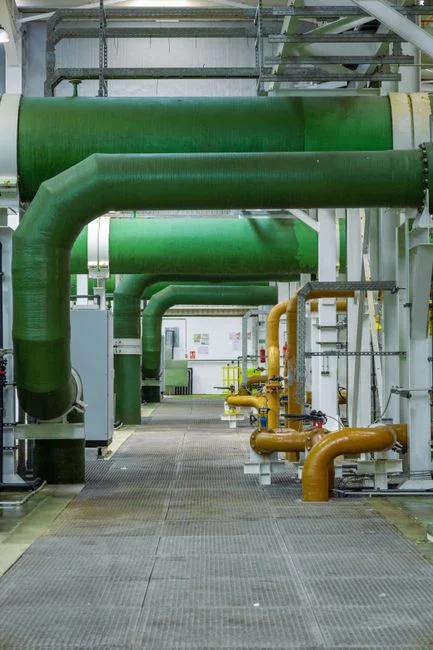
Sizing begins with the 2.0–2.5 g GAC/gC benchmark (ScienceDirect S4) to determine hydraulic loading, bed depth, and backwash frequency.
| Parameter | GAC Vessel (Downflow) | GAC Vessel (Upflow) | PAC Contact Basin |
|---|---|---|---|
| Hydraulic loading | 6–12 m/h | 5–10 m/h, bed expansion <15% | Not applicable (mixing-driven) |
| EBCT / contact time | 15–30 min (typical polishing) | 15–30 min | 1–5 min rapid mix, 30–60 min floc |
| Particle size | 0.6–2.4 mm | 0.6–0.8 mm (low-granulometry, per ScienceDirect S4) | 10–100 µm slurry |
| Backwash / declog | Air-scour + water every 24–72 h; DCS 6–12/day for 4.7–5.5× capacity gain (ScienceDirect S4) | Continuous fluidization; backwash every 3–7 days | None (single pass) |
| Carbon replacement | Thermal regeneration every 6–18 months | Thermal regeneration every 6–18 months | Continuous make-up with sludge |
| Backwash water | 5–15% of throughput | 5–15% of throughput | Nil (PAC exits with sludge) |
Downflow configuration is the preferred default for antibiotic polishing as it maintains the filtration effect. For PAC systems, a velocity gradient of G ≥ 300 s⁻¹ is required to ensure proper flocculation before sedimentation or DAF separation.
Compliance, Cost, and ROI Considerations for 2026 Projects
Regulatory bodies in the EU, China, and India are tightening discharge standards for pharmaceutical residues, making GAC a standard item in 2026 EPC specifications for antibiotic API plants. A documented GAC polish stage provides a defensible design choice for environmental compliance.
For a 500 m³/d plant, GAC vessels and initial media fill typically cost in the low-to-mid six figures USD. A PAC dosing skid with an automatic PAC dosing skid offers 60–80% lower CAPEX but involves higher recurring media costs. Carbon polish stages typically pay back within 24 months by preventing non-compliance fines or enabling water reuse.
Fenton pre-oxidation can be used to lift refractory COD into a biodegradable range, often more economically than oversizing GAC (see Fenton oxidation system for refractory wastewater). Additionally, ozone upstream of GAC is a proven hybrid for PFAS-class and highly polar APIs (see ozone oxidation system for pharmaceutical wastewater).
Frequently Asked Questions
What dose of GAC is needed to reach ~80% removal of residual antibiotics from fermentation wastewater?
Benchmark studies show 2.0–2.5 g GAC/gC at 20 minutes of contact time delivers ~80% removal of 15 pharmaceuticals and benzotriazole (ScienceDirect S4). For PFAS or highly polar APIs, 7.5–10 g GAC/gC is required, at which point an AOP+GAC train is generally more cost-effective than oversizing the carbon.
Should I choose GAC or PAC for a batch antibiotic fermentation plant with variable API loads?
Batch campaigns with sharp API spikes and limited footprint are better served by PAC at 20–200 mg/L in a rapid-mix/flocculation/clarifier train. Continuous campaigns with access to thermal regeneration should utilize GAC at 15–30 min EBCT for lower long-term OPEX.
Can activated carbon polishing stand alone, or does it need upstream biological treatment?
Carbon polishing must be paired with biological treatment and a polishing filter. Raw fermentation broth containing 1,000–6,000 mg/L TSS and 8,000–30,000 mg/L COD will blind a carbon bed rapidly; a DAF unit, an MBR or conventional activated sludge, and a multi-media filter are mandatory to ensure the carbon stage functions correctly.