The Pretreatment Rule That Actually Controls a Newport Chemical Plant
Three regulatory layers can govern a single chemical discharge to the Newport Water Pollution Control Facility (NWPCF), and the most stringent applicable layer is the binding constraint. The three layers are: (1) the general and specific prohibitions at 40 CFR 403.5(a) and 403.5(b); (2) the numeric categorical pretreatment standards issued by EPA in 40 CFR Parts 405–471; and (3) the site-specific local limits developed and enforced by the NWPCF under its approved pretreatment program (per EPA, 2026). The Clean Water Act §307(b) authorizes the categorical layer, while §402(n) authorizes POTW pretreatment programs as part of the NPDES framework.
Two statutory triggers — pass-through and interference — define Layer 1. Pass-through at 40 CFR 403.3(p) is a discharge that exits the POTW into waters of the United States in quantities or concentrations that, alone or with other sources, cause a violation of any requirement of the POTW's NPDES permit, including an increase in the magnitude or duration of a violation. Interference at 40 CFR 403.3(k) is a discharge that, alone or with other sources, both inhibits or disrupts the POTW, its treatment processes, or its sludge processes and therefore is a cause of an NPDES permit violation. Either trigger is a violation even when no numeric limit is exceeded (per EPA, 2026). Layer 1(b) adds eight specific prohibitions, including a closed-cup flashpoint floor below 140 °F, a pH floor below 5.0 in any non-accommodating works, and a temperature ceiling above 40 °C (104 °F) at the POTW headworks.
Layer 2 — the categorical standards — supplies the numeric floor for chemical plants. The relevant subparts are 40 CFR Part 414 (organic chemicals, plastics, and synthetic fibers), Part 415 (inorganic chemicals), Part 417 (soap and detergent manufacturing), Part 419 (petroleum refining), and Part 433 (metal finishing), among others. EPA revises these subparts on a multi-year cycle, so the engineer should always pull the current text of 40 CFR rather than rely on cached values. Layer 3 — Newport's local limits under Ordinance Ch. 13.10 — is often the binding number for chemical plants because the receiving plant's hydraulic or organic capacity is constrained relative to its industrial load (per EPA, 2026).
Newport's Local Limits: The Numbers That Usually Bind
Newport Ordinance Ch. 13.10 publishes a numeric local-limit table that applies at the point where the wastewater is discharged to the NWPCF. The values most likely to bind a chemical plant are reproduced in the table below (per Newport Ordinance Ch. 13.10, S4).
| Parameter | Newport local limit (mg/L unless noted) |
|---|---|
| TPH (Total Petroleum Hydrocarbons) | 2.0 |
| Gold (Au) | 3.0 |
| Iron (Fe) | 15.0 |
| Tin (Sn) | 0.0 |
| Metals not specifically listed (default) | 2.0 |
| Sulfides (as S) | 100.0 |
| Sulfates (as SO₄) | 500.0 |
| Fluoride | 5.0 |
| Mercuric Chloride (as Hg) | 0.5 |
| Phenols (not to exceed) | 1.0 |
| Solvents | 0.0 |
| Total Oil & Grease | 100.0 |
| pH | 6.0 – 9.0 (standard units) |
Several entries in this table are operationally aggressive. The TPH cap of 2.0 mg/L sits roughly 50× below the typical 100 mg/L oil-and-grease ceiling that most chemical-plant pretreatment trains are designed to hit, and the tin and solvents entries at 0.0 mg/L are de facto bans. The mercuric chloride value of 0.5 mg/L, expressed as Hg, is the binding mercury number for any chemical stream that sees mercury catalysts or electrodes. The 500 mg/L sulfate ceiling will bind acid-neutralization trains that use sulfuric acid or lime slurries, and the 1.0 mg/L phenols cap rules out sending resin-regenerate or distillation bottoms through the sewer without polishing. pH 6.0–9.0 is the standard POTW envelope, but the director retains authority to impose mass-based limits where dilution is suspected, and the ordinance flatly prohibits using dilution as a partial or complete substitute for treatment to achieve compliance (per Newport Ordinance Ch. 13.10, S4).
Newport's pretreatment program is approved by the Rhode Island Department of Environmental Management (RI DEM), which acts as the approval authority. The city issues the wastewater discharge permit and enforces the local limits, but any change to a categorical standard or to RI DEM's program approval flows through to the permit. Limits apply at the point of discharge to the NWPCF, so the engineer must verify compliance at the sewer manhole — not at the unit-operation outlet (per Newport Ordinance Ch. 13.10, S4).
SIU Status and What It Adds to Your Compliance Burden
Significant Industrial User (SIU) status is defined at 40 CFR 403.3(v) and is triggered by any one of three conditions: the industrial user is subject to a categorical pretreatment standard; the user discharges an average of 25,000 gpd or more of process wastewater; or the user's process waste stream makes up 5% or more of the POTW's average dry-weather hydraulic or organic capacity (per EPA, 2026). A chemical plant almost always hits trigger 1 because its operations fall under 40 CFR Part 414, 415, 417, 419, or an adjacent subpart, so the relevant question is rarely "Are we an SIU?" but rather "Do we have the BMR, the 90-day reports, and the slug plan current?"
SIU status adds a defined paperwork and monitoring stack under 40 CFR 403.12. The baseline monitoring report (BMR) establishes the pollutant envelope at the point of categorical standard promulgation or new-discharge startup. The 90-day compliance report is filed on a defined schedule thereafter. The control mechanism — the wastewater discharge permit itself — is issued by the City of Newport and incorporates the local limits, the categorical number, and any BMPs. The POTW also retains inspection and sampling authority, and the user must keep self-monitoring records on file. For batch chemical operations, 40 CFR 403.8(f) requires a slug-load control plan that combines equalization capacity, flow and pH monitoring, and written batch-release procedures (per EPA, 2026).
For a plant engineer, the practical implication is that the cost of getting the documentation wrong is rarely the civil penalty itself; it is the operational constraint of having to defend a corrective-action plan while production is already at risk. The cheapest insurance is to size equalization generously, to instrument the equalization basin with redundant pH and conductivity probes, and to write the slug plan to match the actual batch sequence rather than a generic template.
Mapping the Controlling Pollutant to the Right Unit Operation
Four decision axes determine which unit operations a Newport chemical plant actually needs: the controlling pollutant, the SIU status and applicable standard, the flow pattern (batch versus continuous), and the water-reuse potential. Walking through them in order produces a defensible 2026 equipment train (per EPA, 2026).
Axis 1 — controlling pollutant — is the first filter. Oils and total suspended solids (TSS) above roughly 50 mg/L point to a DAF system for chemical plant pretreatment. Dissolved metals that exceed Newport's 2.0 mg/L default or the 0.5 mg/L mercury ceiling point to chemical precipitation followed by a clarifier such as a high-efficiency sedimentation tank for metals precipitation. High COD or BOD that would consume capacity at the NWPCF points to biological polishing. pH swings outside the 6.0–9.0 envelope point to equalization plus PLC-controlled chemical dosing for pH and metals. In practice, most chemical plants hit two or three of these simultaneously, so the full train is the common case.
Axis 2 — SIU status and applicable standard — sets the federal floor. The categorical number is non-negotiable; the local limit is often more stringent. Axis 3 — flow pattern — drives equalization sizing. Batch operations with long cycle times or shared collection systems should be sized for hours to days of retention, while continuous operations can usually run on 4–8 hours. The cost penalty for over-sizing equalization is small relative to a single NPDES excursion, so the typical engineering default is to err on the long side. Axis 4 — water reuse — pushes the design toward MBR-plus-RO when non-contact loops exist, and back toward conventional activated sludge or a simpler aerobic basin when the plant is discharge-only.
| Controlling pollutant / condition | Unit operation | Regulatory driver |
|---|---|---|
| Batch swings in pH, flow, temperature, concentration | Equalization basin | 40 CFR 403.5(a) pass-through/interference; 40 CFR 403.8(f) slug load control |
| Strong acid or caustic batches | PLC-controlled pH dosing | 40 CFR 403.5(b) specific prohibitions; Newport pH 6.0–9.0 |
| Free oils, FOG, TSS | Dissolved air flotation (DAF) | 40 CFR 403.5(a); categorical standard; Newport TPH 2.0 mg/L, O&G 100 mg/L |
| Dissolved metals (Cd, Cr, Cu, Ni, Pb, Zn, Hg) | Chemical precipitation + lamella clarifier | Categorical standard (e.g., 40 CFR Part 433); Newport metals 2.0 mg/L default, Hg 0.5 mg/L |
| High COD/BOD | MBR biological polishing | Categorical standard; local limit on BOD/COD to POTW |
| Residual COD, phenols, color | Multimedia or carbon filtration | Newport phenols 1.0 mg/L; pass-through prevention |
The 2026 default train for a Newport chemical plant discharging to the NWPCF is: equalization → pH adjustment → DAF → precipitation and lamella clarifier → biological polishing (MBR) → multimedia or carbon filtration → discharge to sewer. The default is conservative because Newport's local limits — particularly TPH at 2.0 mg/L, mercury at 0.5 mg/L, and phenols at 1.0 mg/L — leave little room for a single weak step in the chain (per EPA, 2026).
The 2026 Equipment Train and Why Each Step Earns Its Place
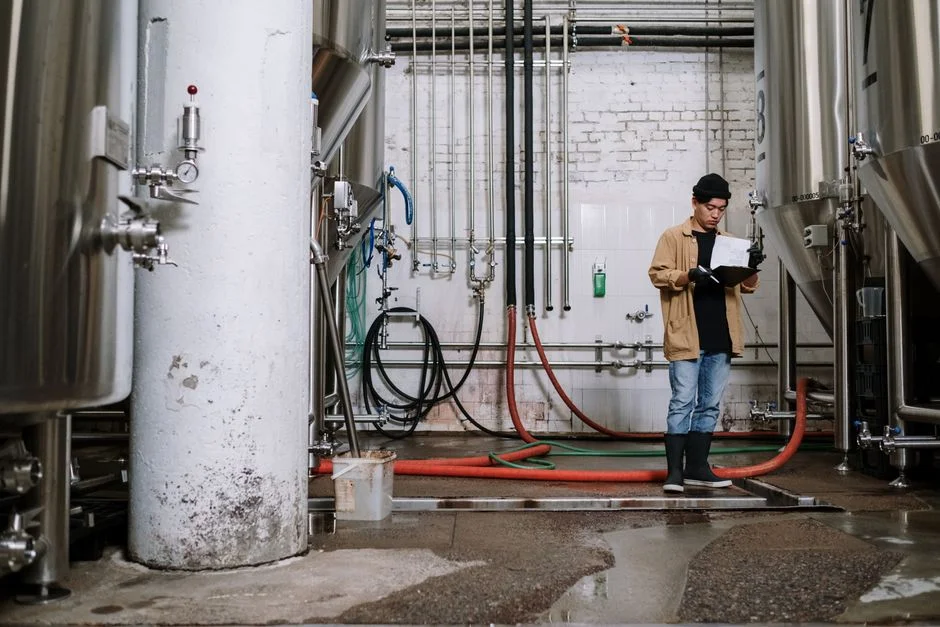
Equalization is the cheapest insurance in the train. A properly sized basin with a PLC-controlled dosing loop damps the pH, flow, and concentration swings that would otherwise cause pass-through under 40 CFR 403.5(a) or a slug-load excursion under 40 CFR 403.8(f). The capital cost of an adequately sized basin is small compared with the cost of a single NPDES excursion, which is why most chemical plant engineers treat equalization as the baseline. The PLC-controlled chemical dosing for pH and metals loop typically combines a pH probe, a redundant conductivity probe, and a PID controller tied to caustic or acid metering pumps, with a hard-wired interlock that diverts off-spec flow back to the basin.
DAF targets the 100 mg/L Total Oil & Grease local limit and protects downstream biology from slug loads of free oil. The DAF system for chemical plant pretreatment handles 4–300 m³/h with micro-bubble technology and is normally sized to remove 80–95% of influent oil and TSS in a single stage. DAF alone will not hit Newport's 2.0 mg/L TPH cap on a stream that starts above 200 mg/L, so the DAF is paired with a downstream polishing step.
Chemical precipitation with a high-efficiency sedimentation tank for metals precipitation targets dissolved metals against Newport's 2.0 mg/L default, the 0.5 mg/L mercury ceiling, and any tighter subpart-specific categorical number. The clarifier is typically run at surface loading rates of 20–40 m/h, which is 5–10× higher than a conventional basin and cuts coagulant and flocculant use by up to 30%. For mercury-bearing streams, the precipitation train usually adds a sulfide or trimercaptotriazine stage to push residual Hg below 0.05 mg/L before the clarifier.
MBR biological polishing drives BOD and COD well below any practical categorical or local limit, and the membrane stage also produces reuse-quality permeate for non-contact loops such as cooling-water makeup. An MBR biological polishing for BOD and COD skid reaches sub-1 μm filtration in a footprint roughly 60% smaller than conventional activated sludge with a separate clarifier. Where the influent is high in non-biodegradable COD, an Fenton or ozone stage is often inserted ahead of the MBR to lift biodegradability, but for most chemical plant discharges the MBR alone is sufficient.
Multimedia or carbon filtration is the final polish. A multi-media or carbon filtration for final polishing stage strips residual COD, color, and the phenols that Newport caps at 1.0 mg/L. The carbon vessel is typically sized for an empty bed contact time of 10–20 minutes to ensure trace organics are adsorbed before the sewer. The combined train — equalization, pH adjustment, DAF, precipitation/clarifier, MBR, and multimedia/carbon — is the engineering default in 2026 for chemical plants discharging to the NWPCF (per EPA, 2026; per Newport Ordinance Ch. 13.10, S4).
Newport-Specific Compliance Checklist Before Sewer Discharge
Use this checklist to verify that the equipment train actually hits the binding limit at the point of discharge to the NWPCF.
- For each pollutant in the discharge, compare the 40 CFR Part 414/415 (or adjacent subpart) categorical number against the Newport local limit in Ordinance Ch. 13.10 and use the more stringent value as the design target (per EPA, 2026; per Newport Ordinance Ch. 13.10, S4).
- Verify at the NWPCF discharge point that pH stays in 6.0–9.0, TPH ≤ 2.0 mg/L, mercury ≤ 0.5 mg/L, sulfates ≤ 500 mg/L, phenols ≤ 1.0 mg/L, and Total Oil & Grease ≤ 100 mg/L, with no dilution used to achieve compliance (per Newport Ordinance Ch. 13.10, S4).
- Maintain a baseline monitoring report, 90-day compliance reports, a current slug-load control plan under 40 CFR 403.8(f), and routine self-monitoring records per 40 CFR 403.12 (per EPA, 2026).
- Schedule a wastewater discharge permit review with Newport's pretreatment coordinator and RI DEM before any process change that alters flow or pollutant loading, since the local-limit table and the categorical subparts are both subject to multi-year revision (per EPA, 2026; per Newport Ordinance Ch. 13.10, S4).
For more detail on the federal and cost side of the same problem, the chemical plant pretreatment compliance near Columbus guide walks through a parallel stack. For unit-operation selection logic in a different industry, the DAF vs clarifier selection guide for 2026 is a useful reference. For operating-cost framing, the petrochemical wastewater OPEX breakdown for 2026 gives current chemical and energy unit costs.
Frequently Asked Questions
Which regulatory layer controls a chemical plant discharging to the NWPCF?
The most stringent applicable layer controls. The three layers are the general and specific prohibitions at 40 CFR 403.5(a) and (b), the numeric categorical standards in 40 CFR Part 414, 415, 417, 419, or 433 (per EPA, 2026), and Newport's local limits under Ordinance Ch. 13.10 (per Newport Ordinance Ch. 13.10, S4). The engineer must compare all three for each pollutant and design to the most stringent value.
Does a typical chemical plant become a Significant Industrial User?
Yes. The SIU definition at 40 CFR 403.3(v) is triggered whenever an industrial user is subject to a categorical pretreatment standard, and chemical plants almost always fall under Part 414, 415, 417, 419, or an adjacent subpart (per EPA, 2026). SIU status triggers a baseline monitoring report, 90-day compliance reports, a control mechanism, and — for batch operations — a slug-load control plan under 40 CFR 403.8(f).
Where do the discharge limits apply, and is dilution allowed?
Newport's local limits apply at the point where the wastewater is discharged to the NWPCF, so compliance must be verified at the sewer manhole, not at the unit-operation outlet. Dilution is not a permitted pathway to compliance, and the director may impose mass-based limits where dilution is suspected (per Newport Ordinance Ch. 13.10, S4).
What unit operations are typical for a Newport chemical plant in 2026?
The typical train is equalization, PLC-controlled pH adjustment, dissolved air flotation (DAF), chemical precipitation with a lamella clarifier, MBR biological polishing, and multimedia or carbon filtration before discharge to the sewer (per EPA, 2026). The exact subset depends on the controlling pollutant, the SIU standard, the flow pattern, and whether water reuse is in scope.
Who is the approval authority for Newport's pretreatment program?
The Rhode Island Department of Environmental Management (RI DEM) is the approval authority for the City of Newport's pretreatment program, and the City of Newport issues the wastewater discharge permit (per Newport Ordinance Ch. 13.10, S4). Both must be engaged before any process change that alters flow or pollutant loading.