
Why Transportation Equipment Plants in Minneapolis Face a DAF-vs-Clarifier Decision in 2026
For a Minneapolis transportation equipment plant — think truck-body fabricators on the east side, rail-car shops along the Minnesota River, EV tier suppliers in Plymouth — the primary clarifier question is not academic. The wastewater mix is distinctive: phosphating and e-coat rinse water, draw-line lubricants, hydraulic and cutting oils, water-based coolants, parts-washer detergents, and occasional solvent slugs. The streams run high in FOG and emulsified oil, moderate in TSS, and low in BOD/COD relative to a food plant. That chemistry profile is what makes the choice between dissolved air flotation and a gravity lamella clarifier a real procurement decision rather than a textbook exercise.
Discharge limits are non-negotiable. MPCA Chapter 7050 (and Chapter 7001 for local limits) and the Metro POTW discharge ordinances — enforced by Metropolitan Council Environmental Services — typically cap oil & grease at 100 mg/L daily max, TSS at 300 mg/L daily max, pH 5–10, with zinc and nickel limits from any plating lines. Older categorical EPA limits still apply on top of these. A clarifier alone rarely meets 100 mg/L O&G on emulsified streams; the math doesn't close.
Then there is the climate filter. Minneapolis averages a January low near 7°F (-14°C), with multi-day stretches below 0°F. An outdoor gravity clarifier needs enclosure, heat tracing, or a buried tank; a skid-mounted high-rate DAF sits indoors, operates at ambient factory temperature, and never sees a frozen surface oil layer. The rest of this guide compares dissolved air flotation against conventional and lamella clarifiers as primary solids-FOG removal for these streams, and gives Minneapolis plant engineers a 2026 decision framework they can actually act on.
How a DAF System Works and How a Gravity Clarifier Works
A dissolved air flotation system separates suspended particles by floating them, not settling them. Pressurized air is dissolved in a recycle stream at 2.5–5.5 atm, then released through needle valves into the flotation chamber as a cloud of 30–100 μm microbubbles. Those bubbles attach to oil droplets and fine solids, lifting them to the surface in roughly 3 minutes, where a rotating skimmer scrapes the float into a sludge hopper. The DAF has four major components — air supply, pressurizing pump, saturation/retention tank, and flotation chamber — and a recycle ratio that typically runs 10–30% of forward flow (Sarı, 2024, doi:10.1201/9781315164199).
A gravity clarifier does the opposite: it relies on quiescent settling under Stokes' law. Heavier solids drop to the bottom cone; surface oils are pushed to a scum beach by a slowly rotating skimmer arm. A conventional clarifier needs 2–4 hours of hydraulic retention to do this work; a lamella clarifier shortens retention to 30–60 minutes by routing flow between inclined plates at 55–60°, multiplying the effective settling area inside a much smaller footprint.
The mechanism difference is the whole game for oily streams. DAF microbubbles attach to oil droplets that gravity would never settle, and the chemistry can be tuned with coagulant — polyacrylamide drives oil removal to roughly 94%, alum to about 89%, no coagulant to roughly 60% (Mohammed, 2019). A clarifier, with or without lamella plates, only captures settleable solids and free oil; emulsified FOG passes through. Multiple academic reviews note that DAF effluent quality, startup speed, and sludge dryness typically exceed sedimentation-based clarifiers on oily industrial streams (Sarı, 2024; Rodrigues, 2007). The Zhang (2024) MMBBR-DAF hybrid work confirms that DAF effluent is a stronger feed for downstream biology than clarifier effluent on synthetic oily wastewater (doi:10.2139/ssrn.4731382).
DAF vs Clarifier: 2026 Comparison Matrix for Transportation Equipment Wastewater
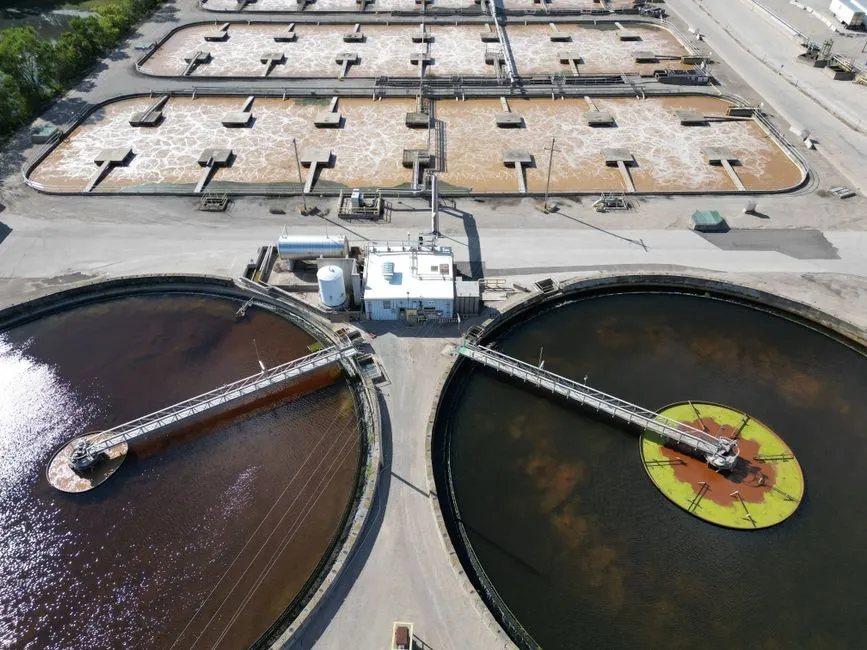
Head-to-head, for a 50 GPM (≈11 m³/h) oily stream typical of a mid-sized truck-body or rail-car plant, the equipment numbers stack up like this:
| Parameter | High-Rate DAF | Conventional Gravity Clarifier | Lamella Clarifier |
|---|---|---|---|
| Hydraulic retention time | ~3 min | 2–4 h | 30–60 min |
| Surface loading rate | 4–5 GPM/ft² | 0.4–0.8 GPM/ft² | 1.5–2.5 GPM/ft² |
| Oil & grease removal | 60% alone; 94% with polyacrylamide; 89% with alum (Mohammed, 2019) | 50–70% (free oil only) | 50–70% (free oil only) |
| TSS removal to effluent | 20–30 mg/L (Wang & Wang, 2022) | 60–80% of influent TSS | 60–80% of influent TSS |
| Thickened sludge solids | 2–3% dry solids — no thickener needed | 0.5–1.5% — needs thickening | 0.5–1.5% — needs thickening |
| Footprint for 50 GPM | 15–25 m² (skid indoor) | 100–180 m² (basin) | 30–50 m² (basin) |
| Footprint ratio vs DAF | 1× | ~7× larger | ~2× larger |
The sludge row is the one that quietly pays the bills. DAF float leaves the unit at 2–3% dry solids, so it can go straight to a small filter press or haul-off. Clarifier underflow at 0.5–1.5% has to be thickened first, which adds a gravity thickener belt, a polymer system, and another building. Footprint is the other quiet killer: a 50 GPM DAF unit such as the HydropureWater dissolved air flotation system fits in a corner of an existing bay; the equivalent conventional clarifier wants a 10 m × 15 m outdoor basin that older Twin Cities brownfields simply don't have.
The rule of thumb from this matrix: DAF wins whenever emulsified FOG exceeds 200 mg/L, when indoor or cold-climate siting is required, or when downstream biology or membrane polishing needs TSS reliably under 30 mg/L. Lamella only competes at low-FOG, space-plentiful sites, or as a polishing step after DAF.
Minneapolis-Specific Factors That Tilt the Choice Toward DAF
Cold-climate operation is the single biggest localizer. Surface oil layers in an outdoor clarifier congeal once ambient drops below freezing, which in Minneapolis happens roughly 140 nights per year. A frozen scum layer defeats skimming and lets oil pass into the effluent. Enclosed, indoor skid-mounted DAFs operate at 60–70°F year-round, and the surface float stays pumpable through every polar vortex. The same logic applies to any buried or partially buried tank design — concrete spalling from freeze-thaw cycles is a real maintenance cost in Minnesota that indoor DAF installations simply don't incur.
Space constraints on older Twin Cities plants push the same direction. Many transportation equipment sites sit on narrow parcels along the Mississippi, Minnesota, and Crow rivers with limited yard space; a 100–180 m² clarifier basin is a non-starter, while a 15–25 m² DAF skid is a retrofit, not a civil project (WesTech, 2025).
Sewer authority limits are stricter than EPA categoricals in this region. Metropolitan Council Environmental Services and most Metro POTWs enforce local limits tighter than the federal baseline — 100 mg/L O&G daily max is the working number, with zinc and nickel often capped in single-digit mg/L. Clarifier alone rarely meets those numbers on emulsified draw-line wastewater; DAF with polymer does it consistently.
Production variability also favors DAF. Transportation equipment lines run batch wash cycles — a day's effluent FOG can swing from 80 mg/L to 600 mg/L in a single shift. A DAF's 3-minute retention absorbs that swing; a clarifier's 2–4 hour retention averages it into a permit excursion. For plants that want to validate before committing CAPEX, mobile DAF trailers (47'-6" to 51'-7" long, brought online in a single day) are deployable for trials or peak-load events (WesTech, 2025).
2026 CAPEX and OPEX Bands for a Minneapolis Transportation Equipment Plant
Budget numbers for a 2026 install, in USD, equipment-only unless stated:
| Plant size | High-Rate DAF unit only | DAF + chemical dosing + sludge press | Conventional clarifier + plate pack | Lamella clarifier + plate pack |
|---|---|---|---|---|
| 25 GPM (~5.7 m³/h) | $90,000–$140,000 | $180,000–$260,000 | $120,000–$180,000 (civil works dominant) | $70,000–$110,000 |
| 50 GPM (~11 m³/h) | $140,000–$210,000 | $280,000–$400,000 | $200,000–$320,000 | $110,000–$170,000 |
| 100 GPM (~23 m³/h) | $220,000–$330,000 | $450,000–$620,000 | $340,000–$520,000 | $180,000–$280,000 |
On CAPEX alone, a lamella clarifier looks 30–50% cheaper than a DAF. That advantage erodes once polymer dosing, sludge thickening, and a small filter press are added — because the clarifier cannot reach 2–3% sludge solids without them, while the DAF float is already pumpable. OPEX tilts the same way. DAF electricity is dominated by the saturation pump at roughly 2–4 kW per 50 GPM, plus polymer at 5–15 mg/L; the bigger OPEX line for a clarifier is sludge pumping and wash-down water. The full line-item OPEX breakdown — including aeration, polymer, hauling, and labor — is laid out in this 2026 DAF operating cost OPEX breakdown.
For most Minneapolis transportation equipment plants, the DAF package has the lower 10-year cost-of-ownership because it eliminates the thickener, compresses civil works, and produces a drier sludge that costs less to haul.
Decision Framework: When to Choose DAF, Clarifier, or Both
Use this as a branching rule on the plant floor:
- Choose DAF if influent FOG > 200 mg/L, or oil is emulsified (draw-line lubricants, water-based coolants, parts-washer detergent carryover), or the plant sits in a cold climate, or the available footprint is under 30 m² for a 50 GPM stream, or the discharge limit is < 100 mg/L O&G.
- Choose lamella clarifier if influent FOG < 100 mg/L, solids are mostly settleable TSS, an outdoor basin fits on the site, and CAPEX budget is the binding constraint.
- Choose DAF + polishing clarifier or MBBR if the plant is targeting < 30 mg/L TSS or < 50 mg/L O&G for an industrial reuse loop, or needs biological polishing for any residual organics. The MMBBR-DAF hybrid configuration has been validated on synthetic oily wastewater at pilot scale (doi:10.2139/ssrn.4731382).
Confirm any of the above with a jar test and a 2–4 week pilot. Mobile/trailer DAF units make a Minneapolis pilot practical within a single day of delivery (WesTech, 2025) — pull a sample, run the trailer for three weeks on your real stream, measure effluent O&G, TSS, and sludge solids, then commit CAPEX with data instead of faith.
Frequently Asked Questions
What MPCA discharge limits apply to oily wastewater from a Minneapolis transportation equipment plant?
MPCA Chapter 7050 (with Chapter 7001 local limits enforced by Metropolitan Council Environmental Services and Metro POTWs) typically caps oil & grease at 100 mg/L daily max, TSS at 300 mg/L daily max, pH 5–10, with single-digit mg/L caps on zinc and nickel from plating rinse water. These local limits are stricter than EPA categorical standards and drive the need for DAF on emulsified streams.
How small can a DAF system be for a low-flow transportation equipment plant?
Skid units in the HydropureWater dissolved air flotation system range cover 4–300 m³/h, which translates to roughly 18–1,300 GPM. A 25 GPM plant in 2026 fits in a single indoor skid with a 15–25 m² floor footprint, retention time of about 3 minutes, and effluent TSS in the 20–30 mg/L band (Wang & Wang, 2022).
How does a lamella clarifier compare as a cheaper alternative to DAF?
A HydropureWater high-efficiency lamella clarifier cuts retention to 30–60 minutes and footprint to 30–50 m² for a 50 GPM stream, with 30–50% lower CAPEX than a DAF. It only removes settleable solids and free oil, though, so it underperforms on emulsified FOG and produces 0.5–1.5% sludge that still needs thickening.
Which polymer feed system pairs with a DAF on emulsified oil wastewater?
Emulsified oil streams respond best to a polyacrylamide coagulant, with oil removal around 94% at saturation pressure 2.5–5.5 atm and a 10–30% recycle ratio (Mohammed, 2019). Pair the DAF with a HydropureWater automatic chemical dosing system sized to the DAF feed rate and the target 5–15 mg/L polymer dose.
What other regulatory guides cover transportation equipment pretreatment in 2026?
For regional regulatory deep-dives, see the Lebanon transportation equipment pretreatment compliance guide and the Wichita transportation equipment pretreatment compliance guide, which cover the parallel Pennsylvania and Kansas pretreatment programs for the same SIC 37 industry.