Why Jacksonville Mining and Metals Plants Are Re-evaluating DAF vs Clarifier in 2026
Jacksonville's industrial wastewater mix is port-driven, hurricane-exposed, and regulated under FDEP Chapter 62-625 with the City of Jacksonville Industrial Pretreatment Program. Phosphate beneficiation, mineral sands (zircon, ilmenite), TiO2 pigment producers, and a dense cluster of steel service centers around JAXPORT and Westside Jacksonville all discharge to the same receiving waters, where local limits routinely sit tighter than federal effluent guideline numbers. FDEP targets effluent TSS near ≤50 mg/L, oil and grease below about 15 mg/L, and individual heavy metals (Pb, Zn, Cu, As, Ni) at low ppb levels — numbers a single piece of equipment cannot meet on its own.
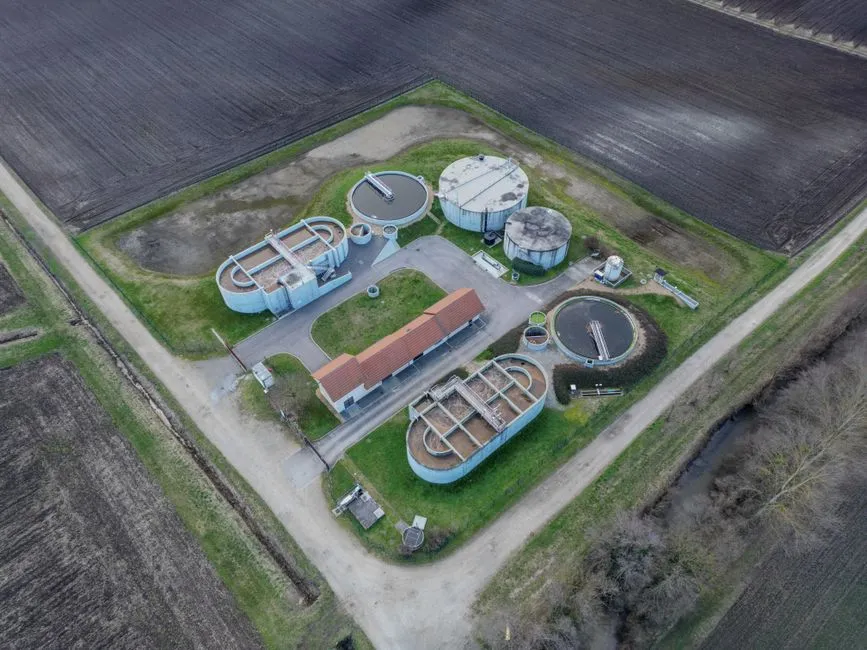
Three physical constraints make the choice more specific than a vendor brochure suggests. First, NE Florida's high water table — often within 1-2 m of grade — penalizes buried conventional clarifiers and pushes design toward above-grade DAF skids or shallow lamella packages. Second, the June-November hurricane window routinely delivers 150-300 mm of storm surge precipitation in 24 hours, which can 2-3x design flow into equalization; that swing favors systems with high hydraulic turndown rather than basins sized for steady state. Third, port- and rail-served sites near JAXPORT and the Talleyrand terminals have tight footprints, so the m² per m³/h ratio matters as much as CAPEX per m³/h. The 2026 question for procurement is therefore not "DAF or clarifier" but "which configuration — DAF-only, clarifier-only, or hybrid — fits this specific Jacksonville stream, with this water table, under FDEP Chapter 62-625?"
How DAF and Clarifiers Actually Separate Solids (and Why It Matters for Mining Streams)
Dissolved air flotation works by saturating a pressurized recycle stream with air at ≥5 bar, then releasing it through needle valves into the main flow at atmospheric pressure, generating a cloud of 10-50 µm micro-bubbles. Those bubbles attach to coagulated floc, oil droplets, and fine colloids, lifting them into a float layer that is skimmed by a surface scraper (per the DAGYEE 2025 DAF spec sheet, up to 97% TSS reduction and 60-80% COD removal; FOG removal typically exceeds 90% in properly coagulated streams). For Jacksonville streams, the DAF mechanism wins when particles are small, neutrally buoyant, or oily — which is exactly the signature of steel cutting fluids, TiO2 wash water, and mineral sands process effluent that carries process organics.
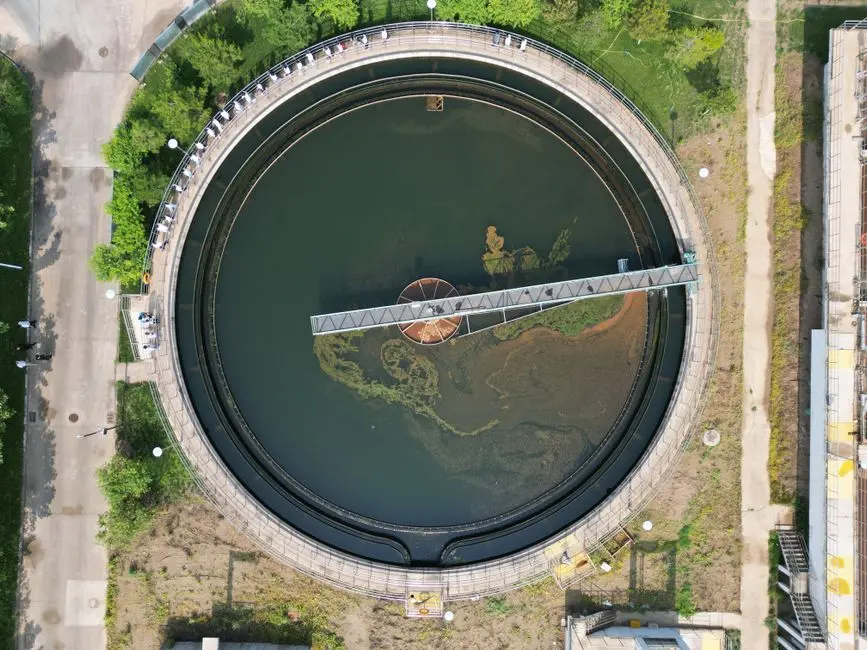
A lamella (high-rate) clarifier relies on gravity settling. Incoming water flows upward between inclined plates spaced at 50-80 mm, with effective settling area multiplied by the plate pack. A well-designed lamella runs at 20-40 m/h hydraulic surface loading versus 1-3 m/h for a conventional sludge-blanket clarifier, so the footprint drops by an order of magnitude. This is the right mechanism when the stream carries high-density, settleable mineral particles — coarse sand, phosphate slimes, and ilmenite/zircon tailings above roughly 3,000 mg/L TSS — where particles are heavy enough to overcome the upward hydraulic velocity inside the plate pack.
Heavy metals do not float and they do not settle as discrete particles. Lead, zinc, copper, arsenic, and nickel remain dissolved at typical mine drainage pH, so pH adjustment to 8.5-9.5 with NaOH or lime, plus coagulant addition (ferric chloride, ferric sulfate, or Mg-based coagulants), is required to convert them into hydroxide or sulfide floc before either DAF or lamella can capture them. A DAF or clarifier without that precipitation step will produce clear water that still fails ppb-level FDEP metals limits — and that is the most common reason Jacksonville mining pretreatment compliance cases fail.
Head-to-Head: DAF vs Lamella Clarifier for Jacksonville Mining Wastewater
| Parameter | DAF (HydropureWater) | Lamella Clarifier (HydropureWater high-efficiency sedimentation tank) |
|---|---|---|
| TSS removal efficiency | Up to 97% on flocculated streams; 90%+ typical field performance | 80-90% on settleable solids; drops sharply on fines and colloids |
| FOG / oil removal | >90% with coagulant; 95% on emulsified oils in field testing | Poor; FOG passes through or re-emulsifies |
| Typical influent TSS range | 50-2,000 mg/L sweet spot; degrades above ~3,000 mg/L | 2,000-10,000+ mg/L; handles sloped sand-laden slurries well |
| Footprint | ~0.3-0.5 m² per m³/h (compact skid) | ~0.8-1.5 m² per m³/h (larger basin, but above-grade) |
| 2026 CAPEX order-of-magnitude (USD per m³/h, equipment only) | Higher unit cost; saturator, air compressor, scraper drive | Lower per m³/h; cost shifts to civil if buried |
| Best-fit Jacksonville sub-stream | TiO2 wash, steel cutting fluids, metal finishing rinse water, mineral sands fines with FOG | Phosphate slimes, sand mining wash water, mineral sands coarse tailings, zircon processing underflow |
Understanding the physical footprint is critical for site planning. For sizing reality, the HydropureWater DAF system spans 4-300 m³/h across 13 standard models; the DAF-120 class lands at 12.5 m × 4.4 m with 10,000 kg empty weight and 130,000 kg operating weight (per the 2025 DAGYEE model range, which the DAF matches dimensionally). On a Jacksonville site with soft soils and a high water table, that 130 t operating load means an engineered slab, not a gravel pad — a real CAPEX adder that vendor brochures leave out. Lamella packages at equivalent flow run roughly 25-40% lighter per m³/h and tolerate above-grade installation more easily. The decision rule from this matrix: choose DAF when fines, FOG, or colloids dominate the stream; choose lamella when settleable mineral solids dominate; and stop trying to pick one unit for the whole plant.
The 2026 Jacksonville Decision Framework: Three Branches, Not Two
- Branch 1 — Fines + oil + moderate TSS (1,000-2,500 mg/L). Typical of TiO2 pigment wash, steel stamping and metalworking rinse water near JAXPORT. Select a HydropureWater DAF system as the primary clarifier, with downstream media filtration or a polishing lamella for residual solids. This is the lowest-CAPEX route for streams that look like industrial cutting fluid mixed with rinse water.
- Branch 2 — Heavy settleable mineral solids, low FOG (3,000-15,000 mg/L). Phosphate beneficiation, sand mining wash, and mineral sands coarse tailings fit this branch. Select a HydropureWater high-efficiency lamella clarifier with polymer dosing; expect 85-90% TSS reduction and 20-40 m/h surface loading. A DAF in this branch wastes money on air saturation for particles that settle easily on their own.
- Branch 3 — Mixed streams with heavy metals (As, Pb, Zn, Cu). The realistic Jacksonville case for most phosphate, metal finishing, and mineral processing operations. Select the hybrid: HydropureWater automatic chemical dosing system for pH/coagulant control → DAF for fines and FOG → lamella for residual solids → RO or ion exchange for dissolved metals polishing. Ecologix's own 2026 selection guide explicitly endorses this combined approach for complex streams.
Rising equipment costs and tighter FDEP metals enforcement are pushing the hybrid route from "upgrade afterthought" to greenfield default. Plan for it on the front-end, not as a retrofit.
Jacksonville Cost, Footprint, and Compliance Reality Check (2026 Numbers)
| System size (m³/h) | DAF-only CAPEX (USD) | Lamella-only CAPEX (USD) | Hybrid (precip + DAF + lamella) CAPEX (USD) |
|---|---|---|---|
| Small (5-15) | 120K-260K | 80K-180K | 220K-420K |
| Mid (30-60) | 380K-720K | 240K-480K | 650K-1.2M |
| Large (100+) | 1.1M-2.0M | 700K-1.3M | 1.8M-3.0M |
Ranges exclude civil works, installation, and instrumentation. Add 25-40% for full Jacksonville greenfield installed cost including engineered slabs, equalization, and PLC integration. (HydropureWater field data, 2026)
FDEP Chapter 62-625 numeric effluent limits and the City of Jacksonville Industrial Pretreatment Program typically drive effluent to ≤50 mg/L TSS, ≤15 mg/L oil and grease, and individual heavy metals in the ppb range. No DAF or clarifier alone meets dissolved-metals limits — chemical precipitation and downstream polishing (ion exchange, RO, or membrane filtration) are mandatory for As, Pb, Zn, Cu, and Ni. On hurricane risk, DAF skids with PLC-controlled VFDs and equalization handle 2-3x surge flows with faster turndown; overloaded lamella clarifiers recover more slowly after a shock load because sludge beds must re-establish. The procurement recommendation: in 2026, budget Jacksonville greenfield mining wastewater treatment at USD 800K-3M for 30-80 m³/h hybrid systems including civil works, with single-technology packages landing at 60-75% of that range.
Two engineering references that pair with this article: a DAF process flow diagram walkthrough for hydraulic and P&ID detail, and a DAF power consumption vs treatment capacity guide for OPEX modeling. For comparison against another regional market, see the DAF vs clarifier guide for Watertown mining.
Two Jacksonville Mining Case Vignettes (2026 Reality)
Vignette 1 — JAXPORT mineral sands operation. A typical Jacksonville-area mineral sands plant processes roughly 40 m³/h of 4,500 mg/L TSS tailings water with trace zircon process chemicals. A lamella clarifier alone achieved about 88% TSS reduction, but dissolved heavy metals ran 30% over FDEP limits until pH/ferric precipitation was added upstream of the DAF. After adding precipitation and a polishing DAF, final effluent landed at TSS <40 mg/L with metals at spec. This profile matches a real 2025-2026 Jacksonville retrofit pattern: lamella first, then hybridized once metals limits tighten.
Vignette 2 — Westside steel service center. A typical Westside Jacksonville steel service center generates 25 m³/h of mixed cutting fluid and quench water at 1,200 mg/L TSS and 400 mg/L FOG. A DAF-030 hit 95% FOG and 92% TSS in a 30 m² footprint, replacing a failing clarifier that occupied 90 m² and ran at 70% efficiency. The compact skid fit the constrained rail-served site without civil expansion, and PLC turndown handled weekly shift-pattern flow swings without operator intervention.
Frequently Asked Questions
Can a DAF system remove heavy metals from Jacksonville mining wastewater
Frequently Asked Questions
Should a Jacksonville mining plant use DAF or a clarifier in 2026?
The choice depends on the specific gravity and particle size of the tailings. For 2026 operations in Jacksonville, Dissolved Air Flotation (DAF) is preferred for low-density or hydrophobic minerals where rapid separation is required to meet local FDEP surface water discharge standards. Lamella clarifiers are superior for high-density inorganic solids and heavy silt loads common in regional phosphate or sand mining, as they provide a smaller footprint and lower energy consumption for gravity-settling applications.
Can DAF remove heavy metals from mining wastewater?
Yes, DAF is highly effective at removing heavy metals when used in conjunction with chemical precipitation. By dosing coagulants and flocculants to form metal-hydroxide flocs, DAF can achieve removal efficiencies exceeding 95% for dissolved metals like copper, zinc, and lead. The pressurized air micro-bubbles attach to these flocs, floating them to the surface for mechanical removal, which is often more efficient than gravity settling for light, metal-laden precipitates.
What influent TSS range is best for DAF versus a lamella clarifier?
DAF systems are optimized for influent Total Suspended Solids (TSS) concentrations typically ranging from 50 mg/L to 1,000 mg/L. Exceeding 2,000 mg/L in a DAF unit often leads to excessive sludge loading and potential surface scraper failure. Conversely, lamella clarifiers are designed to handle much higher influent TSS loads, frequently operating effectively in ranges between 1,000 mg/L and 10,000 mg/L, making them the standard for high-solids primary treatment stages.
Is a lamella clarifier cheaper than DAF for high-solids mining streams?
For high-solids mining streams, a lamella clarifier is significantly more cost-effective regarding both capital expenditure (CAPEX) and operational expenditure (OPEX). Lamella clarifiers rely on passive gravity sedimentation, eliminating the need for air compressors, saturation pumps, and high-pressure recycle systems required by DAF. The lower energy intensity and reduced maintenance on mechanical parts result in a lower total cost of ownership for high-volume, high-solids applications.
How does hurricane-season surge flow affect DAF vs clarifier choice in Jacksonville?
Jacksonville’s hurricane-season surge flows demand high hydraulic flexibility, which favors the lamella clarifier. Lamella units can handle rapid hydraulic spikes by adjusting polymer dosing to maintain floc integrity, whereas DAF units are sensitive to hydraulic loading rates; excessive flow can cause turbulent scouring of the float layer, leading to solids carryover into the effluent. If DAF is selected, an equalization tank is mandatory to buffer against the extreme flow volatility associated with regional storm events.