
Why Los Angeles Hotels Need a Dedicated Wastewater System in 2026
A Los Angeles hotel or resort in 2026 typically needs a packaged MBR or WSZ-series A/O biological plant (10–2,000 m³/day) preceded by a rotary bar screen and DAF for FOG removal from kitchen and laundry waste. Final effluent must meet California Title 22 and EPA secondary treatment limits (BOD₅ ≤30 mg/L, TSS ≤30 mg/L) before discharge to the LA Sanitation (LASAN) sewer system, with on-site reuse options for irrigation.
Resort wastewater is a blended stream, not a single sanitary load. Blackwater from guest-room toilets, greywater from showers and laundry, fats-oils-grease (FOG) from the kitchen, and pool/spa backwash each arrive at the headworks with very different pollutant profiles. Kitchen flows carry BOD₅ of 800–1,500 mg/L and oil & grease of 200–600 mg/L; laundry streams add high TDS, surfactants, and fibrous lint; pool backwash swings in pH and free chlorine. A plant sized only on domestic sewage assumptions will fail on day one.
Three LA-specific drivers make "send it all to the sewer" no longer the cheapest default in 2026. First, California drought-cycle reclaimed-water mandates under Title 22 push hospitality sites toward on-site reuse for landscape irrigation and cooling-tower makeup. Second, LASAN's Industrial Waste Control Division has tightened enforcement on FOG, PFAS, and oil & grease at the sewer manhole. Third, rising sewer discharge fees make the OPEX gap between a permit-only plant and a reuse-equipped plant narrower every year. The municipal context is also stressed: a January 2020 LAHSA point-in-time count recorded roughly 66,436 unhoused people on a single night (Springer, 2023), which frames why regional infrastructure is overstretched and why on-site treatment with reuse is a defensible 2026 strategy. The two end-states for any LA hotel plant are now: (1) LASAN-permitted discharge to the sanitary sewer, or (2) on-site Title 22 reuse for irrigation.
Sizing the Plant: Per-Room and Per-Cover Flow Benchmarks
Defensible design flow for an LA hotel is arithmetic, not a vendor quote. Start at 0.20–0.30 m³/day per occupied room for a midscale or luxury property with conservative fixtures; use 0.35–0.45 m³/day where on-site laundry, full kitchen, and spa are operating (HydropureWater field data, 2025-09). Layer a peaking factor of 2.5–3.0× for the 2-hour morning peak, per LA Municipal Code dosing-zone assumptions, so hydraulic capacity is never set on average daily flow alone.
Restaurant load is sized per cover, not per room: 50–80 L/cover/day at BOD₅ 800–1,500 mg/L and oil & grease 200–600 mg/L. On-site laundry adds 30–60 L/guest/day with elevated TDS, surfactants, and lint, and should be metered separately and equalized in a buffer tank before the headworks — a 4–6 hour holding volume smooths the daily surge.
Worked example: a 250-room resort at 60% occupancy (150 occupied rooms) with a 400-cover restaurant and on-site laundry gives roughly 150 × 0.30 + 400 × 0.065 ≈ 71 m³/day average daily flow, rounding to 75 m³/day once spa and pool backwash are included. Apply the 3.0× morning peak and the design peak hydraulic flow is ~225 m³/day. That single number — not a marketing brochure — drives every downstream specification.
| Stream | Unit Flow | Pollutant Load | Design Note |
|---|---|---|---|
| Guest rooms (occupied) | 0.20–0.30 m³/room/day (midscale–luxury); 0.35–0.45 m³/room/day with laundry, kitchen, spa | BOD₅ 250–400 mg/L, TSS 200–300 mg/L | Baseline design flow |
| Restaurant | 50–80 L/cover/day | BOD₅ 800–1,500 mg/L; O&G 200–600 mg/L | Requires DAF pretreatment |
| On-site laundry | 30–60 L/guest/day | High TDS, surfactants, lint | Equalize 4–6 hr before headworks |
| Pool/spa backwash | Intermittent, 5–15 m³/event | Variable pH, free Cl | Dechlorinate before biological stage |
| Peak factor | 2.5–3.0× ADF | — | Per LA dosing-zone assumptions |
Pretreatment Train: Bar Screen + DAF for FOG and Lint
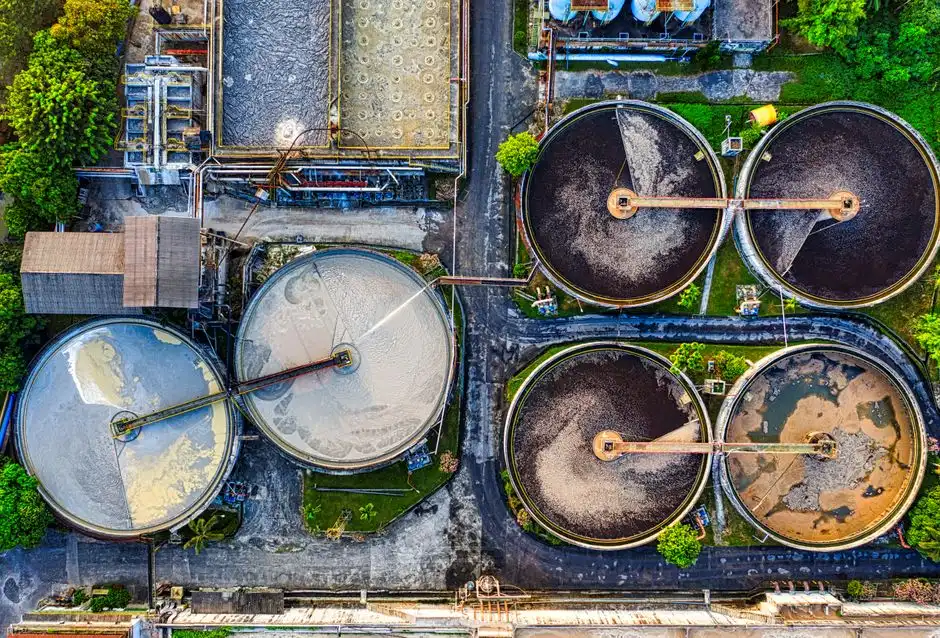
A biological plant alone will fail in LA hotels because the influent is not domestic sewage — it is a kitchen-and-laundry surge superimposed on a sanitary base. Engineered headworks are non-negotiable, and they begin with a rotary bar screen headworks at 3–5 mm aperture to protect downstream pumps and membranes from rags, plastics, and fibrous debris. Anything coarser passes lint and kitchen solids straight into the aeration tank, where it fouls diffusers and membranes within weeks.
Downstream of screening, a DAF for hotel FOG and laundry pretreatment sized for the combined FOG load is the standard 2026 answer. At hydraulic retention 20–30 minutes and an A/S recycle ratio of 0.02–0.05, DAF reliably achieves 60–90% oil & grease removal and 30–50% TSS reduction, even on emulsified grease from dishwasher discharge. DAF outperforms a passive grease interceptor above 50 m³/day kitchen flow because dissolved and emulsified grease, plus surfactants from detergents, defeat gravity separation. Hot dishwasher water (60–70 °C) further emulsifies fats that a hydromechanical box simply cannot capture.
The LASAN local limit is the hard gate: oil & grease ≤100 mg/L at the point of discharge to the sanitary sewer. Exceed this and the property triggers surcharges, mandatory permit re-review, and the real risk of a discharge-permit suspension during a kitchen surge. For a closer look at how DAF fits the process train, the DAF process flow diagram walkthrough covers the recycle loop, air-saturation pressures, and skimmer geometry that govern real-world removal rates.
Biological Stage: MBR vs. WSZ-Series A/O Packaged Plant
The two packaged biological options an LA hospitality engineer will see on a 2026 shortlist are MBR and the WSZ-series underground A/O. They are not interchangeable. MBR couples an anoxic/aerobic activated-sludge basin with submerged PVDF membranes at 0.1 μm nominal pore size, operating at MLSS 8,000–12,000 mg/L — three to four times a conventional aeration tank. Effluent BOD₅ and TSS routinely drop below 10 mg/L, and footprint is ~60% smaller than a CAS plant of equivalent capacity. The packaged MBR sweet spot is 10–2,000 m³/day, which covers every LA hotel and most mid-size resorts.
The WSZ-series underground A/O packaged plant is the lower-CAPEX alternative: anoxic/aerobic contact oxidation + sedimentation + disinfection, factory-built, buried with landscaping above, no dedicated operator, capacity 1–80 m³/h. Effluent is typically 20–30 mg/L BOD₅/TSS — adequate for LASAN secondary discharge but not for Title 22 reuse without tertiary polishing.
| Criterion | MBR (PVDF submerged) | WSZ-Series Underground A/O |
|---|---|---|
| Effluent BOD₅ / TSS | <10 / <10 mg/L | 20–30 / 20–30 mg/L |
| Footprint | ~60% of CAS for same capacity | Buried, very small surface footprint |
| CAPEX (turnkey, 2026) | $15,000–$25,000 per m³/day | $8,000–$14,000 per m³/day (excl. civil) |
| OPEX | 0.15–0.35 USD/m³; membrane replace every 7–10 yr | 0.05–0.12 USD/m³; no membranes |
| Reuse compatibility | Title 22 tertiary-ready with UV/ClO₂ | LASAN discharge; needs tertiary for reuse |
| Permitting complexity (LA) | Higher (industrial-waste permit, reuse cross-connection) | Lower for discharge-only path |
Decision rule: specify MBR when on-site Title 22 reuse, a footprint under 500 m², or sensitive coastal-area discharge is in scope. Specify the WSZ-series underground A/O packaged plant when CAPEX is constrained and the site can discharge to LASAN with secondary-quality effluent. For the deeper MBR economics, the USA MBR engineering and ROI guide walks through membrane-replacement budgeting, energy draw, and California-specific incentives.
Disinfection and Water Reuse Under California Title 22
California Title 22 disinfected tertiary recycled water is the standard any LA hotel should target if reuse is on the table: BOD₅ <10 mg/L, TSS <10 mg/L, turbidity <2 NTU, and total coliform <2.2 MPN/100 mL. The biological stage above sets the BOD/TSS floor; disinfection closes the coliform loop and decides whether the effluent can legally reach landscape sprinklers or a cooling tower.
Three disinfection options are realistic at this scale. Chlorine dioxide, generated on-site, holds a broad pH tolerance and stays effective across the variable organic loads that come with kitchen surges — and it does not form trihalomethanes, which matters for guest-facing reuse safety. UV is footprint-friendly and leaves no residual, but it cannot satisfy any "residual required" reuse condition. Ozone delivers a high kill with no DBPs but carries the highest energy cost and the most complex off-gas management. For hospitality, an on-site chlorine dioxide generator is the practical default in 2026 because of its surge tolerance and EPA/WHO/EU compliance posture.
The 2026 LA reality is that the California State Water Resources Control Board and the LA Department of Water and Power are actively pushing on-site reuse through reduced sewer fees and stormwater credits — so the disinfection section is not a regulatory afterthought, it is the line that unlocks the cost-savings case. Cross-connection control and a dedicated recycled-water distribution loop (purple pipe) are non-negotiable under Title 22.
Permitting, Compliance, and 2026 Cost Bands in LA
An LA hotel procurement manager walking into an LASAN pre-application meeting should arrive with the permit flow already mapped. The Industrial Waste Control Division runs the pre-application; a Wastewater Discharge Permit is required for any discharger above 25,000 gpd (~95 m³/day) — which captures most 200+ room properties. Sampling is at the sewer manhole, not at the plant outlet, so a final sampling port and accessible manhole are part of the civil scope.
LA-specific compliance gates to design against: pH 6.0–9.0, BOD₅ and TSS each ≤30 mg/L, oil & grease ≤100 mg/L, no PFAS exceedance against current EPA health advisories, and no visible foam at the point of discharge. Failure on any of these is a surcharge or permit-review trigger, not a warning.
| Cost Driver | MBR (Turnkey) | WSZ Underground A/O |
|---|---|---|
| CAPEX range (2026 USD) | $15,000–$25,000 per m³/day | $8,000–$14,000 per m³/day (excl. civil) |
| LA seismic civil/structural uplift | +15–20% | +15–20% |
| OPEX (USD/m³ treated) | 0.15–0.35 | 0.05–0.12 |
| Major replacement interval | Membranes every 7–10 yr | No membrane; pumps/UV as scheduled |
| Permit trigger | Wastewater Discharge Permit >95 m³/day | Same threshold; lower reuse-readiness cost |
Add 15–20% to either CAPEX band for LA seismic-rated civil and structural upgrades — this is non-optional in California and frequently missed in out-of-state vendor quotes. Membrane replacement every 7–10 years is the single largest MBR OPEX line and should be amortized into the 20-year lifecycle model from day one.
Frequently Asked Questions
What size packaged wastewater plant does a 200-room LA hotel need?
At 0.25 m³/day per occupied room and ~70% occupancy, average daily flow is ~35 m³/day; with a 3.0× peak factor the design peak is ~105 m³/day. That fits a compact MBR membrane bioreactor packaged system in the 50–80 m³/day range, well below the 95 m³/day LASAN Wastewater Discharge Permit threshold.
MBR or conventional activated sludge for a coastal LA resort with reuse?
Specify MBR. Submerged PVDF membranes at 0.1 μm deliver BOD₅ and TSS below 10 mg/L — the floor needed for California Title 22 disinfected tertiary recycled water (turbidity <2 NTU, total coliform <2.2 MPN/100 mL) without a separate tertiary stage. A conventional CAS plant at 20–30 mg/L BOD/TSS cannot meet Title 22 reuse limits without added coagulation and filtration.
What is the LASAN oil & grease limit at the sewer manhole?
Oil & grease must be ≤100 mg/L at the point of discharge to the LASAN sanitary sewer per the Industrial Waste Control Division's local limits. A DAF unit at 20–30 minute HRT and 0.02–0.05 A/S recycle ratio reliably hits 60–90% removal of the kitchen-and-laundry FOG load before the biological stage, keeping the manhole sample in compliance even during dinner-service peaks.