Why Pharmaceutical Effluent in Spain Faces Tighter Scrutiny in 2026
EU Industrial Emissions Directive 2010/75/EU, combined with the 2022 BAT conclusions for common waste water and waste gas treatment in the chemical sector, binds every Spanish API plant to BAT-AEL ranges for COD, TOC, and total nitrogen, with the lower end triggered when the discharge enters a sensitive receiving waterbody. Real Decreto 509/1996, which transposed the Urban Waste Water Treatment Directive, sets the national floor on COD, BOD₅, and total phosphorus at municipal WWTPs that accept industrial inputs, and autonomous communities layer their own permits on top: the Generalitat de Catalunya through the ACA, the Junta de Andalucía through the Consejería de Sostenibilidad, and Madrid through the Canal de Isabel II sewer-use tariff. Spain sits among the EU's top five API producers by volume, with medicinal-product exports exceeding €17 billion in recent annual reporting (Farmaindustria), so a single non-compliance event can trigger cross-border notification and reputational damage under EU IED. The Gran Canaria wastewater treatment plant assessment (S1) recorded measurable pharmaceutical compound concentrations in Spanish municipal effluent, confirming that regulators are now sampling for APIs at the WWTP inlet, not just at the factory fence line.
What Pharmaceutical Wastewater Actually Contains
Active pharmaceutical ingredient concentrations in manufacturing wastewater span 26 ng/L to 31 mg/L (Larsson et al., 2007; Okeke et al., 2022), a six-order-of-magnitude range driven by batch versus continuous synthesis, product mix, and CIP losses. That range explains why a single technology cannot carry the load: hospital wastewater sits at 0.1–157 µg/L and domestic wastewater at 0.001–32 µg/L (Verlicchi et al., 2012; Parida et al., 2022), so the manufacturing stream is the dominant load on any shared municipal receiver. The Li et al. (2024) review (S3) adds the secondary pollutants engineers must design for: chemical-synthesis API waste typically carries high BOD/COD, total nitrogen, ammonia-N, total phosphorus, TSS, sulfate, chloride, and organic solvents such as methanol, acetone, and DMF. Antibiotic resistance gene (ARG) proliferation is the public-health multiplier — untreated antibiotic API discharge has been directly linked to ARG spread (S5), which is why EU regulators now treat ARG control as a compliance target.
| Parameter | Pharma manufacturing | Hospital | Domestic |
|---|---|---|---|
| API / antibiotic concentration | 26 ng/L – 31 mg/L | 0.1 – 157 µg/L | 0.001 – 32 µg/L |
| COD (typical) | 2,000 – 50,000 mg/L | 500 – 1,500 mg/L | 250 – 800 mg/L |
| Dominant salts | Sulfate, chloride, sodium | Chloride, sodium | Bicarbonate, chloride |
| ARG risk (per S5) | High | Moderate | Low |
The 2026 Reference Process Train: DAF → UASB → MBR → RO
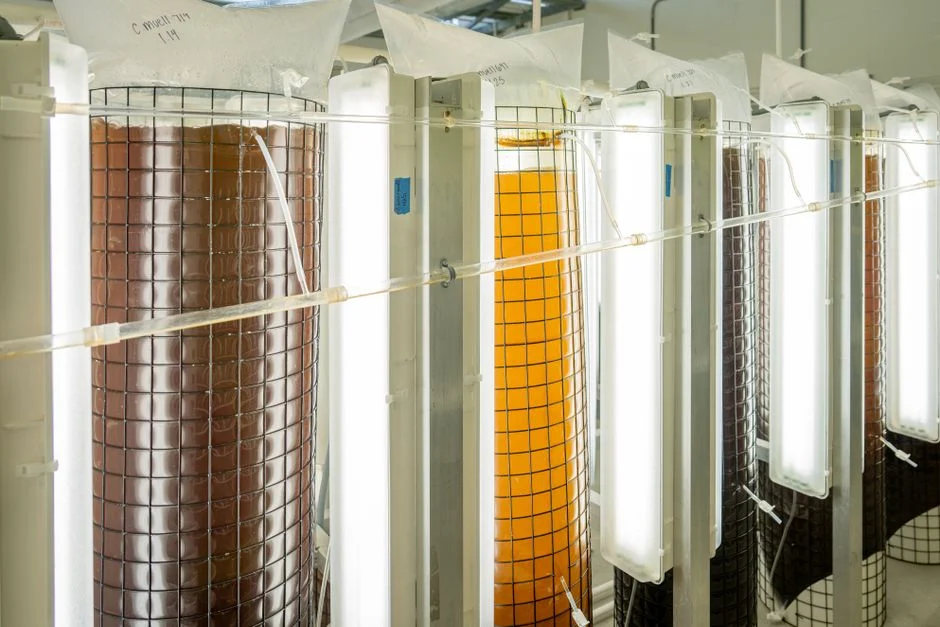
Engineers manage these complex streams by implementing a multi-stage treatment process designed for high-load chemical synthesis. A defensible 2026 train for a Spanish API plant runs in four stages: DAF pre-treatment to drop suspended solids and oil & grease, UASB to digest the high-COD chemical-synthesis load, MBR to produce near-reuse-quality supernatant, and RO to polish the permeate to discharge or reuse standard. Stage 1 — a dissolved air flotation system sized for 4–300 m³/h — strips colloids, fats, and protein-bound APIs that would otherwise foul downstream biology. Stage 2 — UASB at 20–30 day HRT handles sulfate- and organic-sulfur-rich chemical-synthesis wastewater (W. Li et al., 2015) and removes 80–100% of common APIs in peer-reviewed studies (Jones et al., 2005; cited in S5); biogas recovery from this stage partially offsets Spanish industrial electricity costs. Stage 3 — a submerged PVDF MBR at 0.1 µm pore size, such as the HydropureWater MBR membrane bioreactor, replaces the secondary clarifier and produces supernatant with TSS typically below 5 mg/L on a 60% smaller footprint than conventional activated sludge. Stage 4 — a HydropureWater industrial RO system operating at 95% recovery delivers permeate with >99% rejection of residual APIs, divalent salts, and TOC, closing the loop on ARG-spreading risk before either reuse or discharge.
| Stage | Unit operation | Target contaminants | Typical removal / output |
|---|---|---|---|
| 1. Pre-treatment | DAF | TSS, oil & grease, colloids | 90–95% TSS; effluent TSS <30 mg/L |
| 2. Anaerobic | UASB (20–30 d HRT) | High COD, sulfate, organic S | 80–100% API; 60–80% COD |
| 3. Aerobic / membrane | MBR (PVDF, 0.1 µm) | BOD, NH₃-N, residual COD | Effluent BOD <5 mg/L; TSS <5 mg/L |
| 4. Polishing | RO (95% recovery) | Residual APIs, salts, TOC | >99% API rejection; reuse-grade permeate |
How Spain-Specific Constraints Reshape Equipment Selection
Mediterranean Spain runs a structural water deficit that turns reuse from an option into a permitting expectation: RO recovery above 90% feeding cooling-tower make-up or CIP loops is now written into autonomous-community authorisations for new API builds. Spanish industrial electricity in 2025–2026 remains among the most expensive in the EU, so aeration-efficient MBR designs carry measurable OPEX advantage — flat-sheet submerged modules in the DF series flat-sheet MBR module line operate at 10–20× lower energy than external cross-flow designs at equivalent flux. Discharge-recipient rules split the design space: plants discharging to a sensitive area under EU Directive 91/271/EEC must hit the lower end of the BAT-AEL range for total nitrogen and phosphorus, while plants sending effluent to municipal sewer must satisfy local bylaws such as the Tariff of the Barcelona municipal sewer or Madrid Canal de Isabel II. The Hou et al. (2019) train — UASB plus anoxic/oxic plus advanced oxidation — has peer-reviewed Spanish-relevant ARG-mitigation data and is the reference point for biotech API producers facing ARG scrutiny.
Selection Framework: Choosing the Right Train for a Spanish API Plant
Plant operators must match the train to the influent characteristics. Decision rule 1 — high-COD chemical synthesis (COD >10,000 mg/L, sulfate-rich): specify DAF + UASB + MBR + RO; UASB biogas recovery typically offsets 20–30% of aeration electricity, which is the largest variable OPEX line for Spanish plants. Decision rule 2 — formulation or biotech (moderate COD, biological APIs, ARG-sensitive): DAF + SBR or CASS + MBR + RO with ClO₂ disinfection polishing for heat-resistant spores, because biological APIs are the most likely ARG vector. Decision rule 3 — non-critical reuse loops such as garden irrigation, toilet flush, or boiler feed: MBR + RO plus a chlorine dioxide generator sized from 50 g/h to 20,000 g/h to meet EU Drinking Water Directive 98/83/EC reuse protocols for residual microbial control. When the API target drops below 1 µg/L and RO brine disposal economics dominate, consult the ion-exchange retrofit guide as a polish step; ion exchange carries lower brine volume than RO and is often the most cost-effective finishing step for high-purity water loops. For cross-jurisdictional comparison with another regulated Latin-American market, the pharma wastewater guide for Ecuador shows how the same four-stage architecture adapts to a different permit envelope.
Cost, Footprint, and Compliance: What a 2026 Spanish Build Looks Like
Indicative CAPEX for a 500 m³/day MBR + RO packaged pharma-compliant system in 2026 sits in the €1.2M–€2.4M range, covering equipment, installation, and commissioning but excluding civil works, Building Permit fees, and autonomous-community authorisation costs that vary by region. Footprint runs roughly 60% below a conventional activated-sludge plant of the same capacity, which matters where industrial land near the Madrid–Toledo–Barcelona API corridor carries premium price. The compliance documentation the procurement team should expect from any bidder: EN 12255 series for plant performance verification, EN 12880 for sludge handling, Real Decreto 1481/2001 for waste disposal routing, and CE marking on pressure equipment per PED 2014/68/EU. Pair the train with a plate-and-frame filter press sized 1–500 m² for sludge dewatering so the entire plant stays within a single supply scope, a common procurement requirement for Spanish EHS managers who need a single point of warranty.
Frequently Asked Questions
What is the binding EU discharge framework for a Spanish API plant in 2026?
The binding framework is EU Industrial Emissions Directive 2010/75/EU with the 2022 BAT conclusions for common waste water and waste gas treatment in the chemical sector, layered on Real Decreto 509/1996 and autonomous-community permits (ACA in Catalunya, Consejería de Sostenibilidad in Andalucía, Canal de Isabel II in Madrid).
What API removal can a UASB + MBR + RO train realistically deliver?
UASB at 20–30 day HRT removes 80–100% of common APIs (Jones et al., 2005), the MBR drives residual BOD below 5 mg/L and TSS below 5 mg/L, and RO polishing at 95% recovery achieves >99% rejection of remaining APIs, salts, and TOC for reuse-grade permeate.
How much does a 500 m³/day MBR + RO pharma-compliant plant cost in Spain in 2026?
Equipment, installation, and commissioning for a packaged 500 m³/day MBR + RO system typically falls in the €1.2M–€2.4M range, with civil works and autonomous-community authorisation fees additional, and a footprint roughly 60% smaller than an equivalent conventional activated-sludge plant.
Why is antibiotic ARG control now a compliance issue, not just an environmental one?
The S5 review documents that antibiotic API discharge drives antibiotic resistance gene proliferation in receiving waterbodies, which is why EU regulators now treat ARG mitigation as an enforceable outcome of the BAT-AEL framework.