Why Residential Wastewater in Italy Is a 2026 Design Problem
Italy operates 18,162 of its 18,786 registered wastewater treatment plants (as of 2012), but the inventory is dominated by small municipal units—not residential packages—and 542 municipalities holding roughly 2.3 million people (about 4% of the national population) still lacked sewerage connections (per S2, OECD/Wikipedia summary). 178 towns and cities with more than 15,000 inhabitants were already in EU-breach status for wastewater standards as of 2010, and another 143 smaller municipalities lacked secondary treatment or had insufficient capacity. For a residential developer or engineer working in 2026, that gap translates directly into project-level compliance risk: even a 50-home cluster can trigger EU Urban Wastewater Directive 91/271/EEC obligations if it discharges untreated or under-treated effluent to a sensitive water body.
The Italian implementation route runs through the 1999 Galli Law, which reorganized water services into 91 Optimal Service Areas (Ambiti Territoriali Ottimali, ATO)—regional utilities that now set the local point-of-compliance limits any residential plant must meet. The headline design number is the Italian per-capita residential water use of approximately 240 L/day—50% higher than the ~160 L/day figure for France or Spain (per OECD, cited in S2). For sizing, that 240 L/capita/day is the flow baseline; for compliance, 91/271/EEC and the local ATO are the binding documents.
A 2026 design framework also has to address a category the old BOD-centric spec sheets ignore. ASTM E2717-18R25 explicitly extends residential load to pharmaceuticals, natural and synthetic hormones, detergent metabolites, plasticizers, insecticides, and fire retardants—chemicals that the U.S. Geological Survey found in 80% of sampled urban streams (S1). A specifiable Italian residential plant in 2026 must therefore be sized for biological load and chemical load, not just for settleable solids.
Design Parameters for a 2026 Italian Residential Plant
The numbers below are the minimum set an engineer should drop into a sizing sheet for a residential cluster in Italy, anchored to the 240 L/capita/day Italian baseline and standard EU residential pollutant reference values.
| Parameter | Per-capita value (typical residential) | Unit | Notes |
|---|---|---|---|
| Average daily flow (Qavg) | 240 | L/capita/day | Italian national residential baseline (OECD, per S2) |
| BOD5 | ~60 | g/capita/day | Standard EU residential reference |
| COD | ~120 | g/capita/day | Typically 2× BOD for unscreened residential sewage |
| TSS | ~70 | g/capita/day | Higher where food-waste grinders are common |
| NH4-N | ~8 | g/capita/day | Drives nitrification stage sizing |
| Peak factor (small residential, dry weather) | 2.0–2.5 | × Qavg | Common range for <1,000 PE collections |
| Peak factor (seasonal tourist loading, coastal Italy) | up to ~3.0 | × Qavg | Apply where summer population > 3× off-season |
Two operational notes matter at the design stage. Peak factor for small collections below 1,000 population equivalents (PE) is rarely less than 2.0× the average dry-weather flow; for tourist-seasonal sites the practical upper bound is closer to 3× (HydropureWater field data, 2026). ASTM E2717-18R25's Averages Method was written for U.S. single-family homes but the standard itself states that the format "is broadly applied internationally" and that estimates can be expanded to an aggregate number of single-family homes by multiplying by the number of homes, or adapted to multi-unit residential buildings by factoring the parameters for size, occupancy, and fixtures (S1, §1.2). For an Italian residential cluster, the formula reduces to: total flow = 240 L/capita/day × number of residences × average occupancy. The E2717 standard also explicitly excludes bulk organic matter (urine, feces, food waste, cellulose) from its "environmental load" definition, so designers must add the biological load (BOD, COD, TSS, NH4-N in the table above) back into the mass balance separately from the chemical-contaminant load (S1, §1.3.1–1.3.3).
Matching Treatment Process to the Italian Site
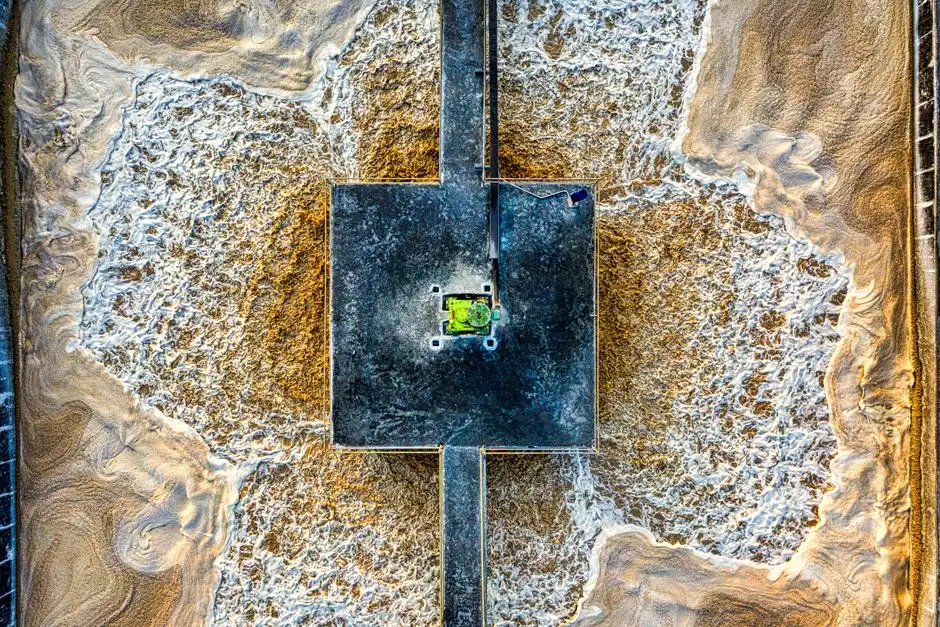
Three process trains cover the realistic 2026 residential market in Italy, with selection driven by population, footprint, discharge destination, and power availability.
| Process | Typical capacity | Footprint | Effluent quality | Best fit in Italy |
|---|---|---|---|---|
| WSZ buried A/O package plant | 1–80 m³/h | Buried, low visual impact | BOD < 25 mg/L, SS < 30 mg/L (typical) | Permanent residential, rural/peri-urban, connected to local ATO |
| MBR (activated sludge + submerged PVDF membranes) | 10–2,000 m³/day | ~60% smaller than CAS for same load | TSS < 1 mg/L, turbidity < 1 NTU (near reuse) | Strict effluent limits, water reuse, sensitive receiving water |
| No-electricity decentralized unit (e.g. BIOROCK-style) | 1–50 PE | Lightweight, fully buried | Secondary-quality, sub-soil discharge typical | Seasonal/second homes, rocky terrain, no grid power |
The WSZ buried A/O package sewage treatment plant combines anoxic and aerobic contact-oxidation stages, built-in sedimentation, and a disinfection stage, runs fully automated without a dedicated operator, and is the right default for permanent residential communities in rural or peri-urban Italy where an ATO sewer is not yet present. The integrated MBR membrane bioreactor system delivers <1 μm effluent and a roughly 60% smaller footprint than conventional activated sludge at the same load, which is what wins in tight urban-infill projects or where the local ATO sets reuse-quality limits (HydropureWater field data, 2026). For a seasonal second home, a restored rural dwelling, or a rocky site, a no-electricity decentralized unit is often the only realistic option—the BIOROCK Italy case (per S4) documents a restoration where seasonality, steep access, and rocky ground all ruled out conventional systems, and the lightweight no-power unit was the deciding factor. DAF or chemical-dosing pretreatment is generally not required for residential sewage, but a GX Series rotary mechanical bar screen at headworks is standard practice to protect downstream biological stages. Where the discharge destination is a bathing-water body or a reuse irrigation system, a chlorine dioxide generator (or ozone) at the train end satisfies Italian bathing-water and reuse rules consistent with EU Drinking Water Directive 98/83/EC and 91/271/EEC.
Sizing Worked Example: 200-Home Italian Residential Cluster
Assume 200 homes, average 2.5 occupants each, permanent residence. Average dry-weather flow = 200 × 2.5 × 240 L/day = 120,000 L/day = 120 m³/day (per S2 flow basis). Apply a peak factor of 2.0–2.5× for a small residential collection: peak flow range 240–300 m³/day, or 10–12.5 m³/h averaged across 24 h.
Pollutant loadings for the same population (500 PE): BOD5 ≈ 500 × 60 g = 30 kg/day; COD ≈ 60 kg/day; TSS ≈ 35 kg/day; NH4-N ≈ 4 kg/day. These map cleanly onto a WSZ unit in the 5–6 m³/h nominal range (with adequate peak margin) or an MBR skid sized at 120–150 m³/day nominal (with the smaller footprint justifying the membrane cost where the receiving water is sensitive). The process narrative is identical in either case: rotary bar screen → equalization / anoxic zone → aerobic contact-oxidation or MBR aeration tank → clarification (CAS) or membrane filtration (MBR) → chlorination or ClO2 disinfection → discharge. Where tighter effluent targets apply, the integrated MBR flat-sheet module (DF series, 0.1 μm) is the upgrade path that drops TSS below 1 mg/L and turbidity to near-reuse quality without rebuilding the upstream biological stage (S2 EU compliance benchmark).
2026 Selection Decision Framework
Procurement-ready logic, in four steps.
- Connection status. If the site is inside an ATO sewer catchment with capacity, connect and pay the tariff. If not connected, the next two questions drive equipment selection.
- Power and seasonality. No grid power, seasonal occupancy, or rocky subsoil → no-electricity decentralized unit (S4 case precedent). Permanent occupancy with grid power → WSZ or MBR.
- Discharge destination and reuse goal. Standard stream or irrigation-grade reuse → MBR with <1 μm effluent (60% smaller footprint). Standard surface-water discharge within ATO limits → WSZ A/O is sufficient and lower CAPEX.
- Documentation. Request the supplier's EU 91/271/EEC conformity dossier, EN 12566-7 package-plant certification where the unit falls under that scope, and a full O&M manual in Italian.
| Site condition | Recommended process | Why |
|---|---|---|
| Connected to ATO sewer | Connection + tariff | Avoids EU 91/271/EEC point-of-compliance risk |
| Unconnected, permanent, grid power | WSZ A/O package | Lowest CAPEX, buried, no operator |
| Unconnected, tight footprint, reuse needed | MBR | 60% smaller footprint, <1 μm effluent |
| Seasonal, no grid, rocky soil | No-electricity decentralized | Lightweight, buried, no power (S4) |
| Coastal / tourist peak loading | Size on peak factor (~3× Qavg) | Avoids hydraulic washout in summer |
For engineers who also work on cross-border residential specs, the residential wastewater treatment in Panama (2026 guide) applies the same flow-and-load logic to a tropical-loading context, and the MBR wastewater treatment in Colombia (2026 engineering guide) gives a closer cost/ROI benchmark for MBR skids in Latin-American residential projects. For Italian operators weighing MBR against sequencing-batch options, the CASS process flow diagram (2026 engineering guide) is a useful process-flow reference.
Frequently Asked Questions
What is the per-capita design flow for a residential wastewater plant in Italy in 2026?
240 L/capita/day, per the OECD figure cited in the Italian water-supply-and-sanitation baseline (S2). Apply a peak factor of 2.0–2.5× for normal small residential collections and up to 3× for tourist-seasonal sites.
What is
Frequently Asked Questions
What is the design per-capita wastewater flow for a residential project in Italy in 2026?
For residential projects in Italy, the standard design flow is calculated based on the Equivalent Inhabitant (EI) unit. In accordance with regional technical regulations (PTA - Piani di Tutela delle Acque), the average daily water consumption is typically estimated at 150 to 200 liters per inhabitant per day, with a corresponding organic load of 60 grams of BOD5 per inhabitant per day.
Which is better for a small Italian residential cluster — a package A/O plant or an MBR?
For small residential clusters, the choice depends on the final discharge destination. An Anaerobic/Oxic (A/O) package plant is generally sufficient for discharge into soil via sub-irrigation, provided the site has adequate permeability. However, if the effluent is discharged into sensitive water bodies or requires water reuse for irrigation, an MBR (Membrane Bioreactor) is superior, as it consistently achieves turbidity levels below 1 NTU and eliminates the need for secondary clarifiers, reducing the footprint by up to 50%.
Do I need a 91/271/EEC-compliant plant for a rural second home in Italy?
Directive 91/271/EEC primarily targets agglomerations with a load greater than 2,000 EI. For a single rural second home, you are typically not required to meet the industrial-scale standards of the Directive; however, you must comply with Legislative Decree 152/2006 (Testo Unico Ambientale). This requires treatment systems that meet local regional discharge limits, often necessitating a primary sedimentation tank (Imhoff tank) followed by secondary biological treatment if soil absorption capacity is insufficient.
Can residential wastewater in Italy be treated without electricity?
Yes, residential wastewater can be treated without electricity using passive systems such as Imhoff tanks coupled with constructed wetlands or subsurface irrigation fields. These systems rely on anaerobic digestion and natural aerobic processes within the soil or gravel media. While energy-independent, these solutions require a larger spatial footprint and specific soil percolation rates (typically between 10 and 60 liters per square meter per day) to ensure regulatory compliance.
What chemical contaminants must a 2026 Italian residential plant design for?
A 2026 residential plant must be designed to remove conventional pollutants, specifically BOD5 (target < 25 mg/l), COD (target < 125 mg/l), and Total Suspended Solids (TSS < 35 mg/l). Furthermore, in areas designated as sensitive under the TUA 152/2006, designs must incorporate nutrient removal processes to achieve Total Nitrogen (TN) levels below 15 mg/l and Total Phosphorus (TP) levels below 2 mg/l to prevent eutrophication in receiving water bodies.