Why the 2021 Tyson–Malayan Flour Mills Partnership Defines the 2026 Compliance Problem
On 10 February 2021, Tyson Foods and Malayan Flour Mills Berhad (MFM) announced a partnership in which Tyson invested in MFM's vertically integrated poultry business — feed mills, hatcheries, farms, and processing — to add supply flexibility and expand halal-certified capacity for both companies (source: Tyson Foods / MFM joint release, 2021-02-10). MFM commissioned a state-of-the-art processing plant in November 2019 with a capacity of up to 280,000 birds per day, a throughput that sets the hydraulic and pollution-load baseline for any retrofit discussion in 2026.
Five years later, that partnership sits inside a different enforcement window. Any change-of-control, throughput expansion, or new effluent line on a Tyson Malaysia asset is now reviewed against the Department of Environment Industrial Effluent Regulations 2009 and the 2026 inspection cycle, not the 2021 announcement cycle. The strategic reason the asset still matters is unchanged: Malaysia's halal industry was projected to reach USD 147.4 billion (RM 614.36 billion) by 2025, per the Halal Industry Development Corporation, and the country exports roughly USD 9 billion (RM 35.4 billion) in halal-certified products annually (per HDC, cited in the 2021 Tyson–MFM release). Scale context for the environmental liability: Tyson reported USD 6 billion in international sales in FY20, including U.S. exports (per Tyson 2021 release).
For a corporate development or environmental affairs advisor, the consequence is direct. The 2021 partnership is the live precedent that defines which plant a Tyson M&A team is most likely to underwrite, the throughput band the ETP must handle, and the halal constraint that the retrofit train cannot violate.
The Four-Layer Malaysian Legal Stack for an Industrial Effluent Discharge
Malaysian industrial wastewater compliance sits on four nested legal layers, and missing any one of them creates a clean enforcement pathway for the Department of Environment (DOE). The umbrella instrument is the Environmental Quality (Industrial Effluent) Regulations 2009, gazetted as PU(A) 434, which sets the binding discharge limits for BOD₅, COD, TSS, FOG (oil and grease), ammoniacal nitrogen (NH₃-N), total nitrogen, and total coliform. Standard A applies to discharges upstream of any raw water intake point; Standard B applies elsewhere. For a Tyson deal team, the question is not "which standard is easier" but "where does the receiving water body sit relative to the nearest intake," because the answer determines the cap on every unit operation downstream.
Layer 2 is the state DOE office — Jabatan Alam Sekitar at the peninsular state level, with parallel offices in Sabah (DOE Sabah) and Sarawak (DOE Sarawak / Natural Resources and Environment Board). Each state DOE issues the written pre-approval letter, the site-specific addendum, and the monitoring frequency. Peninsular states tend to publish addenda in the 20–50 mg/L TKN range; Sabah and Sarawak can run stricter on receiving-water classification. The plant's specific state matters because the addendum is enforceable above the federal floor.
Layer 3 is the Department of Veterinary Services (DVS) and JAKIM (Department of Islamic Development Malaysia). For halal lines, DVS controls slaughter procedure, slaughterman certification, and the stun-versus-non-stun constraint. JAKIM controls the cleaning-agent whitelist: anything porcine-derived, any non-halal-certified surfactant, and any unverified biocide is excluded from the equalization basin chemistry. This is a real engineering variable: a Tyson deal team that specifies a generic antifoam or polymer without checking the JAKIM list risks a halal audit finding that forces a chemistry change at the worst possible moment.
Layer 4 is the local council / IWK (Indah Water Konsortium) trade effluent by-laws for plants inside municipal catchment, or the on-site discharge consent for land irrigation or controlled watercourse release for plants outside catchment. The structure is the same template the Mexico guide used for CONAGUA / NOM / CEC / state — but every instrument name is Malaysian, and the halal constraint has no Mexican analogue.
What the Wastewater Actually Looks Like at a 280,000-Birds-per-Day Plant
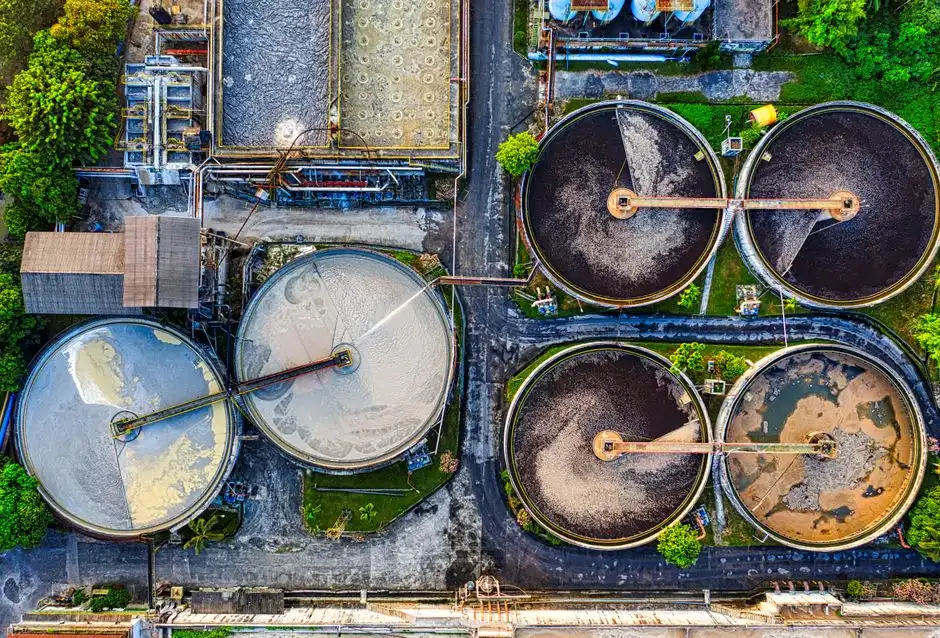
Meat-processing wastewater is not a single stream; it is a sum of five distinct loads that hit the ETP at different times of day. A sampling plan that grabs one composite will under-design the equalization basin by a factor of two. Industry-typical raw ranges for a poultry slaughterhouse with on-site rendering, drawn from HydropureWater field data on meat-processing clients (2026), are BOD₅ 800–2,500 mg/L, TSS 600–1,800 mg/L, FOG 200–800 mg/L, TKN 100–300 mg/L, pH 6–9, and temperature 20–38 °C.
The five streams are: (1) kill-floor blood and paunch contents, (2) rendering-area FOG and suspended solids, (3) blood-recovery line on a roughly 2-hour slug cycle tied to the evisceration line, (4) clean-in-place (CIP) chemicals that push pH and temperature swings, and (5) lairage holding-pen high-N washdown. Peak-to-average flow ratio runs 2:1 to 4:1, and the equalization tank must be sized to the peak, not the daily average, or the aeration basin washes out on first shift.
Blood water is the most expensive single stream to ignore. Approximately 150 kg of blood per slaughtered animal can be recovered, and if it reaches the ETP untreated it spikes BOD₅ above 10,000 mg/L in a 2-hour window. The single highest-ROI retrofit in any meat-processing ETP is therefore not the biological stage — it is a dedicated blood-collection trough feeding a recovery tank, with the recovered blood going to rendering. The primary clarifier then handles the residual load, with a HydropureWater DAF system matched to the FOG and TSS that survive recovery.
DOE Standard A/B Limits Mapped to Unit-Operation Response
The engineering decision lives in the unit-operation response, not the regulation name. Each treated-effluent parameter is paired with a specific unit operation so the vendor's process engineer can request a quote by section, not by plant. The reference train for a 2026 Malaysian Tyson retrofit is screening → DAF → equalization → anoxic/aerobic MBR → on-site chlorine dioxide → sludge dewatering.
| Parameter | Standard A limit | Standard B limit | Typical state addendum | Unit operation that delivers compliance |
|---|---|---|---|---|
| BOD₅ | 20 mg/L | 50 mg/L | 20–30 mg/L | Anoxic/aerobic MBR |
| COD | 50 mg/L | 100 mg/L | ≤100 mg/L | MBR + polishing |
| TSS | 50 mg/L | 100 mg/L | ≤50 mg/L | DAF + MBR membrane |
| FOG / O&G | 10 mg/L | 10 mg/L | ≤10 mg/L | DAF (HydropureWater, 4–300 m³/h) |
| NH₃-N / TKN | 5 mg/L NH₃-N | 10 mg/L NH₃-N | ≤20 mg/L TKN | Anoxic/aerobic MBR (MLSS 8,000–12,000 mg/L) |
| Total coliform | ≤400 MPN/100 mL (proposed tightening varies by state) | ≤5,000 MPN/100 mL | State-specific | On-site ClO₂ generation |
| pH | 6.0–9.0 | 5.5–9.0 | 6.0–9.0 | Equalization with PLC dosing |
| Temperature | ≤40 °C | ≤40 °C | ≤40 °C | Equalization retention |
The DAF is the matched response for FOG above 300 mg/L and also strips a large fraction of TSS and colloidal BOD before equalization. The HydropureWater MBR system (10–2,000 m³/day) is the matched response for the TKN targets state DOE addenda typically impose, operating at MLSS 8,000–12,000 mg/L. The HydropureWater chlorine dioxide generator (50 g/h to 20,000 g/h) is the matched response for total coliform compliance, and it avoids bulk hypochlorite storage on a halal-certified site where JAKIM-approved chemistry is a procurement constraint.
Retrofit Selection Matrix: DAF vs Lamella, MBR vs CAS vs WSZ
The retrofit decision lives in the unit-operation selection, not the brand. For primary FOG and TSS removal, the rule of thumb is: specify DAF when FOG is consistently above 300 mg/L and rendering is on site; specify a lamella clarifier (HydropureWater high-efficiency sedimentation tank at 20–40 m/h surface loading) when FOG is below 200 mg/L and the brownfield footprint is tight. DAF carries higher OPEX (polymer, saturator power) but a sharper effluent on rendering days and a smaller footprint.
| Decision | Condition | Selected unit operation | Trade-off |
|---|---|---|---|
| Primary step | FOG > 300 mg/L, rendering present | DAF (HydropureWater) | Higher polymer OPEX, smaller footprint, sharper effluent |
| Primary step | FOG < 200 mg/L, footprint-constrained | Lamella (high-efficiency sedimentation tank) | Lower OPEX, larger footprint per m³/h |
| Biological step | TKN ≤ 15 mg/L, state DOE watch list | MBR (HydropureWater MBR system) | 0.8–1.4 kWh/m³ aeration, membrane replacement 5–8 yr |
| Biological step | TKN 20–30 mg/L, land available | Conventional activated sludge (CAS) | 0.4–0.8 kWh/m³ aeration, larger basin |
| Biological step | Schedule tighter than budget, ≤80 m³/h | WSZ underground package (integrated unit) | Factory-built, fast-track, capped flow |
For aeration, the 0.4–0.8 kWh/m³ CAS reference versus 0.8–1.4 kWh/m³ MBR is a real OPEX line item, not a marketing footnote — a 5,000 m³/day plant running MBR carries roughly RM 1.0–1.8 million/year in aeration electrical load at 2026 Malaysian industrial tariffs. Halal segregation is a parallel design rule: dedicated drainage from any non-halal or pre-DVS-certified line, JAKIM-approved cleaning protocol, pipework color-coding, and backflow prevention. These are audit-visible items a DOE inspector or JAKIM auditor can find in a single site walk. Equalization pH and chemical stability should be handled with a PLC-controlled automatic dosing system to avoid manual handling errors on a JAKIM-watched site.
CAPEX and OPEX Envelope for a 2026 Malaysian Poultry ETP Retrofit
The 2026 CAPEX drivers for a meat-processing ETP retrofit, in descending order of typical share, are civil works and basin upgrades (the largest line on a brownfield retrofit by a wide margin), membrane modules and replacement intervals for MBR, disinfection systems, instrumentation and SCADA upgrades, and sludge handling — where a HydropureWater plate and frame filter press (1–500 m²) is the standard 2026 spec to hit the 25–30% dry-solids target accepted by Malaysian landfill operators. Pre-treatment screening should be specified as a rotary mechanical bar screen to protect downstream DAF and MBR from paunch-content debris.
| Line item | Typical share of CAPEX | 2026 ringgit anchor | Driver |
|---|---|---|---|
| Civil works and basin upgrades | 35–45% | Largest line; concrete and tankage | Brownfield retrofit, equalization sizing |
| Membrane modules (MBR) | 15–20% | Replacement 5–8 years | TKN compliance |
| Disinfection (ClO₂) | 8–12% | 50 g/h to 20,000 g/h capacity | Coliform compliance, halal chemistry |
| Instrumentation and SCADA | 6–10% | MLSS, DO, pH, flow | State DOE monitoring frequency |
| Sludge dewatering | 5–8% | Plate and frame filter press | 25–30% dry solids landfill target |
| Primary clarification (DAF / lamella) | 8–12% | DAF 4–300 m³/h | FOG and TSS removal |
OPEX is dominated by aeration electrical load, membrane replacement, polymer and chemical cost, and sludge hauling to a Malaysian landfill or to a palm-oil mill co-disposal site. The unit-cost framework should be anchored to Malaysian ringgit and to the 2026 DOE inspection cycle, not lifted from a Mexican or U.S. baseline. The general CAPEX/OPEX allocation logic follows the structure used in the Perak municipal sewage treatment plant 2026 guide, but the line-item weights shift toward membranes and disinfection on a poultry plant because the FOG and TKN loads are higher.
The 90-Day Due-Diligence Window Before Closing on a Malaysian Asset
The 90-day window below is the operational core of the SPA negotiation. Each step produces a deliverable that either strengthens or sets a dollar value on the environmental reps in Schedule 7. The structure mirrors the Mexico playbook but every step and document name is Malaysian.
Days 0–14 — document review and baseline sampling. Pull the current DOE written approval, 36 months of self-monitoring reports, any state DOE show-cause or compound history, the JAKIM halal certificate, and the DVS slaughter license. Commission a 7-day composite sampling campaign with refrigerated auto-samplers at the ETP inlet, the DAF outlet, and the final discharge point. Deliverable: a parameter-by-parameter compliance map against DOE Industrial Effluent Regulations 2009 Standard A or B, with the state addendum flagged.
Days 15–30 — site walk and unit-operation condition audit. Inspect screen aperture and integrity, DAF micro-bubble distribution and skimmer performance, MLSS/MLVSS in the aeration basin (3,000–5,000 mg/L CAS, 8,000–12,000 mg/L MBR), DO probe calibration, sludge age, disinfection residual, and halal drainage segregation. Capture photographs and SCADA trend exports for the last 90 days. Deliverable: a unit-operation condition grade (A/B/C) feeding the retrofit matrix.
Days 31–60 — mass balance and retrofit ranking. Compute kg/day BOD, nitrogen, and phosphorus loads against Standard A/B. Identify the unit operation furthest from compliance — in most legacy plants it is the biological stage's TKN removal, not the primary clarification. Rank retrofit needs by kg removed per dollar of CAPEX. Deliverable: a mass-balance spreadsheet plus a retrofit priority list.
Days 61–90 — vendor RFQ, CAPEX/OPEX envelope, Schedule 7 reps. Issue RFQs for DAF, MBR, ClO₂, and filter press packages; price civil works and instrumentation. Recommend a Schedule 7 environmental rep with an indemnification cap calibrated against the USD 70 million Tyson Farms Black Warrior River verdict (April 2025) rather than the target plant's local discharge history. That verdict is now the floor environmental insurers use to price tail coverage on any Tyson SPA, as documented in the parallel UMC factory ETP due-diligence 2026 checklist and the TI Arizona acquisition compliance guide for cross-border M&A structuring.
Frequently Asked Questions
What is the binding Malaysian wastewater regulation for a Tyson Foods poultry plant acquisition in 2026?
The binding instrument is the Department of Environment Industrial Effluent Regulations 2009 (PU(A) 434), which sets Standard A limits for discharges upstream of any raw water intake point and Standard B limits elsewhere. The state DOE office issues the written pre-approval and site-specific addendum, which can be stricter than the federal floor. For plants inside municipal catchment, Indah Water Konsortium (IWK) trade effluent by-laws add a fourth layer; for plants outside catchment, the on-site discharge consent governs land irrigation or controlled watercourse release.
How does JAKIM halal certification affect wastewater treatment design at a Malaysian poultry plant?
JAKIM and the Department of Veterinary Services (DVS) constrain the chemistry and the drainage layout, not the unit-operation sequence. The cleaning-agent whitelist excludes porcine-derived surfactants, non-halal-certified biocides, and any unverified polymer or antifoam. Segregated drainage from any non-halal or pre-DVS-certified line is required, with pipework color-coding and backflow prevention audit-visible. On-site chlorine dioxide generation is preferred over bulk hypochlorite because it eliminates bulk-chemical storage and holds a stable residual across a wider pH band (4–9) without the JAKIM-flagged chemistry.
What throughput should a Tyson Malaysia ETP retrofit be sized for?
The reference plant is the MFM poultry processing facility commissioned in November 2019, which runs up to 280,000 birds per day (per Tyson Foods / MFM joint release, 2021-02-10). The hydraulic peak-to-average ratio runs 2:1 to 4:1, so the equalization tank must be sized to the peak — not the daily average — or the aeration basin washes out on first shift. Raw influent typically sits at BOD₅ 800–2,500 mg/L, TSS 600–1,800 mg/L, FOG 200–800 mg/L, and TKN 100–300 mg/L (HydropureWater field data, 2026).
What indemnification cap should Schedule 7 of a Tyson Malaysia SPA carry?
Schedule 7 environmental reps and the indemnification cap should be calibrated against the USD 70 million Tyson Farms Black Warrior River verdict (April 2025), not against the target plant's local discharge history. That verdict is the floor Malaysian environmental insurers are now using to price tail coverage on any Tyson Share Purchase Agreement, and the reason a buyer cannot close on legacy discharge records alone. The cap should sit above the verdict number, with carve-outs for unknown pre-closing contamination and for state DOE addenda stricter than the federal Standard A/B.