Why Harleyville Mining and Metals Plants Are Rethinking DAF vs Clarifier in 2026
Harleyville sits inside Dorchester County's kaolin, aggregate, and metals-finishing belt, and the wastewater signature from those operations is unforgiving. Typical influent runs 500–10,000 mg/L TSS, carries iron, aluminum, and manganese fines, swings between pH 4 and 9, and arrives at variable flow because wash-water cycles and batch metal-finishing rinses rarely align (HydropureWater field data, 2026). Two technologies compete for that stream in 2026: a high-efficiency lamella clarifier and a dissolved air flotation system, with the 2026 global heavy metals discharge limits guide as the regulatory backdrop.
South Carolina DHEC R.61-9 industrial wastewater permitting and the 2025–2026 EPA scrutiny of heavy metals are pushing discharge expectations downward — lower metals ceilings, more frequent monitoring, and tighter enforcement on aggregate and critical-minerals processors. Reopened pits, expanded kaolin lines, and new critical-minerals work in 2024–2026 have widened flow variability, exposing a weakness in plants that committed to a single clarifier or a single DAF without reconsidering the trade-off (per EPA heavy-metal framework, 2025-11). Evaluating these two technologies remains a priority for 2026 capital plans in Harleyville.
How a DAF System Actually Treats Mining and Metals Wastewater
Inside a DAF vessel, a pressurized recycle stream is saturated with air at ≥5 bar, then released through nozzles that produce 30–50 micron micro-bubbles (S5). Those bubbles attach to chemically conditioned floc — coagulant plus flocculant dosed upstream — and lift the agglomerated solids to the surface as a float layer that a paddle skimmer scrapes into a sludge hopper. The five-step flow is consistent across vendors: chemical treatment → air injection and contact → flotation separation → surface sludge removal → clarified underflow collection, with part of the clarified water recycled to feed the saturator (S1).
Performance benchmarks from S1 are the headline numbers any Harleyville engineer should write on the bid sheet: TSS reduction up to 97%, COD removal 60–80%, and the ability to remove over 90% of harmful components from industrial effluents when paired with proper coagulation. In a food-stream comparison, DAF hit 95% FOG removal against 70% for a clarifier on the same water (S4). In a mining context, those numbers translate well to metal-hydroxide flocs, oil sheen from metal-finishing rinses, and the fine colloidal clays that come off kaolin processing — exactly the particles that punish a settling tank. The DAF line covers 4–300 m³/h across 13 models, which fits most Harleyville plant capacities without oversizing (HydropureWater spec, 2026).
DAF struggles when slurry density exceeds what 30–50 micron bubbles can lift, so very heavy mineral slurries or grit streams will defeat it. That boundary keeps the lamella in the conversation.
How a Lamella or Conventional Clarifier Treats the Same Stream
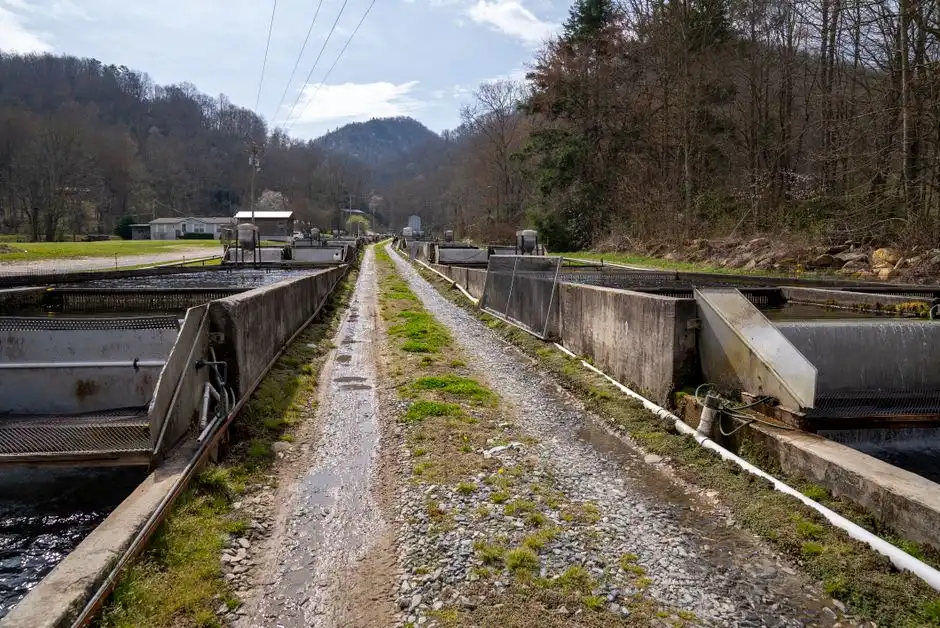
A clarifier relies on gravity, not bubbles, where heavier particles settle onto inclined plates, slide down to a hopper, and the clarified supernatant overflows a peripheral launder. A conventional clarifier runs at roughly 1–3 m/h hydraulic surface loading, which consumes significant floor space. A lamella clarifier stacks inclined plates inside the same footprint and pushes effective surface loading to 20–40 m/h, shrinking the tank by an order of magnitude for the same throughput (HydropureWater lamella spec, 2026). In a Dorchester County aggregate or kaolin plant, that footprint delta is often the difference between fitting a unit inside an existing shed and pouring a new pad.
On heavy mineral solids, the clarifier is cost-effective: a mining facility with heavy sediment loads reduced solids by 90% at lower OPEX than a DAF on the same stream (S4, mining case study). A second lever is chemical — lamella designs with sludge recirculation can cut coagulant and flocculant dose by up to 30% because recirculated solids act as floc nuclei (HydropureWater lamella spec, 2026), and that 30% polymer reduction is the single biggest 2026 OPEX lever for a Harleyville plant buying on total cost of ownership. The trade-off is that lamellas underperform when fines, oils, or metal-hydroxide flocs are too light or too slow to settle, which is the typical signature coming out of a metals-finishing rinse line or a kaolin thickener overflow.
Head-to-Head Comparison: DAF vs Clarifier for Harleyville Mining/Metals Streams
This matrix outlines the technical differences for your procurement committee, with numbers drawn from S1, S4, and the HydropureWater DAF and lamella specifications (2026).
| Parameter | DAF | Lamella Clarifier |
|---|---|---|
| TSS removal | 92–97% (S1) | ~85–90% (S4 mining case) |
| COD / FOG removal | 60–80% COD; 95% FOG on oil-bearing streams (S1, S4) | ~50–70% COD; 70% FOG (S4) |
| Heavy-metal removal (via floc) | Faster capture, shorter residence time — floc lifted before it can break up | Slower; benefits from sludge recirculation to build floc mass |
| Hydraulic surface loading | ~5–10 m/h typical | 20–40 m/h (HydropureWater spec) |
| Footprint per m³/h | Moderate; vertical skid reduces plan area | Smallest per m³/h thanks to inclined plates |
| CAPEX index | Higher — saturator, recycle pump, skimmer drive, controls (S1, S3) | Lower — passive tank, sludge pump, lamella pack |
| OPEX index | Higher — saturation pump power, air, more polymer | Lower — up to 30% chemical savings with sludge recycle (HydropureWater spec) |
| Chemical intensity | Coagulant + flocculant required for bubble attachment | Coagulant + flocculant; reduced by sludge recycle |
| Flow sensitivity | Tolerates swings if A/S ratio is controlled | Sensitive to hydraulic surges; needs equalization |
| Sludge consistency | Thick float (3–5% DS typical), skimmed dry | Settled sludge (1–3% DS), needs thickening before dewatering |
| Best-fit influent | Light fines, metal-hydroxide flocs, oil sheen, colloids | Heavy settleable mineral solids, grit, sand, coarse kaolin |
Sludge consistency is a critical factor for total cost of ownership. A DAF float is already 3–5% dry solids, so it feeds a filter press with less upstream thickening, while a clarifier underflow at 1–3% DS usually needs a sludge thickener first. That difference changes the size of the dewatering train downstream and warrants a specific line item in the CAPEX sheet. Pairing either clarifier with a PLC-controlled coagulant and flocculant dosing skid keeps the chemistry stable across the diurnal swings a Harleyville plant sees from aggregate washing.
Decision Framework: Which System Your Harleyville Plant Should Choose in 2026
Selection should map to four influent tests: total suspended solids character, FOG or oil presence, particle density, and target metal residuals.
| If your stream looks like this… | Choose | Why |
|---|---|---|
| Heavy settleable grit, sand, coarse kaolin, TSS 500–5,000 mg/L, no oil | Lamella clarifier | 90% solids cut at the lowest OPEX; sludge recycle saves 30% polymer |
| Light fines, metal-hydroxide flocs, oil sheen, TSS 2,000–10,000 mg/L, footprint-limited site | DAF | 92–97% TSS, 60–80% COD, 95% FOG; small footprint skid |
| Both light flocs and heavy grit, or strict SC DHEC metal limits requiring polishing | Hybrid DAF + lamella | DAF floats fines and oils, lamella polishes settleables; hybrid trains are explicitly endorsed for complex streams (S4) |
| Variable flow >150 m³/h, OPEX-constrained, chemistry already optimized | Lamella first, DAF as polish | Leverage the 20–40 m/h HSR for primary removal, then float residuals to meet limits |
The hybrid configuration is ideal for sites handling mixed waste streams. A 2026 Harleyville plant handling kaolin thickener overflow plus metal-finishing rinse water benefits from DAF up front to lift the light metal-hydroxide flocs and any oil sheen, followed by a lamella to capture the heavier mineral solids that bleed through. S4 explicitly endorses hybrid trains for complex streams, and the regulatory direction under SC DHEC R.61-9 is pushing more sites toward polishing steps to land tighter metal ceilings.
2026 Costs, Compliance, and Sizing Notes for South Carolina Sites
A DAF skid carries a higher unit cost because of the saturation system, recycle pump, air skid, and skimmer drive (S1, S3). A DAF unit scaled to the 50–100 m³/h band — the most common size for a mid-sized Harleyville aggregate or kaolin line — lands in the mid five-figure USD range for the equipment alone, with the lamella equivalent sitting 20–40% below that on the tank-and-pack scope. The full DAF unit cost and ROI guide walks through the line items, but budget the saturator and controls as roughly a third of DAF total cost.
The lamella is more economical regarding OPEX. The saturation pump on a 50 m³/h DAF draws 3–5 kW continuously, polymer consumption is higher because the floc must be buoyant, and the skimmer drive adds mechanical wear items. The lamella OPEX story is dominated by polymer at up to 30% lower dose with sludge recycle, plus a passive tank with no aeration system. The 2026 guide to reducing chemical sludge production is a useful cross-reference when sizing polymer storage and budgeting for haul-off.
SC DHEC R.61-9 industrial wastewater permitting and the 2026 EPA direction on heavy metals are pushing sites toward tighter discharge ceilings and more frequent monitoring. Neither DAF nor lamella is a permit by itself — both rely on upstream coagulation chemistry to drop metals — but the DAF's faster floc capture and the lamella's sludge recirculation both help stabilize residuals before discharge. Whichever unit you choose, plan a plate and frame filter press for sludge dewatering downstream so the float or underflow leaves the site as a cake rather than a liquid-haul liability.
Frequently Asked Questions
When should a Harleyville mining or metals plant pick DAF over a lamella clarifier in 2026?
Pick DAF when the TSS is dominated by light fines, metal-hydroxide flocs, or oil sheen, when footprint is constrained, or when FOG removal above 90% is required. DAF delivers 92–97% TSS removal and 60–80% COD removal on those streams (S1).
What is the typical hydraulic surface loading for a lamella clarifier versus a DAF?
A lamella clarifier runs at 20–40 m/h thanks to inclined plates, versus roughly 5–10 m/h for a typical DAF, which is why lamellas win on footprint for heavy settleable solids (HydropureWater spec, 2026).