Why 2026 Is a Watershed Year for Hotel Wastewater in Tbilisi and Tskaltubo
Georgia recorded 7.4 million international visitors in 2024, a 4.2% year-on-year increase and 32% above the 2014 baseline (GeoStat, cited via Matador Network, 2025). That surge is converting directly into hotel room-keys: the state-led "New Life for Tskaltubo" masterplan launched in 2022, and the 122-room Marriott conversion of Sanatorium Medea began physical renovation in 2025 after decades of disuse (urbex.nl field report, 2025). Tskaltubo itself is a town of roughly 7,000 residents hosting sanatoriums originally designed for up to 125,000 Soviet-era visitors per year (Matador Network, 2025), so the hydraulic jump from "urbex town" to "operating 4-star inventory" is non-linear.
For an engineer writing a process basis in 2026, the regulator's bottom line is this: effluent discharged to the Mtkvari (Kura) River basin or to municipal sewer must meet the surface-water quality standards set out in GN 1.1-4-2014 and the discharge framework in MoEPA Order N⁰17/N⁰140. Stricter local limits apply near Mtkvari tributaries and the Tskaltubo radon-belt catchment. Plants specified today against inherited Soviet-era BOD5 ≤25 mg/L targets will not pass the current ammonia and total-nitrogen envelope, which is why 2026 is the year to redesign, not retrofit.
Hotel and Resort Influent Characteristics: Flow, Load, and Peak Factors
A defensible influent basis is what separates a bid-winning spec from a rejected one. For a 3–4 star Tbilisi business hotel, design per-guest water use sits at 150–250 L/day; for a Tskaltubo or Bakuriani spa resort with balneotherapy, pool backwash, and radon-bath ancillary flows, lift that to 250–400 L/day. The Tskaltubo masterplan explicitly re-commissions the balneotherapy function, so any spec that ignores mineral-rich backwash is incomplete (urbex.nl, 2025).
Raw wastewater characteristics from the standard hotel wastewater literature fall into these bands: BOD 200–400 mg/L, COD 400–800 mg/L, TSS 200–350 mg/L, NH3-N 20–40 mg/L, and FOG 30–80 mg/L from kitchens. These are typical engineering ranges for mid-range hotel sewage, not source-specific measurements, so treat them as a starting basis and verify with on-site sampling. Two parameters drive the whole train design: peak factor and seasonal factor. Tbilisi city hotels experience a 2.5–3.0× peak factor on morning shower and evening return surges; conference hotels such as the Tbilisi Marriott need 3.0–3.5× to absorb banquet-night loadings. Mountain resorts (Gudauri, Bakuriani, Kazbegi) swing 8–10× between winter ski peak and summer low season — design reactor volume for the shoulder-season average, not the peak weekend, and use equalization to absorb the rest.
| Parameter | Unit | 3–4★ City Hotel | Spa / Mountain Resort |
|---|---|---|---|
| Per-guest water use | L/guest·day | 150–250 | 250–400 |
| Per-guest BOD load | g/guest·day | 40–80 | 60–100 |
| Per-guest COD load | g/guest·day | 80–160 | 120–200 |
| Per-guest TSS load | g/guest·day | 30–60 | 45–80 |
| Per-guest NH3-N load | g/guest·day | 4–8 | 6–10 |
| Diurnal peak factor | × average | 2.5–3.0 | 3.0–3.5 |
| Seasonal swing (mountain) | × low-season avg | 2–3 | 8–10 |
Process Options for Georgian Hotels: MBR, SBR, and Packaged A/O Compared
Three biological trains dominate the 30–250-room Georgian hotel segment. The choice is driven by effluent target, available footprint, and whether the developer wants reuse-quality water for landscape irrigation.
The modular MBR system for hotel wastewater reuse combines anoxic + aerobic zones with submerged PVDF ultrafiltration (0.1–0.4 μm pore size). Operating envelope: HRT 6–8 h, MLSS 8,000–12,000 mg/L, SRT 20–30 days, footprint roughly 60% smaller than conventional activated sludge. Effluent is BOD ≤5 mg/L, TSS ≤1 mg/L, NH3-N ≤1 mg/L — directly reusable for toilet flushing and landscape irrigation. For a hospitality client needing Title-22-quality water for a 1–3 ha garden, MBR is the only train on the list that delivers it without tertiary polishing.
The SBR (sequencing batch reactor) runs a fill–react–settle–decant cycle with HRT 12–24 h and MLSS 3,000–5,000 mg/L. Effluent typically lands at BOD ≤15–20 mg/L, which means post-filtration is required for any reuse application. SBR fits 50–150-room mid-tier Tbilisi hotels with stable occupancy and a willingness to add a sand filter downstream.
The WSZ underground A/O package plant delivers HRT 8–10 h, fully buried installation, and automatic operation with effluent BOD ≤20–25 mg/L and TSS ≤20 mg/L. It is the right call for 20–80-room dense Tbilisi sites in Vake or Vera, where the visible plant footprint is a non-starter and the room count doesn't justify MBR capex. The buried WSZ unit also handles FOG from on-site kitchens without an upstream DAF unit at this scale, provided a grease trap is fitted.
| Parameter | MBR | SBR | WSZ A/O (buried) |
|---|---|---|---|
| HRT | 6–8 h | 12–24 h | 8–10 h |
| MLSS | 8,000–12,000 mg/L | 3,000–5,000 mg/L | 3,000–6,000 mg/L |
| Footprint (m² per m³/d) | 0.15–0.25 | 0.30–0.45 | 0.10–0.20 (buried) |
| Effluent BOD | ≤5 mg/L | ≤15–20 mg/L | ≤20–25 mg/L |
| Effluent NH3-N | ≤1 mg/L | ≤5–8 mg/L | ≤8–15 mg/L |
| Reuse-ready | Yes (direct) | With filtration | No (basic discharge) |
| CAPEX band (USD/m³/d) | 700–1,200 | 500–800 | 350–650 |
Sizing Worked Example: A 120-Room Tbilisi Boutique Hotel in Vake
Translating the bands into a single concrete case: take a 120-room boutique property in the Vake district. Inputs — 120 rooms × 1.6 occupancy ratio × 200 L/guest·day = 38.4 m³/d average dry-weather flow. Apply the 2.8× diurnal peak factor and the hydraulic peak works out to roughly 4.5 m³/h. Organic load is 120 × 1.6 × 0.10 kg BOD/guest·day ≈ 19.2 kg BOD/d, with a 2–4 kg/d FOG contribution from the kitchen line.
Select a modular MBR system for hotel wastewater reuse sized at 45 m³/d nominal (1.15× average, 10× peak to keep transients inside membrane flux limits). Add a 20 m³ equalization tank to flatten the morning-evening surge. Reactor volume splits to roughly 14 m³ aerobic and 5 m³ anoxic; total submerged PVDF flat-sheet membrane area around 80 m². Aeration demand at MLSS 10,000 mg/L is about 60–80 m³/h, served by two duty blowers. Effluent targets: BOD ≤10 mg/L, COD ≤50 mg/L, NH3-N ≤5 mg/L, TN ≤15 mg/L — comfortably inside the GN 1.1-4-2014 envelope and below the Mtkvari tributary ceiling. The 80 m² membrane cassette ships in a single 6 m ISO container, which matters for Vake's narrow access streets.
Discharge, Reuse, and Sludge: Closing the Loop in the Mtkvari Basin
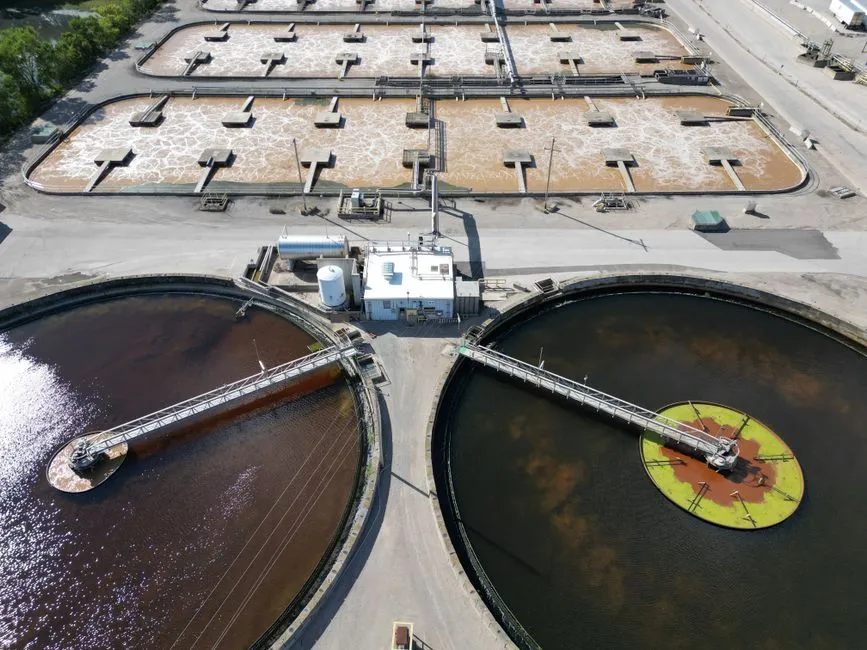
Two discharge routes are realistic for a 2026 Tbilisi hotel. To municipal sewer (Tbilisi Water LLC), pretreatment must hold COD ≤500 mg/L and eliminate visible FOG; the utility's tariff schedule is the gating economic for reuse. To a Mtkvari tributary or the Tskaltubo catchment, full GN 1.1-4-2014 surface-water limits apply and an environmental impact assessment is usually required. Where the catchment drains to a drinking-water abstraction downstream, designers should plan for the tighter NH3-N ≤2 mg/L band rather than the default ≤10 mg/L ceiling.
MBR permeate opens a second revenue line. At 50–80 m³/d it can irrigate 1–3 ha of hotel landscaping, cutting municipal water purchase by 20–40% — against current Tbilisi Water tariffs, that typically pays back the MBR premium in 3–5 years (HydropureWater field data, 2026). For Tskaltubo spa resorts, the same permeate stream can top up decorative thermal pools or supply cooling-tower makeup.
Sludge handling scales linearly with BOD removed. A 120-room hotel on MBR produces roughly 15–20 kg DS/d; a small plate-and-frame filter press for hotel sludge producing 18–22% DS cake handles that in a single 4-hour batch cycle. Disinfection of the permeate before reuse or discharge is done with a chlorine dioxide generator sized to the 30–50 m³/d permeate flow — ClO2 holds residual across the irrigation line better than sodium hypochlorite at Tbilisi's summer distribution temperatures.
Cost Bands and Selection Framework for 2026 Georgian Hotel Projects
Three CAPEX bands cover the realistic procurement envelope for Chinese-supplied packaged plants shipping into Georgia in 2026. Treat them as benchmark estimates, since the cited sources do not contain vendor-specific price lists: WSZ A/O package USD 350–650 per m³/d installed, SBR USD 500–800 per m³/d, modular MBR USD 700–1,200 per m³/d. OPEX (energy + chemicals + membrane replacement amortized over 8–10 years): A/O at USD 0.18–0.35 per m³, SBR at USD 0.25–0.45 per m³, MBR at USD 0.35–0.60 per m³ (HydropureWater field data, 2026).
| Site profile | Recommended train | Why |
|---|---|---|
| 20–80 rooms, dense Tbilisi site, buried install, no reuse | WSZ underground A/O | Lowest CAPEX, invisible footprint, adequate BOD discharge |
| 50–150 rooms, stable occupancy, Tbilisi or Batumi | SBR | Mid CAPEX, simple cycle, post-filter for reuse if needed |
| Any size with landscape irrigation, sensitive Mtkvari catchment, or <500 m² available footprint | Modular MBR | Reuse-ready effluent, 60% smaller footprint, 3–5 yr reuse payback |
| 100+ rooms with conference centre and banquet kitchen | Modular MBR + pre-DAF | FOG buffering from banquet flow + reuse quality |
The defensible selection rule for a 2026 spec: pick MBR when reuse, sensitive Mtkvari sub-catchment, or footprint below 500 m² is on the table; pick SBR for 50–150-room mid-tier hotels with steady year-round occupancy; pick the WSZ underground A/O package plant for 20–80-room dense Tbilisi sites where burial is a permit condition. For a fuller CAPEX/OPEX benchmark, the MBR engineering guide with CAPEX/OPEX benchmarks and the Calgary hotel wastewater treatment 2026 guide walk through comparable cold-climate packaged-plant economics. Regional parallels are also useful — the 2026 hotel wastewater treatment guide for Santiago, Chile and the 2026 hotel wastewater engineering guide for Bogotá cover comparable 30–250-room urban and resort specs.
Frequently Asked Questions
What effluent limits apply to a hotel discharging to the Mtkvari River in Georgia?
Discharge to the Mtkvari (Kura) basin must meet surface-water standards set in GN 1.1-4-2014: BOD ≤15 mg/L, COD ≤50 mg/L, TSS ≤15–30 mg/L depending on receiving-water sensitivity, and NH3-N ≤2–10 mg/L. For sites draining to drinking-water abstractions, the lower NH3-N band applies and an environmental impact assessment is typically required.
How is a hotel wastewater treatment plant sized for seasonal occupancy in mountain resorts?
Size the bioreactor to the shoulder-season average flow, then add equalization for the 8–10× peak-to-trough swing seen at Gudauri, Bakuriani, and Kazbegi. For a 150-room mountain resort at 250 L/guest·day, that typically lands at 25–35 m³/d nominal reactor capacity with 40–60 m³ equalization.
Can treated hotel wastewater be reused for landscape irrigation in Georgia?
Yes. MBR permeate at BOD ≤5 mg/L, TSS ≤1 mg/L, and turbidity typically <1 NTU is suitable for sub-surface and drip irrigation of hotel grounds. At 50–80 m³/d, a 1–3 ha landscape can be irrigated, reducing municipal water purchase by 20–40% and paying back the MBR premium over 3–5 years at Tbilisi Water tariffs.