Why Blue River Mining and Metals Plants Are Re-evaluating Primary Clarification in 2026
Blue River sits in Oregon's Cascade mining belt, where aggregate operations, copper-gold exploration, and small-scale mineral processing plants share a regulatory and hydrological reality: a wet climate, a declining-ore landscape, and the U.S. Environmental Protection Agency's 40 CFR 440 effluent limitation guidelines (Ore Mining and Dressing Point Source Category) for every discharge point. Oregon DEQ's 2026 NPDES permit cycle has tightened total suspended solids (TSS) and metals monitoring frequencies for several facilities in Lane and Linn counties, and operators are getting letters requesting primary-clarification upgrade justifications before reissuance.
Three forces are converging at the same time. First, ore-body decline across the Blue River district means each ton of water now carries more fines per ton of concentrate, increasing hydraulic and solids load on existing thickeners. Second, a single process upset — a tailings line failure during a 25 mm rain event, a mill flush, or an acid mine drainage (AMD) surge from a worked-out pit — can push a 40 CFR 440 effluent limit violation in under an hour. Third, the capital cost of an NPDES consent decree has risen sharply: civil penalties under the Clean Water Act are now adjusted annually for inflation, and Oregon DEQ has issued informal notice that repeat TSS exceedances will trigger state-level enforcement separate from federal action.
The practical question is no longer "do we need to upgrade?" — most Blue River facilities do — but "which primary unit, sized how, in what configuration?" The rest of this guide answers that with a three-question diagnostic, a head-to-head comparison, and a hybrid DAF + lamella clarifier reference design anchored to 40 CFR 440 and Oregon DEQ expectations.
The Three Questions That Decide DAF vs Clarifier for Any Mining Wastewater
Before talking to a vendor, a Blue River engineer can eliminate most of the wrong-fit options by answering three questions about the actual stream, not the textbook category "mining wastewater."
Question 1 — What is the influent TSS and particle density? Dense mineral particles (specific gravity >1.2) settle readily under gravity; DAF's 30–50 micron micro-bubbles (Clearwater, 2026) do very little work on coarse sand. If the dominant species is silt, mill sand, or flotation tailings, gravity wins. If the dominant species is colloidal clay, metal-hydroxide floc, or emulsified oil, DAF wins.
Question 2 — Are oils, flotation reagents, or surfactants present? DAF achieves roughly 95% FOG removal on oily streams compared to a clarifier's 70% (Ecologix, 2025). Xanthates, frothers, MIBC, and compressor condensate all bias the answer toward DAF as the primary unit.
Question 3 — What is the target effluent — bulk TSS, dissolved metals, or water reuse? Bulk settleable solids favor a clarifier. Metal-hydroxide floc capture after pH adjustment (typically pH 8.5–9.5 for most transition metals) favors DAF. Reuse-quality water (<30 mg/L TSS) almost always needs a filter downstream of either primary unit.
A 30-second decision flow that holds up in practice: if TSS >2,000 mg/L and oil/reagent load is low, lead with a clarifier or lamella thickener. If TSS <2,000 mg/L and there is measurable oil, reagent, or fine colloid, lead with a HydropureWater DAF system. Everything else — most real Blue River streams — runs best as a hybrid.
DAF vs Clarifier for Mining: Head-to-Head Comparison
The table below is tuned to mining variables that generic DAF-vs-clarifier articles miss: heavy-metals compatibility, dense-sludge handling, reagent/oil loading, and flow-spike sensitivity. Numbers come from cited vendor and field data; ranges reflect real Blue River variability rather than lab best cases.
| Parameter | DAF | Clarifier / Lamella Thickener |
|---|---|---|
| TSS removal on mining stream | 80–90% with coagulation; falls on coarse sand | 85–95% on settleable mineral solids; falls on colloids |
| Oil / FOG / reagent removal | ~95% on oily streams (Ecologix, 2025) | ~70% on oily streams (Ecologix, 2025) |
| Micro-bubble / mechanism | 30–50 µm air bubbles attach to floc (Clearwater, 2026) | Gravity settling; lamella plates at 20–40 m/h surface loading |
| Footprint for 50 m³/h | 5–8 m² unit + saturator + compressor skid | 4–5 m diameter tank; smaller with inclined plates |
| Chemical demand | Coagulant + polymer; ~30 mg/L Al₂(SO₄)₃ equivalent for floc (USU, 2011) | Polymer only; lamella cuts dose up to 30% vs conventional (HydropureWater field data) |
| Capex per m³/h | Higher (skimmer, saturator, compressor) | Lower for raw hydraulic capacity |
| Opex drivers | Compressed air 0.5–1.5 kWh/m³; chemical | Polymer dose; rake torque; underflow pumping |
| Flow-spike sensitivity | Moderate; hydraulic overflow on top of float blanket | High; solids washout above design rise rate |
| Heavy-metals floc capture (post-pH adjust) | Strong — floc floats cleanly | Moderate — fine hydroxide floc can escape |
| Sludge output | Float 3–6% solids + bottom auger for settled | Thick underflow 5–10% solids (good for filter press) |
| Operating skill | Moderate; PLC + chemistry control | Low–moderate; mechanical rake, simple chemistry |
One-line verdict: DAF wins on oil, reagent, fine colloid, and metal-hydroxide floc; clarifier wins on bulk dense solids and lowest dollar per cubic meter treated. For most Blue River sites, the right answer is to run both, in series, in a defined order — covered in the next section.
When a Clarifier (or Lamella Thickener) Is the Right Primary Choice
A conventional center-feed clarifier or an inclined-plate lamella thickener is the correct primary unit when the stream is dominated by dense, settleable mineral solids. That covers post-mill discharge, aggregate wash water, and most tailings thickener overflows where TSS routinely sits above 2,000–3,000 mg/L of mineral solids with a specific gravity above 1.2. In those streams, the particles want to settle; the engineering problem is just to give them enough quiescent time and surface area.
Lamella clarifiers (inclined-plate designs) push surface loading rates to 20–40 m/h, roughly an order of magnitude higher than conventional clarifiers at 1–2 m/h (HydropureWater field data). For a Blue River site with a tight footprint — a common constraint when plants are tucked into a canyon or alongside an existing mill — that compression is decisive. The underflow typically lands at 5–10% solids, which pairs naturally with a plate-and-frame filter press for cake dewatering. That pairing — a HydropureWater lamella clarifier feeding a filter press — is the workhorse 1+1 mining process train, and a sensible first-quote baseline for any aggregate or copper-moly operation whose stream is mostly settleable fines.
The honest caveat: a standalone clarifier misses oils, flotation reagents, and fine metal-hydroxide floc. Those will pass through to discharge unless paired with DAF, chemical precipitation, or both. Operators who buy a clarifier alone to solve a 40 CFR 440 metals limit are usually back at the vendor within a year.
When a DAF System Is the Right Primary Choice
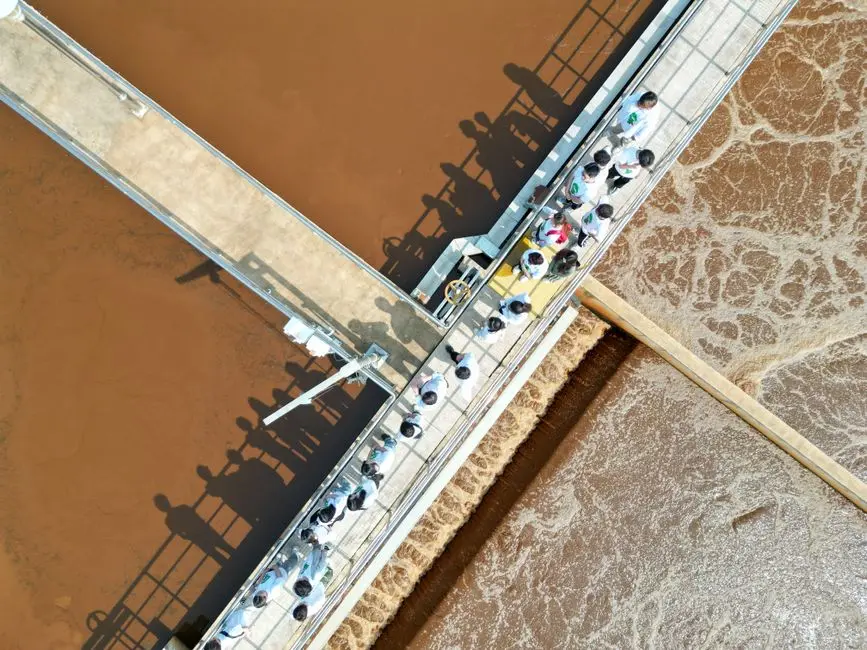
DAF is the right primary unit when the stream carries species that do not settle cleanly: residual flotation reagents (xanthates, dithiophosphates, frothers), compressor or vehicle-wash oils, fine metal-hydroxide floc generated after pH adjustment for dissolved metals, and any colloid-dominant feed. DAF micro-bubbles in the 30–50 micron range attach to chemically conditioned floc and lift it to the surface, where a paddle skimmer removes the float blanket (Clearwater, 2026).
For coagulant-conditioned streams, dose rates around 30 mg/L of aluminum sulfate (or equivalent) have been shown to be effective in published DAF optimization work (USU, 2011), with polymer flocculant added downstream to build floc strength. A modern DAF such as the HydropureWater DAF system also includes a bottom auger to remove settled heavy solids, so it is not "useless" on partially dense streams — but the bubble budget is wasted on coarse sand above ~150 µm, and a pre-screening or grit step is worth specifying.
DAF float cake typically dewaters directly without a press, although the volume is higher than a clarifier underflow at comparable influent load. Pairing the DAF with a HydropureWater automatic chemical dosing system is the practical way to hold floc quality stable across the daily chemistry swings a Blue River mill sees between ore shifts and rain events.
The 2026 Hybrid DAF + Lamella Clarifier Train for Blue River Operations
For most Blue River-area mining and metals plants in 2026, the dominant reference design is no longer DAF or clarifier — it is DAF followed by a lamella clarifier, with chemical dosing and an optional multimedia filter in the loop. The process train: equalization basin → pH/coagulant dosing → DAF (oil, reagent, and fine metal floc removal) → lamella clarifier (residual TSS polishing) → sand/anthracite filter → discharge or reuse. A multi-media filter on the back end is the cleanest way to push TSS below 30 mg/L for reuse loops without overloading the clarifier.
Why this order, and not the reverse? DAF first strips the floatables and the float-aid-bound colloids so the clarifier downstream sees a cleaner, lower-oil stream. The lamella stage can then operate at higher surface loading with less polymer, and field data from similar hybrid configurations show polymer demand drops 20–30% relative to a clarifier handling the raw stream (HydropureWater field data, 2026). That chemistry saving often pays for the DAF's compressed-air power within the first 12 months.
The HydropureWater DAF system covers 4–300 m³/h across 13 standard models, which maps directly onto the 50–500 m³/h envelope most Blue River plants actually operate in. The downstream HydropureWater lamella clarifier covers the same flow band with a much smaller tank diameter than a conventional clarifier, freeing up pad space for a sludge handling building or a future filter press.
From a 40 CFR 440 standpoint, the hybrid gives redundant TSS and metals control. If the DAF is offline for a saturated-air pump rebuild, the lamella can typically hold permit limits on its own for short maintenance windows — and vice versa. For plants near Trapper Creek and similar tributaries, that redundancy is the difference between a planned shutdown and a 40 CFR 440 violation narrative. For a deeper look at how neighboring operations are framing pretreatment compliance, see How Mining & Metals Plants Near Trapper Creek Meet Pretreatment Limits (2026 Guide), and for copper-concentrator water reuse specifically, MBBR Configuration for Copper Concentrator Water: 2026 Reuse & Discharge Guide covers the biological polishing step that typically follows this train.
Sizing, Cost, and ROI Sanity Check for a 2026 Mining DAF or Clarifier
Indicative flow-to-equipment sizing for a Blue River site, anchored to the HydropureWater DAF and lamella clarifier line, looks like the table below. Footprints and weights are order-of-magnitude; a real submittal package should always come from a jar-tested PFD.
| Design flow | DAF unit | Lamella clarifier | Combined footprint (approx.) |
|---|---|---|---|
| 25 m³/h | DAF-25 (~4 m²) | 3 m diameter | ~12 m² plus chemical skid |
| 50 m³/h | DAF-50 (~5–8 m²) | 4–5 m diameter | ~20 m² plus chemical skid |
| 100 m³/h | DAF-100 (~10–12 m²) | 5–6 m diameter | ~35 m² plus chemical skid |
| 200 m³/h | DAF-200 (~18–22 m²) | 7–8 m diameter | ~60 m² plus chemical skid |
Capex order-of-magnitude: DAF systems run higher per m³/h than lamella clarifiers because of the saturator, compressor package, and skimmer mechanism. Lamella clarifiers win on raw hydraulic capacity per dollar, especially with the polymer savings from inclined plates. Opex: the clarifier's polymer dose is the main variable cost; the DAF adds compressed-air power at roughly 0.5–1.5 kWh per cubic meter treated, but the float cake it produces is drier and easier to handle than a clarifier underflow at the same loading.
ROI trigger: if a plant is paying discharge surcharges or faces credible risk of a 40 CFR 440 fine, both DAF and lamella configurations typically pay back in 12–24 months once civil penalties and consent-decaee legal costs are priced in. Frame the choice to the plant manager as risk reduction and permit-renewal insurance, not as a pure cost decision. Sludge handling downstream of either unit is most economically closed out with a plate and frame filter press for the clarifier underflow or a drying bed for DAF float, depending on the site's haulage economics.
Frequently Asked Questions
What influent TSS should push a Blue River plant toward a clarifier instead of a DAF?
As a working threshold, influent TSS above 2,000–3,000 mg/L of mineral solids with a specific gravity above 1.2 favors a clarifier or lamella thickener. Below that, with oil or reagent present, DAF typically outperforms. Many Blue River sites sit across both regimes, which is why the hybrid DAF + lamella train has become the 2026 default.
Does a DAF system meet 40 CFR 440 effluent limits on its own?
For TSS and settleable solids, a well-sized DAF with proper coagulation can meet 40 CFR 440 effluent limitations for the Ore Mining and Dressing category, but dissolved metals still require pH adjustment and precipitation upstream or downstream. For Oregon DEQ NPDES renewals in 2026, expect reviewers to ask for redundant TSS control, which is why most permits are being written around a DAF + clarifier combination rather than a single unit.
How much coagulant does a mining DAF typically need?
Published DAF optimization work (USU, 2011) found roughly 30 mg/L of aluminum sulfate effective for floc formation, with polymer flocculant added to strengthen the floc. Mining streams with high alkalinity or high fines often run higher, so jar testing on the actual feed is the only reliable number.
Can a lamella clarifier replace a conventional thickener in a mining flowsheet?
For primary clarification ahead of a filter press, yes — inclined-plate designs reach 20–40 m/h surface loading versus 1–2 m/h for a conventional clarifier, cutting footprint dramatically. For tailings thickening where underflow density above 50% solids is the target, a conventional thickener or a deep-cone unit is still the right tool; lamella units are optimized for clarification, not paste production.