Why MBBR Works for Copper Concentrator Water
Biofilm tolerates copper where suspended growth fails. Long-term MBBR operations treating gold-mining wastewater showed nitritation remains uninhibited at 0.13–0.61 mg Cu/L influent, and only the nitratation step is impacted at 0.28–0.61 mg Cu/L (source: Springer MBBR Cu-inhibition study, 2018). That single data point has reshaped how engineers spec the biological step on copper-bearing streams: the biofilm, not the floc, is the unit to design around.
The mechanism is straightforward. Attached-growth biomass secretes extracellular polymeric substances (EPS) that complex free Cu²⁺ before it reaches the nitrifying cells in the inner biofilm layer. Historical work by Braam & Klapwijk (1981) and Lee et al. (2009) on activated-sludge systems — both cited in the Springer mining MBBR paper — recorded nitrification failure at copper concentrations an order of magnitude lower than what the MBBR biofilm tolerated. The takeaway for a process memo: activated-sludge sizing factors for Cu cannot be ported to MBBR.
The carrier geometry matters operationally. Kaldnes-type HDPE media have a bulk density of approximately 1.0 g/cm³ — close to water — and are retained inside the reactor by perforated sieve plates (per the IJSR 2017 MBBR review, source: doi 10.21275/art20179091). For copper concentrator water, which carries abrasive flotation fines, HDPE carriers survive where rotating biological contactors (RBCs) would be shredded. Design choices on influent screening at 2 mm and reactor metallurgy follow directly from this carrier robustness. For pretreatment sequencing, see the ammonia drain pretreatment guide for MBBR.
Influent Characterization: What a Copper Concentrator Stream Actually Contains
The design basis for any copper concentrator MBBR hinges on a realistic influent envelope, not a generic mining profile. A mill that runs flotation plus solvent extraction produces a mixed stream: 1–10 mg/L total Cu, 5–80 mg/L ammonia from SX reagents, 200–2,500 mg/L sulfate, 0.5–5 mg/L residual xanthates and dithiophosphates, trace thiosulfate, suspended fines at 50–400 mg/L, and — if cyanidation sits upstream — weak acid-dissociable (WAD) cyanide in the 0.1–2 mg/L range. pH typically sits at 6.5–9.5 depending on lime balance across the mill circuit.
The number that matters for biology is not total Cu, it is free Cu²⁺. Only the ionic fraction inhibits biofilm respiration, so pH and ORP control are part of the biological design — pushing pH above 7.5 precipitates Cu as Cu(OH)₂ and cuts the bioavailable fraction by roughly 80%. Equally, the 0.28–0.61 mg Cu/L nitratation ceiling from the Springer MBBR study (2018) is the upper bound a designer should set on free Cu²⁺ at the aerobic reactor inlet; anything higher requires a sulfide precipitation or ion-exchange trim upstream.
Residual flotation reagents contribute the bulk of the carbon load as chemical oxygen demand (COD), not biochemical oxygen demand (BOD). These organics are poorly biodegradable and pass through conventional BOD₅ analysis, so the BOD/COD ratio will read artificially low. A defensible memo states COD separately and uses the BOD/TKN ratio to size denitrification capacity, not the COD value alone. The table below summarizes realistic influent and effluent targets.
| Parameter | Raw influent (typical range) | Design inlet to MBBR | MBBR effluent (reuse path) | Discharge permit (typical) |
|---|---|---|---|---|
| Total Cu (mg/L) | 1–10 | < 0.6 (post-precipitation) | < 0.1 | < 0.5 |
| Free Cu²⁺ (mg/L) | 0.5–5 | < 0.3 | < 0.05 | — |
| Ammonia-N (mg/L) | 5–80 | 5–80 | < 2 | < 10 |
| COD (mg/L) | 80–400 | 60–300 | < 60 | < 150 |
| Suspended solids (mg/L) | 50–400 | < 30 (post-DAF) | < 1 (with MBR) | < 30 |
| Sulfate (mg/L) | 200–2,500 | 200–2,500 | 200–2,500 (RO trims if reused) | Site-specific |
| pH | 6.5–9.5 | 7.0–8.0 | 7.0–8.0 | 6.0–9.0 |
Compare this envelope with the sister MBBR configuration guide for softener finishing rinse water to see how the copper and ammonia loads differ from a metal-finishing matrix.
The 2026 MBBR Configuration: Five-Stage Train

A defensible block flow for a copper concentrator biological step in 2026 runs five stages end-to-end. The order is not interchangeable; each step protects the next.
- Stage 1 — Coarse screening and grit removal. 2 mm perforated screens ahead of the MBBR protect carriers from packing, ragging, and abrasion. Anything coarser than 2 mm is a known cause of carrier accumulation and dead zones in the aerobic reactor.
- Stage 2 — pH adjustment and optional sulfide polishing. Lime or NaOH dosing lifts pH to 7.0–8.0, which precipitates Cu(OH)₂ and cuts the free Cu²⁺ fraction reaching biology. Where total Cu exceeds 10 mg/L, a sodium sulfide (NaHS) dose at 1.05–1.2× stoichiometric Cu drops free Cu²⁺ below 0.3 mg/L before the MBBR — well inside the 0.61 mg/L nitritation tolerance from the Springer study (2018).
- Stage 3 — DAF or lamella clarification. A dissolved air flotation unit strips residual xanthates, dithiophosphates, and entrained fines that would otherwise coat carriers and inhibit oxygen transfer. The HydropureWater DAF system for residual flotation reagent removal targets this exact load: 20–50 mg/L air-to-solids ratio and a skimmer for floated organics. Where footprints are tight, a high-rate lamella can substitute, though removal efficiency for emulsified reagents drops to 60–70% versus >90% for DAF.
- Stage 4 — Equalization basin. 24–48 h HRT damps slug loads from the mill and gives operations a buffer to pull a reactor offline without spilling. Equalization also stabilizes temperature, which matters because nitrifier kinetics slow sharply below 10 °C.
- Stage 5 — Anoxic MBBR → aerobic MBBR → MBR or clarifier polish. The anoxic stage handles residual COD and, on sulfide-conditioned carriers, drives Cu²⁺ reduction to Cu⁰ for polishing Cu removal before the aerobic reactor. The aerobic MBBR carries the nitritation load, and the downstream polish (MBR for reuse, clarifier + sand filter for discharge) handles the residual SS envelope. The HydropureWater MBR polishing stage for reuse-quality effluent cuts SS to under 1 mg/L and replaces a clarifier-sand filter pair, reducing footprint by roughly 60%. Where a high-rate sedimentation step is preferred over DAF, a high-efficiency sedimentation tank can be substituted for the flotation stage.
Engineering Parameters: Fill Ratio, HRT, Aeration, Temperature
The numbers below are what a process engineer needs in a sizing memo. They reflect published MBBR operating windows (S1, S2) and the Springer 2018 copper-tolerance study, scaled to the mining matrix. The Kaldnes K1 baseline at 20% fill is the academic reference point (S1, doi 10.26418/jtllb.v7i1.31882); mining streams with high-Cu, high-TSS loads generally need 30–40% to absorb shock without nitritation slip.
| Parameter | Anoxic MBBR | Aerobic MBBR | Design rationale |
|---|---|---|---|
| Carrier fill (HDPE Kaldnes-type) | 20–30% | 30–40% | Higher fill in aerobic stage buffers Cu and NH₃ slug loads. |
| HRT | 2–4 h | 6–10 h | Nitrifier kinetics govern aerobic HRT; cold sites extend to 12 h. |
| Dissolved oxygen setpoint | < 0.2 mg/L | 2.0–4.0 mg/L | Coarse-bubble aeration keeps carriers fluidized while maintaining DO. |
| Temperature window | 10–35 °C | 10–35 °C | Nitrification halves per 10 °C drop below 20 °C; heat below 10 °C. |
| Free Cu²⁺ at reactor inlet | — | < 0.6 mg/L | Hard ceiling from Springer MBBR study (2018). |
| pH | 7.0–8.0 | 7.0–8.0 | Below 6.5, free Cu²⁺ rises and nitritation stalls. |
| Effective SRT | Carrier-retention based | Carrier-retention based | No sludge wasting on carriers; biomass controlled by shear. |
Two operational points worth defending in a memo. First, the SRT is implicitly controlled by carrier retention — the biofilm sheds at a rate set by aeration shear, not by wasting. That is the structural advantage over activated sludge: no daily wasting decisions, no clarifier dependency for biomass control. Second, dissolved oxygen below 2.0 mg/L in the aerobic reactor correlates with incomplete nitritation when free Cu²⁺ is above 0.3 mg/L, so DO is the primary control variable, not airflow cost. For comparison against a textile-matrix configuration, see the MBBR configuration guide for desizing effluent.
Single-Stage vs. Two-Stage MBBR: When Each Makes Sense
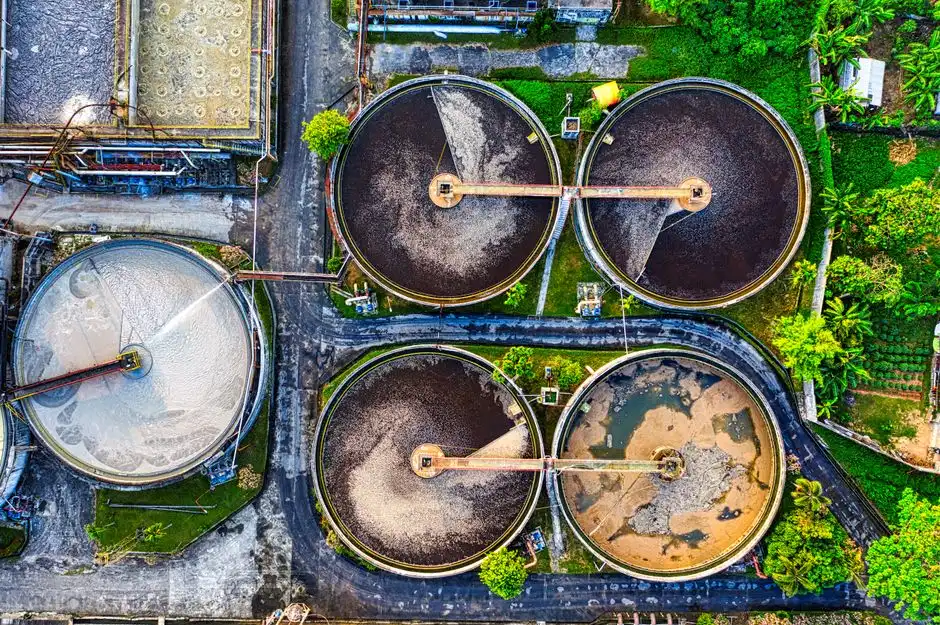
The choice between a single aerobic MBBR and a full anoxic + aerobic train is driven by three questions: ammonia load, discharge limit, and downstream water destination. The table below maps those decisions.
| Criterion | Single-stage aerobic MBBR | Two-stage anoxic + aerobic MBBR |
|---|---|---|
| Capex | Lower (one reactor, no mixers) | Higher (two reactors, anoxic mixers) |
| Best-fit influent | NH₃ < 20 mg/L, low COD, discharge only | NH₃ > 20 mg/L, TN limit < 40 mg/L, reuse goal |
| Typical flow range | 50–100 m³/h sites | 100–500 m³/h sites, or any reuse case |
| Cu slug-load resilience | Limited (no anoxic buffer) | Strong (anoxic stage adsorbs Cu²⁺ spike) |
| Denitrification | None | Yes, if BOD/TKN > 4; otherwise needs supplemental C |
| Downstream polish | Clarifier + sand filter for discharge | MBR for reuse; clarifier + sand filter acceptable for discharge |
| Footprint | Compact | Larger, but MBR polish recovers ~60% versus clarifier train |
For a copper concentrator aiming at mill process-water reuse, the two-stage train is the default. The anoxic stage does double duty: it denitrifies when BOD/TKN is favorable, and it provides a sulfide-conditioned biofilm that reduces Cu²⁺ to Cu⁰ as a polishing step before the aerobic reactor (Springer 2018). When the C/N ratio is below 3, supplement with methanol (3 mg CH₃OH per mg NO₃-N) or acetate. For reuse polishing, the HydropureWater MBR membrane bioreactor module delivers the under-1-mg/L SS envelope the mill circuit needs.
Reuse vs. Discharge: How to Decide on the Back End
The end-of-pipe decision is not technical alone — it is a tradeoff between capex, freshwater cost, and ESG reporting pressure. Two paths dominate in 2026.
Discharge path: MBBR effluent flows to a DAF clarifier for any residual biological floc, then through a sand filter for final TSS trim, and finally to a chlorine dioxide contact basin for disinfection. The envelope is Cu < 0.5 mg/L, NH₃ < 10 mg/L, TSS < 30 mg/L — which covers most mining-region permit frames. Disinfection is best handled with a HydropureWater chlorine dioxide generator for discharge-path disinfection, which tolerates the residual ammonia without forming chloramines the way chlorine would.
Reuse path: MBBR effluent goes to an MBR for SS polish to under 1 mg/L, then to an industrial RO system if sulfate and TDS need to drop for mill-circuit compatibility (especially for SX circuit water where hardness and sulfate foul reagent selectivity). The RO permeate lands in a process water tank; the concentrate returns to the equalization basin or to a brine management step. MBR polish adds approximately 15–25% to the biological capex but eliminates the clarifier and media filter train, and reuse water is valued at $0.50–2.00/m³ in most mining regions — payback inside three years for any site drawing more than 200 m³/d of freshwater. Where TDS reduction is required for mill-grade reuse, the HydropureWater industrial RO system for mill-grade reuse water handles the sulfate and hardness envelope.
The decision rule: if the mine's freshwater cost exceeds $1/m³ and the mill is in a water-stressed basin, the reuse path pays back even with RO. If freshwater is cheap and the discharge permit is generous, the DAF-sand-filter path is the lower-capex choice. Most new copper concentrator designs in 2026 default to reuse, driven by ESG reporting on water intensity per tonne of cathode copper.
Frequently Asked Questions
What copper concentration can an MBBR tolerate before nitrification fails?
Peer-reviewed MBBR data shows nitritation uninhibited at 0.13–0.61 mg Cu/L influent, with nitratation impacted only at 0.28–0.61 mg Cu/L (Springer MBBR Cu study, 2018). The hard ceiling for the aerobic reactor inlet is 0.6 mg/L free Cu²⁺; above that, sulfide precipitation or pH adjustment must trim the bioavailable fraction first.
What carrier fill percentage is standard for copper concentrator MBBR?
Academic baselines sit at 20% Kaldnes K1 fill (S1, doi 10.26418/jtllb.v7i1.31882), but copper and ammonia shock loads on concentrator streams generally justify 30–40% fill in the aerobic stage and 20–30% in the anoxic stage. Higher fill buffers slug loads without changing reactor footprint proportionally.
Do I need an MBR after the MBBR, or is a clarifier enough?
For discharge to a typical TDS-loose permit, a DAF clarifier plus sand filter is sufficient and saves capex. For mill process-water reuse, MBR polish is required because MBBR alone leaves 20–40 mg/L SS, which fouls downstream RO membranes and piping. The HydropureWater MBR module cuts SS to under 1 mg/L and reduces the overall polish footprint by roughly 60% versus a clarifier-sand-filter train. The trade-off is documented against other matrices in the sister MBBR configuration guide for softener finishing rinse water.