Why Kalamazoo Chemical Plants Are Rethinking the Separator in 2026
Kalamazoo County hosts one of the densest clusters of specialty-chemical, pharmaceutical, and coated-paper operations in the Midwest, and the West Michigan service corridor already runs active DAF and clarification programs across Kalamazoo, Holland, and Muskegon (ChemREADY Grand Rapids / West Michigan service territory, 2026). Batch reactors at these plants discharge inconsistent emulsions, solvent carryover, and pH swings that a basic gravity clarifier was never sized to handle. In 2026 the trigger is not capacity alone — it is pretreatment compliance: FOG excursions at the City of Kalamazoo Water Reclamation Plant, tightened internal polymer budgets, and a single separator train that has to cover both oil-rich and solids-rich streams as product mix shifts between API, excipient, and coating campaigns.
The practical decision in front of most environmental engineers here is binary: rebuild the existing clarifier, or install a DAF in front of (or instead of) it. That choice is governed by three local realities — influent FOG fraction, settleable-solids density, and winter operability below -10°C — none of which a generic chemicals article will cover. The rest of this guide is built around those three variables, with a 2026 CAPEX/OPEX ballpark and a four-question screening checklist at the end so the recommendation can survive a procurement review.
How a DAF and a Clarifier Actually Separate Solids
A DAF saturates a pressurized recycle stream with air, then releases it through needle valves or a manifold so that 20–50 micron microbubbles form in the flotation cell. Those bubbles attach to flocculated particles and lift them to the surface, where a paddle skimmer removes the float while an auger extracts heavier settleables from the bottom cone (per SigmaDAF/PEWE mechanism descriptions, 2026). Modern DAFs use a regenerative-turbine pump to aspirate atmospheric air without a compressed-air package, which is the efficiency baseline to specify in 2026 (PEWE ROGUE MAX RGT pump, 20–30 micron bubble size, no compressor required).
A gravity clarifier — including a lamella (high-rate) clarifier — separates by quiescent settling under Stokes' law. Lamella plates multiply the effective settling area and push surface loading rates to roughly 2–4 m³/m²/h (20–40 m³/m²/h is the often-cited hydraulic loading, but the solids loading is the binding constraint at 2–4 m³/m²/h for chemical sludges). The plates shed sludge down to a hopper, and clarified water rises through the plate pack.
That mechanism difference is the whole decision. DAF wins when the target contaminant is lighter than water — free oil, emulsified oil, fine TSS with light floc — because bubble-particle attachment overcomes negative buoyancy. Gravity wins when the particle already wants to sink: dense inorganic sludges, metal hydroxides, crystalline salts. For mixed streams, the standard 2026 configuration is DAF primary followed by lamella polish (Ecologix hybrid case data, 2026).
Kalamazoo Wastewater Characteristics: What the Influent Looks Like
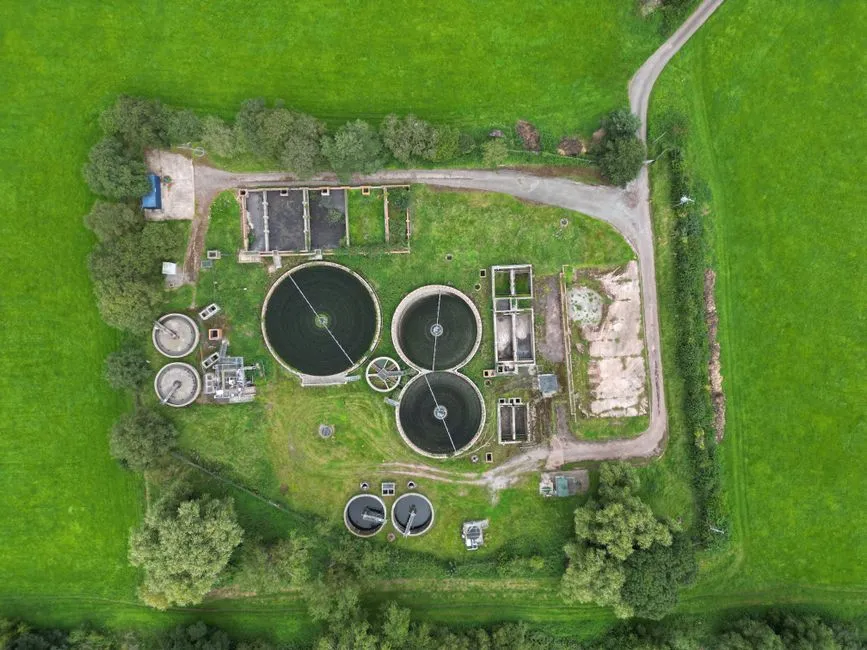
A typical West Michigan specialty-chemical or pharma stream in 2026 looks like this on a composite sample: FOG 200–2,000 mg/L, TSS 500–5,000 mg/L, COD 1,000–15,000 mg/L, pH swinging from 2 to 12 batch-to-batch, with intermittent solvent carryover (acetone, MeOH, IPA, glycol ethers) and surfactant loads from cleaning cycles. Free oil skims in any device; emulsified oil — the kind generated by API synthesis, coating letdowns, and CIP washdowns — does not, and that is where a lamella clarifier alone underperforms.
Foaming and high surfactant loading are routine in coatings and pharma facilities. A DAF tolerates wider feed variation than a clarifier because hydraulic residence time is shorter (typically 15–25 minutes vs 1–3 hours in a clarifier), so a slug of emulsified material does not bury the separator. Pre-treatment chemistry is mandatory upstream of a DAF — coagulant plus flocculant dosing, typically metered through a PLC-controlled automatic chemical dosing system, is the configuration that gets you to the 95% FOG number cited in the selection matrix below (SigmaDAF chemical-conditioning guidance, 2026). The same chemistry helps a lamella clarifier, but it cannot rescue a clarifier from a stable emulsion.
Before you pick equipment, characterize your own stream against the West Michigan profile above. If your quarterly composite shows FOG > 30% of total load, or TSS dominated by particles that do not settle in a 30-minute jar test, you are looking at a DAF problem, not a clarifier problem.
DAF vs Clarifier: 2026 Selection Matrix for Chemical Wastewater
The matrix below is the centerpiece of the buyer's guide. Removal figures are from published industrial case data (Ecologix, 2026) and vendor application notes; footprint and OPEX drivers are typical for 50–300 m³/h chemical-plant flows. Use it as a one-glance decision tool, then validate against your own influent characterization.
| Parameter | DAF (Dissolved Air Flotation) | Lamella / Gravity Clarifier |
|---|---|---|
| FOG removal efficiency | ~95% on emulsified and free oil (Ecologix case data, 2026) | ~70% on free oil; poor on stable emulsions |
| TSS removal efficiency | 80–90% on fine / low-density TSS | ~90% on settleable inorganic TSS (Ecologix mining case, 2026) |
| Footprint (50–300 m³/h) | Compact skid; 10–25 m² for 100 m³/h with lamella-pack DAF | Larger tankage; lamella reduces area ~5–10x vs conventional |
| Hydraulic residence time | 15–25 min | 1–3 h |
| Sensitivity to feed variation | High tolerance; turndown 4:1 typical | Lower tolerance; upset recovery slow |
| CAPEX driver | Air-saturation package, 304/316SS, controls | Tankage + plate pack; no air system |
| OPEX driver | Polymer + pump/rec循环 energy (20–40% higher than clarifier) | Polymer + sludge pumping (lower energy) |
| Sludge dry solids | 3–6% DS — easier to dewater | 1–2% DS — higher hauling cost |
| Best for | FOG, emulsions, fine/low-density TSS, variable flow, indoor skid install | Heavy inorganic TSS >3,000 mg/L, low FOG, low-OPEX operations |
| Hybrid configuration | DAF primary + lamella polish is the standard 2026 answer for chemical streams carrying both emulsions and metal-bearing sludges (Ecologix, 2026) | |
For a 100 m³/h chemical-plant stream in Kalamazoo, a dissolved air flotation system with an integrated lamella pack is the typical 2026 specification. If you are pairing it with a clarifier for solids polishing, the HydropureWater high-efficiency sedimentation tank (lamella clarifier) covers the 50–300 m³/h range with plate spacing of 50–80 mm, which is appropriate for chemical sludges that do not bridge.
Pretreatment, Permits, and Winter Operation in West Michigan
Kalamazoo industrial dischargers send effluent to the City of Kalamazoo Water Reclamation Plant, which enforces local FOG, TSS, pH, and priority-pollutant limits through its industrial pretreatment program. FOG limits in the 100–200 mg/L range are typical for regional POTWs; verify the current 2026 local limit with the WRP before you finalize the design basis. State-level authority sits with MDEQ (now EGLE), and categorical standards under 40 CFR Parts 400–500 may apply depending on SIC code — pharmaceutical, organic chemicals, and metal-finishing subcategories each carry their own pretreatment requirements. If your SIC code triggers a categorical standard, the FOG/TSS numbers in the matrix above become design constraints, not targets.
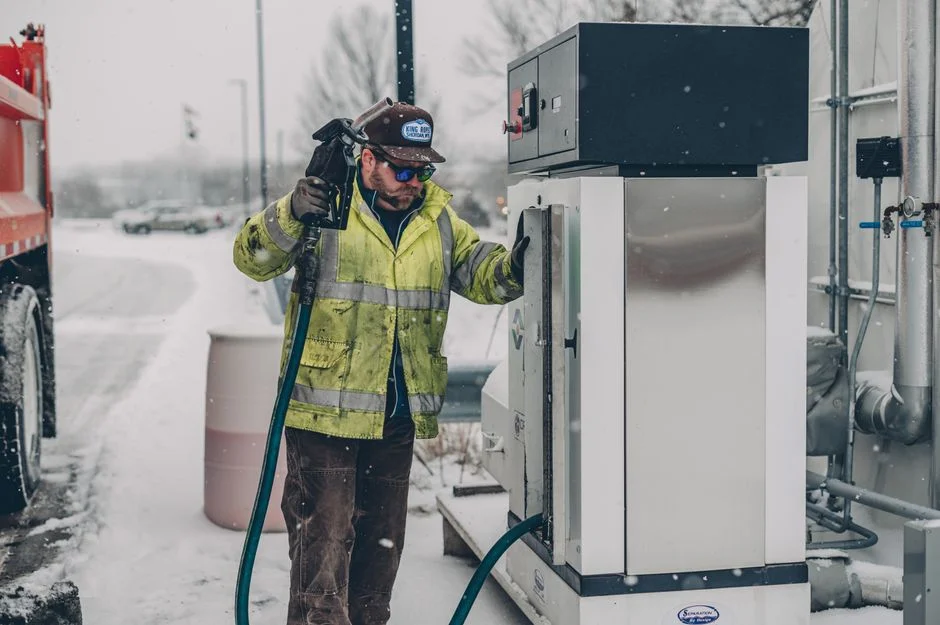
Winter operation is the variable no out-of-region article addresses. Kalamazoo sees 50–80 days per year below -10°C ambient, and an outdoor clarifier loses 20–40% of effective settling area to ice bridging and cold-water viscosity. A DAF can be fully enclosed, insulated, and housed indoors with the rest of the pretreatment train; a lamella clarifier can also be enclosed but the larger footprint makes housing more expensive. For any 2026 installation where the separator will not be in a heated structure, the housing penalty alone often flips the decision toward a DAF on a total-installed-cost basis.
2026 CAPEX and OPEX Ballpark for 50–300 m³/h Flows
The numbers below are 2026 ballpark ranges for skid-mounted, PLC-controlled systems installed in a chemical plant in the Midwest. They are not quotes — treat them as a budgeting envelope for an internal recommendation, then validate against vendor quotes for your specific materials of construction and effluent targets.
| Flow (m³/h) | DAF installed CAPEX (USD, 2026 ballpark) | Lamella Clarifier installed CAPEX (USD, 2026 ballpark) | DAF OPEX (% above clarifier baseline) |
|---|---|---|---|
| 50 | $180k–$280k | $120k–$190k | +20–30% |
| 100 | $280k–$420k | $180k–$280k | +25–35% |
| 200 | $480k–$700k | $320k–$480k | +30–40% |
| 300 | $650k–$950k | $450k–$650k | +30–40% |
DAF CAPEX scales with the air-saturation package, recycle pumps, and 304/316 stainless construction; lamella CAPEX is dominated by tankage and the plate pack, which is why it lands 30–50% below DAF at equivalent flow (per typical 2026 industrial vendor guidance). Modular two-skid DAF designs (the COMPACT-class architecture from SigmaDAF, applied above ~15 m³/h per skid) add redundancy for batch plants where one train can run while the other is in clean-in-place. DAF OPEX is 20–40% higher than a clarifier's because of the recycle pump, the regenerative-turbine aerator, and slightly higher polymer demand; the offset is that DAF sludge typically runs 3–6% dry solids vs 1–2% from a clarifier, which reduces downstream dewatering and hauling cost. Pair the separator with a HydropureWater plate and frame filter press to capture that downstream benefit.
For related process context, see our DAF vs clarifier buyer's guide for food and beverage wastewater and the POTW pretreatment compliance guide for petroleum plants; for ZLD and polishing context downstream of the separator, see this industrial process wastewater treatment article on ZLD and polishing.
Four-Question Screening Checklist Before You Sign a PO
Run these four questions against your influent data. Any "yes" that does not have a corresponding technology answer below is a flag to revisit the basis of design before you bid.
- Is FOG or emulsified oil the permit driver? If yes, specify DAF — clarifiers will not reliably hold FOG below 100–200 mg/L on an emulsion.
- Is inorganic TSS > 3,000 mg/L the dominant load, with FOG < 200 mg/L? If yes, a lamella clarifier is defensible, and a DAF is overspecified — but consider DAF + lamella polish if any batch swings toward emulsified material.
- Does feed flow vary by more than 2× batch-to-batch? If yes, DAF handles turndown better; a clarifier will either underflow on peak batches or sludge-blanket on low-flow nights.
- Is the separator going indoors or in a heated enclosure? If yes, DAF wins on compactness; if it must be outdoors in West Michigan, budget housing for either technology but expect the housing penalty to favor DAF on a total-installed basis.
Hand this list to procurement alongside your influent characterization. If three of the four point to DAF, you have a defensible single-technology spec; if two point each way, specify the hybrid DAF + lamella polish configuration and price both trains independently.
Frequently Asked Questions
How do you size a DAF for chemical emulsions at 50–300 m³/h?
Size the flotation cell for a hydraulic loading of 5–15 m³/m²/h and a recycle ratio of 20–40% (SigmaDAF sizing guidance, 2026). For emulsified chemical streams, target 30% of the design flow as recycle, run a jar test to confirm polymer dose, and verify with a 24-hour pilot before committing CAPEX.
When is a lamella clarifier enough for a chemical plant?
A lamella clarifier is enough when the stream carries < 200 mg/L FOG, > 3,000 mg/L settleable inorganic TSS, and stable flow with limited batch swings. Outside those bounds — especially when FOG exceeds 30% of the load — a clarifier alone will not hold permit.
Should a DAF and a lamella clarifier be used together for chemical wastewater?
Yes, for mixed streams with both emulsions and metal-bearing sludges: DAF primary removes FOG and fine TSS, then a lamella polish settles the denser inorganic fraction. This hybrid is the standard 2026 answer for complex chemical streams (Ecologix, 2026).
What permits apply to a DAF or clarifier installation in Kalamazoo in 2026?
Discharge to the City of Kalamazoo Water Reclamation Plant is governed by the local industrial pretreatment ordinance; state authority sits with EGLE (formerly MDEQ), and 40 CFR Parts 400–500 categorical standards may apply depending on SIC code. Confirm both the local FOG/TSS limits and the SIC-specific categorical standards before finalizing the design basis.