Data Center Cooling Blowdown Manchester Sites Face in 2026
For data center cooling blowdown Manchester projects, the usual train is screening, softening with side-stream filtration, high-recovery reverse osmosis at 75–95%, and concentrate dosing or crystallisation. Blowdown typically equals 20–25% of make-up volume alongside RO reject and humidifier bleed. United Utilities sewer discharge requires a trade-effluent consent covering temperature, pH, metals, and TDS.
Generic global guidance fails here because the water-use distribution is skewed. The joint techUK/Environment Agency survey of 73 England sites (published August 2025) found 51% of facilities already run waterless cooling, 64% consume under 10,000 m³/year, and only 4% exceed 100,000 m³/year (datacentrereview.com, 2025-08). That 4% band is where Manchester hyperscale builds sit. With the UK Government targeting a 20× increase in sovereign compute by 2030, regulators and United Utilities will scrutinise this high-use cohort first (datacentrereview.com, 2025-08).
techUK is pressing the Government to publish a Water Exploitation Index by river basin and to fast-track new reservoir capacity — none have been built at scale for over 30 years — and to act on the Independent Water Commission's Final Report (datacentrereview.com, 2025-08). For a Manchester engineer, that means consent limits will tighten basin by basin, not loosen. Pennine source water from United Utilities is moderately soft and cool, which helps cooling chemistry, but it sits inside the North West river-basin planning area where cumulative abstraction is already a live policy issue. Blowdown reuse is moving from a sustainability preference to a planning-permit expectation for any site above that 4% high-use threshold.
What a Manchester Data Centre Actually Discharges
Cooling tower blowdown (CTBD) is the controlled purge from an evaporative cooling loop: pure water leaves as vapour, and dissolved salts, silica, treatment chemicals, and corrosion by-products stay behind and concentrate in the circulating water (per ide-tech.com, 2026; per waterutilityreport.com, 2026-04-14). When dissolved-solids loading reaches a setpoint, operators bleed a side-stream — the blowdown — to keep scaling, microbiologically influenced corrosion, and biological fouling under control. CTBD is concentrated process water by design, not accidental contamination.
The headline ratio is cycles of concentration (CoC): at 4 CoC the blowdown is 25% of make-up volume; at 6 CoC it drops to 20% (genesiswatertech.com, 2026). A 10 MW evaporatively cooled facility can intake on the order of 15 million gallons (~57,000 m³) per month, of which roughly 25% leaves as blowdown (genesiswatertech.com, 2026). Most plants we size for Manchester carry more than CTBD alone. The full site water balance typically includes humidifier bleed from adiabatic/free-cooling modes, RO reject from make-up treatment, generator jacket-coolant and periodic test water, fire-system test drains, and the occasional emergency dump (extending waterutilityreport.com, 2026-04-14). Any of these can dominate the discharge profile on a given day.
Sizing the envelope in UK units: industry WUE sits at 0.47–0.65 gal/kWh = 1.8–2.5 L/kWh (genesiswatertech.com, 2026), so a 50 MW Manchester facility implies on the order of 80,000–130,000 m³/yr of contact water. The table below maps the main streams and their typical treatment destinations.
| Stream | Typical source on a Manchester site | Typical flow as % of make-up | Primary discharge route |
|---|---|---|---|
| Cooling tower blowdown (CTBD) | Evaporative chillers / cooling towers | 20–25% | Trade effluent consent to UU sewer; or RO reuse loop |
| Humidifier bleed | Adiabatic / direct-evaporation humidifiers | 5–10% | Trade effluent consent or on-site treatment |
| RO reject (make-up plant) | Brackish or softened RO producing demin make-up | 15–25% of RO feed | Trade effluent consent; can be blended with CTBD to RO |
| Generator coolant / test water | Diesel generator jackets, periodic test runs | Intermittent, small | Trade effluent consent; oil/water separator pre-treatment |
| Fire-system test drain | Sprinkler/deluge system flushes | Intermittent | Trade effluent consent; first-flush attenuation |
UK and England-Specific Compliance Drivers

Three consent layers stack on a Manchester site, and the equipment specification depends on which layer bites first.
The day-to-day layer is United Utilities' trade-effluent consent under the Water Industry Act 1991. Any discharge to foul sewer — the route almost every Manchester site will use — must have a consent with numeric limits on temperature (typically ≤ 43 °C), pH (typically 6–10), suspended solids, oils, heavy metals, and ammonia. In stressed sub-catchments United Utilities also caps volumetric discharge and may set a TDS ceiling. On-site recovery reduces both the consent fee (volume-weighted) and the risk of breaching a tightened limit (extending waterutilityreport.com, 2026-04-14).
The second layer is the Environmental Permitting (England and Wales) Regulations 2016, enforced by the Environment Agency. Direct discharges to surface water or groundwater need an EPR permit. Most Manchester sites route to sewer and avoid EPR 2016, but a hyperscale site that builds a cooling-water recycling loop with a brine bleed to a watercourse triggers permit review. The EA's Richard Thompson has tied future permitting to "evolving standards" and basin-level sustainability (datacentrereview.com, 2025-08), so even a sewer-discharging site should expect tighter renewal terms.
The third layer is policy direction. The Independent Water Commission's Final Report and techUK's call for a Water Exploitation Index by river basin are forward signals of stricter basin-level caps (datacentrereview.com, 2025-08). A February 2026 TNFD case study, cited by Water Utility Report, frames mismanaged blowdown as a source of salts, heavy metals, and pollutants — useful board-level language when justifying capital for reuse (per waterutilityreport.com, 2026-04-14).
Cooling Tower Blowdown Chemistry and Why Cycles of Concentration Matter
Cycles of concentration (CoC) is the ratio of dissolved solids in the circulating water to dissolved solids in the make-up. A loop running at 4 CoC has concentrated the dissolved minerals four-fold relative to what came out of the tap (genesiswatertech.com, 2026). Push the loop to 6 CoC and you get 6× concentration, but the blowdown fraction only drops from 25% to 20% of make-up — a 5-percentage-point or 20% blowdown reduction, not the 50% improvement engineers often quote (genesiswatertech.com, 2026).
Above 5–6 CoC the operational risk curve steepens. Scaling on heat exchangers, microbiologically influenced corrosion (MIC), and biological fouling all rise sharply without advanced chemistry or physical treatment to keep surfaces clean (genesiswatertech.com, 2026). CTBD is enriched in sparingly soluble salts — silica, calcium carbonate, calcium sulfate — and these compounds set the recovery ceiling for any downstream membrane system (per ide-tech.com, 2026). That is also why conventional brackish-water RO (BWRO) caps out at 75–80% recovery on CTBD before scaling becomes unmanageable (ide-tech.com, 2026). Any process-train design that claims higher recovery without addressing the silica and calcium chemistry is selling a future clean-in-place problem.
How Do High-Purity Water Systems Serve Data Center Cooling?
High-purity water systems for data center cooling produce demineralised make-up and polish recovered blowdown so the loop can hold target CoC without runaway scale. Softened or RO-treated make-up lowers hardness and silica load entering the tower. Recovered permeate from a blowdown RO train with silica around 1 mg/L can re-enter the make-up header as cooling-tower feed (ide-tech.com, 2026).
Closed-loop chilled-water circuits and evaporative towers share different purity targets. Closed loops mainly need corrosion control and low particulate loading. Evaporative towers need continuous blowdown control plus make-up quality that supports the chosen CoC. Water treatment for data center cooling towers in closed-loop and hybrid plants therefore mixes softening, side-stream filtration, RO, and biocide dosing rather than a single unit operation.
Most plants we size for the 20–50 MW band run make-up RO at the lower end of the recovery range until silica and calcium chemistry are confirmed on site water. Specifying a single nominal recovery point without a documented curve across the expected silica and calcium range is the fastest way to lock in CIP downtime later.
Recommended Process Train for a Manchester Hyperscale Site
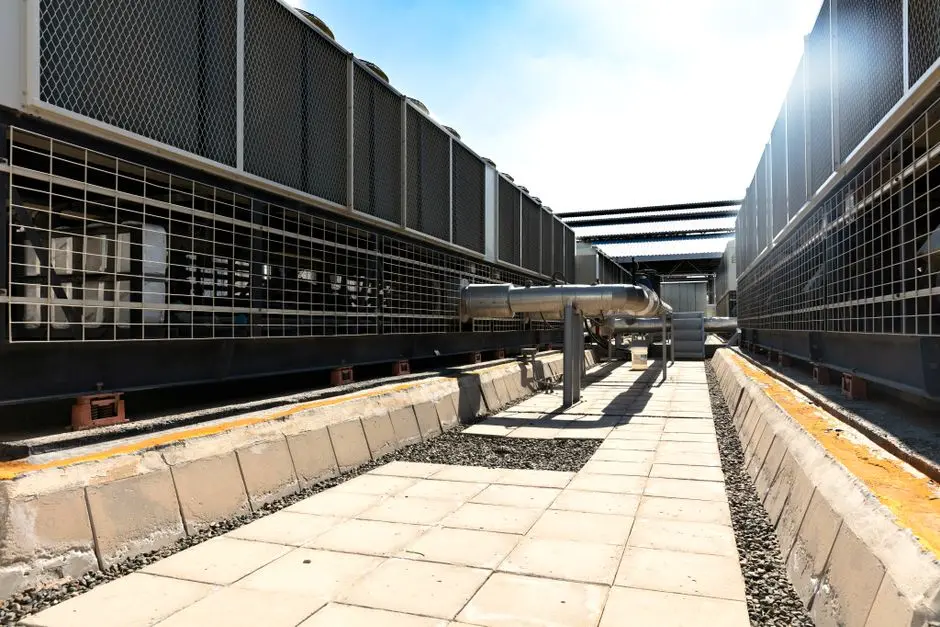
For a 20–50 MW Manchester site the following five-stage train is the minimum defensible specification. Stages 1–3 deliver reuse-grade water for cooling-tower make-up; Stages 4–5 handle the concentrate and protect the loop biologically.
Stage 1 — pre-treatment. A rotary bar screen on the raw blowdown sump removes gross debris and protects downstream membranes and pumps; for a 20–50 MW site with blowdown in the 5–15 L/s range per tower, a 1–2 mm aperture self-cleaning strainer is typical.
Stage 2 — softening and side-stream filtration. Lime/soda or ion-exchange softening drops calcium and alkalinity, and a multi-media filtration skid brings the Silt Density Index (SDI) below 3 ahead of the RO — the standard gate for stable membrane operation (extending genesiswatertech.com, 2026; ide-tech.com, 2026).
Stage 3 — high-recovery reverse osmosis. Conventional BWRO tops out at 75–80% recovery (ide-tech.com, 2026). A chemistry-managed train that pairs RO with a seeded-crystallisation reactor, or dynamic RO cycling, reaches ~95% recovery with permeate silica around 1 mg/L — directly reusable as cooling-tower make-up (ide-tech.com, 2026). The high-recovery RO system should be specified with a documented recovery curve across the expected silica and calcium range, not a single nominal point.
Stage 4 — concentrate management. Route the high-TDS reject to sewer under trade consent, or to a crystalliser/evaporator for sites where sewer capacity, consent volume caps, or planning constraints rule out a liquid discharge (saltworkstech.com, 2026). A PLC-controlled chemical dosing skid ties antiscalant, pH correction, and biocide feed into the RO cleaning cycles.
Stage 5 — disinfection. An on-site chlorine dioxide generator provides on-demand microbial control for both the cooling loop and the recycled water, avoiding the persistent halogenated by-products associated with bulk chlorine dosing. The table summarises stage, target parameter, and typical UK operating point.
| Stage | Equipment | Target parameter / KPI | Typical UK operating point |
|---|---|---|---|
| 1 | Rotary bar screen / self-cleaning strainer | Aperture, debris capture | 1–2 mm aperture, 5–15 L/s per tower |
| 2 | Softener + multi-media filter | SDI to RO | SDI ≤ 3; Ca²⁺ reduced to ≤ 20 mg/L as CaCO₃ |
| 3 | High-recovery RO (with crystallisation) | Recovery, permeate silica | 75–95% recovery; permeate SiO₂ ≈ 1 mg/L |
| 4 | Chemical dosing + concentrate routing | Antiscalant dose, discharge consent | Antiscalant 2–5 mg/L; TDS to sewer per UU consent |
| 5 | Chlorine dioxide generator | Residual ClO₂, microbial count | 0.1–0.5 mg/L residual; TVC ≤ 10³ CFU/mL |
How Effective Is Data Center Water Recycling?
Data center water recycling effectiveness on evaporative sites is set by membrane recovery and the CoC the loop can hold. Conventional BWRO recovers 75–80% of CTBD before silica and calcium scale dominate; chemistry-managed high-recovery trains reach about 95% with permeate silica around 1 mg/L (ide-tech.com, 2026). At 60% blowdown recovery on a 15 MW UK reference case, recovered volume sits on the order of millions of cubic metres per year when WUE is 1.8–2.5 L/kWh (genesiswatertech.com, 2026).
Effectiveness is not only a recovery percentage. Sites that raise CoC from 4 to 6 cut blowdown from 25% to 20% of make-up — a 5-percentage-point change — while concentrating sparingly soluble salts that punish membranes if pretreatment is weak (genesiswatertech.com, 2026). Recycling that ignores humidifier bleed, RO reject, and intermittent generator test water understates peak discharge and overstates reuse uptime.
For Manchester hyperscale projects above the 4% high-use band identified in the techUK/EA survey, recycling also reduces volume-weighted trade-effluent fees and planning risk under basin-level scrutiny (datacentrereview.com, 2025-08). Sub-5 MW colocation rooms rarely justify the same train: operator load and payback both argue for modular physical separation plus polishing instead of full RO plus ion exchange (genesiswatertech.com, 2026). Capex planning for data center cooling blowdown Manchester campuses should therefore split hyperscale RO trains from colo polishing packages early in FEED.
Designing for Manchester's Source Water and Climate
United Utilities surface water from the Pennines is moderately soft (typically 30–60 mg/L as CaCO₃ hardness) and cool year-round. That chemistry lowers scaling tendency in the cooling loop, but low-mineralised water is also more corrosive to ferrous metallurgy, so the chemistry programme should bias toward corrosion inhibitors rather than relying on scale-inhibitor residuals alone (extending genesiswatertech.com, 2026).
Manchester's mean annual air temperature is roughly 10 °C, which means free-cooling and adiabatic modes are usable for a larger fraction of the year than in warmer markets. The practical effect is a proportionally lower blowdown volume, because less evaporative heat rejection is needed in winter. The caveat is that humidifier bleed and adiabatic flushes can spike during summer heat events, and a real water balance should be modelled month by month, not from an annual average.
Combined-sewer overflow (CSO) risk in the Manchester catchment rises during storm events. On-site attenuation, or first-flush reuse for non-critical loops, is a positive at planning — the EA's basin-level thinking rewards sites that do not push peak discharge into the public sewer at the wrong hour.
Capital Cost, Operating Cost, and ROI for a Manchester 15 MW Reference Case
Adapting the 15 MW U.S. reference case to UK units and price points: a 15 MW Manchester site running evaporative cooling at typical UK WUE of 1.8–2.5 L/kWh (genesiswatertech.com, 2026) and 60% blowdown recovery implies on the order of 3 million m³/yr of recovered water. At UK modular-skid pricing, CAPEX falls in the order-of-magnitude band of £150,000–250,000 for a two-stage blowdown treatment skid sized to the site. Water savings alone at typical United Utilities non-domestic rates give a simple payback of about 6.7 years (adapted from genesiswatertech.com, 2026).
The honest payback sits between 3 and 5 years once avoided costs are included: United Utilities trade-effluent consent charges (volume-weighted), sewer discharge volume fees, the implicit water-stress risk premium for any site above the 4% high-use band (datacentrereview.com, 2025-08), and lower Legionella control cost because the loop runs at a more stable biological loading (extending genesiswatertech.com, 2026). One scale rule worth stating: full RO plus ion-exchange trains need dedicated operators and typically do not repay below 50 MW (genesiswatertech.com, 2026). For sub-5 MW Manchester colocation sites, modular physical separation plus targeted polishing is the right answer, not a hyperscale RO train imported from another market. The cost breakdown below is for a 15 MW reference case.
| Cost line | Order-of-magnitude value (15 MW, UK) | Notes |
|---|---|---|
| CAPEX — modular two-stage blowdown skid | £150,000–250,000 | Sized for 60% recovery; includes dosing skid |
| OPEX — chemicals & membranes | £15,000–25,000/yr | Antiscalant, CIP chemicals, membrane replacement at 5–7 yr cycle |
| Avoided water cost | £30,000–45,000/yr | 3 million m³/yr × United Utilities non-domestic rate band |
| Avoided trade-effluent consent & discharge fees | £10,000–20,000/yr | Volume-weighted; site-specific |
| Simple payback (water only) | ~6.7 years | Direct water savings |
| Adjusted payback (with avoided costs) | 3–5 years | Includes consent fees, risk premium, Legionella control saving |
Implementation Checklist for a Manchester Project in 2026
- Baseline the water balance. Install metering on make-up, blowdown, evaporation, and discharge; expect real blowdown to run 15–30% above theoretical because of unmeasured losses and emergency dumps (genesiswatertech.com, 2026). Without a metered baseline, any reuse business case is guesswork.
- Lock in permits early. Pre-engage United Utilities for trade-effluent consent, confirm EPR 2016 position with the Environment Agency, and record the Water Exploitation Index basin score once the Government publishes it (datacentrereview.com, 2025-08).
- Fix the process targets before the equipment. Define target cycles of concentration, recovery rate, and reuse end-use before selecting a process train; choose a design that lets CoC climb without chemical overload (genesiswatertech.com, 2026).
- Right-size to the MW class. Match the train to the site's operational capacity — full RO/ion-exchange needs dedicated operators and typically does not repay below 50 MW; sub-5 MW colocation sites should default to modular physical separation and targeted polishing (genesiswatertech.com, 2026).
- Model peak months, not annual averages. Manchester free-cooling lowers winter evaporative load, but summer humidifier bleed and adiabatic flushes can dominate the discharge envelope on hot days.
- Document the recovery curve. Require silica and calcium envelopes with the RO bid package so 75–95% recovery claims are tied to chemistry, not a single nameplate point (ide-tech.com, 2026).
- Plan concentrate routing with UU. Confirm sewer capacity, TDS ceilings, and volume caps before locking crystalliser versus sewer discharge for the RO reject.
Who this is for: EPC and owner-engineers designing 20–50 MW+ evaporative Manchester campuses that sit in the high-use cohort and need trade-effluent consent plus reuse-grade make-up. Who should look elsewhere: air-cooled or fully waterless halls, and sub-5 MW colo rooms that will not repay a full RO/ion-exchange staffed train. Next step: send the site water balance, CoC target, and UU consent draft limits with a scoped inquiry via request a blowdown treatment quote so the skid recovery band can be matched to silica and calcium before bid drawings freeze.
Frequently Asked Questions
What permits does a Manchester data centre need for cooling tower blowdown discharge?
Any discharge to foul sewer requires a trade-effluent consent from United Utilities, with numeric limits on temperature (typically ≤ 43 °C), pH (6–10), suspended solids, oils, and metals, and sometimes a TDS or volume cap. Direct discharges to surface water or groundwater need an Environment Agency permit under EPR 2016. Most Manchester campuses avoid EPR by routing to sewer, but brine bleeds to a watercourse still trigger permit review (per waterutilityreport.com, 2026-04-14; datacentrereview.com, 2025-08).
How much blowdown does a typical data centre produce?
At 4 cycles of concentration the blowdown is 25% of make-up volume, dropping to 20% at 6 CoC — a 5-percentage-point reduction, not 50% (genesiswatertech.com, 2026). A 10 MW evaporatively cooled facility can intake on the order of 57,000 m³/month, of which roughly 25% leaves as blowdown (genesiswatertech.com, 2026). Real sites also carry humidifier bleed and RO reject that can dominate peak days.
Can blowdown be reused as cooling tower make-up?
Yes. High-recovery RO with seeded-crystallisation or dynamic cycling reaches about 95% recovery with permeate silica around 1 mg/L — directly reusable as cooling-tower make-up (ide-tech.com, 2026). Conventional BWRO alone is limited to 75–80% recovery on CTBD before scaling becomes unmanageable (ide-tech.com, 2026). Pretreatment that holds SDI ≤ 3 is the usual gate before the membranes.
Does a sub-5 MW colocation site in Manchester need a full RO reuse train?
No. Hyperscale RO plus ion-exchange trains need dedicated operators and typically do not repay below 50 MW (genesiswatertech.com, 2026). For sub-5 MW Manchester colocation sites, modular physical separation (media filtration, DAF) plus targeted polishing is the right scale match. Capex in the £150,000–250,000 modular band is aimed at larger evaporative campuses, not micro rooms.
How should closed-loop cooling tower water treatment be specified?
Closed-loop and hybrid data center cooling systems need corrosion control, side-stream filtration, and biocide residuals sized to the metallurgy and free-cooling calendar. Evaporative sections still need blowdown control at 20–25% of make-up at 4 CoC. Match purity targets to end use: demin make-up for towers, lower particulate specs for closed chilled water, and a documented CoC ceiling before antiscalant dose is locked.