Why Orlando Transportation Equipment Plants Are Rethinking Clarifiers in 2026
Orlando transportation equipment factories — auto parts stamping, aerospace component machining, and final vehicle assembly — generate a wastewater mix that conventional gravity clarifiers were never designed to handle. The dominant loads are not heavy settleable grit; they are emulsified oils from parts-washer baths, fats and lubricants from assembly, semi-synthetic cutting fluids from CNC operations, and phosphate from conversion-coating and pre-paint lines. Periodic slug discharges from batch cleaning and paint-booth dump events push FOG spikes well above routine baseline.
The City of Orlando Industrial Pretreatment Program enforces FOG limits in the 100–200 mg/L range at the discharge sampling point, and surcharges for elevated FOG or TSS arrive on every exceedance — a working reality for plants still relying on settling clarifiers that physically cannot lift emulsified droplets with specific gravity near 1.0. A settling vessel depends on density differential; when the contaminant is lighter than water or stabilized by surfactant, no amount of residence time produces clean overflow. Add the tighter 2026 enforcement posture and rising Florida biosolids tipping fees, and the clarifier's economic case collapses well before its mechanical one does. EPA pretreatment standards for FOG and the EU Urban Waste Water Directive 91/271/EEC (cited in industry guidance, 2025) both push operators toward technologies that deliver consistent effluent under variable loads — a description that fits DAF far better than gravity settling.
How a DAF Clarifier Works (and How a Conventional Clarifier Differs)
A DAF clarifier separates contaminants by buoyancy rather than settling. Coagulant (typically ferric chloride or polyaluminum chloride) and a cationic or anionic polymer are dosed at 0.5–5 mg/L into a flocculation chamber, where velocity gradients near 70 s⁻¹ build a discrete floc. A side-stream recycle of clarified effluent — 20–40% of forward flow — is pressurized to 4–6 bar in a packed saturator (85–95% saturation efficiency), then released through a nozzle array into the flotation cell. The pressure drop generates 20–100 µm micro-bubbles that attach to floc and oil droplets, lifting them at 5–15 m/h to the surface where a mechanical skimmer removes the float (per industry DAF engineering guidance, 2025).
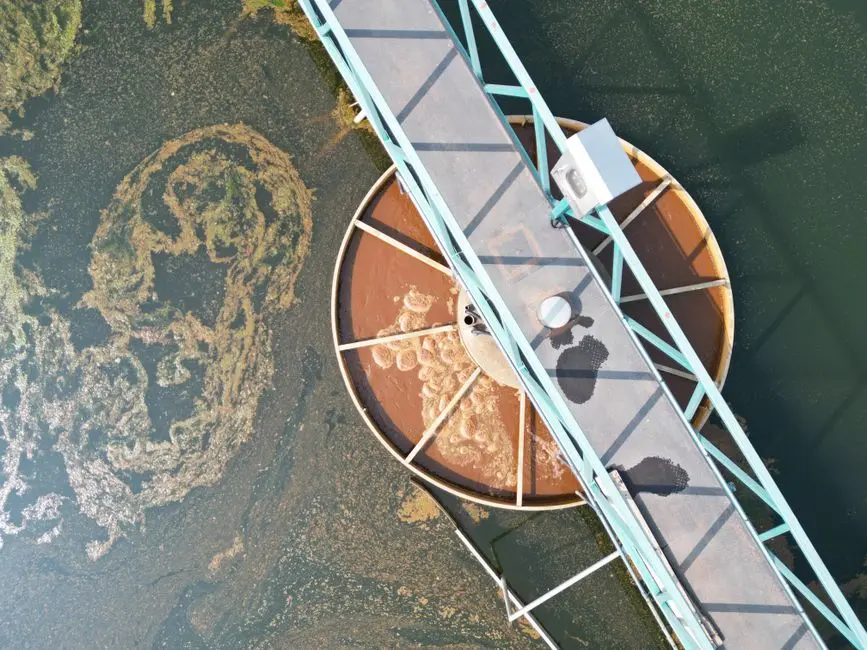
A conventional clarifier inverts that logic. Coagulated water enters a large quiescent basin, retains for 2–4 hours, and relies on gravity to drop solids to a bottom scraper while surface scum exits over a weir. Removal depends on particle specific gravity being meaningfully above 1.0; for light or emulsified matter this simply does not happen within a practical footprint. The high-rate lamella clarifier is the engineering middle ground: inclined plates at 55–60° steepen the effective settling area, pushing hydraulic loading to 20–40 m/h and retention down toward 60–90 minutes, while still relying on gravity separation.
The single most important control variable on a DAF is the air-to-solids (A/S) ratio, held between 0.005 and 0.06 mL of air per mg of suspended solids. Below that band, bubbles are too few to lift the floc; above it, turbulence shears the floc and the float blanket destabilizes. On a settling clarifier, the equivalent "control variable" is simply time — and time is the commodity an Orlando plant never has enough of when a 6,000 L parts-washer dump hits at 10:30 a.m.
Head-to-Head Comparison: DAF vs Conventional Clarifier for Transportation Equipment Wastewater
For light, emulsified, or phosphate-laden streams, the trade-offs are stark enough that one table settles the question. The numbers below come from DAF engineering guidance (2025) and operational data across food, metalworking, and transportation pretreatment applications.
| Parameter | DAF Clarifier | Conventional / Lamella Clarifier |
|---|---|---|
| TSS removal (light, emulsified streams) | 92–97% | 50–70% |
| FOG removal | >95% | 30–50% |
| Hydraulic loading rate | 5–15 m/h conventional; up to 40 m/h high-rate | 1–2 m/h (conventional); 20–40 m/h (lamella) |
| Footprint for same flow | Baseline | ~4–5× larger for conventional; ~2× for lamella |
| Hydraulic retention | 15–30 minutes | 2–4 hours (conventional); 60–90 min (lamella) |
| Sludge solids concentration | 3–5% (float) | 1–2% (underflow) |
| Sludge volume reduction vs clarifier | 50–70% less hauled | Baseline |
| Energy use | 0.2–0.5 kWh/m³ | 0.05–0.15 kWh/m³ (mostly pumping) |
| Polymer demand | 0.5–5 mg/L (typically required) | Often coagulant-only sufficient |
| CAPEX (4–300 m³/h) | $50,000–$500,000 (2025) | Lower equipment cost; higher civil works |
| OPEX drivers | Higher energy + chemical, partly offset by sludge savings | Lower energy; higher sludge hauling |
| Tolerance to slug loads | Active aeration adapts via recycle and A/S tuning | Passive vessel — surges pass through to effluent |
Read across the FOG and TSS rows first. A 30–50% FOG removal on a parts-washer feed of 800 mg/L FOG leaves 400–560 mg/L in the overflow — roughly twice the City of Orlando surcharge trigger. A DAF at 95% leaves 40 mg/L, comfortably below the limit. The footprint row explains why: DAF hits 5–15 m/h versus 1–2 m/h for a conventional clarifier, so the same 100 m³/h flow fits in roughly 20–25% of the basin area. Sludge economics close the loop: a 3–5% float versus a 1–2% underflow is the difference between one hauling trip and three for the same dry-solids mass.
Match the Technology to Your Waste Stream: Decision Framework for Orlando Plants
For most Orlando transportation equipment plants, the choice is not DAF or clarifier — it is whether to run DAF alone, a settling clarifier alone, or a hybrid. The matrix below translates the table above into a rule an operations manager can apply during a Friday afternoon review.
| If your waste stream looks like this… | …choose |
|---|---|
| FOG >100 mg/L, emulsified oils, batch parts-washer discharges | DAF primary |
| Paint-booth water, phosphate from conversion coating | Chemical precipitation → DAF polishing |
| Heavy grit, metal shavings, inorganic TSS >1,000–2,000 mg/L | Lamella or conventional clarifier primary |
| Steady flow, FOG <50 mg/L, mostly settleable fines | Lamella clarifier (high-rate, lower CAPEX) |
| Combined grit removal + FOG/emulsified polishing above ~50 m³/h | Hybrid: lamella primary → DAF secondary |
The hybrid configuration is the workhorse for Orlando plants above roughly 50 m³/h: a lamella clarifier drops the heavy inorganic load cheaply, and a DAF polishes the emulsified FOG and colloidal fraction to compliance. The DAF range covers 4–300 m³/h across 13 standard models, which lines up with virtually every discrete parts plant and tier-2 supplier in the metro. For phosphate-bearing conversion-coating effluent, chemical precipitation with alum or PAC followed by DAF is the standard treatment train — the DAF stage captures the metal-phosphate floc before it reaches the sewer. For a deeper look at the broader pretreatment picture (BOD polishing, biological steps, sludge dewatering downstream of the clarifier or DAF), the 2026 BOD removal technology comparison covers the next unit operation in the train.
2026 ROI Example: 100 m³/h Transportation Parts Plant in Orlando
Baseline: a 100 m³/h, two-shift Orlando parts plant is running an aging settling clarifier. FOG excursions have triggered four surcharge events in the past year, totaling roughly $15,000 in surcharges and consent-order fees. Annual sludge hauling runs about $40,000 on 1–2% underflow solids.
Capital: a DAF skid sized for 100 m³/h — SS304 construction, PLC-controlled polymer dosing, automatic skimmer — falls in the $180,000 band of the $50,000–$500,000 published CAPEX range (per 2025 DAF engineering guidance for the 4–300 m³/h class).
Operating costs: at 0.35 kWh/m³ (mid-band), 6,000 operating hours per year, and a Florida average commercial electricity rate of $0.11/kWh, energy alone is roughly $23,000/year. Polymer at a typical 2 mg/L dose runs about $8,000/year. Total DAF OPEX: ~$31,000/year.
Savings: a 60% reduction in sludge volume at 3–5% float solids versus 1–2% underflow cuts hauling from $40,000 to roughly $16,000 — about $24,000/year saved. Adding the avoided $15,000 in FOG surcharges yields $39,000/year in direct benefit. Net annual benefit against incremental OPEX ($31,000 DAF OPEX versus the small clarifier OPEX it replaces) is in the $25,000–$30,000/year range, putting simple payback at roughly 5–6 years on direct dollars — and under 5 years once consent-order risk and shutdown-avoidance value are priced in.
For plants with a heavier FOG load (closer to a food processor than an auto parts stamper), published ROI bands drop to 1.5–3 years (per 2025 DAF engineering guidance). Transportation plants sit in the longer-payback end because their FOG load is intermittent rather than continuous, but compliance-risk premium and the option to recycle DAF polish water back into parts-washer rinses tighten the number further. The full DAF clarifier selection spans 13 models from 4 m³/h to 300 m³/h to match whatever flow a 2026 capacity audit turns up.
Installation, Operations, and Maintenance Considerations in Orlando
Most DAF underperformance traces back to three preventable O&M gaps. First, screening: a rotary mechanical bar screen upstream is non-negotiable for protecting saturator nozzles and recycle pumps from plant rag and wipes — a clogged nozzle drops the A/S ratio faster than any chemical tweak can recover. Second, pH control: most cationic and anionic polymers used in DAF need pH 6.5–8.5 to build a floc strong enough to ride the bubble plume; quarterly jar testing keeps the dose and charge matched to the actual waste mix. Third, water chemistry: Central Florida's hard water scales saturator internals and nozzles monthly, so descaling intervals should be on the maintenance calendar, not discovered after float quality drops.
Specify SS316 for skimmer blades, fasteners, and any wetted bracketry — Florida humidity accelerates SS304 corrosion at the air-water interface. Skimmer blades warrant weekly visual inspection; annual calibration of pressure transmitters, recycle flow meters, and the streaming-current sensor (if fitted) is the minimum data-quality bar for any NPDES reporting. For a high-rate lamella clarifier in the hybrid train, the O&M focus shifts to plate inspection for fouling or biofilm, plus sludge pump reliability — the lamella concentrates everything into a smaller pump that cannot afford to miss a cycle. Pair the DAF or lamella with a PLC-controlled polymer dosing skid tied to flow-proportional pacing; manual dose adjustment is the most common root cause of cloudy-day excursions in 2026 field data. For a peer perspective on U.S. transportation equipment compliance practice outside Florida, the 2026 transportation equipment pretreatment compliance guide and the foundry and metal-finishing sludge dewatering guide cover complementary unit operations downstream of the clarifier or DAF.
Frequently Asked Questions
When is a conventional clarifier still the right choice for an Orlando transportation plant?
Choose a conventional or lamella clarifier when the dominant load is heavy, settleable inorganic solids — grinding swarf, metal shavings, foundry grit above 1,000–2,000 mg/L TSS — and FOG is consistently below 50 mg/L. In that envelope a lamella clarifier delivers 20–40 m/h hydraulic loading at lower CAPEX than DAF, and the DAF microbubble stage is not needed.
What is the typical 2026 ROI for a DAF system on transportation equipment wastewater?
For high-FOG industries the published ROI band is 1.5–3 years (per 2025 DAF engineering guidance). For a 100 m³/h Orlando parts plant with intermittent FOG excursions, a worked calculation lands at roughly 5–6 years on direct hauling-plus-surcharge savings, dropping under 5 years once compliance-risk and shutdown-avoidance value are included. Sensitivity is dominated by local sludge tipping fees and electricity rate.
Can DAF handle phosphate from conversion coating and paint-booth water?
Yes — but only after chemical precipitation. Dose PAC or alum to precipitate phosphate, flocculate with polymer, then send the conditioned stream through a DAF. This train reliably drops total phosphorus low enough to meet most Orlando-area industrial discharge limits, and the DAF float captures the metal-phosphate floc rather than letting it bleed into the sewer.
What flow rate justifies a hybrid lamella → DAF configuration?
Workshop judgment places the hybrid payback crossover around 50 m³/h. Below that, a single DAF sized for the full stream is usually simpler and cheaper. Above 50 m³/h, the lamella takes the cheap heavy-solids removal and the DAF polishes the emulsified fraction, with the 3–5% float sludge cutting hauled volume by roughly 50–70%.
How much polymer does a DAF actually consume on a parts-washer feed?
Typical DAF polymer demand sits between 0.5 and 5 mg/L (per 2025 DAF engineering guidance), with 1–3 mg/L being the common operating range for emulsified oils and parts-washer effluent. Quarterly jar testing against the actual mixed influent — not the cleanest or dirtiest shift — is the only reliable way to pin the dose.