
Why EV Assembly Plant Wastewater Is Its Own Engineering Problem
Volkswagen treats wastewater at its EV assembly plants using a multi-stage train: source separation of paint-shop, phosphating, and oily streams; physico-chemical pretreatment; an activated-sludge biological stage designed for phenolic-bearing effluent (documented at VW-Navarra in collaboration with the University of Navarra); followed by tertiary polishing and reuse — including a 2023 MDPI Water study evaluating treated effluent as feedstock for green hydrogen via Solid Oxide Electrolysis Cells (Maddaloni et al., 2023, DOI 10.3390/w15142569).
An EV assembly plant is not a generic industrial site, and treating it like one produces overloaded biology, foaming aeration tanks, and discharge violations. The wastewater comes from at least four segregated streams: paint-shop blowdown (phenolics, surfactants, VOCs, typically COD 1,000–5,000 mg/L with phenolics 50–500 mg/L); phosphating and E-coat rinse water (zinc, nickel, manganese, fluoride, pH 2–4); general oily water from body-shop machines and floor wash; and domestic sewage. EV-specific additions — battery module electrolyte traces and dry-room humidification condensate — add a small but novel load, but painting and phosphating still dominate the mass balance.
VW's 1997 platform strategy (Wilhelm, Springer, DOI 10.1007/978-3-642-60374-7_12) standardized production across the VW, Audi, Seat, and Skoda brands. That same logic applies to utility systems: a Tier-1 OEM reuses a reference design and adapts it, rather than reinventing the treatment train at every new plant.
Source Separation: The First Engineering Decision
VW's treatment train starts at the shop floor, not at the wastewater plant. The first engineering decision involves determining which streams are kept apart on their way to the central plant. Phenolic-bearing paint-shop blowdown is segregated because mixing it with phosphating effluent shifts pH and metal speciation, which destroys the biology downstream. Phosphating rinse water — high in zinc, nickel, and manganese, and at pH 2–4 — is kept in a dedicated neutralization loop until metals are precipitated, because zinc at >10 mg/L will inhibit nitrification and poison heterotrophs. Oily body-shop water is collected separately so a industrial DAF system for oily automotive wastewater can strip free oil before it emulsifies into the biological tank.
The University of Navarra's VW-Navarra research page documents that the plant coordinates environmental work across the Painting, Environment, and Prevention Service departments (en.unav.edu, Chair business Volkswagen). That organizational structure mirrors the segregation philosophy: each shop owns its stream and its pretreatment, then hands a defined-quality effluent to the central biological stage.
| Stream | Source | Key Contaminants | Typical Influent Range | First Treatment Step |
|---|---|---|---|---|
| Paint-shop blowdown | Painting, electrodeposition rinse | Phenolics, surfactants, VOCs, COD | COD 1,000–5,000 mg/L; phenolics 50–500 mg/L | Equalization + biological |
| Phosphating rinse | Pre-treatment line | Zn, Ni, Mn, F⁻, low pH | pH 2–4; Zn 20–100 mg/L | pH correction + precipitation |
| Body-shop oily water | Stamping, machining, floor wash | Free and emulsified oil, TSS | Oil 200–2,000 mg/L; TSS 500–3,000 mg/L | DAF |
| Domestic sewage | Offices, canteen, locker rooms | BOD, ammonia, pathogens | BOD 200–400 mg/L; NH₃-N 20–50 mg/L | Screening + biological |
Source separation allows the biological stage to function effectively. Each stream receives tailored pretreatment before recombination, which is why a VW-class plant runs four pretreatment chains feeding two or three biological reactors rather than a single mixed influent.
Pretreatment: DAF, Equalization, and pH Correction
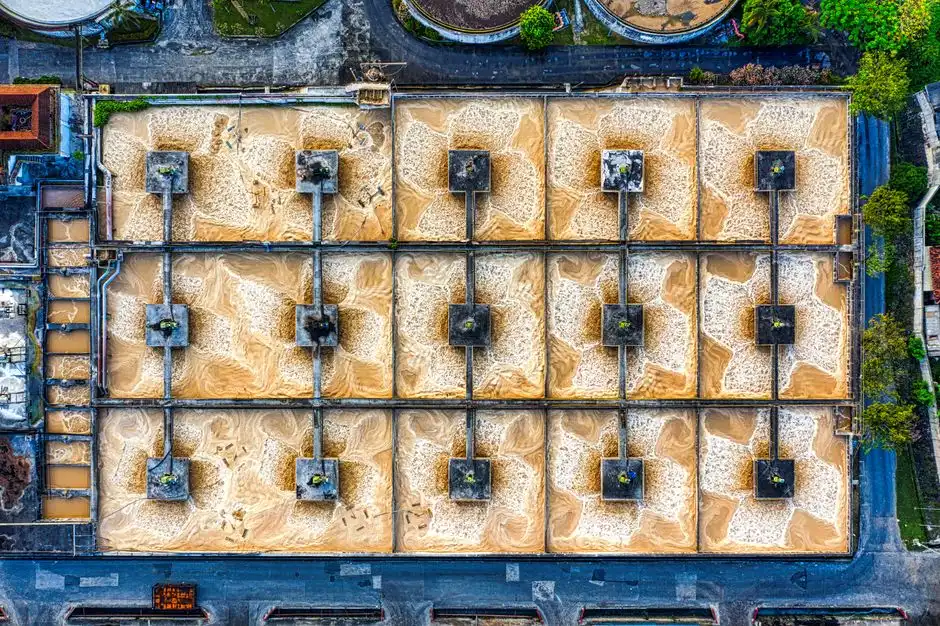
Standard hardware sits between the shop floor and the bioreactor: a dissolved air flotation unit, equalization basins, a PLC-controlled coagulant and pH dosing skid, and a rotary bar screen at the head of the plant for gross solids. The DAF handles oil, grease, and suspended solids from body-shop and general oily streams; it also serves as a polishing step for paint-shop overflow carrying entrained pigment solids. Equalization dampens the slug load from batch painting and prevents hydraulic shocks to the aeration basin.
pH correction is the most failure-prone step in a VW-class train. Phosphating rinse water arrives at pH 2–4 and must be lifted to 6.5–7.5 before it can be blended with paint-shop effluent and fed to biology. Lime or caustic dosing is the default; the skid must handle both acid and alkaline streams because the equalization tank receives both. Chemical dosing is a standard packaged step — coagulant (typically polyaluminum chloride at 50–200 mg/L) and flocculant (PAM, 1–5 mg/L) are dosed ahead of the DAF or a downstream lamella clarifier to capture colloidal paint solids that would otherwise bleed through and foul the membranes in any downstream MBR.
The Biological Stage: Activated Sludge Tuned for Phenolic Effluent
The biological stage is the technical heart of a VW plant, specifically the work conducted at VW-Navarra with the University of Navarra. The research portal lists a project that investigated the operational feasibility of an activated sludge bioreactor fed with phenolic effluent from VW-Navarra and examined the behavior of industrial effluent presenting relevant ionic strength before conventional (biological) and advanced (photooxidation) treatment (Principal Investigators: Mabel Rodríguez and Paz Morer, TECNUN; VW-Navarra coordinator: Ana Moreno, Environment). That project provides the published framework for how VW manages its phenol-loaded stream biologically rather than shipping it off-site as hazardous waste.
The mechanism utilizes acclimatized heterotrophic biomass using phenolics as a primary carbon and energy source. Acclimatization typically takes 2–4 weeks of stepped feed increase, after which phenolics removal above 95% is achievable on a once-through basis. Key operating parameters for an automotive paint-shop activated sludge system are MLSS 3,000–5,000 mg/L, HRT 12–36 h, F/M ratio 0.1–0.3 kg BOD/kg MLSS·d, DO 2–4 mg/L, and pH 6.5–7.5. Sludge age is held at 20–40 days to retain the slow-growing phenol-degrading population. The study compared this conventional train with advanced photooxidation (UV/H₂O₂ and photo-Fenton) — useful as a polishing step for residual phenolics when the discharge limit is tight, but not economical as the primary reduction step.
| Parameter | Typical Operating Range | Design Notes |
|---|---|---|
| MLSS | 3,000–5,000 mg/L | Higher end improves phenolics removal but hurts settling |
| HRT | 12–36 h | 24 h is a common baseline for paint-shop blend |
| F/M ratio | 0.1–0.3 kg BOD/kg MLSS·d | Lower ratio favours phenolic degradation |
| DO | 2–4 mg/L | Below 2 mg/L, phenolics removal collapses |
| SRT | 20–40 days | Retains slow-growing phenol-degraders |
| Phenolics influent | 50–500 mg/L | Target effluent: <0.5 mg/L for discharge, <0.1 mg/L for reuse |
Modern plants often replace the clarifier with an MBR membrane bioreactor using a submerged PVDF membrane module with a pore size below 1 μm. An MBR decouples biomass retention from hydraulic retention, runs at MLSS 8,000–12,000 mg/L, and pushes effluent TSS below 1 mg/L, allowing the downstream tertiary stage to be sized for dissolved solids only. For phenol-bearing paint streams, an MBR provides a safety margin: if a slug load escapes acclimatization, the membrane retains the biomass in the tank, shortening recovery time.
Tertiary Polishing and the Reuse Loop
Water passes through tertiary polishing following the biological stage. A typical VW-class train runs multi-media filtration (sand + anthracite + garnet) to reduce residual TSS, then disinfection — most commonly on-site generated chlorine dioxide from a chlorine dioxide generator, or ozone where residual chlorine is a concern for the receiving system. Multi-media filtration handles the bulk of residual particulates, while a polishing multi-media filter downstream of an MBR serves as a guard filter for RO pretreatment.
Reuse is the strategic direction for these facilities. Treated effluent is currently sent to cooling-tower make-up, landscape irrigation, and toilet flushing. The 2023 MDPI Water paper by Maddaloni et al. (DOI 10.3390/w15142569) evaluated treated wastewater as feedstock for Solid Oxide Electrolysis Cells, demonstrating that municipal and industrial treated effluent can be a viable water source for green hydrogen production after demineralization. A industrial RO system for treated wastewater reuse acts as the convergence point between the wastewater plant and the electrolyzer room. RO drops conductivity to below 10 μS/cm and silica below 0.5 mg/L, meeting the requirements for an SOEC stack. VW is shifting from "treat and discharge" to "treat and reuse" as on-site hydrogen demand grows.
What a Similar Plant Should Spec in 2026
For a sub-200 m³/day satellite plant, the packaged reference train includes a rotary bar screen, equalization basin, DAF, activated sludge or MBR, multi-media filter, and disinfection. For sites with tight footprints, a packaged underground unit such as the WSZ underground integrated sewage treatment unit offers a pre-assembled biological skid at 1–80 m³/h, though a full-size auto assembly plant running paint-shop effluent typically requires a custom-engineered MBR. If phenolics regularly exceed 200 mg/L, specify an MBR with PVDF membranes; if the stream is mostly domestic with light industrial blending, a packaged biological skid is sufficient.
Where reuse for cooling-tower make-up or SOEC feedstock is planned, RO is mandatory and must be sized for 65–75% recovery with antiscalant dosing. The baseline compliance target is the EU Urban Waste Water Directive 91/271/EEC for discharge to municipal sewer, with local limits (typically COD < 125 mg/L, total phenols < 0.5 mg/L, Zn < 2 mg/L) layered on top. Specify the train to meet these specific regulatory numbers.
Frequently Asked Questions
What unit operations does a Volkswagen EV assembly plant use to treat wastewater?
VW uses source separation, DAF and equalization pretreatment, pH correction, an activated-sludge or MBR biological stage tuned for phenolic effluent, multi-media filtration, and disinfection, with reverse osmosis added where the treated water is reused for cooling or hydrogen generation. The biological stage for phenolic paint-shop effluent is documented in the University of Navarra / VW-Navarra research project led by Mabel Rodríguez and Paz Morer.
How does VW handle phenolic wastewater from painting?
Phenolic paint-shop blowdown is segregated at source and fed to an acclimatized activated-sludge bioreactor, typically operated at MLSS 3,000–5,000 mg/L, HRT 12–36
Frequently Asked Questions
How does Volkswagen treat wastewater at its EV assembly plant?
Volkswagen utilizes a multi-stage process integrating physical-chemical separation followed by advanced biological treatment to meet discharge standards. The process typically begins with coagulation and flocculation to remove suspended solids and heavy metals, followed by membrane bioreactors (MBR) or reverse osmosis (RO) to achieve high-purity effluent that can be recycled for industrial cooling or floor cleaning.
What pollutants come from automotive paint shop wastewater?
Paint shop effluent is characterized by high concentrations of organic solvents, surfactants, pigments, and heavy metals such as zinc, nickel, and chromium. These streams also contain complex polymers and resins, which contribute to high chemical oxygen demand (COD) levels often exceeding 2,000 mg/L, requiring targeted pre-treatment to prevent toxicity to downstream biological systems.
Why does VW-Navarra use activated sludge for phenolic effluent?
Activated sludge systems are employed at the Navarra facility to effectively degrade phenolic compounds, which are common byproducts of specialized coating and sealing processes. By maintaining a controlled microbial population in an aerobic environment, the plant can achieve phenolic removal efficiencies of 95% to 99%, ensuring the effluent meets local environmental regulations before final discharge or reuse.
Can treated automotive wastewater be reused for green hydrogen?
Yes, treated wastewater can serve as a sustainable feedstock for green hydrogen production via electrolysis, provided it undergoes additional polishing. The water must be treated to ultra-pure standards, typically achieving conductivity levels below 0.1 µS/cm through deionization and electrodeionization (EDI) to prevent degradation of the electrolyzer membranes and ensure optimal catalyst performance.
What is the typical treatment train for an EV manufacturing plant?
The standard treatment train begins with oil-water separation and neutralization tanks to balance pH levels. This is followed by dissolved air flotation (DAF) to remove emulsified oils and solids, a biological treatment stage (such as an MBR) for organic reduction, and a final tertiary stage using nanofiltration or reverse osmosis to remove dissolved salts and trace contaminants, enabling a closed-loop water cycle.