Why Copper Plating Rinse Water Is Unusual for an MBR
Copper plating rinse water is a high-volume, low-COD stream with total copper commonly in the 5–500 mg/L range (general industry knowledge — the scraped MBR review sources do not provide a specific plating-rinse Cu range). It inverts the standard MBR design assumption that the feed is an organic-rich, biologically treatable stream. Free Cu²⁺ is inhibitory to heterotrophic bacteria and acutely toxic to nitrifiers even at low mg/L concentrations (general electroplating literature; inhibitory thresholds for unacclimated activated sludge are typically cited in the 1–5 mg/L free-Cu²⁺ range, though this is industry knowledge rather than a value pulled from the scraped sources). A biomass that is supposed to do most of the polishing work is, in this case, the first thing to fail.
The MBR review literature (Water SA; Case Studies in Chemical and Environmental Engineering, 2021) frames the technology as a biological-plus-membrane hybrid that excels at organics, suspended solids, and some nutrient work — but it assumes a feed the biomass can actually metabolize. Plating rinse inverts that assumption. The MBR is still the right end-of-pipe technology for the permeate quality it delivers, but it works only when the influent copper has already been driven below biotoxic thresholds by a chemical precipitation train. A configuration selected from a generic MBR selection matrix — without that train upstream — will collapse within days of copper shock loading.
The thesis for the rest of this article is straightforward: a submerged PVDF MBR preceded by alkaline precipitation and lamella clarification is the standard 2026 configuration for copper plating rinse water, because free Cu²⁺ is biotoxic to activated sludge even at low mg/L. Submerged MBRs (0.1 μm PVDF, integrated aeration) deliver <1 μm effluent at roughly 60% smaller footprint than a conventional activated-sludge system with a tertiary clarifier, suitable for either reuse back to the rinse line or compliant discharge under EU IED and China GB electroplating limits. The rest of the article derives that configuration from the chemistry.
Pretreatment Train Before the MBR
The job of the pretreatment train is to drop total copper to a level the biomass can tolerate, strip the bulk of suspended solids before they reach the membrane, and hold pH inside the band the MBR biomass needs. Without this train the MBR is effectively running on a toxic feed, and no membrane spec will save it.
Step one is pH adjustment to 9–10 with NaOH (or lime where alkalinity budget allows) to precipitate Cu(OH)₂ (general electroplating chemistry — typical working pH for Cu precipitation is 9–10, flagged as industry knowledge). At this pH residual soluble copper falls to the low mg/L range, which is the first prerequisite for a healthy bioreactor. Step two is a high-efficiency lamella clarifier for rapid solids removal; surface loading rates in the 20–40 m/h range reduce TSS load to the MBR by 80–90% (per HydropureWater lamella clarifier spec). Step three is a polishing multi-media filter to drop residual TSS below ~20 mg/L and protect the membrane surface, with SDI reduction documented in the product spec. Step four is pH re-adjustment to 6.5–7.5 before the MBR tank using an automatic chemical dosing system for stable influent pH. Clarifier sludge is routed to a plate-and-frame filter press for copper-rich cake production and offsite metal recovery.
| Stage | Unit Operation | Target Effluent | Source |
|---|---|---|---|
| 1 | NaOH / lime dosing | pH 9.0–10.0; Cu → low mg/L as hydroxide | General electroplating chemistry |
| 2 | Lamella clarifier | TSS reduction 80–90%; surface loading 20–40 m/h | HydropureWater lamella clarifier spec |
| 3 | Multi-media filter | TSS < 20 mg/L; SDI reduction for membrane protection | HydropureWater multi-media filter spec |
| 4 | pH re-adjust + auto dosing | pH 6.5–7.5 to MBR tank | HydropureWater auto dosing system spec |
| 5 | Plate-and-frame press (sludge) | Copper-rich cake for offsite recovery | HydropureWater filter press spec |
Two practical points on the chemistry: first, pH 9–10 is the right working window for Cu(OH)₂, but overshooting to 11+ re-dissolves copper as cuprate and undoes the precipitation — pH control matters more than reagent dose. Second, the clarifier underflow is the highest-value stream on the site; a properly dewatered copper cake has resale value to a metals reclaimer, which is why the filter press is worth specifying up front rather than as an afterthought.
Submerged vs Sidestream MBR for Copper Rinse
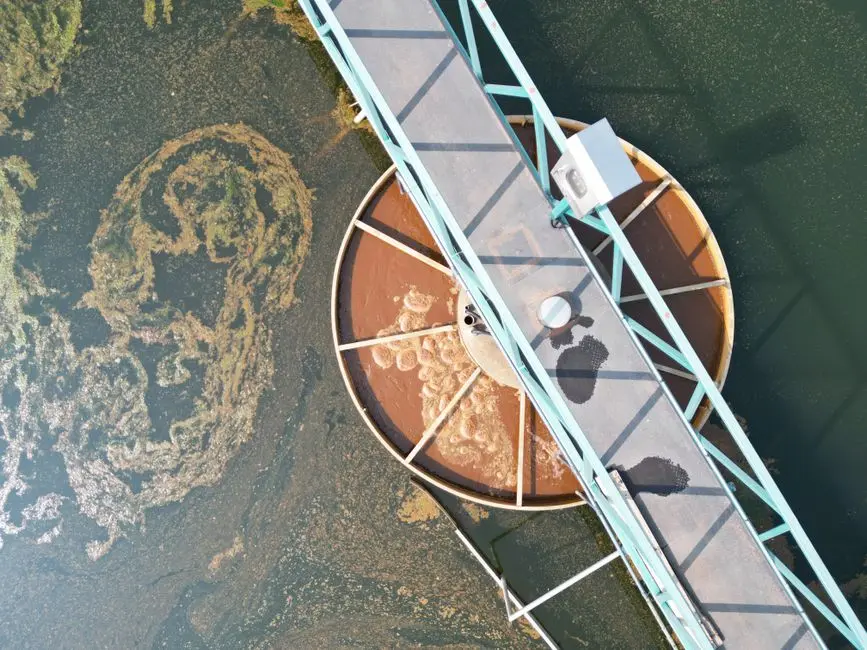
For copper rinse specifically, the choice is not really balanced — it is submerged — but the trade-offs are worth laying out so the engineer can defend the selection in a basis-of-design document. A submerged MBR system uses DF series PVDF flat sheet membrane modules immersed directly in the aeration tank, with coarse-bubble scouring providing both oxygen and surface shear at a 0.1 μm pore size. A sidestream (external) MBR keeps the membranes in a separate pressurized loop driven by a cross-flow pump, generating high velocity across the membrane surface to control fouling on streams that the submerged geometry cannot handle.
Submerged configurations draw 10–20× less energy than external cross-flow systems because the recirculation pump is replaced by the aeration system, which is already running for oxygen delivery (per HydropureWater DF spec). Sidestream MBRs handle higher TSS and more viscous streams and tolerate higher MLSS without the same flux penalty, but the high cross-flow velocity that protects the membrane also causes shear-induced biomass lysis, which releases bound copper back into solution inside the recirculation loop — exactly the wrong place for a copper-sensitive biomass.
For plating rinse, the influent after pretreatment is low in TSS, low in COD, and intermittent (the line runs in shift patterns, not 24/7). The aeration shear of a submerged MBR is enough to control fouling at the resulting fluxes, and the gentle hydraulic environment is more forgiving of copper-shock transients than a high-shear sidestream loop. The submerged geometry is the right default; a sidestream is only justified if a downstream process step requires it, which is rare for this duty.
| Parameter | Submerged MBR | Sidestream MBR |
|---|---|---|
| Typical energy use | 0.2–0.6 kWh/m³ permeate | 2–6 kWh/m³ permeate |
| Footprint vs. conventional | ~40% of CAS + clarifier | ~50–60% of CAS + clarifier (loop adds footprint) |
| Membrane area per m³/d | 0.05–0.10 m²/(m³/d) | 0.03–0.06 m²/(m³/d) |
| Operable MLSS range | 8,000–12,000 mg/L | 10,000–20,000 mg/L |
| Tolerance to high TSS / viscous feed | Limited (pretreatment required) | High |
| Shear impact on biomass | Low (aeration-driven) | High (pump-driven lysis risk) |
| Cleaning frequency (typical) | Relax daily; CIP monthly | Relax daily; CIP biweekly–monthly |
| Fit for Cu rinse (post-precipitation) | Preferred | Over-specified, energy-inefficient |
Sources: submerged values per HydropureWater DF series spec; MLSS, energy, and cleaning ranges per MBR review literature (Water SA; Case Studies in Chemical and Environmental Engineering, 2021). Footprint ratios are typical engineering values, not a single citable figure.
Process Flow and Membrane Specification
The 2026 process train, end to end, runs: collection / equalization → pH adjust to 9–10 with NaOH → lamella clarifier (Cu(OH)₂ settling, sludge to filter press) → pH re-adjust to 6.5–7.5 → submerged MBR tank with PVDF flat-sheet modules → permeate tank → either direct reuse to the rinse cascade or downstream UV / ClO₂ polish for discharge (per MBR review process layouts and the HydropureWater process chain). The equalization tank matters more than it looks — plating lines dump in batches, and a 30-minute buffer blunts the worst of the copper-shock transients before they reach the clarifier.
Membrane specification: 0.1 μm PVDF flat sheet, 80–225 m² membrane area per module, 32–135 m³/day per module depending on the DF series frame size (per HydropureWater DF module spec). MLSS operating range 8,000–12,000 mg/L — enabled by the submerged geometry, which decouples biomass retention from clarifier performance (per MBR review literature). Flux typically runs at 15–25 LMH for this duty. Backwash is a periodic relax plus chemical cleaning cycle: NaOCl (300–500 mg/L) for organic fouling and citric acid (1–2%) for iron and hardness scale, on a weekly-to-monthly cadence. After the precipitation train, copper itself does not foul PVDF aggressively — iron and hardness scale are the dominant foulants, which is why the cleaning protocol targets them rather than copper.
Two operational notes worth flagging in a commissioning plan: the MBR should never be fed at pH 9–10 (the residual Cu that the clarifier missed stays in solution above pH 8 and will re-toxify the biomass), and the membrane should be brought up to operating flux over 30–60 minutes after a cleaning cycle rather than slammed back to full rate — sudden pressure transients on a freshly cleaned PVDF surface shorten module life.
2026 Reuse vs Discharge Decision Framework
The end-of-pipe decision is driven by two things: the local discharge limit (sewer agreement, EU IED BAT-AELs for surface treatment of metals, or China GB electroplating pollutant standards for mainland sites) and the rinse line's reuse specification. The MBR permeate alone is suitable for reuse to a cascade rinse if conductivity stays below the rinse requirement and on-line conductivity confirms it (general reuse engineering practice — flagged as industry knowledge). For a direct discharge path, the permeate is typically routed through an industrial RO system if the local limit is tight on TDS, or through a chlorine dioxide generator for microbial polish if the limit is biological. For regulatory context, the EU IED 2026 surface treatment monitoring guide and the related Cr(VI) reduction and precipitation guide for electroplating wastewater cover the compliance framing in detail.
The decision rule is simple: if the rinse water reuse ratio can exceed ~70% and the local sewer fee is high (or the discharge permit caps volume), MBR + RO reuse pays back the RO capex through reduced water purchase and discharge fees. If sewer capacity is ample, reuse plumbing cost is high, and the discharge standard is met by MBR permeate alone, MBR alone to discharge is sufficient. The electroplating wastewater treatment cost 2026 CAPEX/OPEX breakdown gives a defensible cost model for either path.
| Path | Configuration | Best Fit When | Watch Out For |
|---|---|---|---|
| Reuse to rinse cascade | MBR permeate + on-line conductivity | Rinse spec met by MBR effluent; reuse ratio > 70% | Conductivity drift; cross-contamination of bath chemistry |
| Reuse to rinse + RO polish | MBR → RO → reuse | High reuse ratio; tight incoming water cost; tight discharge salt limits | RO capex; concentrate disposal |
| Direct discharge (MBR only) | MBR → ClO₂ or UV → sewer | Ample sewer capacity; discharge standard met by MBR effluent | Permit compliance monitoring cost |
| Direct discharge (MBR + RO) | MBR → RO → sewer | Tight TDS / heavy-metal sewer limits | RO concentrate stream; 15–25% of feed becomes brine |
Frequently Asked Questions
What free Cu²⁺ concentration is biotoxic to activated sludge?
Unacclimated heterotrophs show measurable inhibition at 1–5 mg/L free Cu²⁺, and nitrifiers are acutely affected at the low end of that range. This is why alkaline precipitation to pH 9–10 must drop total Cu to low mg/L before the MBR tank (general electroplating literature — flagged as industry knowledge, not a value from the scraped sources).
How often does a submerged PVDF MBR need chemical cleaning on copper rinse duty?
Typical cadence is a daily membrane relax plus a CIP (NaOCl 300–500 mg/L + citric acid 1–2%) every 1–4 weeks, depending on flux and upstream iron loading. After precipitation pretreatment, copper itself is not the dominant foulant — iron and hardness scale are (per MBR review literature and HydropureWater DF operating guidance).
What effluent quality can the MBR deliver on copper plating rinse?
With proper pretreatment, a submerged PVDF MBR delivers <1 μm TSS-free permeate with total Cu typically <0.1 mg/L, suitable for either reuse to a cascade rinse or downstream RO / ClO₂ polish for discharge (per HydropureWater DF module spec and MBR review literature).
Is the permeate safe to reuse directly in a plating rinse line?
Yes, if on-line conductivity confirms the permeate meets the rinse spec and the bath chemistry is not sensitive to residual dissolved solids. For tight specs, an RO polish is the safer choice — most sites run MBR + RO for reuse and MBR alone for discharge (general reuse engineering practice — flagged as industry knowledge).