
Why DAF Alone Won't Discharge-Compliant Passivation Chrome Rinse
A dissolved air flotation unit by itself will not make passivation chrome rinse compliant for sewer discharge or reuse; it only works as the solid-liquid separation step that follows Cr(VI) reduction and Cr(III) precipitation. Passivation rinse water from nitric-acid or sodium-dichromate baths on zinc, aluminium, or stainless steel parts typically carries Cr(VI) between 5–500 mg/L and total chromium up to 600 mg/L (HydropureWater field data, 2026). Micro-bubbles in a DAF cell attach to suspended particles, oil droplets, and floc but have no mechanism to capture dissolved ionic species. Sending raw chrome rinse to DAF produces clean-looking water that still contains the full dissolved chromium load.
The 2026 best practice is post-coagulation DAF placed after Cr(VI) reduction to Cr(III) and hydroxide precipitation at pH 8.5–9.5, with pre-coagulation DAF reserved as a TSS-polish step on a chrome-free rinse train. Untreated industrial wastewater causes oxygen depletion, ecosystem imbalance, and human health risks (DUT 2020, doi:10.51415/10321/3182); hexavalent chromium is a confirmed Group 1 carcinogen via inhalation and a heavy-metal toxicant in aquatic systems. Budget, footprint, and discharge paperwork depend on getting this sequence right the first time.
The Chemistry DAF Has to Follow: Cr(VI) Reduction and Precipitation
Reduction must happen at pH 2.0–2.5 with a holding time of 20–30 minutes before any pH adjustment, because Cr(VI) reduction kinetics are strongly pH-dependent and slow above pH 2. Ferrous sulfate dosed at an Fe:Cr molar ratio of at least 3:1 is the workhorse reductant; sodium bisulfite (NaHSO₃) at roughly 4:1 mass ratio to Cr(VI) is the alternative when sludge handling favours a lower-iron route. Oxidation-reduction potential (ORP) must drop below 250 mV at the end of the reaction tank to confirm complete conversion — a reading above 350 mV means residual Cr(VI) is still leaving the reactor (HydropureWater field data, 2026).
After reduction, raise pH to 8.5–9.5 with NaOH or lime to precipitate Cr(OH)₃. The theoretical minimum solubility of Cr(III) at pH ≈9.0 is about 0.08 mg/L; the DAF's job is to capture the resulting floc. The floc is gelatinous and benefits from 0.5–2 mg/L of anionic polyacrylamide to build a floatable matrix. Operating temperature should sit between 20–35°C; below 10°C reduction kinetics slow significantly and the operator will see incomplete conversion even with correct stoichiometry. The full Cr(VI) reduction and Cr(III) precipitation process for electroplating wastewater is the established baseline for this train.
| Step | Setpoint | Reagent / Target | Verification |
|---|---|---|---|
| Reduction pH | 2.0–2.5 | H₂SO₄ control | pH probe, end-of-reactor |
| Reductant dose | Fe:Cr ≥3:1 (molar) or NaHSO₃:Cr(VI) ≈4:1 (mass) | FeSO₄·7H₂O or NaHSO₃ | ORP <250 mV |
| Reduction HRT | 20–30 min | Reaction tank | Residence time check |
| Precipitation pH | 8.5–9.5 | NaOH or Ca(OH)₂ | pH probe, post-mix |
| Polymer dose | 0.5–2 mg/L | Anionic polyacrylamide | Jar test, float quality |
| Temperature | 20–35°C | Heat exchanger if needed | Inline thermometer |
Two DAF Configurations That Actually Work on Chrome Rinse

Config A — Post-coagulation DAF (the 2026 standard): The reduction/precipitation/flocculation train sits upstream; the DAF cell captures the Cr(OH)₃ floc as a floated sludge blanket. Operating envelope: hydraulic loading 5–15 m/h, recycle ratio 10–30%, saturation pressure 4–6 bar, micro-bubble size 10–80 μm. On a properly conditioned feed this configuration achieves >95% TSS removal with total chromium overflow typically below 2 mg/L, which clears most US POTW and EU industrial discharge thresholds (HydropureWater field data, 2026). The dissolved air flotation system is built around this envelope.
Config B — Pre-coagulation DAF as a polish step on a chrome-free train: This is viable only when the plater has segregated rinse streams so that the chrome-bearing drag-out is reduced in a separate vessel. The pre-coagulation DAF then handles TSS, oils, and metal-hydroxide sludges on the chrome-free rinses (cleaners, pickling rinses, nickel rinses) before they join the main treatment train. The MDPI 2020 pre- vs post-coagulation comparison (Response Surface Methodology, mdpi.com/2227-9717/8/4/383) showed that the pre-coagulation mode can match post-coagulation TSS removal for non-reactive streams, but it collapses once dissolved metals are present because there is no floc to float yet.
Two failure modes show up frequently in audit findings. First, putting DAF before reduction is ineffective: chrome remains dissolved as Cr(VI), the bubbles have nothing to attach to, and the overflow leaves the cell unchanged. Second, skipping the pH raise (reduction straight to DAF) leaves Cr(III) soluble below pH 5; the float comes off clean and the subnatant carries the full chromium load to drain. Die-cast aluminum wash pretreatment before DAF follows a similar logic — conditioning before flotation, not after.
| Criterion | Config A: Post-coagulation DAF | Config B: Pre-coagulation DAF polish |
|---|---|---|
| TSS removal | >95% | 80–90% (chrome-free feed only) |
| Effluent total Cr | Typically <2 mg/L | Not applicable — chrome segregated upstream |
| Footprint | Larger (reaction + floc + DAF) | Smaller (DAF only) |
| OPEX driver | FeSO₄/NaHSO₃, NaOH, polymer | Polymer only |
| Influent Cr swing sensitivity | Low if ORP/pH controlled | High — any chrome slip breaks the train |
| Foam carryover risk | Moderate | Moderate–high |
Reuse vs Discharge: What DAF Overflow Can and Cannot Do
Post-coagulation DAF overflow with total Cr under 2 mg/L clears most US POTW pretreatment limits and EU industrial discharge thresholds for total chromium, though local limits vary widely. California's limits can fall below 0.1 mg/L total Cr for some dischargers, and several US POTWs enforce 0.1–1.0 mg/L caps (per EPA 40 CFR 133 categorical standards and local POTW programs, 2026). Confirm the local limit before sizing the train; do not assume the 2 mg/L overflow will pass everywhere.
For reuse in the rinse loop, DAF overflow alone is not reuse-quality: residual dissolved Cr, TDS, and conductivity remain too high. The required polish train is DAF → multi-media filter → ion exchange or RO, and the practical reuse target is the WHO drinking-water guideline of 0.05 mg/L total Cr (WHO, 2022) for any worker-contact rinse. A common hybrid is partial reuse — send 60–70% of DAF overflow to drain and route the remaining 30–40% through reverse osmosis for water purification followed by a multi-media filter for ultrapure water, then blend the permeate with fresh DI and recycle to the final rinse stage. A DAF + RO combination typically yields 75–85% water recovery on chrome rinse (HydropureWater field data, 2026). Operators running an MBBR downstream should review passivation chrome rinse pretreatment before MBBR to confirm the upstream envelope matches the biology.
Operating Parameters and Common Failure Modes
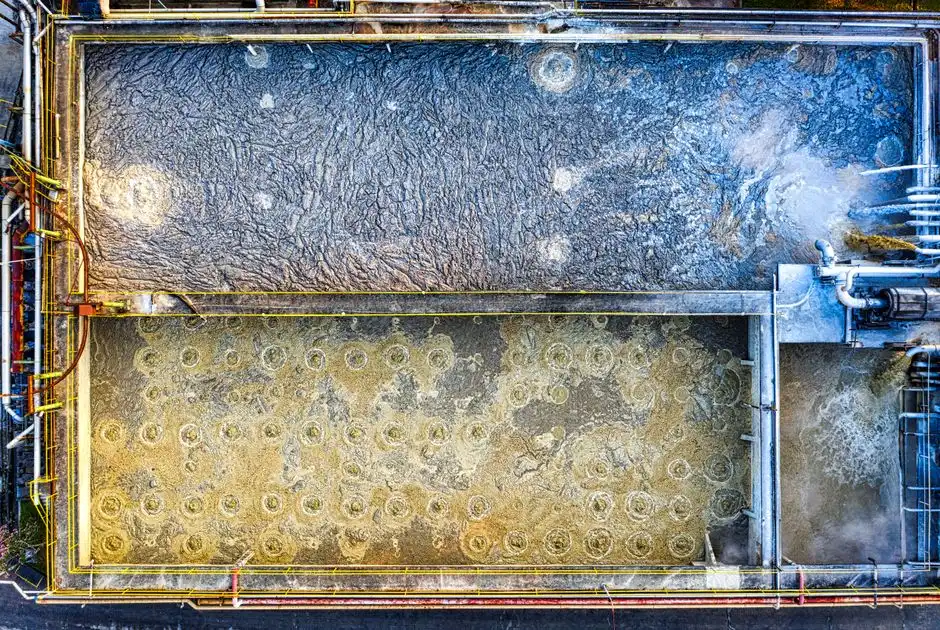
The table below provides the operating setpoints; common failures typically stem from improper chemical conditioning or hydraulic loading. Foam carryover usually traces back to excess polymer or surfactant loading from upstream cleaners — switch to an anti-foam-compatible flocculant and lower the recycle ratio. Total Cr in the overflow above 2 mg/L almost always means incomplete reduction; check that ORP is under 250 mV at pH 2 and increase the Fe(II) dose until the probe confirms conversion. Cloudy subnatant points to a broken floc or an overloaded cell — drop hydraulic loading below 8 m/h and verify polymer activation. Sludge re-dissolution in the float hopper happens when pH drifts below 7 in the float; dose NaOH at the skimmer or shorten float residence time to keep the Cr(OH)₃ floc stable (HydropureWater field data, 2026). An automatic chemical dosing system for Cr(VI) reduction is the cleanest way to hold ORP and pH inside the windows above, and a high-efficiency sedimentation tank upstream can act as a guard when influent Cr swings.
| Parameter | Target | Alarm / Action |
|---|---|---|
| Recycle ratio | 10–30% | >35% → foam risk; <8% → poor float |
| Saturation pressure | 4–6 bar | <3.5 bar → bubble size too large |
| Hydraulic loading | 5–15 m/h | >15 m/h → cloudy subnatant |
| Polymer dose | 0.5–2 mg/L anionic | >3 mg/L → foam carryover |
| Pre-DAF pH | 8.5–9.5 | <8.0 → Cr(III) re-dissolves |
| Float solids | 3–6% w/w | <2% → under-loaded; >8% → rake torque high |
Frequently Asked Questions
Can DAF alone discharge passivation chrome rinse? No. DAF removes suspended solids but does not act on dissolved Cr(VI) or Cr(III). A reduction step (Fe:Cr ≥3:1 at pH 2.0–2.5) and a pH-raise to 8.5–9.5 must precede it.
Should DAF go before or after Cr(VI) reduction? After. Post-coagulation DAF is the 2026 standard; pre-coagulation DAF is only viable as a polish step on a segregated, chrome-free rinse train.
What total Cr can post-coagulation DAF overflow achieve? Typically below 2 mg/L, which clears most US POTW and EU industrial discharge limits, but some California and POTW-specific limits fall under 0.1 mg/L — always verify the local number.
<