Why Battery Formation Rinse Defies Conventional Clarifiers
Battery formation rinse water carries a low bulk COD of 50–300 mg/L but a contaminant matrix that defeats gravity settling: free Li+ at 20–200 mg/L, F− at 5–80 mg/L from LiPF6 hydrolysis, suspended carbon black at 30–200 mg/L, residual NMP at 10–100 mg/L, and trace Co/Ni/Mn fines at 1–10 mg/L. The density of these particles sits within 10–20% of water — carbon black at 1.0–1.2 g/cm³ and Li2CO3 at roughly 2.1 g/cm³ — so Stokes-law settling in a lamella clarifier requires clarifier areas 5–10× larger than an equivalent battery formation rinse pretreatment train anchored on dissolved air flotation.
Flotation is the dominant separation mechanism because the bubble–floc aggregate has an effective density well below 1.0 g/cm³ and rises 0.5–2 m/min in a 4–6 bar saturator system. Fluoride above 10 mg/L forms complexes with Al3+ and Fe3+ coagulants — AlFx(3-x)+ species with x = 1–6 — which co-precipitate into the floc matrix and ride the float layer out. The MDPI 2020 study on pre- and post-coagulation DAF confirmed that combined coagulation + DAF outperforms either unit operation alone for fine particulates, and that principle transfers directly to formation-rinse chemistry where the particulates are sub-50 µm and near-neutrally buoyant.
Pre-Coagulation-DAF vs Post-DAF-Coagulation: The Configuration Decision
Pre-coagulation + DAF is the 2026 default configuration for lithium-bearing formation rinse. Acid (H2SO4 to pH 6.5–7.5) and cationic polymer are dosed upstream of the saturator, flocs mature in a 5–10 min flocculation chamber, and the micro-bubble contact step carries floc to the surface. The MDPI 2020 evaluation of acid-coagulation-DAF versus acid-DAF-coagulation found the pre-coag stream produced float solids of 3–5% DS and effluent TSS of 5–10 mg/L — roughly 30–40% lower TSS than the post-DAF-coag stream at matched coagulant dose, because Li+ and F− bind to the polymer matrix during flocculation rather than after the float has already left the cell. The same study anchors the inline assumption that pre-coag outperforms post-DAF-coag for fine, near-neutrally buoyant particles like carbon black and Co/Ni/Mn fines.
Post-DAF-coag (acid-DAF-coagulation) is used when the upstream stream shows pH swings greater than 2 units or emulsified NMP above 200 mg/L. The post-DAF-coag stream handles variable feed because the float step strips emulsified oil and free NMP first, then a downstream coag/polish stage handles what bled through. The trade-off is footprint: a second tank and 15–25% more hydraulic retention, plus a second polymer dosing point. The OSTI preliminary work on coagulation–flocculation/DAF for nuclear-industry wastewater demonstrated that DAF columns effectively remove 60Co surrogates — a direct analogue to the Co/Ni/Mn fines in formation rinse, where the dominant removal mechanism is entrainment in the floc blanket rather than true flotation of the metal itself.
Decision rule for 2026: choose pre-coag-DAF if F− > 20 mg/L or Li+ > 100 mg/L; choose post-DAF-coag if upstream pH swings > 2 units or emulsified NMP > 200 mg/L; default to pre-coag-DAF for everything else.
| Parameter | Pre-coagulation + DAF | Post-DAF coagulation |
|---|---|---|
| Coagulant dose point | Upstream of saturator | Downstream of DAF cell |
| Float solids (% DS) | 3–5 | 1.5–2.5 |
| Effluent TSS (mg/L) | 5–10 | 15–25 |
| F− reduction (%) | 70–90 | 50–70 |
| Li+ removal mechanism | Polymer-bound, rides float | Partial, polish-stage dependent |
| Footprint | Baseline | +15–25% (second tank) |
| Best fit feed | F− > 20 mg/L; Li+ > 100 mg/L | pH swing > 2 units; NMP > 200 mg/L |
DAF Operating Parameters That Actually Matter for Formation Rinse
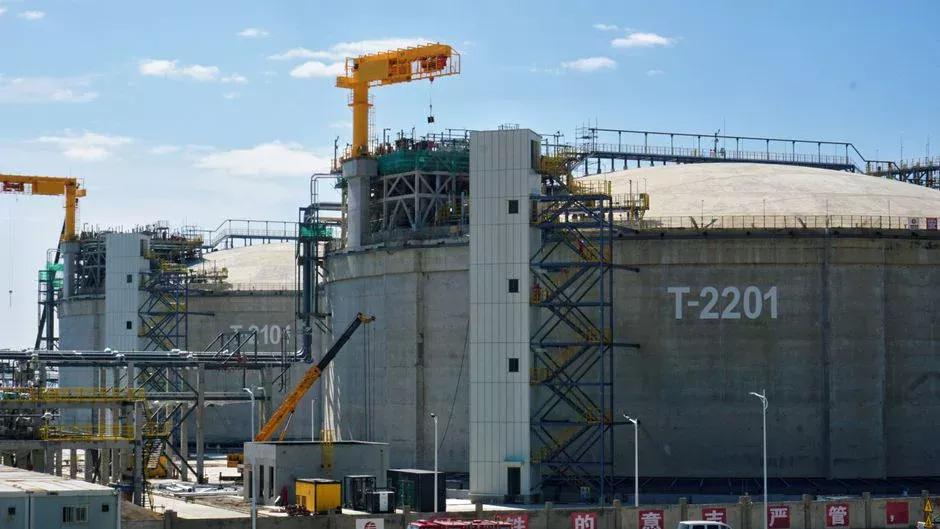
P&ID specifications for a formation-rinse DAF must tie each parameter to the influent matrix rather than generic municipal numbers. Hydraulic residence time in the flotation cell runs 15–25 minutes — push to 20–25 min when F− loading exceeds 40 mg/L, because AlFx floc needs longer contact time to mature and rise. Recycle ratio sits at 5–25% of forward flow; the higher end (15–25%) is required when influent TSS exceeds 150 mg/L to keep the air-to-solids ratio above 0.005 g air per g TSS, which is the threshold below which float recovery collapses.
Bubble size of 20–80 µm is produced by a saturator at 4–6 bar. Smaller bubbles (20–40 µm) carry more floc per unit air volume but risk re-aeration and float-blanket disturbance if the skimmer runs too fast — a 1–4 hour scraping interval keeps float depth in the 50–200 mm operating window. Saturator water temperature runs 10–30 °C; below 10 °C, air solubility rises and micro-bubble yield improves by 15–20%, but cationic polymer activity drops 10–30%, so dose adjustment of 10–20% is mandatory in cold-weather sites. The dissolved air flotation system spans 4–300 m³/h across 13 standard models, which covers a single formation channel (≈5 m³/h) up to a multi-line gigafactory header (≈250 m³/h) without custom-tank engineering.
| Parameter | Typical range | Selection driver |
|---|---|---|
| HRT in flotation cell (min) | 15–25 | 20–25 when F− > 40 mg/L |
| Recycle ratio (%) | 5–25 | 15–25 when TSS > 150 mg/L |
| Bubble size (µm) | 20–80 | 20–40 for fines > 50% of TSS |
| Saturator pressure (bar) | 4–6 | 5–6 for < 40 µm median bubble |
| Float depth (mm) | 50–200 | Settle > 60 s before scrape |
| Scrape interval (h) | 1–4 | Shorter when float solids > 4% DS |
| Hydraulic capacity (m³/h) | 4–300 | 13 standard DAF models |
The 2026 Process Train Around the DAF
The DAF functions as a core separation step within a larger treatment sequence. Upstream of the flotation cell: 24-hour equalization for hydraulic and load dampening, pH adjustment to 6.5–7.5 with H2SO4 or NaOH, coagulant dosing (alum or poly-Al-Cl at 30–80 mg/L as Al), cationic polymer at 0.5–3 mg/L, and a 5–10 min flocculation chamber with G = 50–80 s−1. The DAF sits in the middle of the train, and the front-end chemistry is inseparable from DAF performance — a PLC-controlled automatic chemical dosing skid holds the polymer-to-TSS ratio inside ±5% across the 24-hour feed swing.
Two downstream routes branch from the DAF effluent. The reuse route runs DAF → multi-media filter → 5 µm cartridge → RO → permeate to the rinsing loop, with RO concentrate sent to lithium recovery or ZLD. The discharge route runs DAF → MBBR or activated sludge for residual COD/NMP polishing → sand filter → UV or ClO2 disinfection → discharge. Sites targeting reuse at 60–75% recovery pair the DAF with RO; sites prioritizing lowest capex and direct discharge run the biological polishing branch instead. For comparison, a parallel DAF configuration for paint booth curtain water follows similar front-end chemistry but with a different downstream polishing train.
2026 Compliance Targets and Reuse Economics
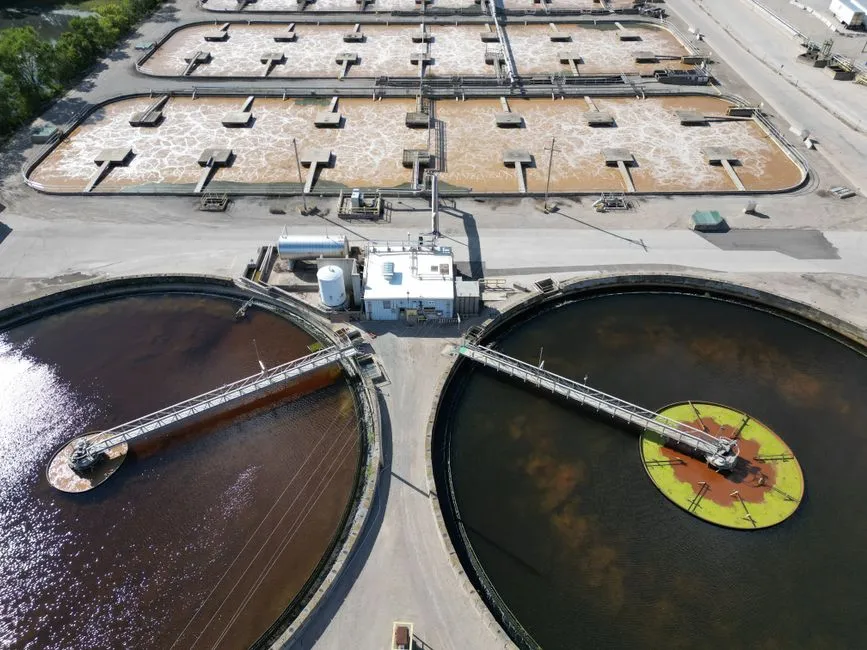
Configuration decisions must satisfy both regulatory limits and financial payback requirements. China GB 30485-2020 sets lithium-battery-industry discharge limits at Li+ ≤ 50 mg/L, F− ≤ 10 mg/L, COD ≤ 150 mg/L, and SS ≤ 70 mg/L — a pre-coag-DAF + RO train hits all four with margin. EU IED 2010/75/EU BAT-AEL for battery manufacturing targets TSS at 10–30 mg/L monthly average; DAF effluent alone meets the upper band, and RO closes the gap to the tightest reuse limits.
Closed-loop rinse reuse recovers 60–75% of formation rinse water. A 100 m³/h formation loop at $1.50/m³ water cost — a typical 2026 municipal-plus-scarcity blended rate for industrial users in coastal China, Spain, and the U.S. Southwest — pays back a DAF + RO train in 18–30 months on water savings alone, before lithium recovery credit. DAF OPEX is dominated by polymer dose (15–30% of total) and sludge hauling, not energy — the saturator pump and scraper draw 10–20× less energy than an equivalent MBR, which matters when a gigafactory is running 24/7 and the utility bill is the second-largest opex line after chemicals. For a deeper look at the energy footprint versus sedimentation, the 2026 DAF vs sedimentation comparison breaks down the kWh/m³ delta and the capex payback curve.
Frequently Asked Questions
Can DAF remove fluoride from formation rinse? DAF alone achieves 70–90% F− reduction when paired with alum or poly-Al-Cl at pH 6.5–7.5, because Al3+ forms AlFx(3-x)+ complexes that co-precip