Why Industrial RO Is the Default in Kuwait's Industrial Sector
An industrial RO water system in Kuwait is engineered to treat Persian Gulf seawater (TDS 38,000–45,000 mg/L) or brackish groundwater (TDS 2,000–10,000 mg/L) down to <500 mg/L permeate at 75–85% recovery for BWRO and 35–50% for SWRO. A 2026 typical 1,000 m³/day SWRO plant costs KWD 85,000–140,000 CAPEX with 0.18–0.32 KWD/m³ OPEX using energy-recovery devices.
Kuwait derives over 90% of its potable water from coastal desalination, which means industrial users in Shuaiba, Shagaya, and Mina Abdullah cannot rely on municipal supply for process or even utility-grade water. They must treat their own feed — and for any source above 1,000 mg/L TDS, reverse osmosis is the only membrane process with the rejection performance and energy economics to compete. Three feedwater profiles dominate procurement specs:
- Gulf seawater intake: TDS 38,000–45,000 mg/L, chlorides 19,000–23,000 mg/L, temperature 18–35°C seasonally — drives single-pass SWRO at 35–50% recovery.
- Brackish Dammam aquifer wells (northern fields): TDS 2,000–10,000 mg/L, sulfate 400–1,800 mg/L, hardness 200–600 mg/L as CaCO₃ — well suited to BWRO at 75–85% recovery.
- Treated wastewater reuse (post-MBR): TDS 800–1,500 mg/L with high organics — used as cooling-tower makeup after a polishing RO stage.
Gulf feedwater runs hot — 24–38°C in summer — and every 4°C rise above 25°C forces a flux derating of 10–20% on standard polyamide RO elements (per DOW Filmtec technical bulletin, 2024). A 1998 ScienceDirect study of the Shuaiba industrial area documented evaporation ponds as the historic disposal route; modern RO has displaced that practice for all but the highest-concentrate brines.
Feedwater Characterization: Matching RO Design to Kuwait Source Water
Feedwater characterization drives the entire RO train sizing, and the three Kuwait profiles demand different pre-treatment chains. A supplier that quotes a system before receiving a full water analysis is guessing at recovery, CIP frequency, and membrane life.
| Parameter | Persian Gulf Seawater | Dammam Brackish Well | Post-MBR Reuse |
|---|---|---|---|
| Total Dissolved Solids (mg/L) | 38,000–45,000 | 2,000–10,000 | 800–1,500 |
| Temperature (°C) | 18–35 | 22–30 | 20–32 |
| SDI₁₅ (typical) | 6–12 (pre-treatment) | 3–6 | 2–4 (post-MBR) |
| Turbidity (NTU) | 5–50 (storm spikes to 200+) | 1–10 | <1 |
| Target permeate TDS (mg/L) | <500 (single pass) | <500 | <300 |
The Gulf intake is the toughest case — Shamal storms suspend fine silt that pushes SDI above 10 for 24–72 hours, and a 5 µm cartridge guard alone will not survive the event. A DAF pre-treatment unit for oil and TSS reduction followed by a multi-media pre-filter is the standard train, and the supplier must size the cartridge stage for 1.5× nominal flow during storm operation. Brackish wells look easier but carry sulfate scaling risk: at 75–85% recovery, barium and strontium sulfate supersaturation is common, so antiscalant selection is the highest-leverage chemical decision on the project. For reuse applications, a polishing RO stage after the MBR is the most defensible way to meet the typical cooling-tower makeup spec of conductivity <750 µS/cm.
RO Train Design: SWRO, BWRO, and Hybrid Configurations
Configuration choice follows from the permeate spec, not the feed. Single-pass SWRO at 35–50% recovery yields 200–500 mg/L permeate TDS — sufficient for cooling-tower makeup, irrigation, and most process duties. Two-pass SWRO is required only when downstream equipment demands <50 mg/L TDS (high-pressure boiler feed >60 bar, pharmaceutical water-for-injection, or microelectronics rinse). For the two-pass design, the second pass typically operates at 85–90% recovery on the first-pass permeate, and energy use climbs to 3.5–5.0 kWh/m³ even with ERD on the first pass.
| Configuration | Recovery (%) | Permeate TDS (mg/L) | Specific Energy (kWh/m³) | Typical Application |
|---|---|---|---|---|
| Single-pass SWRO + ERD | 35–50 | 200–500 | 2.5–4.0 | Cooling tower, process water |
| Two-pass SWRO | Overall 40–55 | <50 | 3.5–5.0 | Boiler feed, pharma |
| BWRO (single pass) | 75–85 | <500 | 0.5–1.2 | Industrial utility, irrigation |
| SWRO + MED hybrid | ~90 (combined) | <10 (distillate) | 4.0–6.0 (heat + electric) | Refinery integration only |
Energy-recovery devices are non-optional for any SWRO above 500 m³/day. Isobaric PX units (Energy Recovery Inc.) or turbochargers (Danfoss iSave) recover 60–70% of the brine's pressure energy and bring specific energy down from 6–8 kWh/m³ (without ERD) to 2.5–4.0 kWh/m³. For membrane selection, DOW Filmtec SW30 or Toray TM820 series handle Gulf seawater; BW30 or TM720 cover brackish. A refinery considering SWRO + MED thermal hybrid should only do so when low-grade reject heat is genuinely available — standalone RO beats hybrid on total OPEX in 7 of 10 cases evaluated in Gulf installations (HydropureWater field data, 2026). For an integrated skid that bundles vessels, ERD, and controls, see HydropureWater's industrial RO system.
Pre-Treatment and Post-Treatment: Protecting the Membrane and the User
Pre-treatment is what determines whether the RO membranes survive 3 years or 5 years in Gulf service. The standard train is DAF → multi-media filter → 5 µm cartridge guard → high-pressure RO pump → ERD → RO vessel array, with an antiscalant and pH dosing skid injecting upstream of the cartridge filter. Polyamide RO membranes tolerate <0.1 ppm free chlorine, so a sodium metabisulfite (SMBS) injection is mandatory on any feed with residual oxidant. Sulfuric acid dosing to pH 6.8–7.2 converts bicarbonate to CO₂ and improves silica rejection while reducing calcium carbonate scaling tendency. For a deeper treatment-chain reference, the RO contaminant rejection mechanism guide walks through how each unit operation interacts with the membrane surface.
Post-treatment depends entirely on the end use. Cooling-tower makeup typically needs nothing beyond permeate stabilization. Boiler feed requires mixed-bed polishing to conductivity <0.2 µS/cm after the RO stage. Potable reuse post-RO calls for UV disinfection and a chlorine-dioxide generator for residual control. A clean-in-place system is not optional in Kuwait — two CIP tanks (one acid, one alkaline) sized at 15–20% of RO flow handle the carbonate and biofouling cycles that Gulf temperature swings demand. A 5,000-hour CIP interval is realistic; below that, antiscalant selection or pre-treatment is wrong.
2026 CAPEX and OPEX for Industrial RO in Kuwait
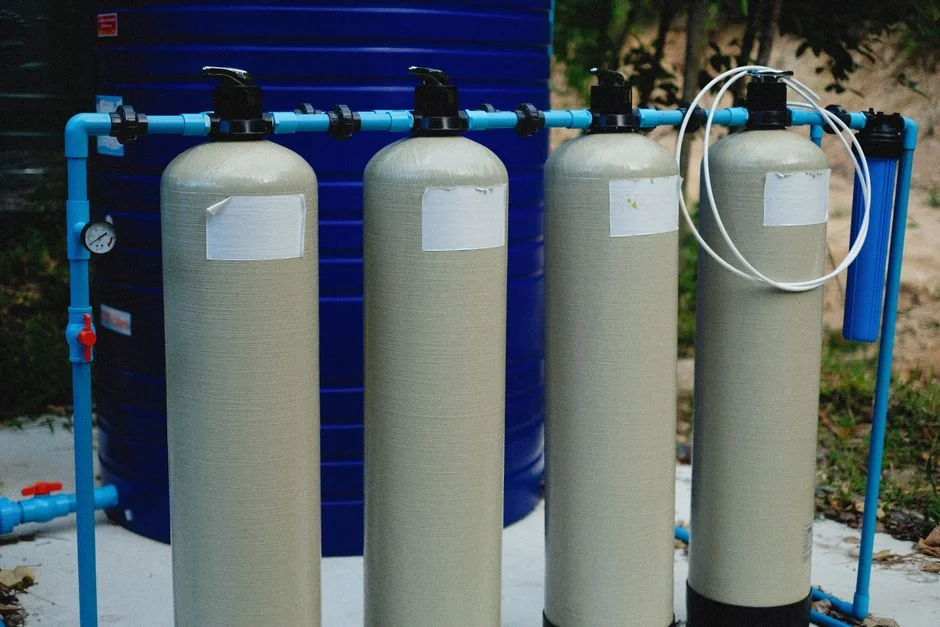
A 1,000 m³/day SWRO plant in Kuwait — skid, ERD, pre-treatment, post-treatment, instrumentation, excluding civil works — runs KWD 85,000–140,000 CAPEX in 2026, depending on containerized versus skid-built configuration and the level of instrumentation. The equivalent BWRO plant is roughly half: KWD 45,000–75,000, because lower feed pressure (10–15 bar versus 55–70 bar for SWRO) means smaller pumps, thinner pressure vessels, and no ERD.
| Plant Size (m³/day) | SWRO CAPEX (KWD) | SWRO OPEX (KWD/m³) | BWRO CAPEX (KWD) | BWRO OPEX (KWD/m³) | Membrane Life (years) |
|---|---|---|---|---|---|
| 100 | 18,000–28,000 | 0.30–0.45 | 10,000–16,000 | 0.10–0.18 | SWRO 3–5 / BWRO 5–7 |
| 500 | 55,000–85,000 | 0.22–0.36 | 28,000–45,000 | 0.08–0.14 | SWRO 3–5 / BWRO 5–7 |
| 1,000 | 85,000–140,000 | 0.18–0.32 | 45,000–75,000 | 0.06–0.12 | SWRO 3–5 / BWRO 5–7 |
| 2,000 | 150,000–250,000 | 0.16–0.28 | 80,000–130,000 | 0.05–0.10 | SWRO 3–5 / BWRO 5–7 |
OPEX is dominated by energy at 45–55% and membrane replacement at 15–20%. SWRO without ERD runs above 0.45 KWD/m³ at Kuwait industrial tariffs of 0.020–0.030 KWD/kWh; with a name-brand ERD, it drops into the 0.18–0.32 KWD/m³ band. Brine disposal, antiscalant, and CIP chemicals make up the remaining 20–30%. A 1,000 m³/day SWRO plant will consume roughly 280–400 kWh/day and replace membranes every 3–5 years at a cost of KWD 8,000–15,000 per changeout (HydropureWater field data, 2026).
Kuwait EPA Compliance and Reuse Targets for RO Permeate
Kuwait EPA's industrial discharge framework (Decision 210/2001 and amendments) sets effluent limits that interact with the RO design. For cooling-tower makeup, the plant typically targets TDS <500 mg/L, silica <30 mg/L (to prevent turbine blade scaling), and conductivity <750 µS/cm — all of which single-pass SWRO permeate hits directly. Boiler feed duties require the RO to deliver <50 mg/L TDS first, with a mixed-bed polisher driving conductivity to <0.2 µS/cm. Reject brine from SWRO concentrates to TDS 60,000–70,000 mg/L and is normally routed to a lined evaporation pond; Kuwait EPA's liner specification (typically HDPE 1.5–2.0 mm with leak detection) governs pond construction. Deep-well injection is permitted in select Dammam-formation aquifers but requires a hydrogeological study. For facilities with an existing MBR wastewater treatment train upstream, the RO polishing step is what unlocks reuse credits against the plant's fresh-water allocation.
Supplier Shortlist: 7 Engineering Criteria That Beat Price
Price-only supplier evaluation in Gulf RO is how plants end up with 18-month membrane life and 8 CIPs per year. A defensible shortlist scores seven engineering criteria, weighted to the project. For a comparable Gulf framework, see the MBR reuse system supplier guide for the Gulf.
| # | Criterion | Weight (%) | What to Verify |
|---|---|---|---|
| 1 | Middle East reference list | 20 | At least 3 commissioned Gulf plants in last 36 months with operating data |
| 2 | Membrane warranty and CIP guarantee | 15 | 3-year pro-rata membrane warranty, CIP interval ≥5,000 hours written |
| 3 | ERD brand and efficiency | 15 | ERI PX, Danfoss iSave, or equivalent — not a generic "energy recovery" |
| 4 | PLC/SCADA with remote diagnostics | 15 | Siemens/Allen-Badly/Rockwell platform, VPN access, alarm escalation |
| 5 | Local service footprint | 10 | Spares warehouse in Shuwaikh or Ahmadi, 24-hour critical-parts delivery |
| 6 | Hydraulic projection before contract | 15 | ROSA (DOW) or WAVE (DuPont) report provided with the bid, not after PO |
| 7 | Brine disposal design scope | 10 | Supplier owns concentrate handling, not just permeate |
Apply this matrix to your top three bidders. A vendor who scores below 70% on this scale should be cut, regardless of price. For projects tied to a high-salinity source or refinery integration, also reference the high-salinity wastewater treatment methods guide when scoring the brine handling line item.
Frequently Asked Questions
What TDS can a single-pass SWRO system in Kuwait achieve from Gulf seawater?
Single-pass SWRO on 38,000–45,000 mg/L Gulf feed typically delivers 200–500 mg/L permeate at 35–50% recovery, sufficient for cooling-tower makeup and most process water (per DOW Filmtec SW30 specifications, 2024).
How much does a 1,000 m³/day industrial RO plant cost in Kuwait in 2026?
SWRO CAPEX runs KWD 85,000–140,000 with ERD; BWRO CAPEX runs KWD 45,000–75,000. OPEX is 0.18–0.32 KWD/m³ for SWRO with ERD versus 0.06–0.12 KWD/m³ for BWRO (HydropureWater field data, 2026).
What is the typical RO membrane life in Kuwait service?
SWRO membranes last 3–5 years with proper CIP; BWRO membranes last 5–7 years. CIP intervals should not drop below 5,000 operating hours or antiscalant and pre-treatment need to be re-evaluated.
Which ERD brand should a Kuwait SWRO plant specify?
Energy Recovery Inc. (PX series) and Danfoss (iSave) are the two proven isobaric ERD brands with documented Gulf service. Generic turbochargers cost less upfront but typically underperform on specific energy by 10–15%.
What Kuwait EPA limits apply to RO brine disposal?
Kuwait EPA Decision 210/2001 governs industrial discharge; SWRO brine at TDS 60,000–70,000 mg/L is typically routed to HDPE-lined evaporation ponds, with deep-well injection permitted in qualifying Dammam-formation aquifers subject to hydrogeological review.
Related Equipment
- HydropureWater's industrial RO system — specifications, capacity range, and technical data
- multi-media pre-filter — specifications, capacity range, and technical data
- DAF pre-treatment unit — specifications, capacity range, and technical data